What Are Parallel Lines?
Parallel lines are two straight lines in the same plane that never intersect, no matter how far they are extended, and that stay a constant distance apart. The symbol is , so "line is parallel to line " is written .
A transversal is a line that crosses two or more other lines. The rich behaviour of parallel lines only becomes visible once a transversal cuts across them, which is why the properties below are usually taught together with the transversal setup.
Why Do Two Lines That Never Meet Control So Many Angles?
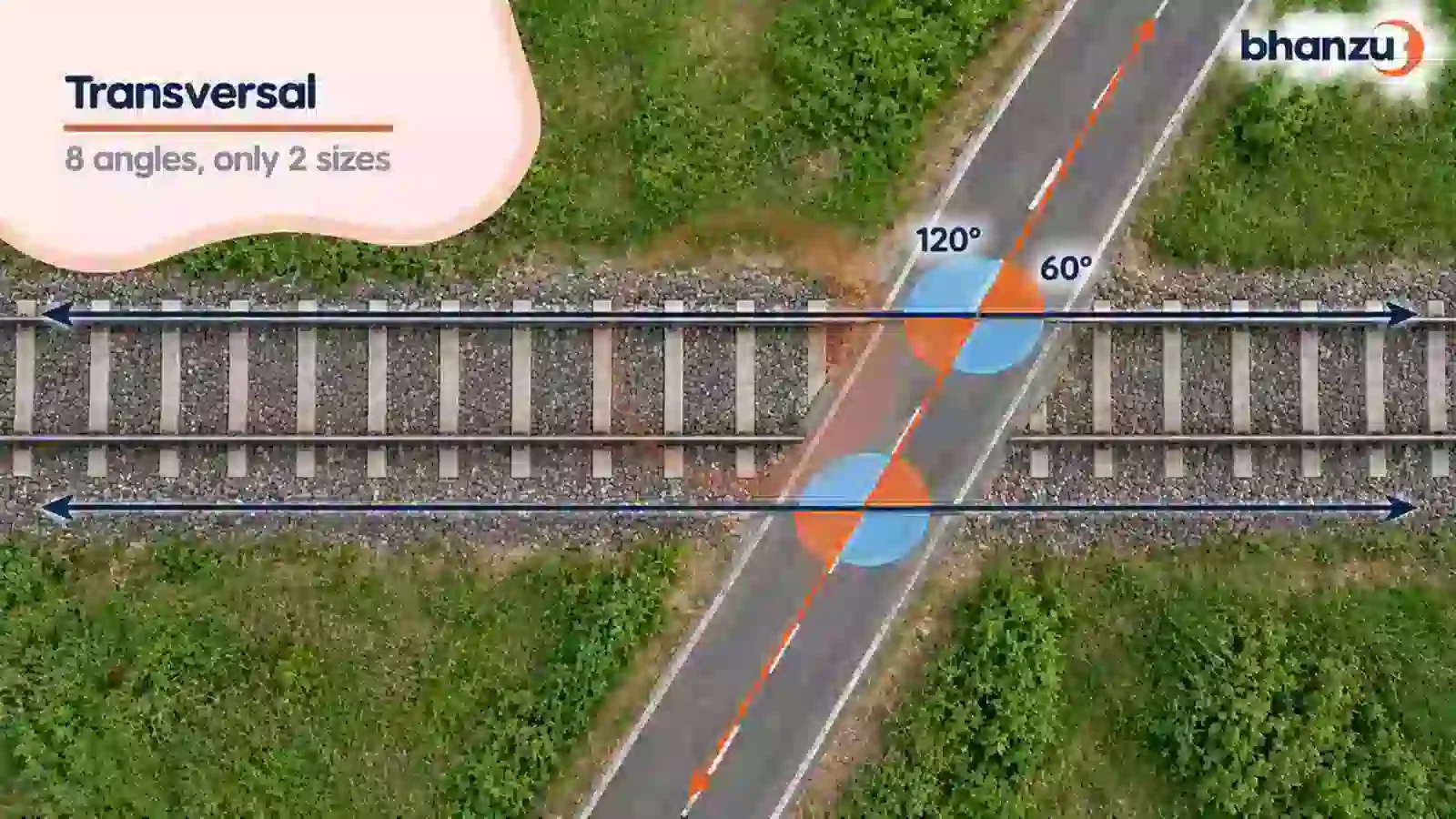
Railway tracks run for miles side by side and, by definition, never meet at all.
That single fact - never meeting - forces a chain of exact angle relationships the moment a third line crosses them. Cut two parallel lines with a transversal and eight angles appear, but they are not eight independent values: they collapse into just two distinct sizes, locked together by the properties below. Learn those properties once and you can find every angle in a parallel-line figure from a single measurement.
What Are the Angle Properties of Parallel Lines?
When a transversal cuts two parallel lines, four angle-pair properties hold. These are the properties examiners test most.
Corresponding angles are equal. Angles in the same position at each intersection (for example top-right at both crossings) are equal: .
Alternate interior angles are equal. The angles between the two lines, on opposite sides of the transversal, are equal: .
Alternate exterior angles are equal. The angles outside the two lines, on opposite sides of the transversal, are equal: .
Co-interior (same-side interior) angles are supplementary. The angles between the two lines, on the same side of the transversal, add to : .
The first three say "equal"; the fourth says "sum to ." Every angle in the figure is either equal to a given angle or supplementary to it. This is the same structure developed in full under parallel lines cut by transversal.
What Are the Other Properties of Parallel Lines?
Beyond the transversal angles, parallel lines have three structural properties worth stating on their own.
They are equidistant. The perpendicular distance between two parallel lines is the same at every point.
They have equal slopes. On a coordinate plane, parallel lines have identical slopes, , which is the algebraic test developed under slope of parallel lines.
They obey transitivity. If line and line , then . Parallelism carries through a chain of lines.
The slope property is the bridge between geometry and coordinate algebra: two lines are parallel exactly when their slopes match, which is why and never meet.
How Do You Prove the Alternate Interior Angles Are Equal?
The proof chains the corresponding-angles property with the fact that vertically opposite angles are equal.
Setup. Let two parallel lines be cut by a transversal, forming angles through . Take alternate interior angles and .
Step 1. By the corresponding-angles property, (they occupy the same position at the two intersections).
Step 2. and are vertically opposite angles, so .
Step 3. Combining Steps 1 and 2, .
That is the alternate interior angles property. The co-interior property follows the same way: since and form a linear pair, substituting gives .
Where Are the Properties of Parallel Lines Used?
These properties are working tools in design, navigation, and construction.
Finding unknown angles. Given one angle in a parallel-line figure, every other angle follows from the four properties - the core skill in geometry exams.
Architecture and engineering. Parallel beams, rails, and road lanes are laid out so cross-members meet them at controlled, equal angles.
Coordinate geometry. Testing whether two lines are parallel by comparing slopes, and writing the equation of a line parallel to a given one.
Proving other theorems. The angle-sum property of a triangle is proved by drawing a line parallel to one side and using alternate interior angles.
Examples of the Properties of Parallel Lines
Example 1
Two parallel lines are cut by a transversal. One angle is 70°. Find its corresponding angle.
Corresponding angles are equal, so the corresponding angle is also .
Final answer: .
Example 2
Co-interior angles are given as 110° and 80°. A student says the lines must be parallel because both angles are "clearly slanted the same way." Is that correct?
Wrong path. The student judges parallelism by how the angles look rather than by the property.
Why it breaks. Co-interior angles on parallel lines must be supplementary. Here , so the property fails and the lines are not parallel.
The rescue. Test the property, not the picture: parallel lines force co-interior angles to sum to exactly . Since the sum is , the lines converge.
Final answer: not parallel; co-interior angles sum to , not .
Example 3
A transversal cuts two parallel lines. An alternate interior angle is 125°. Find the other alternate interior angle.
Alternate interior angles are equal.
Final answer: .
Example 4
Co-interior angles are and . Find given the lines are parallel.
Co-interior angles are supplementary:
Final answer: .
Example 5
Line has equation . Is the line parallel to it?
Parallel lines have equal slopes. Both slopes are .
Final answer: yes; equal slopes mean the lines are parallel.
Example 6
In a figure, and . A transversal makes a corresponding angle with line . What corresponding angle does it make with line ?
By transitivity, , so line behaves exactly like line under the transversal. Corresponding angles are equal across all three parallel lines.
Final answer: .
Where Do Students Trip Up on Parallel-Line Properties?
The most common misstep is treating co-interior angles as equal, like corresponding and alternate pairs, when they are actually supplementary. Naming which pairs are equal and which pair is supplementary before writing any equation prevents the majority of errors.
Mistake 1: Setting co-interior angles equal
Where it slips in: When a student applies "equal" to every angle pair on parallel lines.
Don't do this: Writing for co-interior angles.
The correct way: Co-interior (same-side interior) angles are supplementary: . Only corresponding, alternate interior, and alternate exterior pairs are equal. The one supplementary pair is the exception that trips up the memorizer who learned "parallel angles are equal" as a blanket rule.
Mistake 2: Applying the properties when the lines are not parallel
Where it slips in: When the figure shows two lines with a transversal but no parallel marks.
Don't do this: Assuming corresponding angles are equal for any two lines.
The correct way: These properties hold only when the two lines are parallel. Check for arrow marks or a stated before using them; on non-parallel lines the angle pairs are simply unequal.
Mistake 3: Mixing up alternate interior and alternate exterior
Where it slips in: When identifying which region an angle sits in.
Don't do this: Pairing an interior angle with an exterior one and calling them alternate.
The correct way: Interior angles lie between the two parallel lines; exterior angles lie outside them. Alternate pairs must both be interior or both exterior, and on opposite sides of the transversal. Rail networks rely on this precisely: sleepers (cross-ties) meet the two rails at equal alternate angles, so a misread angle in the plan would twist the track out of gauge.
Conclusion
The four transversal properties of parallel lines: corresponding, alternate interior, and alternate exterior angles are equal; co-interior angles are supplementary ().
Parallel lines are also equidistant, share equal slopes, and obey transitivity.
Alternate interior angles are proved equal by chaining corresponding angles with vertically opposite angles.
Only co-interior angles are supplementary; every other named pair is equal.
The properties apply only when the lines are genuinely parallel.
To build these skills with a teacher, explore Bhanzu's geometry tutor or middle school math tutor sessions, or browse math classes online for structured angle practice.
Read More
Practice These to Solidify Your Understanding
Work through these problems in order:
Two parallel lines are cut by a transversal; one angle is . Find its co-interior angle.
Alternate exterior angles are and . Find .
Is the line parallel to ?
Answer to Question 1: Co-interior angles are supplementary: . Answer to Question 2: Alternate exterior angles are equal: . Answer to Question 3: Both slopes are , so yes, the lines are parallel.
Want a live Bhanzu trainer to work through parallel-line angle problems with you? Book a free demo class.
Was this article helpful?
Your feedback helps us write better content