What Are Intersecting Lines?
Intersecting lines are two or more straight lines that pass through a single common point. That shared point is the point of intersection, and it is the only point the lines have in common — two distinct straight lines can meet at one point and no more.
A line, in geometry, is a perfectly straight path with no thickness that extends without end in both directions. When two such lines are not parallel and not the same line, they are guaranteed to cross somewhere, and they cross only once. That "only once" is not a casual observation — it is a theorem, and it is the first thing that separates intersecting lines from every other arrangement.
Can two lines intersect at more than one point?
No. Two distinct straight lines intersect at exactly one point. If they shared two points, then a single straight line would pass through both — and since only one line can pass through two given points, the two "lines" would actually be the same line. So the moment you have two genuinely different straight lines that cross, they cross once.
Properties Of Intersecting Lines
Intersecting lines carry a few properties that follow directly from the single-crossing rule. Rather than memorise them as a list, notice that each one is a consequence of the lines meeting at one point.
Exactly one point of intersection. Two distinct lines share that one point and no other.
Four angles are formed. The two lines split the space around the crossing point into four angles whose measures add to .
Vertical (opposite) angles are equal. The two angles directly across from each other are always congruent.
Adjacent angles are supplementary. Any two angles that sit next to each other along one of the lines add to , because together they form a straight line.
These four properties are the engine behind most beginner geometry proofs about crossing lines. They also set up the contrast with parallel lines, which by definition never intersect and so never form these angle pairs.
What Angles Do Intersecting Lines Form?
When two lines intersect, they form four angles at the point of intersection, organised into two relationships that always hold.
Vertical angles (also called opposite angles) are the pairs that sit directly across the intersection from each other. In the diagram, and are a vertical pair, and so are and . Vertical angles are always equal: and .
Adjacent angles share a common arm and a common vertex. The pairs and , or and , lie along one straight line, so each pair is supplementary — it adds to .
Put together, if you know one of the four angles, you know all four. Say . Then its vertical partner , and the two adjacent angles .
Perpendicular And Oblique Intersecting Lines
Not all intersecting lines cross the same way, and the angle at the crossing names the type.
When two lines intersect so that all four angles are exactly , the lines are perpendicular. This is the special, tidy case — the four angles are not just supplementary, they are all equal right angles. Perpendicular lines are intersecting lines, just the most symmetric kind.
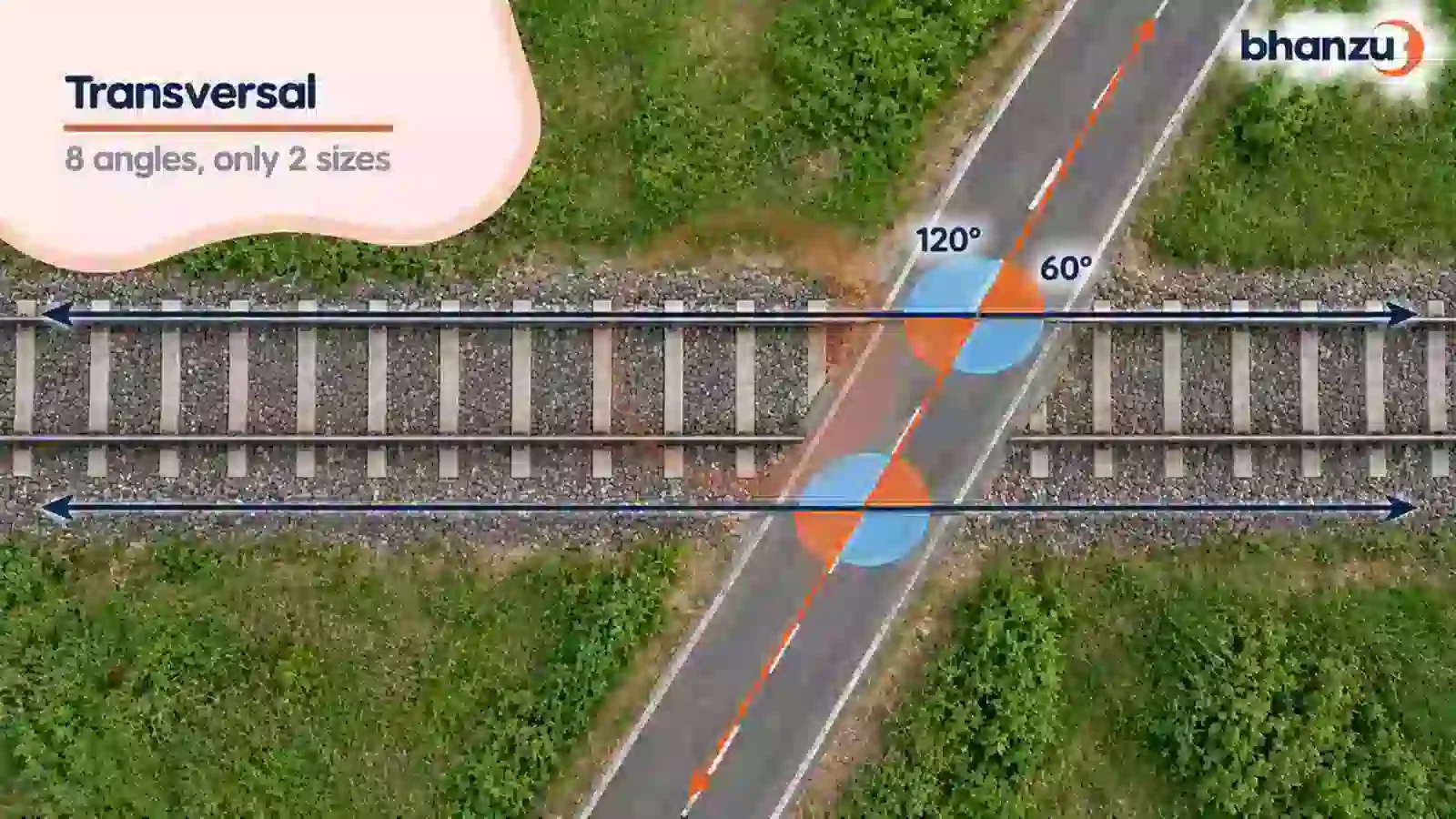
When the lines cross at any angle other than , they are oblique intersecting lines. The four angles then come in two unequal pairs — say . Most real intersections, from a pair of scissors to a railway crossing, are oblique. A common point of confusion worth flagging: every perpendicular pair is intersecting, but not every intersecting pair is perpendicular. The word "intersecting" only promises a single crossing point, not a right angle.
This also distinguishes intersecting lines from skew lines, which live in three dimensions, never meet, and are not parallel either — they simply pass each other in different planes.
Examples of Intersecting Lines
Example 1
Two lines intersect at a point. One of the four angles is . Find the other three angles.
The angle vertical to the angle is equal to it, so one other angle is .
The two adjacent angles are each supplementary to :
The four angles are .
Example 2
Two intersecting lines form a pair of vertical angles measuring and . Find .
Wrong path first. A student sees two angles and writes , treating them as supplementary. Check that assumption — these are described as vertical angles, not adjacent ones. Vertical angles are equal, not supplementary, so the setup is wrong.
Correct. Set the vertical angles equal:
Subtract from both sides:
Add to both sides:
Divide by :
The flaw in the first attempt was reaching for "angles add to " before reading which relationship the angles actually had.
Example 3
Do the lines and intersect? If so, where?
The lines have different slopes ( and ), so they are not parallel and must intersect at one point.
Set the expressions equal to find the shared x-value:
Substitute into either equation:
The point of intersection is .
Example 4
Are these intersecting or perpendicular? Two lines cross and one angle measures .
If one of the four angles at the crossing is , its vertical angle is also , and the two adjacent angles are each.
All four angles are .
The lines are perpendicular — a special case of intersecting lines.
Example 5
Three distinct lines pass through one common point. How many points of intersection are there?
When all three lines share a single point, they are concurrent, and there is exactly one point of intersection.
If the three lines did not all pass through one point, each pair could cross separately, giving up to three intersection points — but the concurrent case collapses them into one.
Example 6
Lines and are given. State the condition for them to intersect at exactly one point.
Two lines intersect at a single point when their slopes differ, which in coefficient form means the ratios of the and coefficients are not equal:
When this holds, the lines are neither parallel nor coincident, so they cross exactly once. (Equal ratios across all three coefficients would mean the same line; equal ratios for and but not would mean parallel lines.)
Where Intersecting Lines Earn Their Keep
Intersecting lines are not a textbook curiosity — they are the geometry of every place two paths meet.
Navigation and mapping. Lines of latitude and longitude intersect to pin down a single location on Earth; the whole grid-reference system depends on two lines crossing at one point.
Engineering and structures. The spokes of a bicycle wheel meet at the hub; trusses and frames transfer load through crossing members whose angles must be exact.
Solving equations. The point where two lines intersect is the simultaneous solution of their two equations — which is why "solving a system" and "finding where lines cross" are the same task. This thread runs straight into linear algebra and into how mapping software finds routes.
The reason vertical angles being equal matters so much is that it is one of the first results students can prove rather than measure — a small but real step from "the picture looks right" to "this is true for every crossing, always."
Where Students Trip Up On Intersecting Lines
Mistake 1: Confusing vertical angles with adjacent angles
Where it slips in: Whenever a problem gives two angle expressions and the student has to decide whether to set them equal or add them to .
Don't do this: Adding vertical angles to , or setting adjacent angles equal.
The correct way: Vertical (opposite) angles are equal; adjacent angles (along one line) are supplementary. Read which pair the problem names before writing the equation.
The first instinct, when two angles appear at a crossing, is to assume they sum to — but that only holds for adjacent pairs. Vertical pairs are equal. Identifying the pair type before setting up the algebra is the habit that fixes this.
Mistake 2: Assuming intersecting means perpendicular
Where it slips in: When a diagram looks roughly square-cornered and the student labels every crossing as .
Don't do this: Treating "the lines intersect" as "the lines meet at a right angle."
The correct way: Intersecting lines meet at one point at any angle. Only when all four angles equal are the lines perpendicular. The memorizer who learned "crossing lines make right angles" gets caught on oblique crossings — most real intersections are oblique.
Mistake 3: Thinking two lines can cross twice
Where it slips in: When students picture curves rather than straight lines, or sketch sloppily.
Don't do this: Marking two intersection points for two straight lines.
The correct way: Two distinct straight lines intersect at exactly one point. Two crossing points would force them to be the same line. (Curves are a different story — but lines are not curves.)
Key Takeaways
Intersecting lines are straight lines that meet at exactly one point, the point of intersection.
Two distinct straight lines cross at one point and no more — never two.
A crossing forms four angles: vertical (opposite) angles are equal, adjacent angles are supplementary.
Perpendicular lines are the special intersecting case where all four angles are .
In coordinate geometry, the point of intersection is the simultaneous solution of the two lines' equations.
A Practical Next Step
Practice these problems to solidify your understanding. Draw the crossing first, label the four angles, then solve:
Two lines intersect; one angle is . Find the other three.
Vertical angles measure and . Find .
Where do and intersect?
If the angle relationships still blur together, return to the side-by-side diagram and trace which pairs are vertical and which are adjacent. To go deeper, follow the threads to transversal angle pairs, points and lines, and the vertical line. Want a live Bhanzu trainer to walk through more intersecting-lines problems? Book a free demo class.
Answer to Question 1: .
Answer to Question 2: .
Answer to Question 3: .
Was this article helpful?
Your feedback helps us write better content