What Are Lines And Angles?
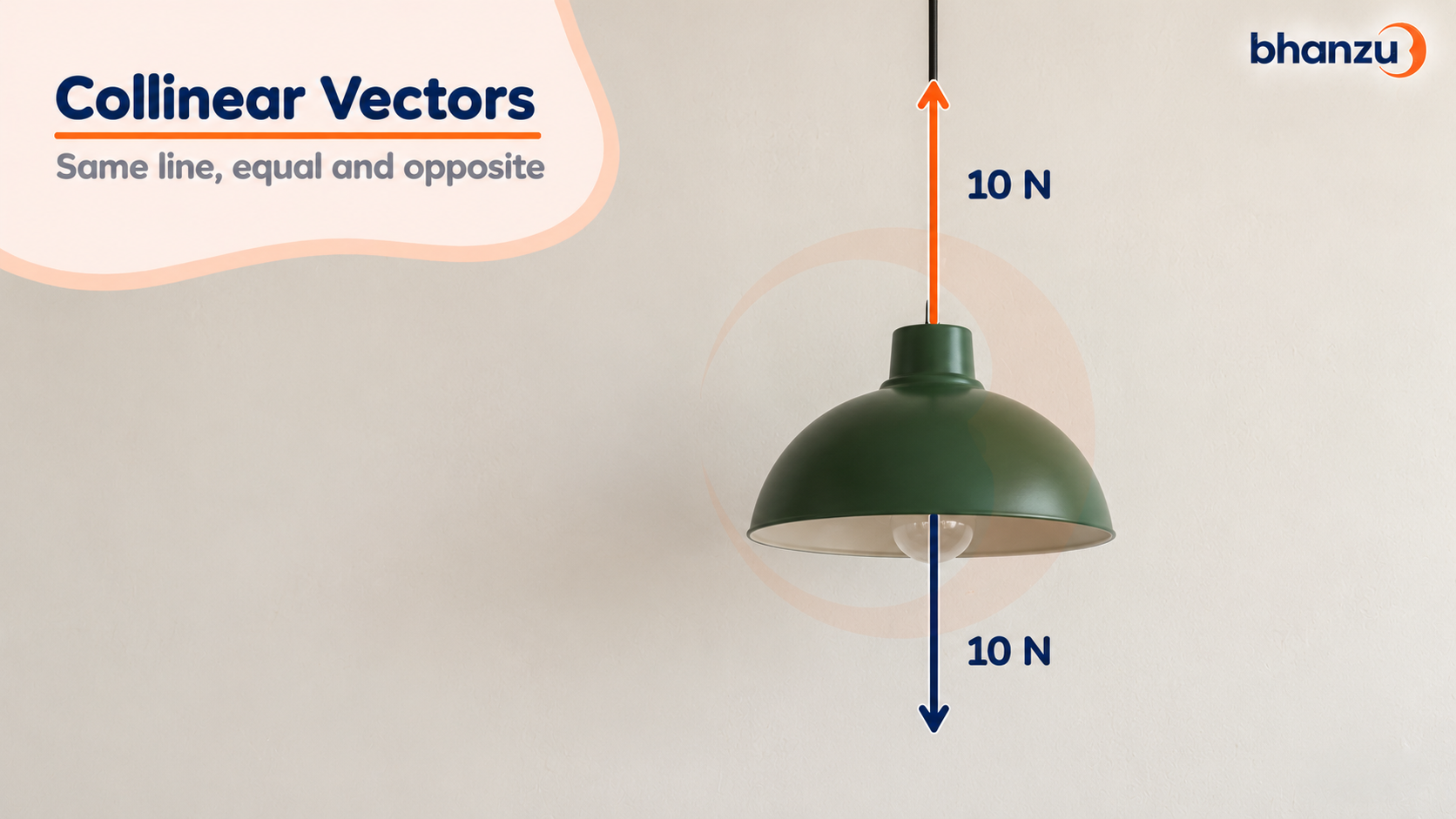
A line is a straight, one-dimensional path that extends without end in both directions. A line segment is a piece of a line with two endpoints, and a ray has one endpoint and runs on forever in a single direction. An angle forms wherever two rays or segments share an endpoint, and its size is the opening between them, measured in degrees.
Lines and angles are studied together because you cannot have one without the other. The moment two lines meet, they create angles, and the size of those angles is what tells you how the lines are related. For the full anatomy of the openings themselves, see the guide to angles.
What Are The Types Of Lines?
Lines are classified by how they sit relative to one another.
Intersecting lines cross at exactly one point, forming angles at the crossing. See intersecting lines for the angle pairs they create.
Perpendicular lines are intersecting lines that meet at exactly . Read more on perpendicular lines.
Parallel lines never meet, no matter how far they extend, and stay the same distance apart. See parallel lines.
A helpful anchor for all three is the plain idea of a straight path; the broader treatment of lines in geometry covers rays, segments, and collinear points in one place.
What Are The Types Of Angles?
When lines meet, the angles they form fall into the standard size categories: acute (under ), right (exactly ), obtuse (between and ), straight (exactly ), and reflex (between and ). Sorting an angle by size is the first move before you use any angle-pair rule.
What Angle Pairs Form When Lines Meet?
Two special pairs appear the instant two lines cross at a point.
Linear pair: two adjacent angles whose non-common arms form a straight line, so they always add to . See linear pair of angles.
Vertically opposite angles: the two angles directly across from each other at the crossing, which are always equal.
A common reader question is do vertically opposite angles have to be equal, or only sometimes? They are always equal, for any two intersecting lines, because each pair shares a linear-pair partner that pins the values together.
What Happens When A Transversal Cuts Parallel Lines?
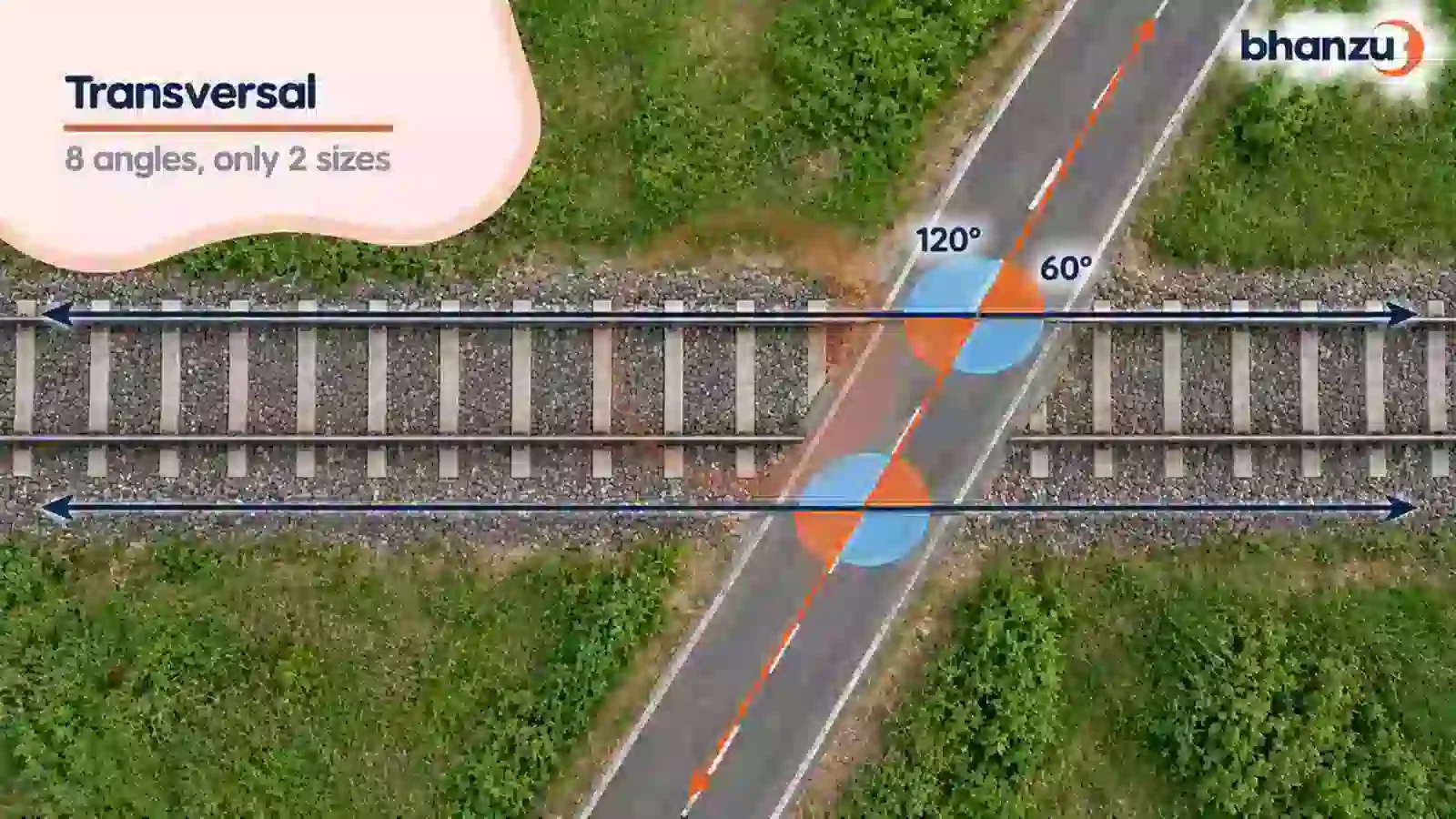
A transversal is a line that crosses two or more other lines. When a transversal cuts a pair of parallel lines, it creates eight angles with tidy relationships:
Corresponding angles sit in matching positions at each crossing and are equal. See corresponding angles.
Alternate angles sit on opposite sides of the transversal, between or outside the parallels, and are equal. See alternate angles.
Co-interior angles sit on the same side of the transversal, between the parallels, and add to .
The catch that trips up most students: these equalities hold only when the two lines are parallel. If the lines are not parallel, corresponding and alternate angles are simply unequal, and no rule rescues you.
Examples Of Lines And Angles
Example 1
Two lines cross at a single point but not at . What kind of lines are they?
They meet at one point, so they are intersecting. Because the meeting angle is not , they are not perpendicular.
Final answer: they are intersecting (but not perpendicular) lines.
Example 2
A transversal cuts two lines. A student sees a pair of alternate angles, declares them equal, and writes to match the other angle. But the two lines are not marked parallel. What is the error?
Here is the tempting move: apply "alternate angles are equal" the moment you spot an alternate pair. So the student sets . Take a second. The equal-angle rules for a transversal are conditional; they hold only when the two crossed lines are parallel. Nothing in the figure says these lines are parallel, so the rule does not apply and is not forced to . The rescue is to check for the parallel marks first. Only if the lines carry matching arrowheads (or are stated parallel) can you conclude the alternate angles are equal.
Final answer: without parallel lines, alternate angles are not necessarily equal, so cannot be found from this rule alone.
Example 3
Two angles form a linear pair. One measures . Find the other.
A linear pair adds to .
Final answer: the other angle is .
Example 4
Two lines intersect. One of the four angles is . Find the angle vertically opposite it and one angle adjacent to it.
The vertically opposite angle is equal, so it is . An adjacent angle forms a linear pair with the angle, so it is .
Final answer: the vertically opposite angle is and each adjacent angle is .
Example 5
A transversal cuts two parallel lines. A corresponding angle to is , and . Find .
Corresponding angles are equal when the lines are parallel, and here they are.
Final answer: .
Example 6
Two co-interior angles between parallel lines are and . Find .
Co-interior angles on the same side of the transversal add to .
Final answer: .
Why Do Lines And Angles Matter?
"Parallel rails and true angles are what keep a train on its track." The rules of lines and angles are not classroom trivia; they are the working grammar of everything that must be built straight, level, or aligned. A transversal cutting parallel lines is the exact geometry of a road crossing railway tracks, a staircase stringer meeting its treads, and a truss meeting its chord.
The study runs deep enough to have reshaped mathematics itself:
The parallel idea is foundational. Euclid's assumption that parallel lines never meet held for two thousand years and defines the flat geometry of everyday building.
Challenging it opened new worlds. When mathematicians asked what happens if parallels can meet, they discovered the curved geometries that later described the universe in Einstein's relativity.
The angle rules are practical proofs. Corresponding and alternate angles let a surveyor confirm two walls are truly parallel using only a straight edge and a measured angle.
Euclid set out his line-and-angle rules, including the famous parallel postulate, in the opening pages of his geometry; you can read Euclid's Book I definitions and postulates that still frame the subject today.
What Are The Most Common Mistakes With Lines And Angles?
Mistake 1: Applying transversal rules without parallel lines
Where it slips in: any transversal figure where the lines are not marked or stated parallel.
Don't do this: call corresponding or alternate angles equal on sight.
The correct way: confirm the lines are parallel first. The first instinct on seeing an alternate pair is to declare them equal, but that equality is borrowed entirely from the parallel condition, and it vanishes the moment the lines are not parallel.
Mistake 2: Confusing alternate and co-interior angles
Where it slips in: naming the angle pairs between two parallel lines.
Don't do this: treat every "inside" pair as equal.
The correct way: alternate angles (opposite sides of the transversal) are equal, while co-interior angles (same side) add to . The memorizer who learned "inside angles are equal" gets co-interior pairs wrong every time, because those sum rather than match.
Mistake 3: Assuming intersecting means perpendicular
Where it slips in: describing two lines that cross at an angle other than .
Don't do this: call every crossing "perpendicular."
The correct way: perpendicular is the special case where the meeting angle is exactly . All perpendicular lines intersect, but most intersecting lines are not perpendicular.
Conclusion
Lines and angles studies how straight paths relate and the openings they form where they meet.
Lines are intersecting, perpendicular, or parallel; perpendicular is the special case of intersecting.
At any crossing, vertically opposite angles are equal and a linear pair adds to .
A transversal across parallel lines makes corresponding and alternate angles equal and co-interior angles sum to .
The equal-angle rules apply only when the lines are genuinely parallel.
To take lines and angles further with a teacher, explore Bhanzu's geometry tutor sessions, a high school math tutor, or structured math classes online.
What To Practice Next
Draw two parallel lines and a transversal, number all eight angles, then fill in every value from a single given angle using the corresponding, alternate, and co-interior rules. If you get stuck, revisit the transversal section and confirm the lines are truly parallel before applying any rule. Want a live Bhanzu trainer to walk through transversal problems with you? Book a free demo class.
Read More
Was this article helpful?
Your feedback helps us write better content
Frequently Asked Questions
What are the key concepts in lines and angles?
What are the different types of angles formed by a transversal?
Are vertically opposite angles always equal?
What is the difference between a line and a line segment?
Do the transversal angle rules work for non-parallel lines?