What Are Corresponding Angles?
Two angles formed by a transversal crossing two lines are corresponding angles when they sit in the same relative position at their respective intersections — both top-left, both bottom-right, etc.
The Corresponding Angles Postulate. If two parallel lines are cut by a transversal, then each pair of corresponding angles is equal (congruent).
The reverse — the Corresponding Angles Converse — is also true: if a transversal cuts two lines and a pair of corresponding angles is equal, then the two lines are parallel. This converse is the most commonly used tool for proving that two lines are parallel from angle information.
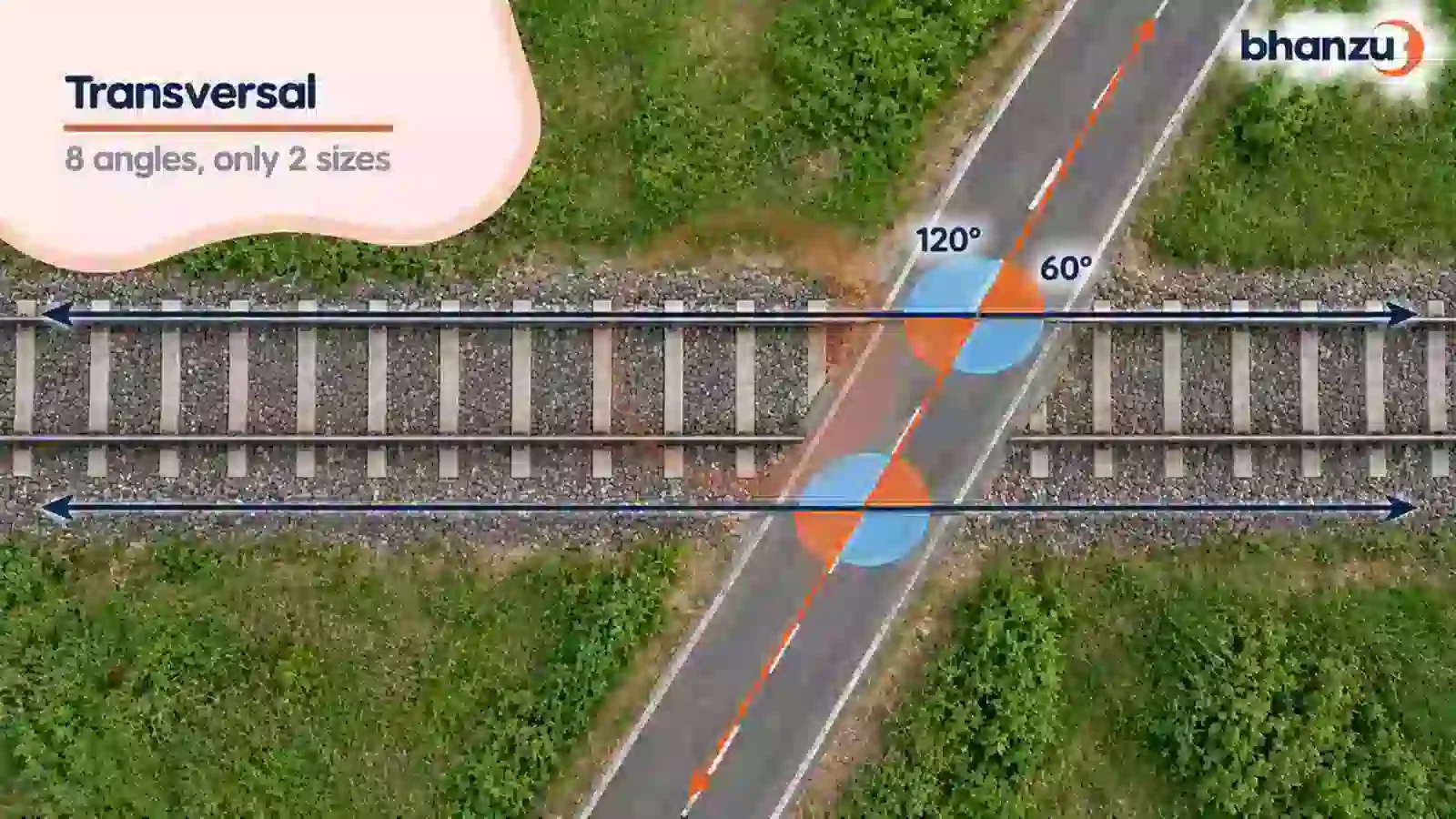
A transversal across two parallel lines forms angles total: four at each intersection. Of those , exactly pairs are corresponding pairs.
The Angle-Pair Table on a Transversal
When a transversal crosses two parallel lines, four named pair-relationships emerge. Corresponding angles are one of them; the others are alternate interior, alternate exterior, and co-interior angles.
Pair name | Position | Relationship (parallel lines) | Pair count in the diagram |
|---|---|---|---|
Corresponding angles | Same relative position at each intersection | Equal | 4 pairs |
Alternate interior angles | Between the parallels, opposite sides of the transversal | Equal | 2 pairs |
Alternate exterior angles | Outside the parallels, opposite sides of the transversal | Equal | 2 pairs |
Co-interior angles | Between the parallels, same side of the transversal | Sum to | 2 pairs |
Vertical angles | Opposite at a single intersection | Equal (always, parallel or not) | 4 pairs (2 at each intersection) |
Linear pair | Adjacent on a single straight line | Sum to (always) | 8 pairs total |
The whole pattern is symmetric: knowing any one corresponding-angle pair pins down all angles in the diagram. There are only ever two distinct measures — the acute one and the obtuse one (when the transversal isn't itself perpendicular to the parallels).
Visualising the Eight Angles
In a standard textbook diagram, label the angles 1 through 8:
Upper intersection: top-left, top-right, bottom-left, bottom-right.
Lower intersection: top-left, top-right, bottom-left, bottom-right.
The four corresponding pairs are then:
↔ (both top-left)
↔ (both top-right)
↔ (both bottom-left)
↔ (both bottom-right)
When the two horizontal lines are parallel, each of these four pairs is equal. So , , , .
Three Worked Examples, From Quick to Stretch
Quick. Two parallel lines are cut by a transversal. One angle is . What is the corresponding angle on the other line?
Corresponding angles are equal when lines are parallel. So the corresponding angle is also .
Standard (Wrong path first). In the diagram, and are corresponding angles. The two crossed lines are parallel. Find and the measure of each angle.
Wrong path. A student writes — applying the co-interior relationship (sum to ) instead of the corresponding relationship (equal). Computing: gives , and the angles come out to and . Plug back: — the algebra is internally consistent, but the answer is wrong because the relationship was wrong. Corresponding angles are equal, not supplementary.
Diagnosing the error. Same-relative-position pairs are equal. The slip is reading "two angles, two intersections" and reaching for the sum equation by reflex. The Corresponding Angles Postulate is equality — that is its core content.
Correct path. Set the two equal:
So and .
Check: corresponding angles, parallel lines, both measure . ✓
In the Bhanzu Grade 8 weekend cohort, this exact slip — applying the supplementary equation to a corresponding-angle pair — shows up in roughly six out of every ten students on first attempt. The trainer's fix is to ask: "Are these angles in the same position?" before any equation is written.
Stretch. Two lines are cut by a transversal. A pair of corresponding angles measures and . (a) For what value of are the lines parallel? (b) Find the angle measure at that value.
The corresponding-angles converse says: the lines are parallel if and only if the corresponding angles are equal. Set:
(a) The lines are parallel when .
(b) Substituting back: . (Cross-check: ✓.)
This is the converse direction in action — given a pair of measures, deduce the parallelism rather than assume it.
How Corresponding Angles Connect to the Other Pair Types
Once you know corresponding angles are equal (when the lines are parallel), every other parallel-line angle relationship follows:
Alternate interior angles. corresponds to (both bottom-left). and are vertical angles (both at the lower intersection, opposite). So . Therefore — the alternate interior pair. The chain: corresponding + vertical = alternate.
Alternate exterior angles. Same reasoning with the exterior angles.
Co-interior angles. corresponds to . and form a linear pair (adjacent at the lower intersection on a straight line). So , giving — co-interior.
This is why most geometry textbooks introduce the Corresponding Angles Postulate first and derive the others — it is the foundational equality.
Where Corresponding Angles Show Up in the Real World
Railway tracks crossed by sleepers. The parallel rails plus a transverse sleeper form corresponding-angle equality at each crossing — the check that the sleepers are perpendicular to the rails.
Sets of parallel ramps with cross-pieces. Staircases, ladders, and certain truss bridges rely on the corresponding-angles equality for their planar geometry.
Surveying and map-making. Parallel longitude lines (locally) cut by an east-west road create corresponding angles; the surveyor uses the equality to check the road's bearing.
Architecture. Building facades with parallel floors and a single diagonal stairway use corresponding-angle reasoning to keep the stairs visually consistent across floors.
Optics. Light passing through parallel-sided glass refracts at corresponding angles when it enters and exits — the ray-in / ray-out parallelism is the corresponding-angles converse.
Three Habits That Lose Marks on Corresponding Angles
1. Applying the equality without the parallel-lines hypothesis.
Where it slips in: The diagram has two lines and a transversal, but the parallel mark is missing or the question says "two lines" without specifying parallel.
Don't do this: Assume corresponding angles are equal regardless.
The correct way: Corresponding angles are equal if and only if the lines are parallel. Without the parallel hypothesis, the equality may not hold — and the question may be asking you to test whether the lines are parallel using the angle information.
2. Confusing corresponding with alternate interior.
Where it slips in: Both pairs involve angles at different intersections. The visual distinction is subtle — corresponding angles are at the same relative position; alternate interior angles are between the parallels on opposite sides of the transversal.
Don't do this: Treat any "two angles, two intersections" pair as corresponding.
The correct way: Use the position test. Both angles top-left? Corresponding. Both interior, opposite sides of the transversal? Alternate interior. Both interior, same side? Co-interior.
3. Using the sum-to- equation instead of the equality.
Where it slips in: Under exam pressure, a student writes for a corresponding-angle pair because the co-interior relationship is more recently studied.
Don't do this: Apply the supplementary equation to every parallel-line angle pair.
The correct way: Three of the four named pair types are equal (corresponding, alternate interior, alternate exterior). Only co-interior sum to . When in doubt, the equality is the default; the sum is the exception.
The Bhanzu Grade 8 trainer's first-week habit is to have students chant the pattern aloud: "Corresponding equal. Alternate interior equal. Alternate exterior equal. Co-interior sum to one-eighty." The repetition installs the right reflex.
Bhanzu's Approach to Corresponding-Angles Problems
In a Bhanzu Grade 8 geometry session, the corresponding-angles postulate is taught as a postulate, not a theorem — students learn early that it cannot be derived from simpler axioms and must be accepted. The session then derives every other parallel-line angle relationship from it, giving the student a coherent map rather than four disconnected facts. Across cohorts since 2023, students who learn the postulate-first structure score roughly a third higher on cumulative parallel-line assessments than students who memorise four independent rules.
Conclusion
Corresponding angles are pairs of angles in the same relative position at each intersection formed by a transversal crossing two lines.
When the two lines are parallel, corresponding angles are equal — the Corresponding Angles Postulate.
The Corresponding Angles Converse — if corresponding angles are equal, the lines are parallel — is the standard tool for proving parallelism from angle data.
Once the corresponding-angles equality is established, alternate interior, alternate exterior, and co-interior pair relationships follow as consequences.
The most common slip is applying the supplementary equation () to a corresponding pair. Corresponding angles are equal — that is the headline fact.
Take Corresponding Angles for a Test Drive
Two parallel lines are cut by a transversal. A pair of corresponding angles is and . Find .
In a diagram, and are corresponding angles. . Find , then find the alternate interior angle of on the other line.
Two angles in a transversal diagram are equal, both measuring . Identify two possible relationships they could have (i.e., what pair types make sense).
(Answers: 1. ; 2. , the alternate interior is also ; 3. corresponding, alternate interior, alternate exterior, or vertical angles — any pair type whose relationship is equality.)
Want a Bhanzu trainer to walk through more corresponding-angles problems with your child? Book a free demo class — live online globally.
Also Read:
Was this article helpful?
Your feedback helps us write better content