What Is the Parallel Lines and Transversal Configuration?
A transversal is a line that crosses two (or more) other lines at distinct points. When the two lines it crosses are parallel — straight lines in the same plane that stay the same distance apart and never meet — the configuration is called parallel lines cut by a transversal.
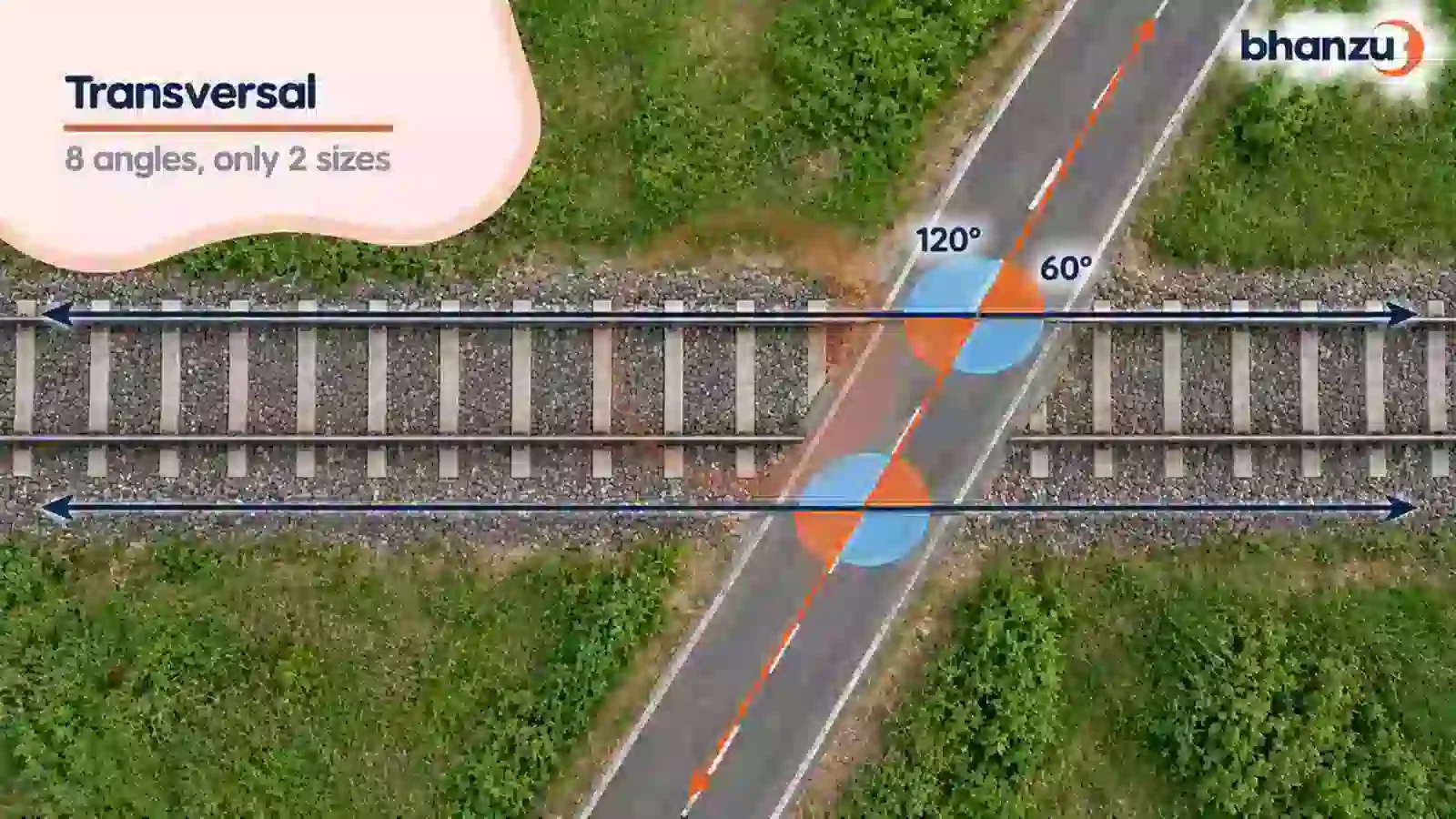
The transversal meets each parallel line at one point, and at each crossing it forms four angles, giving eight angles in total. The region between the two parallel lines is the interior; the region outside them is the exterior. Every one of the four named angle pairs is defined by where its two angles sit — interior or exterior, and which side of the transversal.
The Four Angle Pairs
Here are the four relationships, each defined by position, with what the parallel condition forces. Using the numbering to from the figure ( are the interior angles):
Angle pair | Where the two angles sit | The pairs | Relationship (lines parallel) |
|---|---|---|---|
Corresponding angles | Same position at each crossing (one interior, one exterior, same side) | ; ; ; | Equal |
Alternate interior angles | Both interior, opposite sides of the transversal | ; | Equal |
Alternate exterior angles | Both exterior, opposite sides of the transversal | ; | Equal |
Co-interior angles (same-side interior / consecutive interior) | Both interior, same side of the transversal | ; | Supplementary (sum to ) |
A fifth relationship runs underneath all of them: vertical angles (the opposite angles at a single crossing, like and ) are always equal — whether or not the lines are parallel. The parallel condition is what links the two crossings together; vertical angles link angles within one crossing.
So three of the four named pairs are equal (corresponding, alternate interior, alternate exterior) and one is supplementary (co-interior). That single split — three equal, one adds to — is the heart of the topic.
Why the Pairs Are Equal or Supplementary
These relationships are not coincidences; they chain out from one starting fact. The corresponding angles postulate is taken as given: when lines are parallel, corresponding angles are equal. Everything else follows.
Alternate interior angles equal. equals (vertical angles), and equals (corresponding). So by the transitive step.
Alternate exterior angles equal. Same chain, run on the exterior angles: a vertical-angle step plus a corresponding-angle step gives .
Co-interior angles supplementary. and are co-interior. Since (alternate interior) and (they sit on a straight line at Q), substituting gives .
This is the reason a single given angle unlocks all eight: read off the two distinct values (an angle and its supplement), then assign each of the eight to one group or the other by position.
The Converse — Proving Lines Are Parallel
Every one of these relationships runs backwards, and the reverse direction is what makes the configuration genuinely useful. If a transversal crosses two lines and any one of these holds — a corresponding pair equal, an alternate interior pair equal, an alternate exterior pair equal, or a co-interior pair supplementary — then the two lines must be parallel
Forward, parallel lines force the angle relationships; backward, the angle relationships prove the lines parallel. That converse is how a drafter, a carpenter, or CAD software checks parallelism from a single measured angle pair instead of extending the lines to see whether they ever meet.
Examples of Parallel Lines Cut by a Transversal
With the eight angles, the four pairs, and the converse in place, here is the configuration applied. The problems build from naming a pair up to a co-interior solve and a converse check.
Example 1
Two parallel lines are cut by a transversal. measures . Find its corresponding angle and its co-interior partner.
Corresponding angles are equal, so . The co-interior partner of (its same-side interior angle, ) is supplementary to it, so . Final answer: and the co-interior angle .
Example 2
Two parallel lines are cut by a transversal. One alternate interior angle is and its partner is . Find x.
A first instinct is to add the two expressions to , treating them like the co-interior pair: , which gives and . Check that against the figure. These are alternate interior angles — both interior, on opposite sides of the transversal — so the rule is that they are equal, not supplementary. The "add to " set-up belongs to the co-interior (same-side) pair, not this one.
The correct way sets them equal:
Each angle is then . Final answer: , each angle .
Example 3
Two parallel lines are cut by a transversal. A pair of corresponding angles is and . Find x.
Corresponding angles are equal, so set the expressions equal:
Final answer: .
Example 4
Two parallel lines are cut by a transversal. A co-interior (same-side interior) pair measures and . Find x and each angle.
Co-interior angles are supplementary, so they add to :
The angles are and , which indeed sum to . Final answer: ; angles and .
Example 5
. Find its alternate exterior partner , and the corresponding angle .
Alternate exterior angles are equal, so . Corresponding angles are equal, so as well — both belong to the same one of the two distinct angle values. Final answer: and .
Example 6
A transversal crosses two lines, making a pair of co-interior angles that measure and . Are the two lines parallel?
Co-interior angles between parallel lines must be supplementary. Check: . Since the pair is supplementary, by the converse the two lines are parallel. Final answer: yes, the lines are parallel — the co-interior pair summing to is the proof.
Why Parallel Lines and a Transversal Matter
The reason this configuration anchors a whole geometry unit is that it is the first place a student sees a system of angle relationships all driven by a single condition — and that system runs straight out into the built world.
It proves the triangle angle sum. Draw a line through one vertex of a triangle parallel to the opposite side, and the triangle's two base angles reappear at that vertex as alternate interior angles. They plus the top angle sit on a straight line, so the three angles sum to . That cornerstone proof is unavailable without this configuration.
It is how parallelism gets checked. Carpenters, drafters, and surveyors confirm two edges are parallel by measuring one angle pair the transversal makes — the converse at work — rather than extending the edges to a vanishing point.
Roads, rails, and architecture run on it. Railway sleepers cross parallel rails as transversals; the repeated equal angles keep the gauge constant. Parking-lot lines, truss bracing, and window mullions all live in this configuration, where a single angle fixes the rest.
CAD and graphics enforce it. Software that locks two edges "parallel" is enforcing the converse — equal corresponding (or alternate) angles — every time you constrain a sketch, and rendering engines use the same angle relationships to draw perspective.
For a Grade 8 student, this is often the first topic where one fact (the parallel condition) cascades into a whole set of consequences — the experience that makes geometry start to feel like a connected system rather than isolated rules.
Where Students Trip Up on Parallel Lines and a Transversal
Mistake 1: Treating alternate angles as supplementary (or co-interior as equal).
Where it slips in: A student sees two angles in the interior strip and reaches for the wrong rule — adding an alternate interior pair to , or setting a co-interior pair equal (Example 2 shows the first).
Don't do this: Apply "add to " to every interior pair regardless of which side of the transversal they sit on.
The correct way: Check the side of the transversal first. Opposite sides (alternate) means equal; same side (co-interior) means supplementary. Position decides the rule.
Mistake 2: Applying the relationships when the lines aren't parallel.
Where it slips in: A figure shows two lines that look roughly parallel but carry no parallel marks, and the student sets corresponding (or alternate) angles equal anyway.
Don't do this: Assume "looks parallel" means "is parallel" and apply the equal/supplementary rules.
The correct way: The relationships need the lines to be given parallel (matching arrowheads or a stated condition). Without that, the angles are not guaranteed equal or supplementary. The rusher who jumps to the equation loses marks here most often. (If you are instead given an angle relationship and asked about the lines, that is the converse — and then you may conclude parallel.)
Mistake 3: Mixing up the four named pairs by position.
Where it slips in: A student labels an alternate exterior pair as "corresponding," or calls a co-interior pair "alternate interior," because the names blur together.
Don't do this: Guess the pair's name from rough position instead of checking interior/exterior and which side of the transversal.
The correct way: Run two checks for any pair — (1) interior or exterior? (2) same side or opposite side of the transversal? Corresponding = same side, one of each (one interior, one exterior); alternate = opposite sides; co-interior = same side, both interior. The memorizer who learns the four names without the position test keeps swapping them under pressure.
Key Takeaways
When parallel lines are cut by a transversal, eight angles form four pairs: corresponding, alternate interior, alternate exterior, and co-interior.
Three pairs are equal (corresponding, alternate interior, alternate exterior); the co-interior (same-side interior) pair is supplementary.
All eight angles reduce to just two distinct values — an angle and its supplement — so one given measurement unlocks the rest.
Every relationship has a converse: an equal or supplementary pair proves the two lines parallel.
Always confirm the lines are parallel before applying the equal/supplementary rules, and name each pair by interior/exterior and side of the transversal.
Practice These Problems to Solidify Your Understanding
Two parallel lines are cut by a transversal. A corresponding pair is and . Find x.
Two parallel lines are cut by a transversal. A co-interior pair is and . Find x and each angle.
A transversal crosses two lines, making alternate interior angles that both measure . Are the lines parallel, and which result tells you?
Answer to Question 1: corresponding angles are equal, so , giving .
Answer to Question 2: co-interior angles are supplementary, so , giving , with angles and .
Answer to Question 3: yes, by the converse — equal alternate interior angles force the lines parallel. If Question 2 gave a value from setting the expressions equal, you used the alternate (equal) rule on a co-interior pair by mistake (see Mistake 1).
Want a live Bhanzu trainer to walk your child through parallel-line angle relationships and proofs? Book a free demo class — online globally.
Was this article helpful?
Your feedback helps us write better content