Key Points
- A net shows each face of a solid exactly once, so a triangular prism's net has two triangles and three rectangles.
- A prism whose base has sides has faces, and a pyramid with the same base has faces.
- Only 11 of the 35 shapes made from six joined squares fold into a cube, and each of the 11 cube nets has 5 fold lines.
- Common Core standard 6.G.A.4 asks 6th graders to find surface area from nets of 3D figures made of rectangles and triangles.
Every box was once flat
Cut a cereal box along the right 7 of its 12 edges, and it opens into one flat piece. Six rectangles lie on the table, still joined, in three matching pairs. Fold it back up and the box returns, with no face missing and none doubled.
That flat piece is a net. Packaging engineers design cardboard boxes as flat nets, because boxes are cut from flat sheets. Sheet-metal workers cut air ducts the same way, and clothing designers lay out sewing patterns, flat pieces of fabric shaped to wrap around a body.
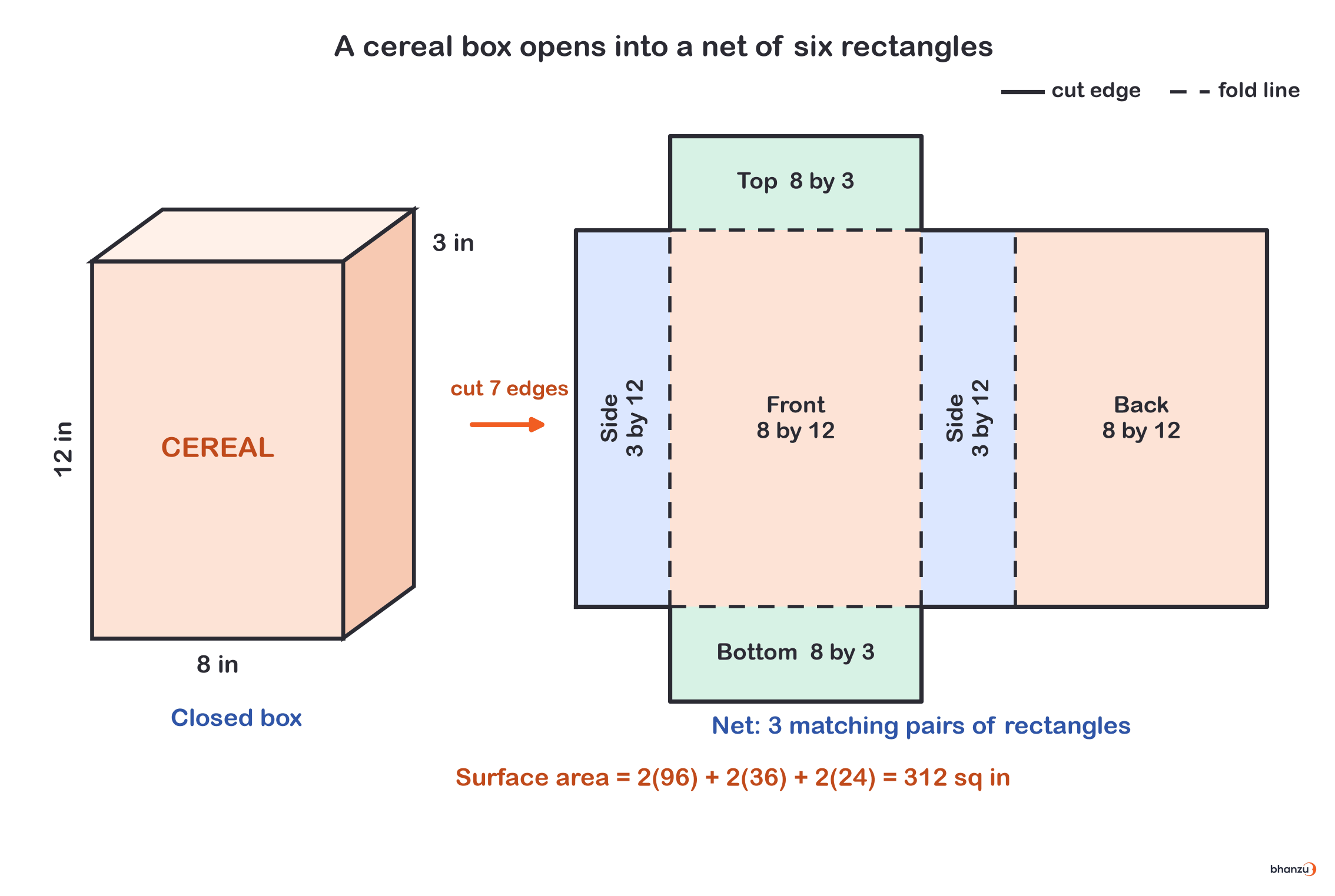
What is a net of a 3D figure?
Nets of 3D figures lay a solid's faces out as polygons (closed shapes with straight sides) that stay joined at their edges, so the pattern folds back with no gaps and no overlaps. A face is a flat side of the solid, an edge is where two faces meet, and a vertex is a corner where edges meet.
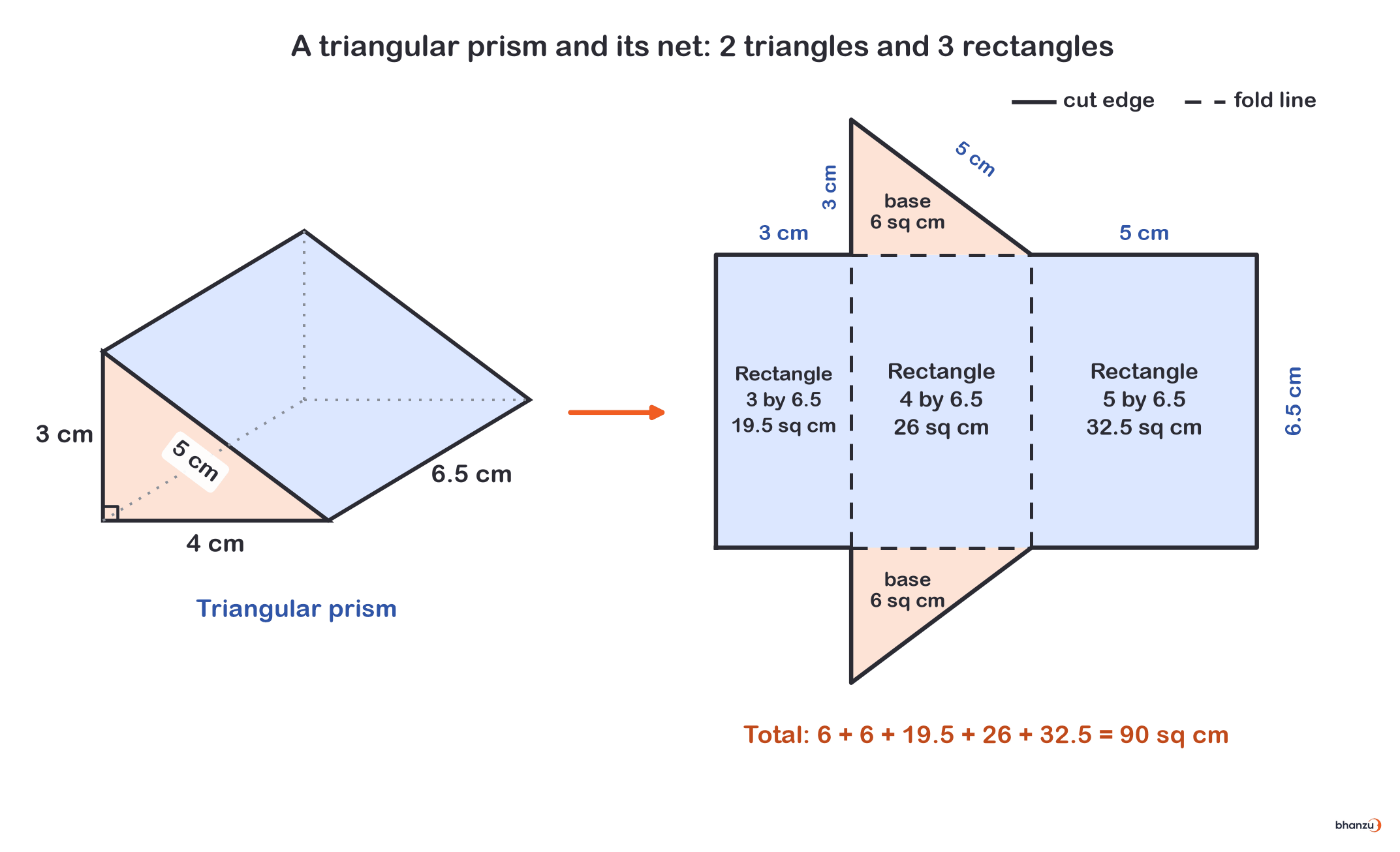
A solid whose faces are all polygons is a polyhedron, and cubes, prisms and pyramids each have more than one net, because you can choose which edges to cut. The net is 2D, so its area is in square units, and that area equals the surface area of the 3D solid.
This is Common Core standard 6.G.A.4, which calls for nets made of rectangles and triangles. This year your child should be able to sketch the net of a solid, name the solid a net makes and add up its face areas.
How do you match a net to its 3D figure?
Count the faces, then name the shapes. A prism has two matching bases joined by rectangles, so a prism whose base has sides has faces. A pyramid has one base with a triangle on each side, all meeting at one top point, so it has faces.
- Count every face, including those that end up at the back or underneath.
- Find the bases. Two matching polygons with rectangles between them make a prism, and one polygon ringed by triangles makes a pyramid.
- Fold it in your head (or on paper). Each face must land on its own side, with no overlap and no gap.
| Solid | Faces in its net | Number of faces |
|---|---|---|
| Cube | 6 squares | 6 |
| Rectangular prism | 6 rectangles in 3 matching pairs | 6 |
| Triangular prism | 2 triangles and 3 rectangles | 5 |
| Rectangular pyramid | 1 rectangle and 4 triangles | 5 |
| Square pyramid | 1 square and 4 triangles | 5 |
| Triangular pyramid | 4 triangles | 4 |
Triangles do two different jobs. In a triangular prism net, the two triangles are the matching bases, and three rectangles wrap between them. In a square pyramid net, the four triangles are the sides, leaning in until their tips meet.
The face count has one blind spot. A triangular prism and a square pyramid both have 5 faces, so step 2 decides. Cylinders and cones have curved surfaces, so their nets need circles, which you'll measure in 7th grade.
How many nets does a cube have?
A cube has exactly 11 different nets. Six squares joined edge to edge make 35 shapes in all, and only those 11 fold into a cube, a count listed in the Online Encyclopedia of Integer Sequences.
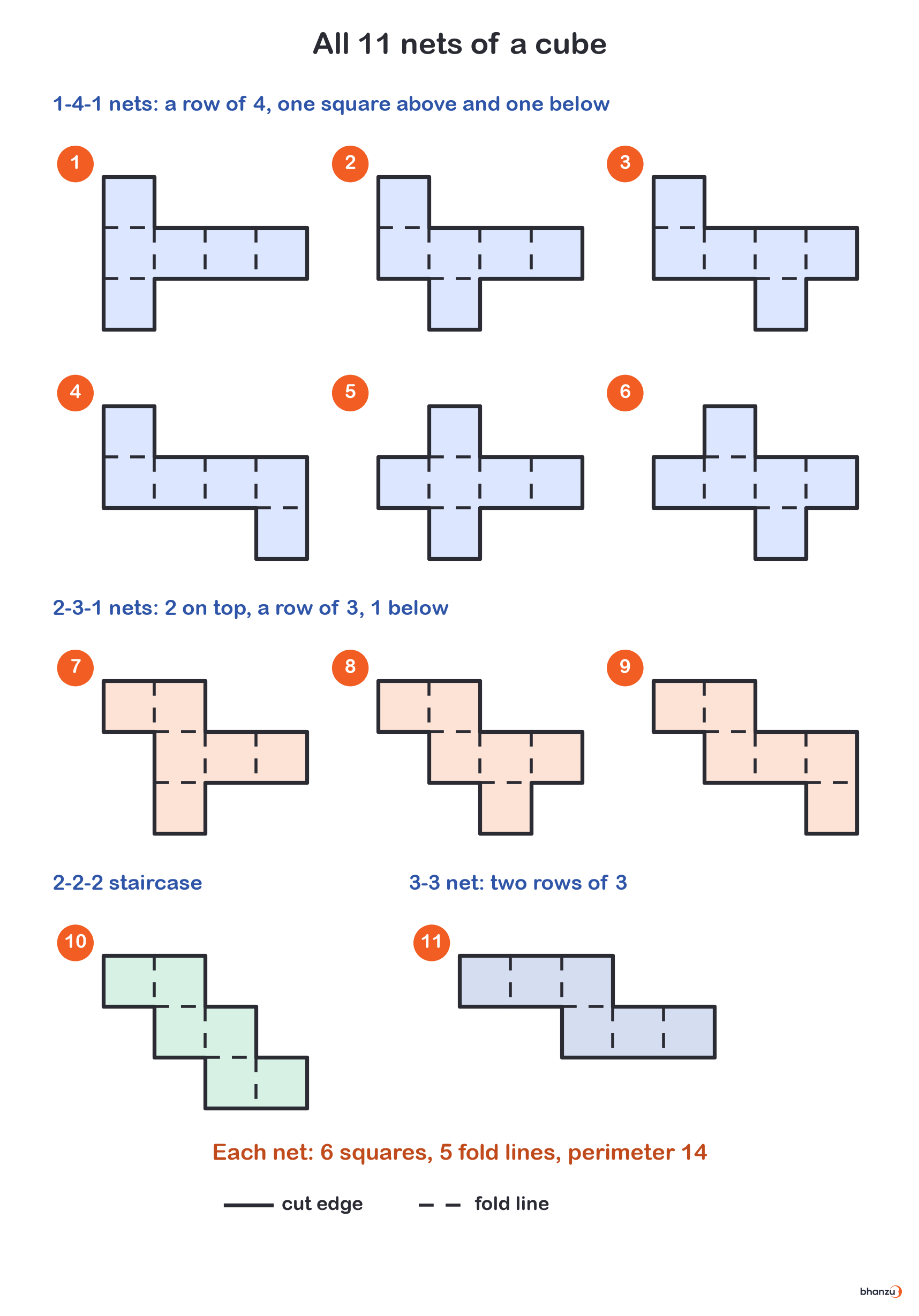
Six of the 11 nets are 1-4-1 nets (a row of 4 squares with one square above and one below). The other five are three 2-3-1 nets, one 2-2-2 staircase and one 3-3 net. A child who counts six squares and stops there has done half the job, so run these checks first.
- No 2 by 2 block. Four squares around one point cannot fold, because a cube's corner has only three faces.
- No row of 5 or more. A row of 4 wraps once around the cube, so a fifth square lands back on the first.
- Fold it. Every square must land on a different face.
Each of the 11 nets has an outline exactly 14 unit edges long, while a six-square shape with a 2 by 2 block measures 12 or less. The two quick checks throw out 12 of the 35 shapes, but 12 of the 23 that pass still fail when folded. Those 12 are genuinely hard to spot by eye, so the fold check is never optional.
How do you use a net to find surface area?
Surface area is the total area of every face of a solid, so a net turns it into an addition problem, one face at a time.
A rectangle's area is length times width, because that many unit squares fit in its rows. A triangle with base and height fills half of a by rectangle.
With for length, for width and for height, a rectangular prism's surface area has a short form.
| Symbol | Meaning | Units |
|---|---|---|
| surface area of all 6 faces | square units, such as | |
| length | a length unit, such as inches | |
| width | same unit as | |
| height | same unit as |
Each product appears twice because every face of a rectangular prism has a matching face opposite it, and the net shows both. OpenStax Prealgebra 2e builds the formula the same way, by doubling each face you can see.
The cereal box in Image 1 is 8 in by 3 in by 12 in, so its face pairs are 96, 36 and 24 square inches. Its surface area is square inches.
Try It Yourself
Pick one of the five solids, move the slider to unfold it into its net or fold it back up, and drag the picture to turn it. Watch the readout count faces, fold lines and surface area, and notice that the fold lines always come out one fewer than the faces.
Examples of nets of 3D figures
Example 1
A net has 2 triangles and 3 rectangles. Which 3D figure does it fold into?
The two matching triangles are the bases, and the three rectangles join them.
The face count is , which fits a prism with a 3-sided base.
The net folds into a triangular prism.
Example 2
Six squares sit in a row of 4, with one more square above the 1st and one above the 2nd. Does this pattern fold into a cube?
The tempting answer is yes, because a cube has 6 faces and the pattern has 6 squares.
Fold it. The row of 4 wraps into four sides. The square above the 1st folds over to make the top, and the square above the 2nd folds onto that same top.
Two faces overlap and the bottom stays open, so this is not a cube net. The pattern also contains a 2 by 2 block, and its outline is only 12 unit edges long.
Move the square above the 2nd so it sits below the 2nd instead. One square now folds into the top and the other into the bottom, which makes one of the six 1-4-1 nets in Image 3.
Example 3
The net of a square pyramid shows 1 square and only 3 triangles. What is missing, and where does it go?
A square pyramid has a 4-sided base, so its net needs faces.
The net shows only 4. One side of the square has no triangle.
The missing face is one triangle, attached to that open side of the square.
Example 4
A box is 5 in long, 3 in wide and 2 in tall. Use its net to find its surface area.
The top and bottom are each .
The front and back are each .
The two ends are each .
The box has a surface area of 62 square inches.
Example 5
A triangular prism has right-triangle ends with sides 3 cm, 4 cm and 5 cm, and it is 6.5 cm long. Find its surface area from the net in Image 2.
The two triangles each have a base of 3 cm and a height of 4 cm.
The three rectangles form one strip cm wide and 6.5 cm long.
Check with the separate rectangles, . The prism has a surface area of 90 square centimeters.
Example 6
Priya's gift box is a square pyramid with an 8 in by 8 in base. Each triangular face has a base of 8 in and a height of 5 in. How much cardboard does its net use, without glue flaps?
The base is .
Each triangle is .
The four triangles together are .
The net uses 144 square inches of cardboard.
Why do nets of 3D figures matter?
Nets matter because they turn a solid into a flat sheet, and flat sheets are how boxes and cartons get made and measured.
- It lets one flat sheet become a box. In 2018, Americans threw away or recycled 33.3 million tons of corrugated boxes, more than any other single product, and the US Environmental Protection Agency reports that 96.5 percent of them were recycled. Each one began as a flat, creased net.
- It turns a 3D job into 2D area you already know. Wrapping paper, paint and cardboard are sold by area, and a net lays out every face to cover.
- It trains your eye to track hidden faces, a skill that returns with cross sections of 3D figures in 7th grade.
- It separates covering from filling. The box in Example 4 has a surface area of 62 square inches but a volume of 30 cubic inches, and volume with fractional edge lengths covers the filling side.
A net is the bridge between the solid in your hand and the flat measurements you can calculate.
Nets of 3D figures: spot the trap before you fall in
Mistake 1: Counting only the faces you can see
Where it slips in: Naming a solid from a drawing or a net, as in Example 1. A child who rushes counts the wrapping rectangles and skips the ends, which look like an outline rather than faces.
Don't do this: Saying a triangular prism has 3 faces because it has 3 rectangles.
The correct way: Count both triangle bases too, so faces, matching for a 3-sided base.
Mistake 2: Thinking any six squares make a cube
Where it slips in: Deciding whether a pattern is a cube net, as in Example 2.
Don't do this: Accepting a row of 4 with squares above the 1st and 2nd, a pattern with a 2 by 2 block and a perimeter of 12.
The correct way: Move the square above the 2nd to below the 2nd, which makes a 1-4-1 net with a perimeter of 14 that folds cleanly.
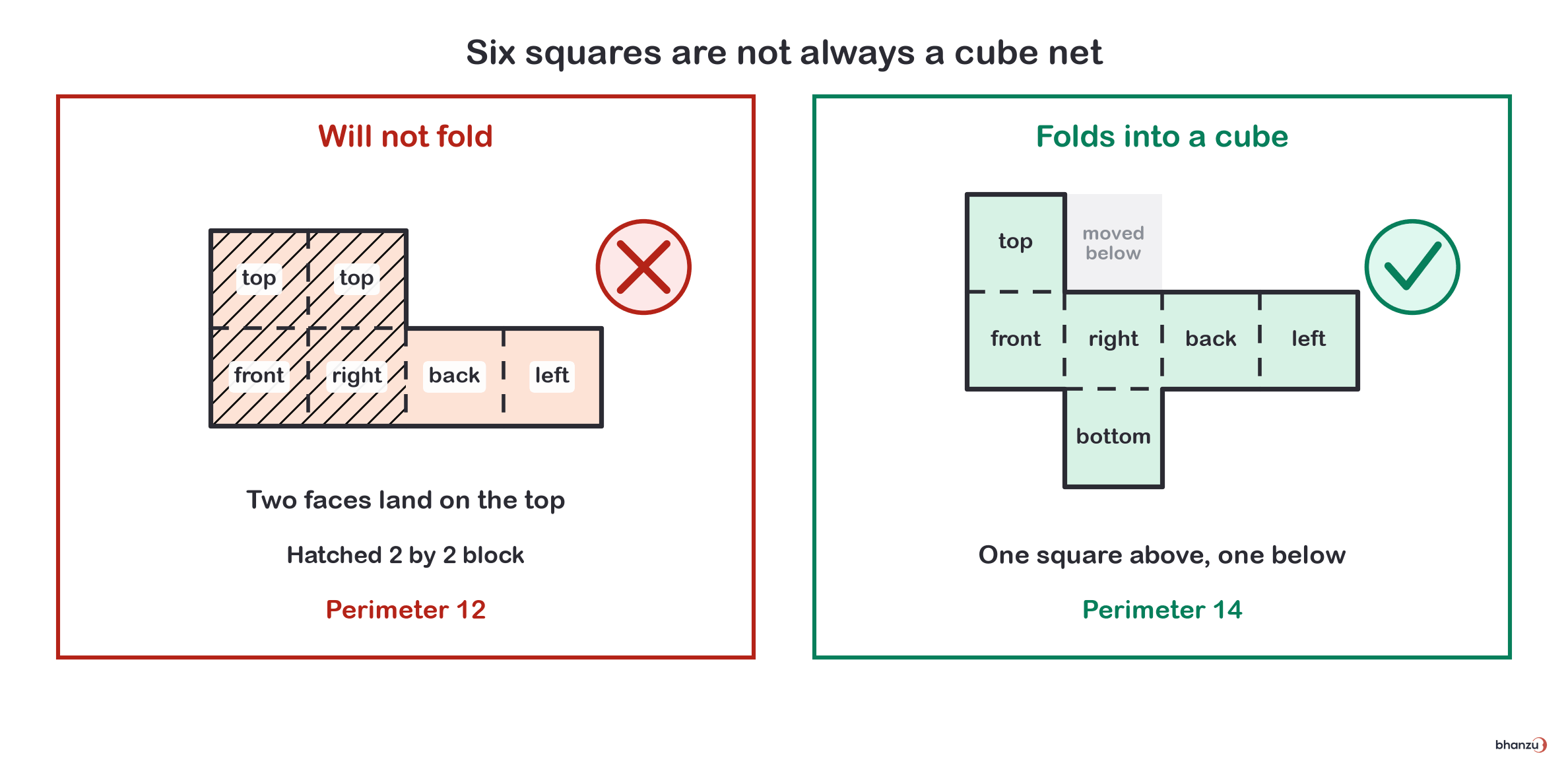
Children folding in their heads often turn every flap the same way, so two flaps swing to the top and none reach the bottom. Folding one paper copy usually breaks the habit, because the collision is hard to miss.
Mistake 3: Adding only three faces for surface area
Where it slips in: Finding the surface area of a rectangular prism, as in Example 4, where a drawing shows only three faces.
Don't do this: Adding and calling 31 square inches the surface area.
The correct way: Double each face to count its opposite partner, so square inches.
A second mix-up often rides along, writing the answer in cubic inches. Surface area covers flat faces, so it is measured in square units, and the difference between area and surface area is one flat shape versus every face of a solid.
The pattern hiding inside nets of 3D figures
Every net of a solid with faces has exactly fold lines. A cube's 6 faces need only 5 hinges to stay in one piece, and one more hinge would close a ring of faces around a corner that could never open flat.
The edges you cut follow a rule too. A solid's cut edges always come out one fewer than its vertices, and fold lines plus cut edges add up to every edge of the solid.
| Solid | Faces | Fold lines | Vertices | Cut edges |
|---|---|---|---|---|
| Cube | 6 | 5 | 8 | 7 |
| Triangular prism | 5 | 4 | 6 | 5 |
| Square pyramid | 5 | 4 | 5 | 4 |
The cube's 7 cut edges explain the perimeter check. Each cut edge shows up twice on the outline of the net, once on each side of the cut, so every cube net's outline is unit edges long. A cereal box has the same 8 corners as a cube, so it also opens flat after exactly 7 cuts.
Key Takeaways
- To name a solid from its net, count the faces, then check whether the triangles are a pair of bases or a ring of sides.
- Before calling six squares a cube net, look for a 2 by 2 block or a row of 5, then fold it.
- Surface area from nets of 3D figures means adding every face once, which for a rectangular prism means doubling three face areas.
- For more practice spotting six-square patterns that will not fold, explore Bhanzu's 6th grade math tutor or geometry tutor sessions.
Read More
Research Behind This Article
- NGA Center and CCSSO, Common Core State Standards for Mathematics, Grade 6 Geometry (2010). thecorestandards.org
- OEIS Foundation, A000105, Number of free polyominoes (or square animals) with n cells (2026). oeis.org
- OEIS Foundation, A091159, Number of distinct nets for the n-hypercube (2026). oeis.org
- OpenStax, Prealgebra 2e, Section 9.6, Solve Geometry Applications, Volume and Surface Area (2020). openstax.org
- US Environmental Protection Agency, Containers and Packaging, Product-Specific Data (2026). epa.gov
Quick Quiz: Check Yourself
Three levels with new shapes every time. Easy names a solid from its net or counts its faces. Medium asks whether six squares fold into a cube or for a box's surface area, and Hard finds the surface area of a triangular prism or square pyramid.
Was this article helpful?
Your feedback helps us write better content
Frequently Asked Questions
What does the net of a square based pyramid look like?
What is the net of a triangular pyramid?
How can I teach nets of 3D shapes at home?
How many glue flaps does a net need?
Is the surface area of a cube found from its net?
Why are nets of 3D figures important in 6th grade?