Key Points
- To draw polygons on the coordinate plane, plot each vertex as an ordered pair , join the points in their listed order and then join the last point back to the first.
- A shared x-coordinate makes a vertical side, measured by subtracting the y-coordinates, and a shared y-coordinate means subtracting the x-coordinates.
- A side that crosses an axis adds two distances from that axis, so the side from to is 9 units long, not 1.
- Sixth graders work with polygons in all four quadrants, while slanted sides wait for the Pythagorean theorem in 8th grade.
A grid invented in 1637
In 1637, a French thinker showed that shapes could be described with numbers. René Descartes published La Géométrie that year, and it tied algebra to geometry so closely that today's grid is still called the Cartesian plane. Give each corner of a shape an address of two numbers (its coordinates), and you can measure the shape without a ruler.
The same idea runs far outside math class. Satellites store each photo of Earth as a grid of squares. Video games place every character on screen with an x and a y, and architects sketch floor plans on grids before a wall goes up.
What are polygons on the coordinate plane?
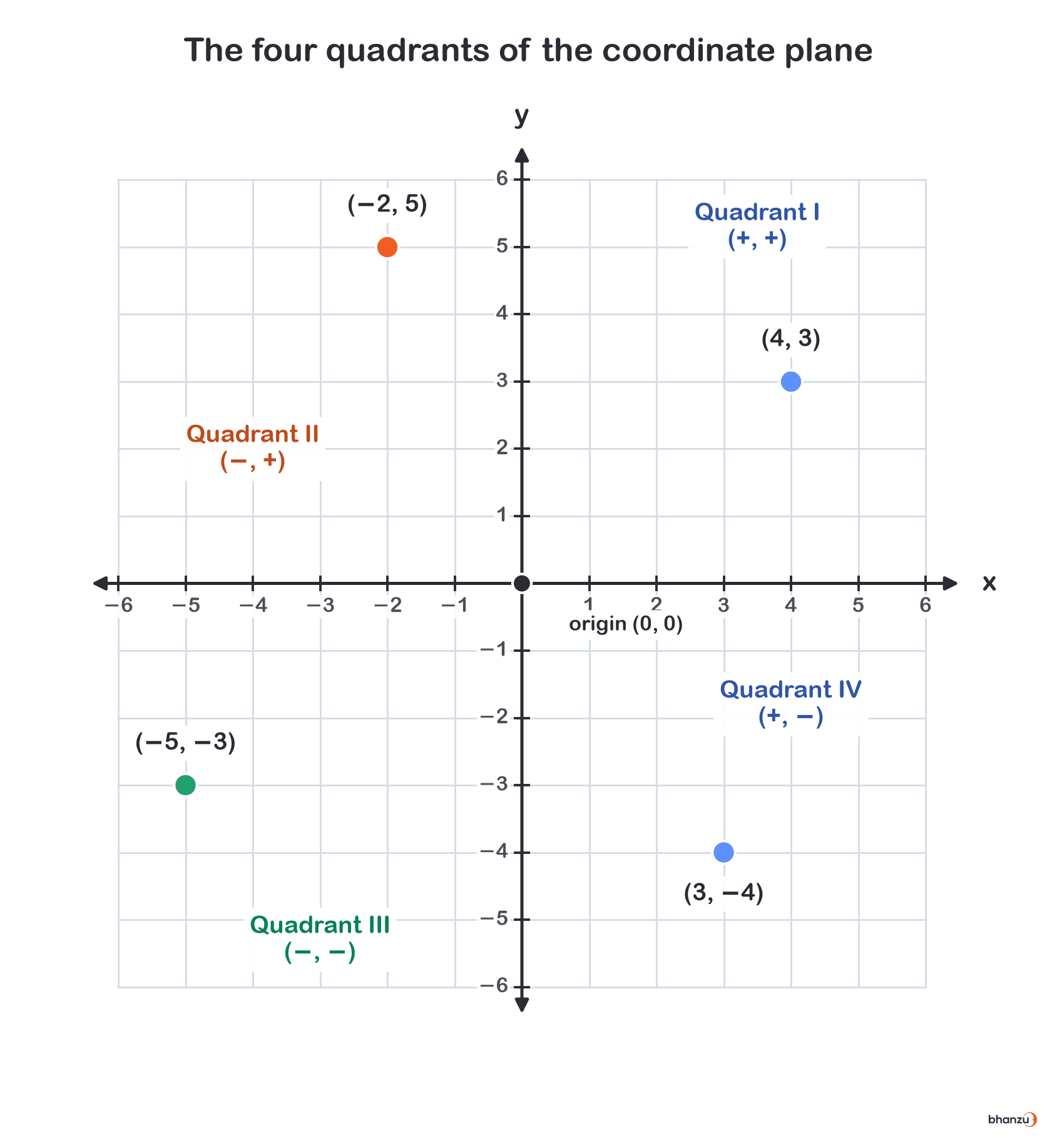
Polygons on the coordinate plane are closed shapes with straight sides whose corners, called vertices, are points on a grid of two number lines. That grid is the coordinate plane, where the horizontal x-axis and the vertical y-axis cross at the origin, .
Each vertex is an ordered pair . The x-coordinate comes first and tells you how far to move across, and the y-coordinate tells you how far to move up or down. The axes split the plane into four quadrants, numbered I to IV counterclockwise from the upper right, so corner above sits in quadrant II.
These shapes are flat (2D), so perimeter is measured in units and area in square units. This is Common Core standard 6.G.A.3, which asks sixth graders to draw polygons from vertex coordinates and use them to find side lengths. For parents, the goal this year is that your child can plot points in all four quadrants, negatives included, and measure any side that runs straight across or straight up and down.
How do you draw a polygon from its vertices?
Plot every vertex, join the vertices in their listed order, then join the last one back to the first. The order matters as much as the points.
- Start each point at the origin.
- Move across by the x-coordinate, right if positive and left if negative.
- Move up or down by the y-coordinate, up if positive and down if negative, and mark the point.
- Label the point with its vertex letter.
- Join the points in order, then join the last point to the first to close the shape.
How do you find a missing coordinate point? A rectangle with sides along grid lines uses exactly two x-values and two y-values, each one twice. Given , and , the values and have appeared only once, so the fourth corner is .
How do you find a side length from coordinates?
Look for the coordinate the two points share. A shared x-coordinate means a vertical side, so subtract the y-coordinates. A shared y-coordinate means a horizontal side, so subtract the x-coordinates (larger minus smaller, since a length can't be negative).
| Points | Shared coordinate | Work | Length |
|---|---|---|---|
| and | 6 units | ||
| and | 7 units | ||
| and | 4 units |
Subtracting works because every row and column of the grid is a number line, and the gap between 1 and 7 on a number line is 6. Children who count squares often tap each grid line with a pencil and get 7 for that first row, because they count the lines they touch instead of the spaces between them. Counting jumps fixes it.
What if the two points are in different quadrants? Then the side crosses an axis, so add the two distances from zero. Each distance is an absolute value, a number's distance from zero, and Common Core standard 6.NS.C.8 asks for exactly this. For the second row, the work is
Subtracting the signed numbers agrees, . Mirror points such as and use the opposite numbers and , so they sit units apart.
The third row is the genuinely confusing case. Both points sit left of the y-axis, 6 and 2 units away, so the side is units even though is the larger number. Slanted sides, such as to , can't be measured this way and wait for the Pythagorean theorem in 8th grade.
How do you find area and perimeter on a coordinate plane?
Perimeter is the distance around a polygon, so add every side length and give the answer in units. Area counts the unit squares inside, in square units.
| Symbol | Meaning | Units |
|---|---|---|
| area | square units | |
| length | units | |
| width | units | |
| base, along a grid line | units | |
| height, straight up from the base | units |
A rectangle units long and units wide holds rows of unit squares, which is why multiplying gives its area. A right triangle is half of the rectangle drawn around its base and height, so its area is half of . When the top corner sits above a point inside the base, the height splits the triangle into two right triangles, and the same rule holds.
An L-shape is a composite figure, and two routes give its area.
- Split and add. Cut the shape into rectangles and add their areas.
- Box and subtract. Draw one rectangle around the whole shape and subtract the missing corner.
Both routes reuse the area of composite shapes idea from 3rd grade, and splitting into rectangles and triangles is how the area of polygons is found in general.
Satellite pictures rely on the same square counting. NASA's Landsat 9, launched in 2021, records most of its images in squares (pixels) 30 meters on a side. Each square covers square meters, so counting squares estimates the area of a lake or a field. You'll stretch these grids again in 7th grade, when scale drawings let one unit stand for many feet.
Try It Yourself
Plot the corners in the order shown by tapping the grid, or move the crosshair with the arrow keys and press Enter. Each corner joins the one before, and when the shape closes, every side shows its length and working. Watch the sides that cross an axis, then read the perimeter and area.
Examples of polygons on the coordinate plane
Example 1
Find the length of the side from to .
Both points have x-coordinate 2, so subtract the y-coordinates.
The side is 6 units long.
Example 2
Find the length of the side from to .
Both points have y-coordinate 3, so the x-coordinates do the work.
The tempting move is to drop the sign and subtract, .
That can't be right. sits 4 units left of the y-axis and sits 5 units right of it, so the side crosses the axis and must be longer than 5 units.
Add the two distances from the y-axis instead.
The side is 9 units long, and agrees.
Example 3
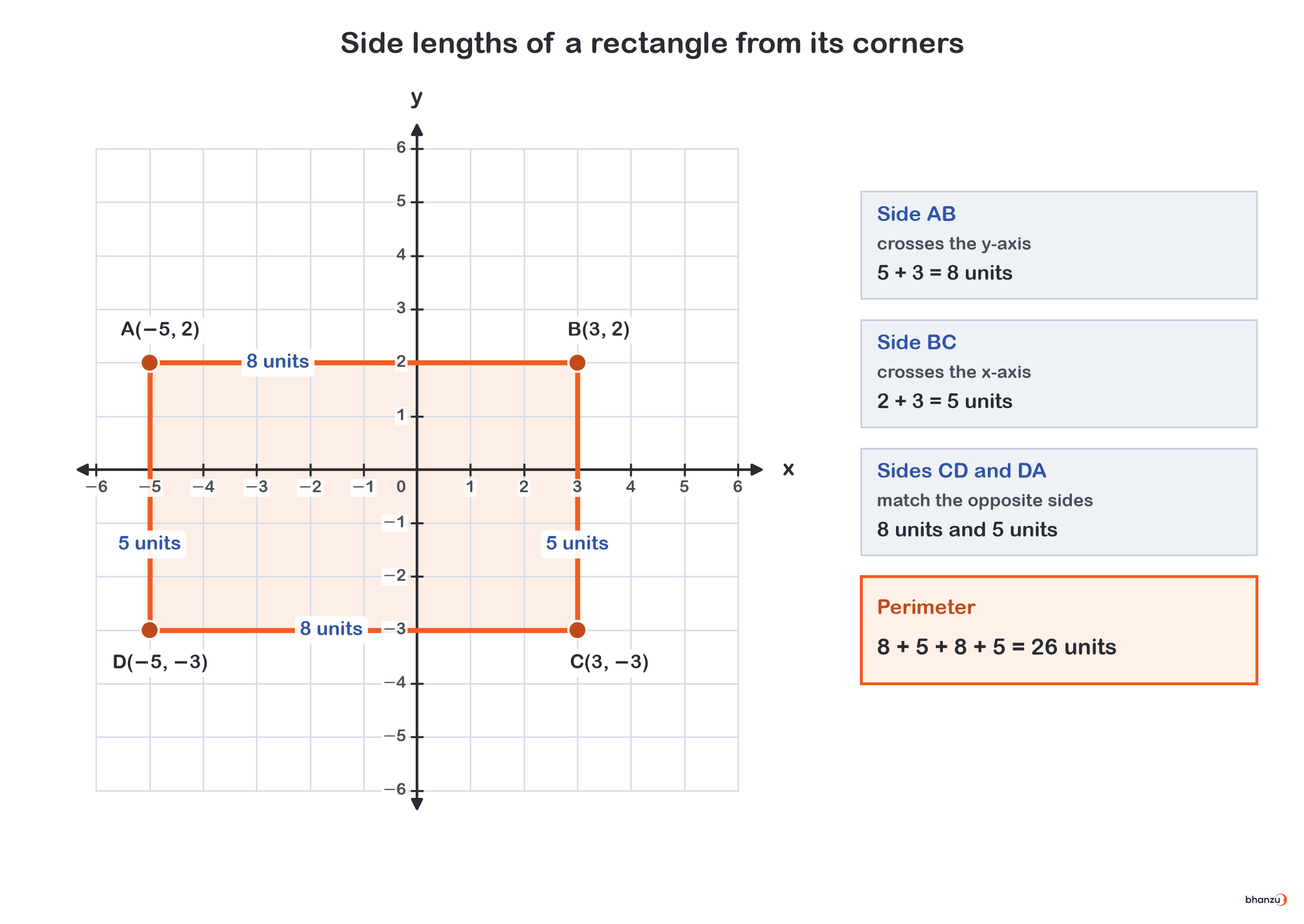
Draw the rectangle , , , and find its perimeter.
Join the points in order and close the shape.
Side crosses the y-axis, so it is units.
Side crosses the x-axis, so it is units.
Opposite sides of a rectangle match, so units and units.
The perimeter is 26 units.
Example 4
Three vertices of a rectangle are , and . Find the fourth vertex and the area.
The x-values , and need a second , and the y-values , and need a second .
The fourth vertex is .
The width is units and the height is units.
The area is 35 square units.
Example 5
Find the area of the triangle with vertices , and .
The base runs along from to , so .
The height runs along from to , so .
The base and height meet at a right angle at .
The area is 24 square units.
Example 6
A garden bed has corners at , , , , and , with 1 foot per grid unit. How much fencing goes around it, and how many square feet does it cover?
Going around from , the sides measure 9, 4, 5, 3, 4 and 7 feet.
Split the bed into a 9 by 4 rectangle and a 4 by 3 rectangle.
Check with a 9 by 7 box around the bed, minus the empty 5 by 3 corner.
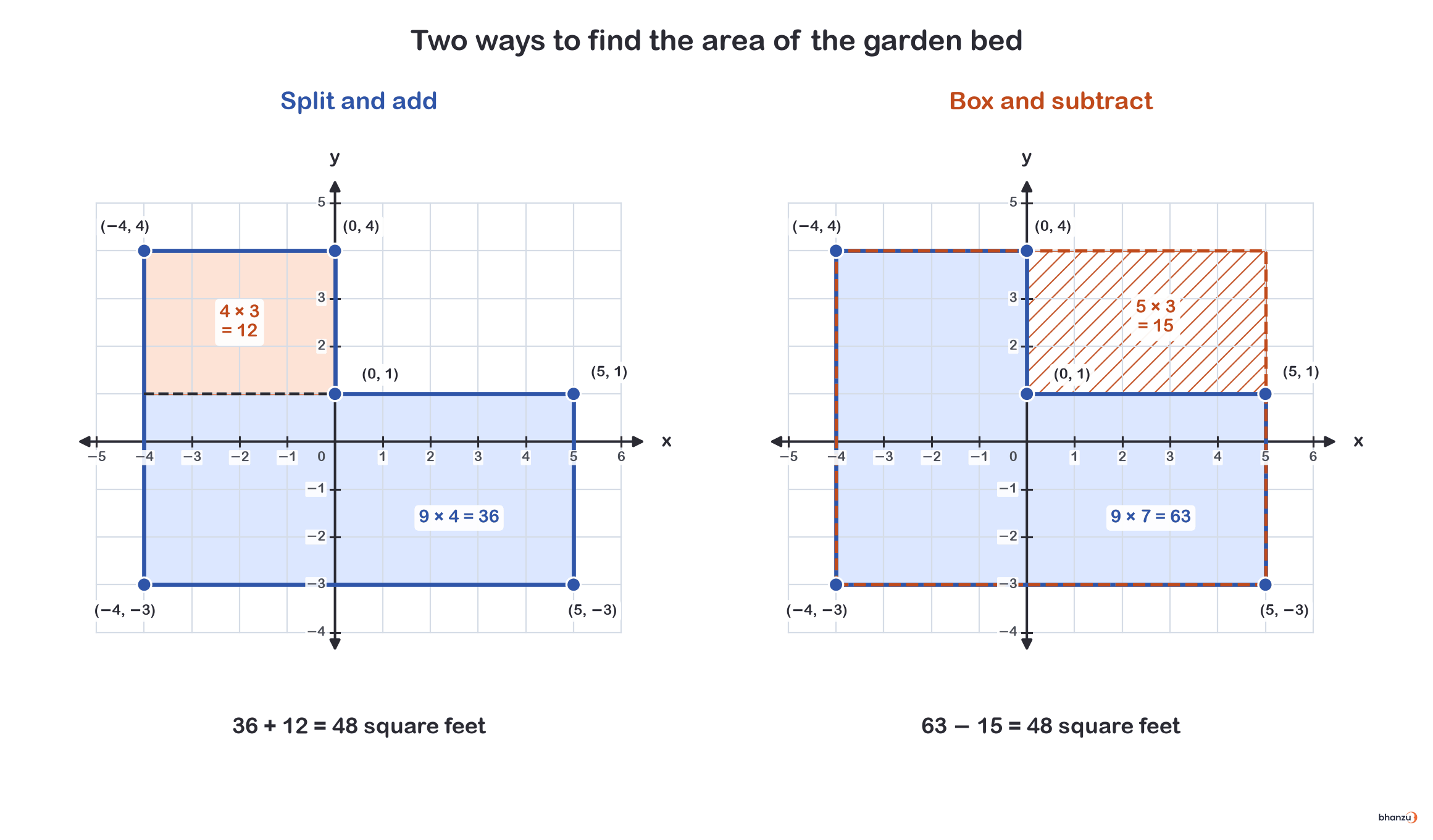
The garden bed needs 32 feet of fencing and covers 48 square feet.
Polygons on the coordinate plane beyond the textbook
A grid turns a place into numbers, so you can measure it from a plan without walking it with a tape measure. Exact coordinates give exact lengths, and exact lengths give exact perimeters and areas.
- It sizes up a fence or a garden bed. Perimeter says how much fencing to buy, and area says how much soil to order.
- It places things on a screen. Every character in a game has an x and a y, and sliding it left changes only its x-coordinate.
- It lets builders check a plan first. Floor plans on grids show rectangular and L-shaped rooms whose areas come from splitting and adding.
Grid reasoning keeps growing after 6th grade. The 2024 Nation's Report Card assessed 115,200 eighth graders in five content areas, geometry and measurement among them. One of its examples of eighth-grade work at the Advanced level is using midpoints to work out where points sit relative to each other on the coordinate plane.
What are the most common mistakes with polygons on the coordinate plane?
Mistake 1: Swapping x and y
Where it slips in: Plotting a vertex such as . Children often read the pair as "up, then across", because nothing in the two numbers says which comes first. Across first is a shared convention, so names the same point for every reader.
Don't do this: Plotting instead, 2 units left and 3 units up.
The correct way: Move 3 units right for , then 2 units down for . The point lands in quadrant IV.
Mistake 2: Joining the vertices out of order
Where it slips in: Drawing from a list such as , , and .
Don't do this: Joining to to to , so two sides cross and make a bow tie.
The correct way: Join to to to and back to . The result is a 6 by 5 rectangle with a perimeter of 22 units and an area of 30 square units.
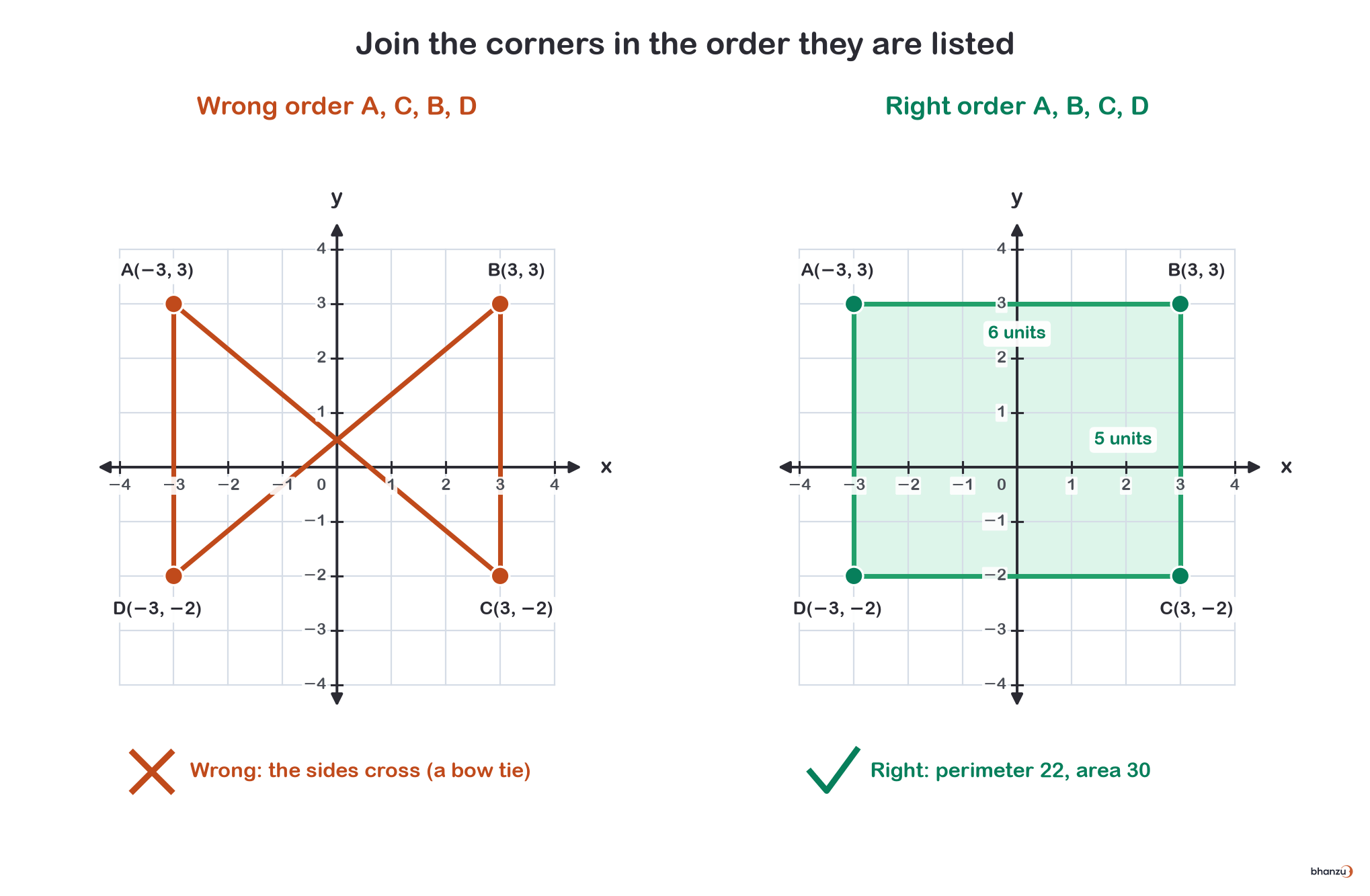
A child who rushes treats the list as dots to plot rather than a path to follow, so the letters stop mattering once the points are down.
Mistake 3: Using a slanted side as the height
Where it slips in: The area of a triangle such as , and .
Don't do this: Using the slanted side from to as the height.
The correct way: Measure straight down from to the x-axis, a height of 4 units. The area is square units.
The slanted side looks as if it goes up, which is why it tempts. Height meets the base at a right angle.
What most guides miss about polygons on the coordinate plane
Two things usually go missing.
Negative coordinates can feel like later-grade work, yet Common Core places all four quadrants in 6th grade under standard 6.NS.C.8, so a corner at is fair game this year.
Look up the area of a polygon from its coordinates and you'll soon meet the shoelace formula, a shortcut from later courses. Sixth grade area needs only subtracting coordinates, familiar formulas and splitting shapes. Keep the skill apart from ratios on the coordinate plane too, where plotted points line up along a line instead of closing into a shape.
Key Takeaways
- Read every ordered pair as across first, then up or down, before the pencil touches the grid.
- Find the shared coordinate first, because it tells you which way the side runs and which numbers to subtract.
- A side that crosses an axis needs its two distances from the axis added together.
- Polygons on the coordinate plane get their area from unit squares, so even an L-shape comes down to multiplying and adding.
- For more practice with sides that cross an axis and with finding a rectangle's missing corner, explore Bhanzu's 6th grade math curriculum or work with a geometry tutor.
Read More
- Inequalities on a Number Line
- Volume With Fractional Edge Lengths
- Area vs Perimeter
- Area of Triangle in Coordinate Geometry
- Types of Polygon
Research Behind This Article
- MacTutor, University of St Andrews, René Descartes (2014). mathshistory.st-andrews.ac.uk
- OpenStax, Prealgebra 2e, 11.1 Use the Rectangular Coordinate System (2020). openstax.org
- NGA Center and CCSSO, Common Core State Standards for Mathematics, Grade 6 Geometry (2010). thecorestandards.org
- NGA Center and CCSSO, Common Core State Standards for Mathematics, Grade 6 The Number System (2010). thecorestandards.org
- NASA, Landsat 9 (2026). science.nasa.gov
- National Center for Education Statistics, NAEP Mathematics: 2024 Results for Grades 4 and 8 (2025). nationsreportcard.gov
Quick Quiz: Check Yourself
Three levels, new points every time: a side in one quadrant, then a side across an axis or a missing corner, then a rectangle or L-shape's perimeter or area, or a right triangle's area.
Was this article helpful?
Your feedback helps us write better content
Frequently Asked Questions
How do you find distance on a coordinate plane?
Can you find the perimeter of a triangle on a coordinate plane?
How do you find a trapezoid's area on a coordinate plane?
How can I tell if my child is ready for polygons on the coordinate plane?
How can I help my child practice polygons on the coordinate plane at home?