How Many Lines of Symmetry a Rectangle Has
A rectangle has exactly 2 lines of symmetry. A line of symmetry is a straight line that divides a shape into two halves that are exact mirror images, so that folding along the line makes the halves land precisely on top of each other.
For a rectangle, the two lines are:
The vertical line through the midpoints of the top and bottom (the longer pair of sides), which splits the length in half.
The horizontal line through the midpoints of the left and right (the shorter pair of sides), which splits the width in half.
Fold along either of these centre lines and the two halves match perfectly. No other line through a rectangle does this — in particular, the diagonals do not. This is the single most important fact about rectangle symmetry, and the rest of the article explains why. It is one specific case of the broader idea of line symmetry.
Examples of Lines of Symmetry in a Rectangle
The examples move from confirming the two valid folds to testing the diagonal, contrasting with a square, and applying the idea on the coordinate plane.
Example 1
Confirm the vertical line of symmetry of a 6 cm by 4 cm rectangle.
Label the rectangle with cm (top and bottom) and cm (sides).
The vertical line passes through the midpoint of and the midpoint of .
Folding along it sends the left half onto the right half.
The left 3 cm of the top lands on the right 3 cm of the top, and the left side lands on the right side (both 4 cm).
The halves match, so the vertical centre line is a line of symmetry.
Example 2
Test whether a diagonal of the same rectangle is a line of symmetry.
A natural first instinct is that the diagonal should be a line of symmetry, because it cuts the rectangle into two triangles of equal area.
Fold along diagonal . The 6 cm side tries to land on the 4 cm side .
, so the edge overshoots.
The two triangles and are congruent, but they are rotations of each other, not reflections across .
The fold fails, so the diagonal is not a line of symmetry. Equal area is not the test — matching mirror halves is.
Example 3
Why does a square have 4 lines of symmetry but a rectangle only 2?
A square is a rectangle with all four sides equal. Repeat the diagonal fold on a square:
The side lengths are equal, so when you fold along a diagonal, each side lands exactly on the adjacent side.
Both diagonals now pass the fold test.
So a square gains its two diagonal lines of symmetry precisely because its sides are equal — the condition a non-square rectangle fails. A rectangle keeps only the vertical and horizontal centre lines. This is part of why the relationship "is a square a rectangle" matters: every square is a rectangle, but the extra equal-side condition gives it extra symmetry.
Example 4
A rectangle has corners at , , , and . Write the equations of its lines of symmetry.
The centre of the rectangle is the midpoint of the diagonal:
The vertical line of symmetry passes through , so its equation is .
The horizontal line of symmetry passes through , so its equation is .
These two lines cross at the centre , and reflecting the rectangle across either one maps it back onto itself.
Example 5
Identify the rotational symmetry of a rectangle.
Symmetry is not only about folding. Rotate a rectangle about its centre:
A turn of sends each corner to the opposite corner, and the rectangle looks identical.
A full turn of returns it to the start.
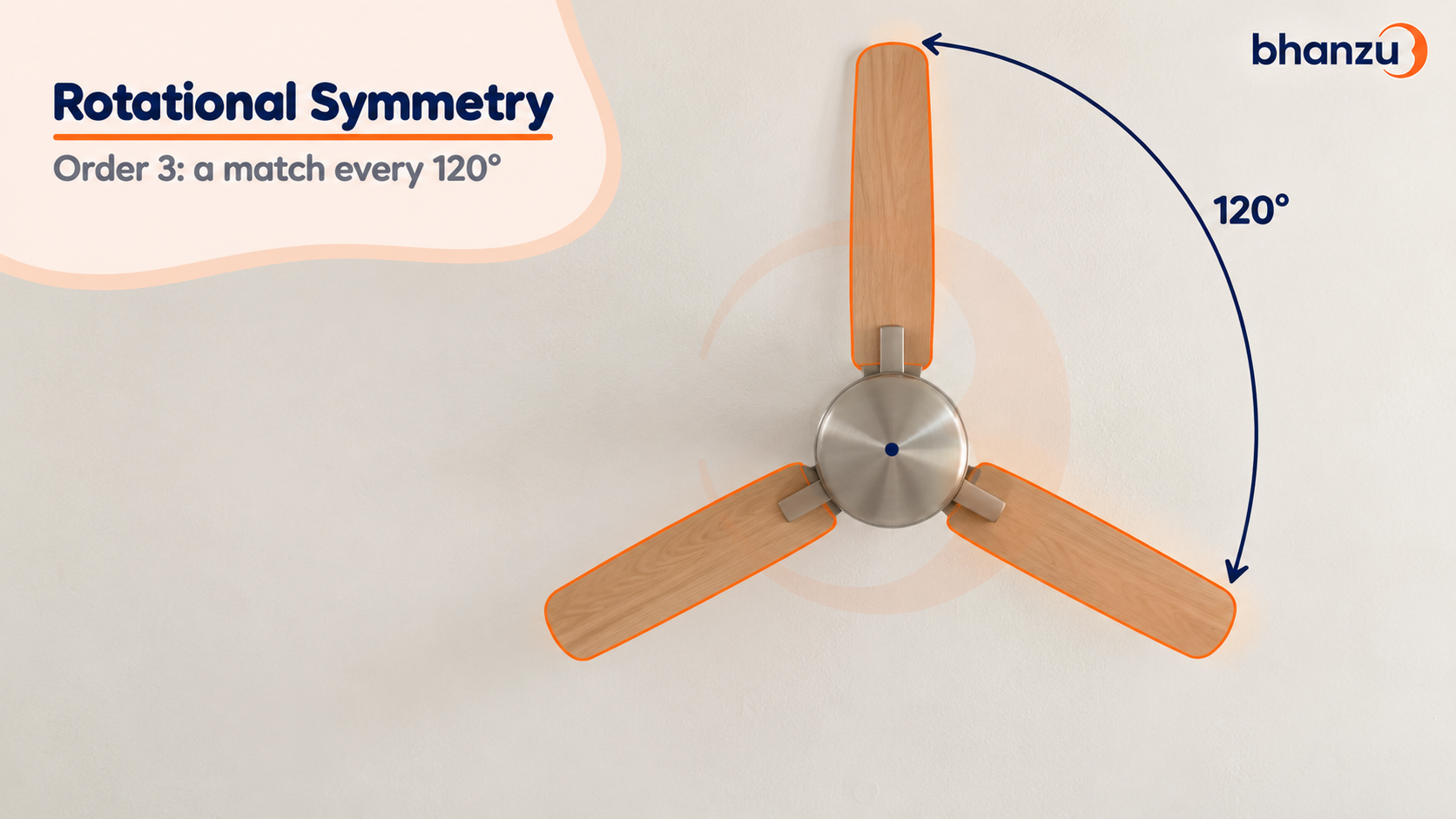
So a rectangle has rotational symmetry of order 2 — it matches itself twice in a full turn (at and ). A square, by contrast, has order 4. Rotational symmetry is a separate property from line symmetry; a rectangle has 2 of each.
Example 6
How many lines of symmetry does a rectangle with a length-to-width ratio of 2:1 have?
The ratio does not change the answer. As long as the figure is a rectangle that is not a square, the two side lengths differ, so:
The vertical and horizontal centre folds always match.
Both diagonal folds always fail.
The count is 2 lines of symmetry for every rectangle, whether the ratio is 2:1, 3:1, or 1.1:1. Only when the ratio reaches exactly 1:1 (a square) does the count jump to 4.
Why the Diagonal Fold Fails
The reason a rectangle stops at two lines of symmetry comes down to one structural fact: its adjacent sides have different lengths.
A line of symmetry requires that reflecting the shape across it produces the same shape. Reflection across the vertical centre line swaps left and right while keeping every length the same — the long sides stay long, the short sides stay short, and everything maps onto a matching part. The same holds for the horizontal centre line.
Reflection across a diagonal, however, would have to swap a long side with a short side. Because in our examples, that reflection sends an edge to a place where no matching edge exists. The shape cannot land on itself.
This is the same logic that separates a rectangle from a rhombus: a rhombus has all sides equal but unequal angles, so its diagonals are lines of symmetry while its centre lines are not — the mirror opposite situation. Knowing which property (equal sides or equal angles) a quadrilateral has tells you immediately where its mirror lines can be, which is why symmetry counting is a fast diagnostic across the whole family of quadrilaterals.
Common Mistakes With Rectangle Symmetry
Mistake 1: Counting the diagonals as lines of symmetry
Where it slips in: Whenever a student treats a rectangle like a square.
Don't do this: Writing "a rectangle has 4 lines of symmetry" by including both diagonals.
The correct way: Fold-test each diagonal. The unequal side lengths make the halves overshoot, so each diagonal fails. The correct count is 2 — the vertical and horizontal centre lines only.
Mistake 2: Mixing up lines of symmetry with diagonals
Where it slips in: A rectangle has 2 diagonals and 2 lines of symmetry, and the memorizer who learns "two" without the reasoning swaps them.
Don't do this: Drawing the diagonals when asked for the lines of symmetry. They are different lines: the diagonals run corner to corner; the lines of symmetry run midpoint to midpoint of opposite sides.
The correct way: Lines of symmetry connect the midpoints of opposite sides. Mark the midpoints first, then draw the vertical and horizontal lines between them.
Mistake 3: Confusing line symmetry with rotational symmetry
Where it slips in: Questions that ask for "the symmetry of a rectangle" without specifying which kind; the second-guesser reports one number and assumes it answers both.
Don't do this: Answering "2" and assuming it covers both lines and rotations without saying which.
The correct way: State both. A rectangle has 2 lines of symmetry (line/reflection symmetry) and rotational symmetry of order 2 ( and ). They are separate properties that happen to share the number 2 here.
Key Takeaways
A rectangle has exactly 2 lines of symmetry: the vertical and horizontal lines through the midpoints of opposite sides.
The diagonals are not lines of symmetry, because the rectangle's unequal side lengths make a diagonal fold overshoot.
A square has 4 lines of symmetry; the extra two are its diagonals, which only work because all its sides are equal.
A rectangle also has rotational symmetry of order 2 ( and ) — a separate property from its line symmetry.
The lines of symmetry on the coordinate plane are (centre x-value) and (centre y-value).
To work through symmetry and the wider family of quadrilaterals with a teacher, explore Bhanzu's geometry tutor, our elementary math tutor program, or math classes online.
A Practical Next Step
Work through the exercises below, drawing each shape and fold-testing every candidate line:
A rectangle 10 cm by 2 cm — how many lines of symmetry? (Answer to Question 1: 2.)
A square 5 cm by 5 cm — how many lines of symmetry? (Answer to Question 2: 4.)
A rectangle with corners , , , — write its lines of symmetry. (Answer to Question 3: and .)
If the diagonal question still feels uncertain, return to Example 2 and the "Why the diagonal fold fails" section. Want a live trainer to check your folds and reasoning? Try a free Bhanzu class.
Read More
Symmetry in Geometry — line and rotational symmetry together.
Properties of a Rectangle — sides, angles, and diagonals in full.
Difference Between a Square and a Rectangle — equal sides versus right angles.
Diagonal of Rhombus — why a rhombus's diagonals are its lines of symmetry.
Hexagon Shape — a six-line-of-symmetry regular polygon.
Was this article helpful?
Your feedback helps us write better content
Frequently Asked Questions
How many lines of symmetry does a rectangle have?
Why are the diagonals of a rectangle not lines of symmetry?
Does a rectangle have rotational symmetry?
How is a square different from a rectangle for symmetry?
Where are the lines of symmetry on a rectangle drawn?