Key Points
- Equations of proportional relationships always have the shape , so doubling doubles , and an of 0 gives a of 0.
- To find , divide any value by its matching value, then check that every other pair gives the same quotient.
- A taxi fare of $3 to start plus $2 per mile is not proportional, because its values for 1, 2 and 4 miles are 5, 3.5 and 2.75.
- Common Core places writing in 7th grade, and swapping which quantity is turns into its reciprocal, such as 4 and one fourth.
One number runs the whole gas pump
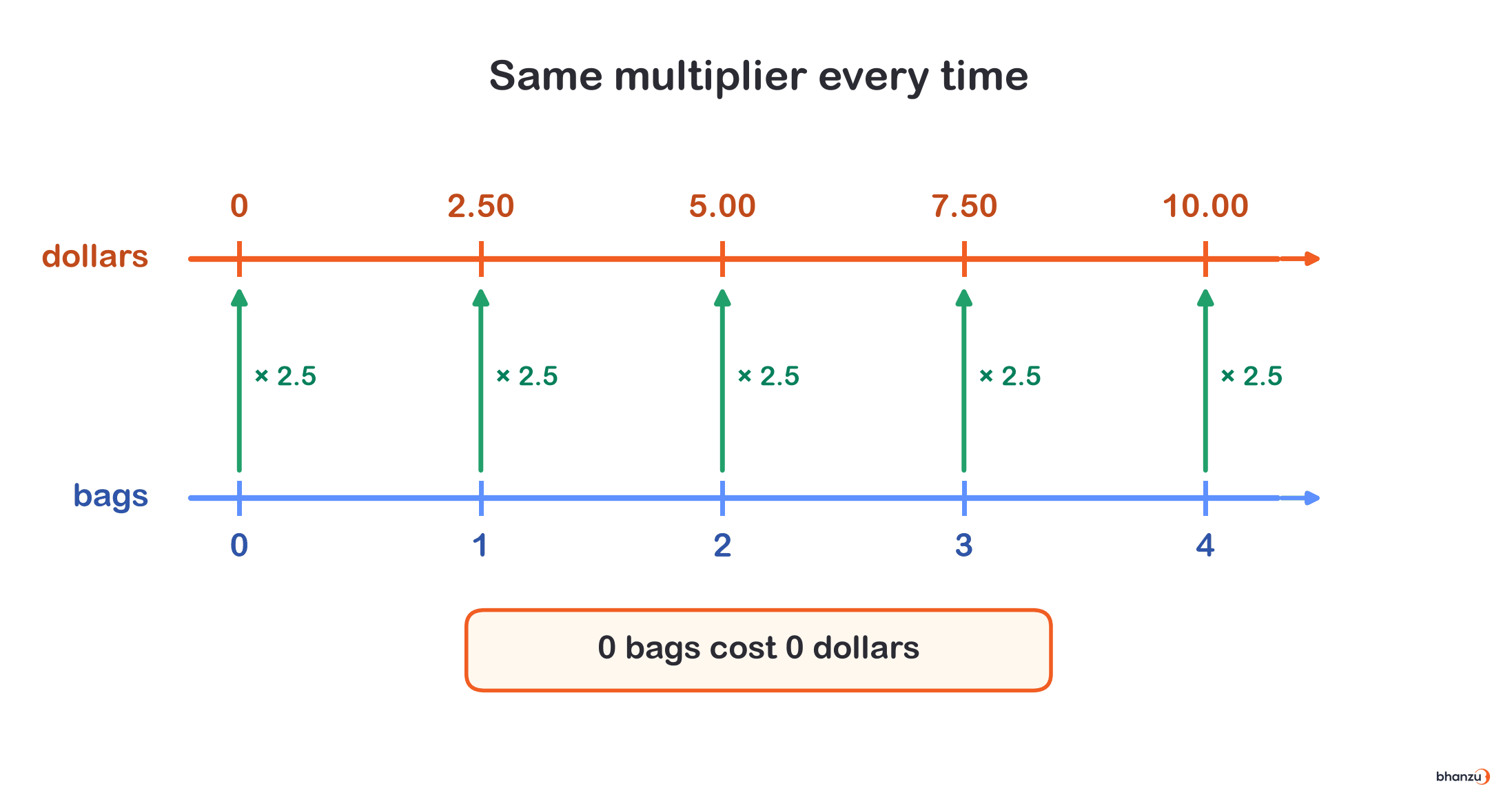
A gas pump multiplies by one number for every gallon it pours. Pump 2 gallons and the screen shows twice the price of 1. Pump 10 and it shows ten times as much, with no start fee added (unlike a taxi meter).
A popcorn stand with one price per bag runs on the same rule, and so does a faucet that pours the same amount every minute. Spot that single multiplier, and one short equation answers every question about the situation, forward and backward.
Mapmakers use one scale number to turn centimeters on paper into kilometers on the ground. Bakers use a single multiplier to stretch a 12-cookie recipe to 120, and electricians use Ohm's law to get the voltage across a resistor from the current flowing through it.
What is the equation of a proportional relationship?
Equations of proportional relationships say that equals one fixed number times , every time, written . Here and are variables (quantities that change together), and is a constant, a number that stays put. That number is the constant of proportionality, also called the unit rate, the value of when is 1.
| Symbol | Meaning | Units at a gas pump |
|---|---|---|
| the total cost | dollars | |
| the constant of proportionality, the price of 1 gallon | dollars per gallon | |
| the number of gallons | gallons |
The formula works because every gets multiplied by the same number, and 1 times that number is the number itself. In the week of November 16, 2026, the US average price of regular gasoline was $3.805 a gallon, according to the US Energy Information Administration. That week a pump ran on , with the cost and the gallons, and the price changes weekly while the shape of the equation stays the same.
This skill is Common Core standard 7.RP.A.2c, which asks 7th graders to write proportional relationships as equations, such as total cost for items at price . By the end of 7th grade, your child should be able to build from a table, a graph or a sentence and use it to find a missing amount in either direction. In Algebra 1 the same equation returns as direct variation, which the OpenStax textbook Elementary Algebra 2e defines with .
How do you find k from a table, a graph or a description?
To write an equation for a proportional relationship, divide a value by the value it is paired with, and the quotient is . Every form of a proportional relationship hides that same number.
| Where it comes from | How to read | Popcorn at $2.50 a bag |
|---|---|---|
| A description | the number after "per", "each" or "for every" | "$2.50 per bag" gives 2.5 |
| A table | divide by in any row | |
| A graph | read at , or divide at any point except (0, 0) | the point (1, 2.5) |
- Say in words which quantity is and which is , such as bags and dollars.
- Divide one value by its matching value. In ratio tables, any row works.
- Check that every other pair gives the same quotient and that 0 of gives 0 of . If either check fails, stop, because no equation fits.
- Write with your number in place of .
- Substitute one pair back in to confirm it.
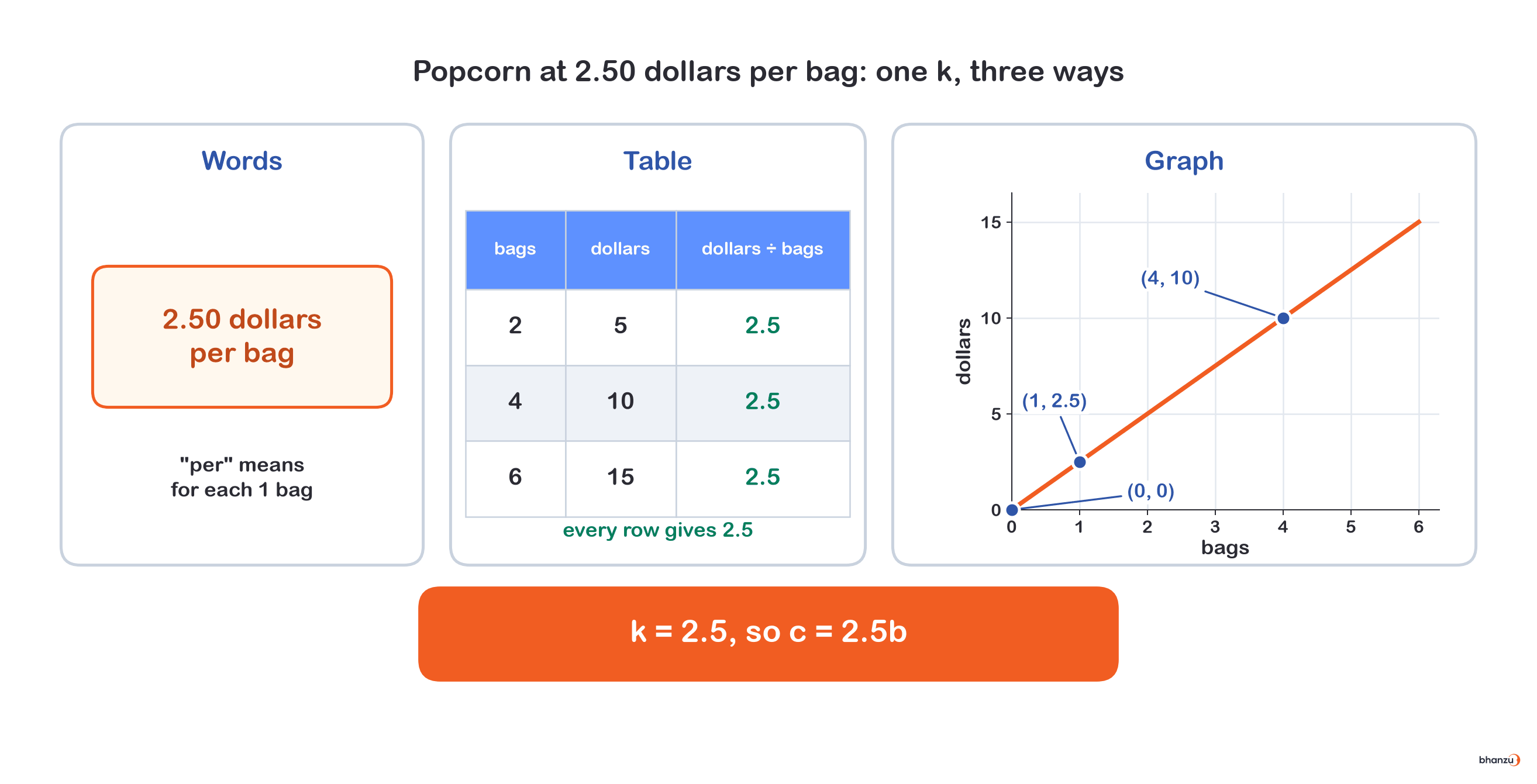
On a graph, a proportional relationship is a straight line through (0, 0), the origin, as graphs of proportional relationships explains. The origin is the one point that cannot give , because has no value.
A child who finds 2.5 in the first row often writes the equation at once and never divides the second row, which is how a hidden start fee slips past. The Institute of Education Sciences practice guide on fractions recommends visual tools such as ratio tables for this work. It reports that students tend to build ratios up by adding before they see the multiplying pattern.
Try It Yourself
Drag the k slider and watch every y value in the table change by the same multiplier while the line keeps passing through (0, 0). Then raise the start amount and see the row stop matching and the line leave the origin, which means the relationship is no longer proportional. Press Reset to return to k = 2.5 with no start amount.
Which quantity is x and which is y?
The quantity you know or choose is , the independent variable, and the quantity that depends on it is . The question decides which is which.
A faucet fills 8 gallons in 2 minutes. With minutes as , gallons per minute, but with gallons as , minute per gallon. Swapping the letters turns into its reciprocal (the number you multiply by to get 1).
| The question asks for | Equation to use | What means |
|---|---|---|
| gallons after 5 minutes | , so 20 gallons | 4 gallons per minute |
| minutes to fill a 30-gallon tub | , so 7.5 minutes | one fourth of a minute per gallon |
This part confuses plenty of adults, because two different equations are both correct for one faucet. Neither one is wrong. Pick the one whose is the thing the question asks for.
How do you use y = kx to solve problems?
Put the number you know in its place and solve for the other one. To find , multiply by . To find , divide both sides by .
| Words in the problem | Math it means |
|---|---|
| "$2.50 per bag" or "each bag costs $2.50" | |
| "the total cost" | , written here as |
| "costs" or "is" | |
| "how many bags can $20 buy" | solve for |
For the popcorn stand, let be the cost in dollars and the number of bags.
Nine bags cost , so $22.50. To work backward from $20, substitute 20 for .
Divide both sides by 2.5.
Examples of equations of proportional relationships
Example 1
Smoothies cost $4 each. Write an equation for the total cost of smoothies.
The word "each" gives the price of 1 smoothie, so .
As a check, three smoothies cost dollars.
Example 2
Working 2, 3 and 5 hours earns $27, $40.50 and $67.50. Write an equation for the pay after hours.
Divide each pay by its hours.
Every row gives 13.5, so the relationship is proportional and .
Example 3
A recipe table pairs 3, 5 and 8 cups of flour with 24, 40 and 64 cookies. Write an equation for cookies from cups .
The tempting move is to compare the first row by subtracting. It has 24 cookies and 3 cups, a difference of 21, so the rule looks like .
That rule fits row one and nothing else. For 5 cups it predicts cookies, but the table says 40. For 0 cups it promises 21 cookies made from no flour at all.
Divide instead of subtracting.
Row two agrees, since .
Example 4
A proportional graph passes through (0, 0) and (8, 6). Write its equation and find when .
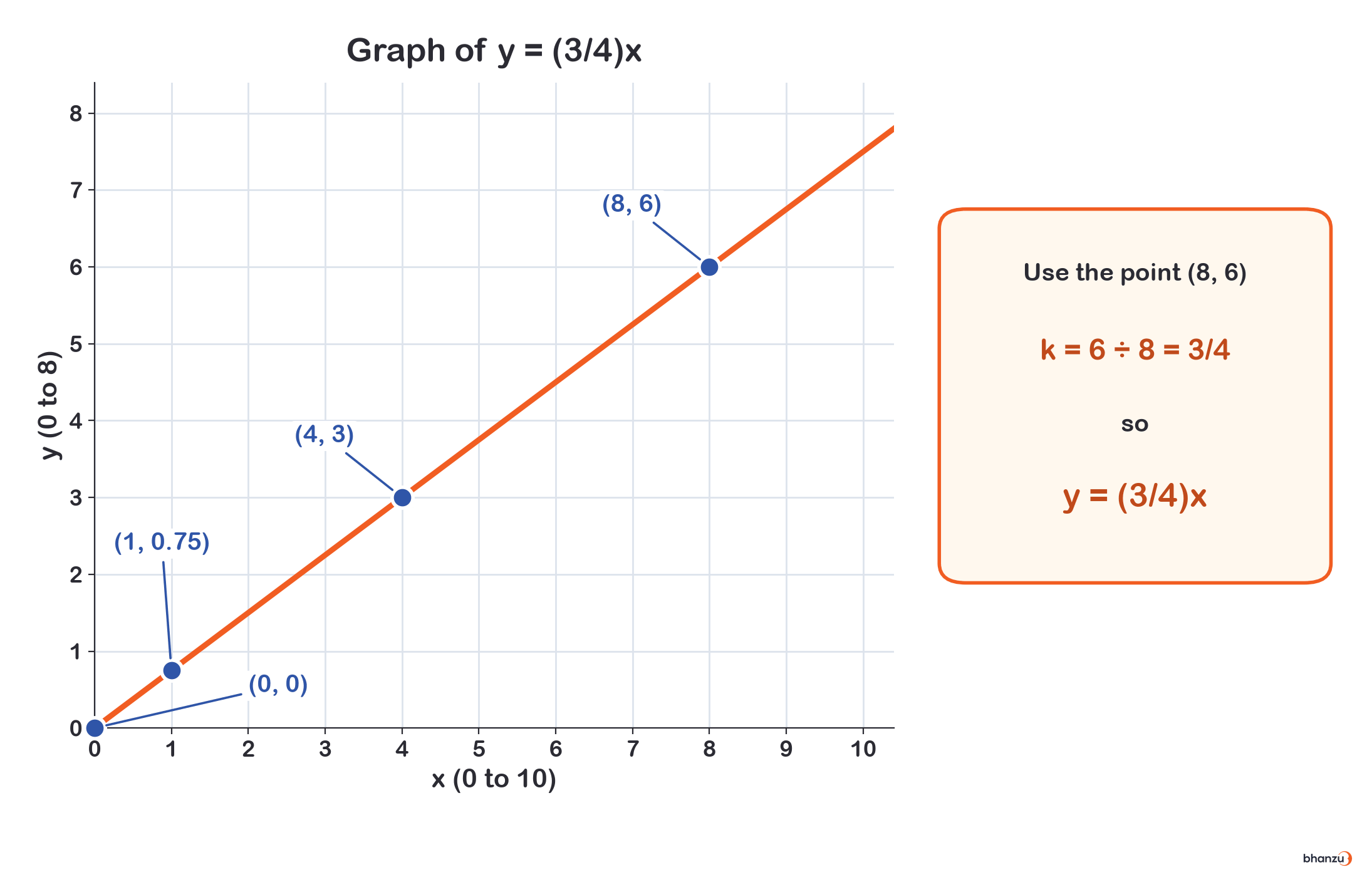
When , .
Example 5
Regular gas cost $3.805 a gallon in the week of November 16, 2026. How many gallons does $45.66 buy?
Let be the number of gallons and the cost in dollars.
Divide both sides by 3.805.
The $45.66 buys 12 gallons, and confirms it.
Example 6
Shop A rents bikes at a price proportional to time, $18 for 3 hours. Shop B charges $5 an hour plus a $6 helmet fee. Which shop is cheaper for 5 hours, and is Shop B proportional?
For Shop A, , so .
Five hours at Shop A cost dollars.
Five hours at Shop B cost dollars.
Shop A is cheaper by $1. Shop B is not proportional, because 3 hours there cost $21 and , while . Zero hours at Shop B would still cost the $6 fee.
What makes y = kx worth learning?
One short equation replaces a table that never ends and answers questions in both directions, which is why 7th grade trades long ratio tables for .
- It prices any amount without new work. The popcorn rule handles 1 bag or 1,000 bags.
- It makes exact conversions possible. Since July 1, 1959, one inch has been exactly 2.54 centimeters, as the National Institute of Standards and Technology records, so turns a 60-inch height into (no rounding needed).
- It runs backward as easily as forward. Divide both sides of by 2.54, and 254 centimeters becomes 100 inches.
- It sets up 8th grade, where becomes the slope of a line and students start comparing proportional relationships given in different forms.
- It is a skill many 8th graders are still building. In the 2024 NAEP mathematics results, 28 percent of eighth graders performed at or above NAEP Proficient and 39 percent scored below NAEP Basic, 8 points more than in 2019.
Each use comes from the same move. Find what 1 of is worth, then let that number do the multiplying.
The part of proportional equations nobody explains
The constant is a rate with units, and three useful facts follow from that.
- The units set the order of division. "Dollars per bag" means dollars divided by bags, so popcorn gives , while bags per dollar would be .
- Zero always gives zero. A table can leave out its 0 row, but every time, so asking what 0 of would cost exposes any start fee in one quick step.
- One equation beats one proportion. A proportion such as finds one missing value, while finds every missing value in the relationship.
Proportional equations: spot the trap before you fall in
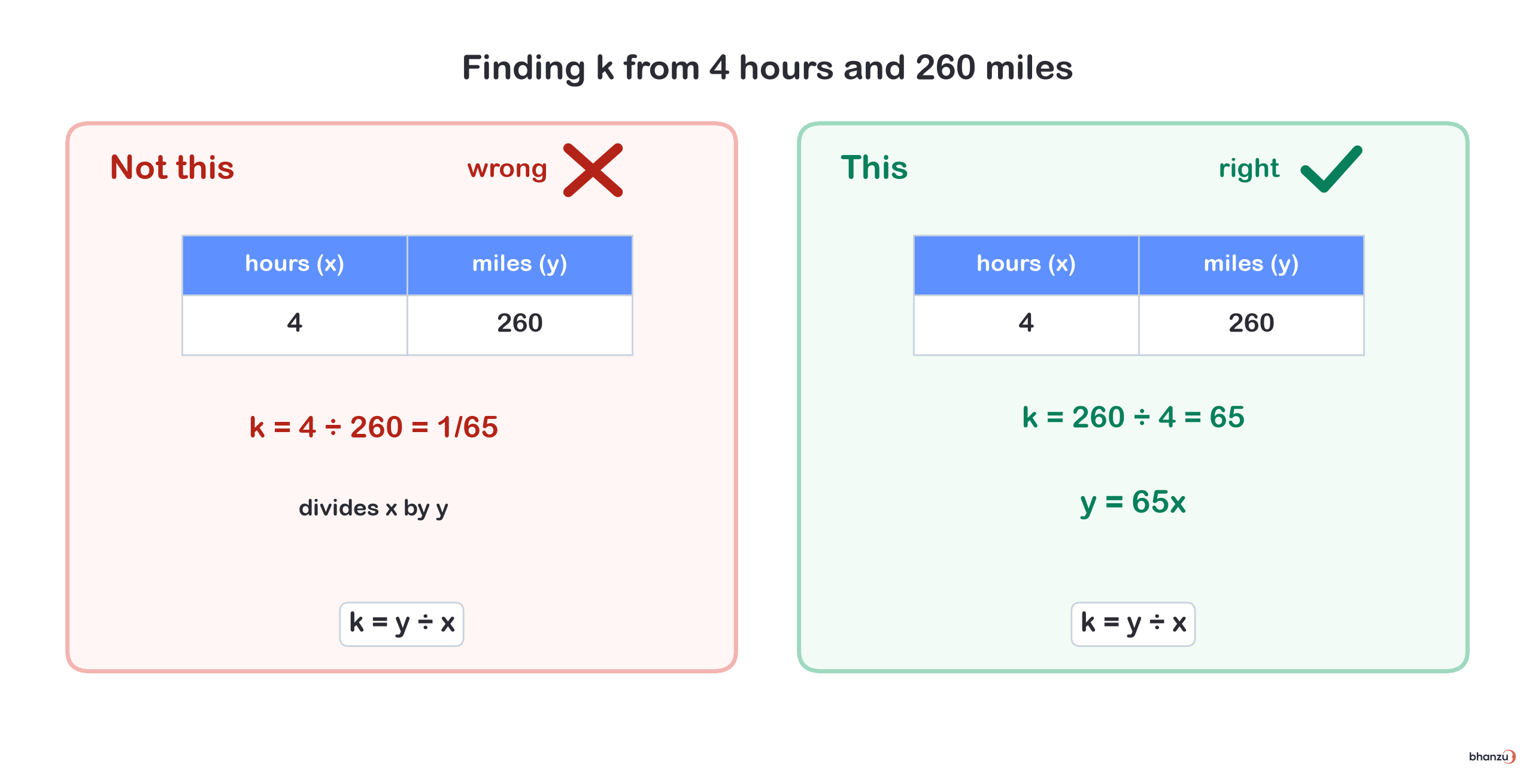
Mistake 1: Dividing x by y to find k
Where it slips in: Reading from a table of 4 hours and 260 miles, because the eye moves left to right and divides the first column by the second.
Don't do this: , so , which claims a 4-hour drive covers of a mile.
The correct way: , so , which is 65 miles per hour.
The wrong answer looks tidy, and a child who gets a clean number tends to trust it without reading it back as 65 miles each hour.
Mistake 2: Writing the units as the equation
Where it slips in: Turning "Maya reads 12 pages every 20 minutes" into symbols, because children copy the sentence order and let the letters stand for the words instead of for numbers.
Don't do this: .
The correct way: Let be the number of pages and the number of minutes. Then pages per minute, so , and 45 minutes gives pages.
Mistake 3: Calling a start fee proportional
Where it slips in: A taxi charges $3 to start plus $2 per mile, so 1, 2 and 4 miles cost $5, $7 and $11. Both columns grow together and the first row gives , so it feels proportional.
Don't do this: , which predicts $20 for 4 miles instead of $11.
The correct way: Divide every row to get 5, 3.5 and 2.75. The quotients change, and 0 miles still costs $3, so no equation fits. The fare follows , a non-proportional relationship equation that 8th grade calls slope-intercept form.
Key Takeaways
- Ask what 1 of is worth in , and that number is .
- Divide every row of a table before you trust the first quotient.
- Before writing equations of proportional relationships, ask what 0 of would cost, because any answer other than 0 means a start fee.
- Decide what the question asks for first, then let that quantity be .
- To practice checking every row before trusting , with a teacher who catches the start-fee trap, explore Bhanzu's 7th grade math curriculum or an algebra tutor.
Read More
- Simple Interest
- Ratios on the Coordinate Plane
- Equivalent Ratios
- Double Number Lines
- Slope of a Line
- What Is a Ratio
Research Behind This Article
- US Energy Information Administration, Gasoline and Diesel Fuel Update (2026). eia.gov
- NGA Center and CCSSO, Common Core State Standards for Mathematics, Grade 7, Ratios and Proportional Relationships (2010). thecorestandards.org
- OpenStax, Elementary Algebra 2e, Section 8.9, Use Direct and Inverse Variation (2020). openstax.org
- Institute of Education Sciences, What Works Clearinghouse, Developing Effective Fractions Instruction for Kindergarten Through 8th Grade (2010). ies.ed.gov
- National Institute of Standards and Technology, SI Units: Length (2025). nist.gov
- National Center for Education Statistics, The Nation's Report Card: 2024 Mathematics Assessment, Grades 4 and 8 (2025). nationsreportcard.gov
Quick Quiz: Check Yourself
Three levels, new numbers every time: find k from a table and price tickets, then find a fraction k or use a graph point, then work backward from a total and compare two shops.
Was this article helpful?
Your feedback helps us write better content
Frequently Asked Questions
Is the constant of proportionality the same as the unit rate?
Is the constant of proportionality the slope?
Can the constant of proportionality be 0?
Can a proportional relationship have negative numbers?
What do 7th graders learn about proportional relationships?
How do you teach proportional relationships at home?