What Is the Slope of Parallel Lines?
Two lines are parallel when they lie in the same plane and never intersect, no matter how far they are extended. The slope of a line is its steepness, written as the ratio rise over run, . Put those two ideas together and you get the core fact: parallel lines have equal slopes, so .
The reasoning is short. Slope measures the angle a line makes with the horizontal, and parallel lines make the same angle with the horizontal, which keeps them from ever crossing, so they must carry the same slope. The relationship runs both ways: equal slopes (with different y-intercepts) guarantee the lines are parallel, and parallel lines guarantee equal slopes. This sits right beside the slope of perpendicular lines, where the slopes instead multiply to .
How to Find the Slope of a Parallel Line
When a problem hands you one line and asks for a line parallel to it, you do not compute anything new for the slope. You copy it.
Find the slope of the given line. If it is in slope-intercept form , the slope is the coefficient . If it is in standard form , rearrange to first.
The parallel line has the same slope.
Use any extra information (a point the new line passes through) to pin down its y-intercept, not its slope.
The given point never changes the slope. It only fixes which of the many parallel lines you want.
The Derivation: Why m₁ = m₂
The formula for the angle between two lines with slopes and is:
Parallel lines never meet, so the angle between them is . Substituting gives , which forces the numerator to vanish:
The angle formula uses , the tangent ratio from trigonometry; here all that matters is that . So "equal slopes" is not a rule to memorise on faith. It falls straight out of the angle between two lines being zero.
Examples of the Slope of Parallel Lines
With the rule and its derivation in place, here is the concept doing real work. The problems build from reading a slope off an equation up to proving two given lines are parallel.
Example 1
Find the slope of any line parallel to .
The line is in slope-intercept form with . A parallel line has the same slope.
Final answer: slope .
Example 2
Find the slope of a line parallel to .
A common first move is to read the slope straight off as (the coefficient of ) or as the constant. Test that by the definition: the slope is only visible once the equation is solved for . Solving, , so , giving a slope of , not . The slip is reading a coefficient off standard form without rearranging first.
Done correctly:
A parallel line copies this slope.
Final answer: slope .
Example 3
Are the lines and parallel?
Read the first slope: . Rearrange the second: , so , giving . The slopes are equal and the y-intercepts differ ( versus ), so the lines are parallel.
Final answer: yes, both have slope .
Example 4
Find the equation of the line through parallel to .
The parallel line has slope . Use point-slope form with the point :
The point fixed the y-intercept at ; the slope came entirely from the parallel line.
Final answer: .
Example 5
Two horizontal lines are and . Are they parallel, and what is their slope?
Every horizontal line has slope , since the y-coordinate never changes. Both lines have slope and different heights, so they are parallel.
Final answer: parallel, each with slope .
Example 6
A line passes through and . A second line passes through and . Are they parallel?
First slope: . Second slope: . Equal slopes, so the lines are parallel.
Final answer: yes, both have slope .
Why Equal Slopes Matter Beyond the Worksheet
The "same tilt holds them apart" idea is doing quiet work all around you, well past a geometry page.
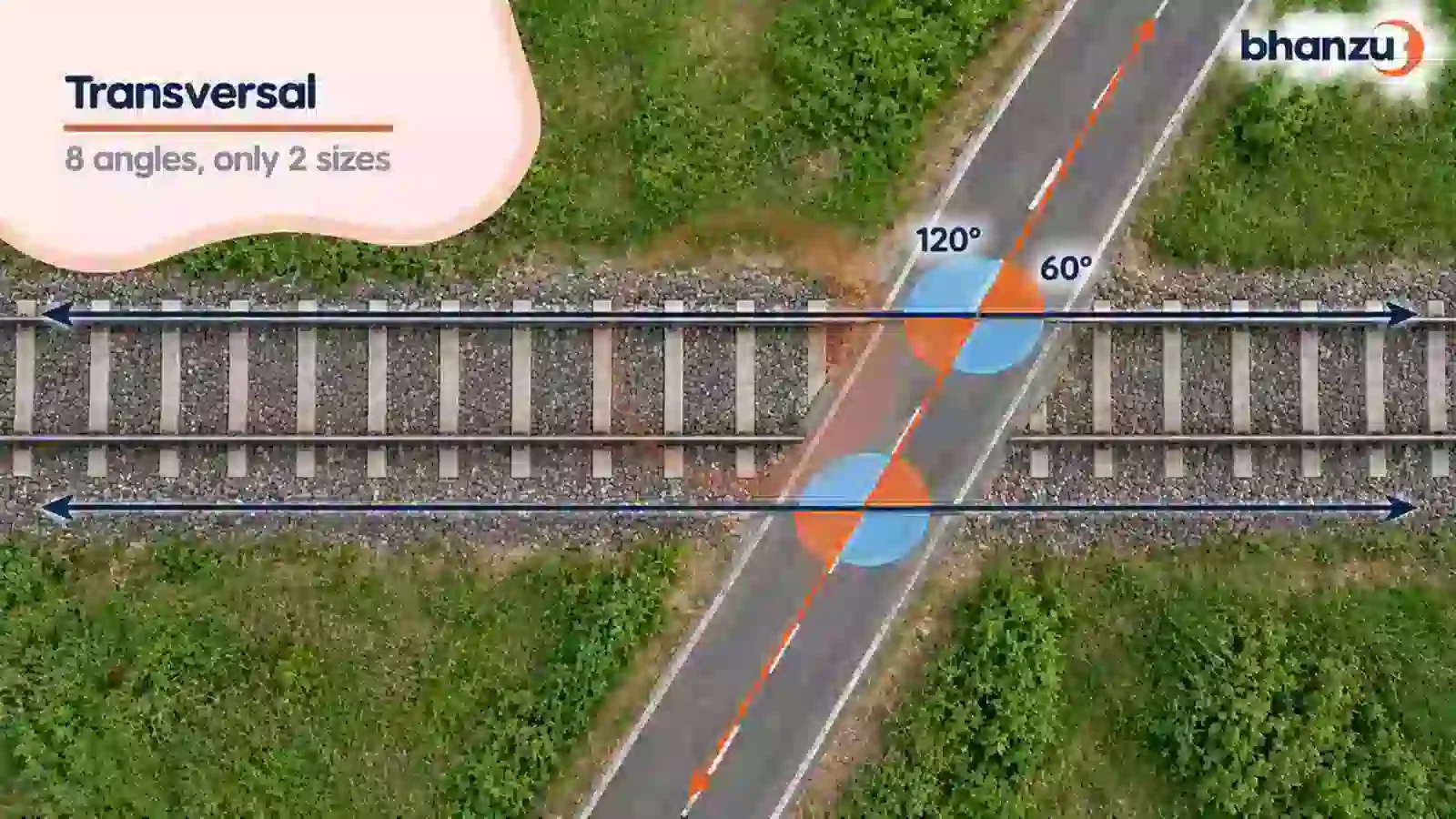
Rail and road design. Two rails, or the two edges of a highway lane, must hold equal slope so the gap between them stays constant; a slope mismatch narrows or widens the path.
Architecture and drafting. Parallel beams, parallel floors, and the parallel lines of a perspective drawing all rely on matched slope to read as parallel to the eye.
Computer graphics. A renderer testing whether two edges are parallel compares their slopes directly — equal slope is a fast parallelism check that avoids extending the lines.
Economics. Two cost lines with the same per-unit rate have equal slope; they stay a fixed amount apart, so one option never catches the other.
The destination this points toward is vectors: two line segments are parallel exactly when their direction vectors are scalar multiples of each other, which is the same equal-slope idea written in a form that also works in three dimensions. The coordinate framework underneath all of it traces back to René Descartes, who in 1637 married algebra to geometry so that a line's tilt could be read as a single number.
Where Students Trip Up on the Slope of Parallel Lines
Mistake 1: Reading the slope off standard form without rearranging
Where it slips in: A line is given as , and the student calls (or the constant ) the slope.
Don't do this: Treat the coefficient of in standard form as the slope directly.
The correct way: Solve for first. For , the slope is , not .
Mistake 2: Confusing parallel with perpendicular
Where it slips in: A problem asks for a parallel line, and the rusher reaches for the perpendicular rule out of habit.
Don't do this: Take the negative reciprocal of the slope for a parallel line.
The correct way: Parallel lines have equal slopes, . The negative reciprocal () belongs to perpendicular lines. The memorizer who learned both rules in the same lesson swaps them most often.
Mistake 3: Calling identical (coincident) lines "parallel"
Where it slips in: Two equations turn out to have the same slope and the same y-intercept.
Don't do this: Report them as parallel.
The correct way: Parallel lines need equal slopes but different y-intercepts. Same slope and same intercept means the two equations describe the same line — coincident, not parallel. Check the intercept after you check the slope.
Key Takeaways
The slope of parallel lines is equal: if two lines are parallel, then .
Equal slopes with different y-intercepts mean parallel; equal slopes with the same intercept mean the lines are identical.
To find a parallel line, copy the slope and use a given point to fix the new y-intercept.
The rule is derived from the angle-between-lines formula with — it is not an arbitrary fact.
The most common mistake is reading a slope off standard form without first solving for .
Practice These Problems to Solidify Your Understanding
Find the slope of any line parallel to .
Are the lines and parallel? Justify with their slopes.
Find the equation of the line through parallel to .
Answer to Question 1: slope . Answer to Question 2: yes; the first rearranges to , so both have slope with different intercepts. Answer to Question 3: . If Question 2 looked unequal, check that you solved the first equation for before reading its slope (see Mistake 1).
Want a live Bhanzu trainer to walk your child through slopes and parallel lines? Book a free demo class — online globally.
Was this article helpful?
Your feedback helps us write better content