What Is the Angle Sum Property?
The angle sum property is the rule that the interior angles of a polygon add up to a fixed total determined only by the number of sides. The three headline cases are:
Triangle (3 sides): the interior angles sum to 180°.
Quadrilateral (4 sides): the interior angles sum to 360°.
Polygon ( sides): the interior angles sum to .
An interior angle is the angle formed inside the figure at each vertex. The property holds for every triangle without exception, and for every convex polygon; it also holds for simple (non-self-intersecting) concave polygons. It is one of the most reused facts in geometry because it lets you find a missing angle from the ones you already know. The triangle case is important enough to have its own name, the triangle sum theorem, and the general polygon case is developed further under the sum of angles in a polygon.
Why Do the Angles of Every Triangle Add to the Same Number?
Cut any triangle out of paper, tear off its three corners, and place them tip to tip: they always form a straight line.
That straight line is 180°, and it is the same for a scrawny sliver of a triangle or a fat near-equilateral one. The angle sum property is the rule that fixes this total, and it does not stop at triangles. Every closed straight-sided figure has an interior-angle sum you can predict from the number of sides alone, without measuring a single angle. Once you see why the triangle locks at 180°, the quadrilateral's 360° and the polygon's fall out of the same one idea.
What Is the Angle Sum Formula for a Polygon?
For a polygon with sides, the sum of the interior angles is:
Here is what each part means:
- the total of all interior angles of the polygon, in degrees.
- the number of sides (equal to the number of vertices).
- the number of triangles the polygon splits into when you draw all diagonals from one vertex.
- the angle sum of each of those triangles.
The formula reads as a sentence: break the polygon into triangles, and each triangle contributes 180°. Substituting values gives the familiar totals below.
Polygon | Sides | Triangles | Interior-angle sum |
|---|---|---|---|
Triangle | 3 | 1 | 180° |
Quadrilateral | 4 | 2 | 360° |
Pentagon | 5 | 3 | 540° |
Hexagon | 6 | 4 | 720° |
Octagon | 8 | 6 | 1080° |
How Do You Prove the Angle Sum Property of a Triangle?
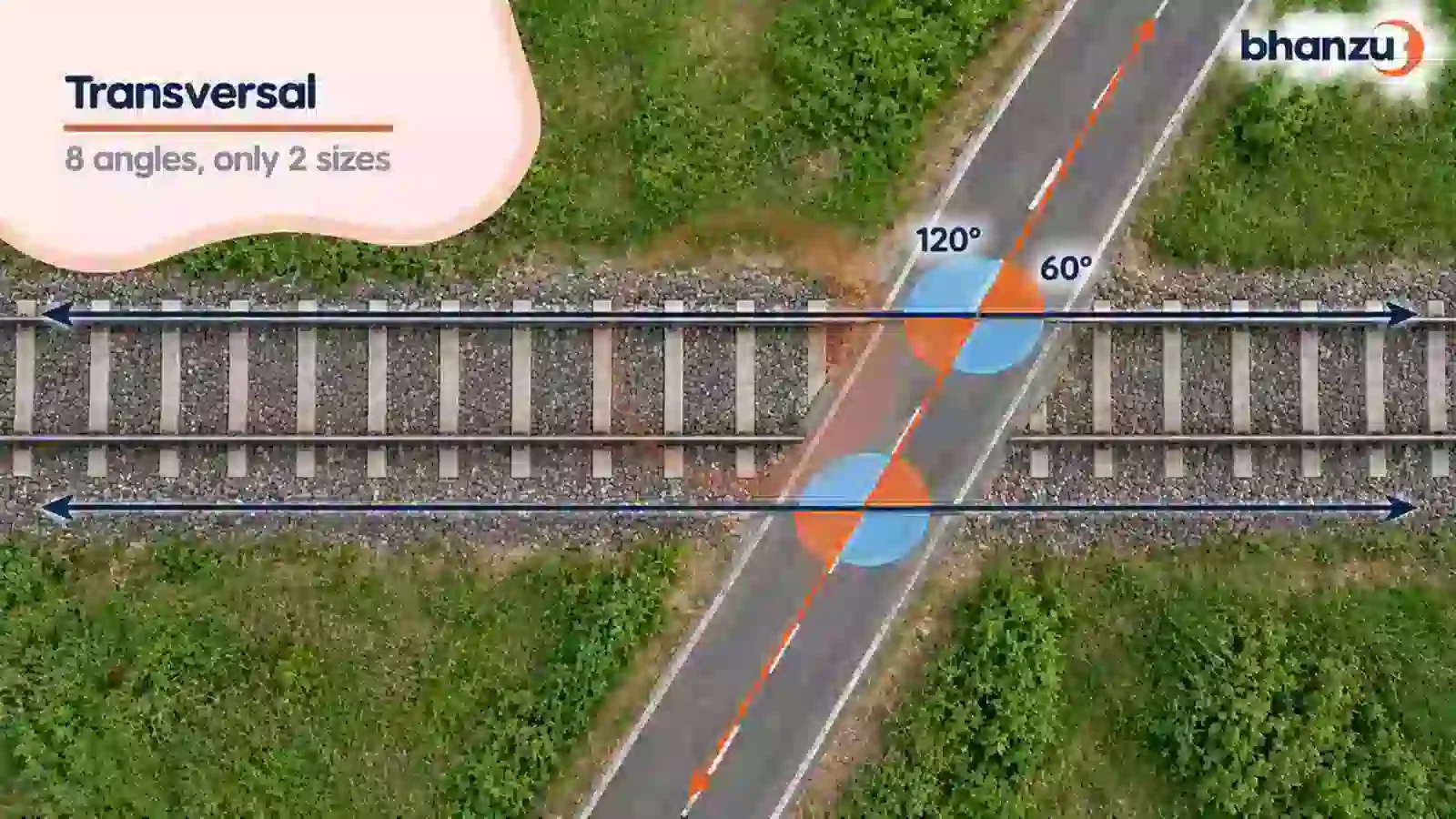
The proof draws one line parallel to a side, then uses the angles a transversal makes with parallel lines.
Setup. Take triangle . Through vertex , draw a line parallel to the base .
Step 1. Because and is a transversal, the alternate interior angles are equal: .
Step 2. Because and is a transversal, the alternate angles are equal again: .
Step 3. The three angles at sit on the straight line , so they add to a straight angle:
Step 4. Replace and using Steps 1 and 2:
That is the angle sum property of a triangle. The two equal-angle steps rely on the way a transversal cuts parallel lines, the same relationship behind interior angles formed on parallel lines.
How Do You Prove the Angle Sum of a Quadrilateral Is 360°?
Split the quadrilateral into two triangles with a single diagonal.
Take quadrilateral and draw the diagonal . This cuts the shape into triangle and triangle . Each triangle has an angle sum of , and together their angles account for all four interior angles of the quadrilateral:
Regrouping, . This is why the angles of a quadrilateral always total 360°, and it is exactly the case of the polygon formula: .
What Are the Key Properties of the Angle Sum Rule?
The angle sum property carries a few consequences worth stating on their own:
Fixed by side count. The interior-angle sum depends only on , never on the polygon's size or shape.
One unknown angle is always findable. If you know all but one interior angle, subtract the known ones from the total to get the last.
Regular polygons split evenly. In a regular -gon every interior angle is equal, so each measures .
Exterior angles are the complement. At each vertex the interior and exterior angles are supplementary, and the exterior angles of any convex polygon sum to regardless of , a fact used alongside the exterior angle theorem.
It generalises the triangle. Every case reduces to counting triangles, which is why the whole family of polygons obeys one formula.
Where Is the Angle Sum Property Used?
The property is a working tool, not just a classroom fact.
Finding missing angles. Surveying, drafting, and any figure with one unmarked angle uses the total-minus-known trick to recover it.
Tiling and tessellation. Floor tiles and honeycomb patterns fit without gaps only when the angles meeting at a point add to ; the interior-angle sizes come straight from this property.
Structural design. Trusses and frames are built from triangles precisely because a triangle's angles - and therefore its shape - are rigidly fixed by the 180° rule.
Checking a construction. If measured interior angles do not sum to the predicted total, the drawing or the reading is off. The relationship also underpins how the interior angles of general quadrilaterals are analysed.
Examples of the Angle Sum Property
Example 1
Two angles of a triangle are 65° and 47°. Find the third angle.
The three angles sum to 180°, so the third is .
Final answer: the third angle is 68°.
Example 2
A student claims a triangle can have angles 90°, 60°, and 40°. Is this possible?
Wrong path. The student adds "a right angle plus a couple of ordinary angles" and assumes any three angles that look reasonable will form a triangle.
Why it breaks. Check the total: , which exceeds 180°. The angle sum property forbids any triangle whose interior angles sum to more (or less) than 180°, so no such triangle exists.
The rescue. The three angles must add to exactly 180°. A valid right triangle here would need the two non-right angles to total 90°, for example 90°, 60°, and 30°.
Final answer: impossible; the angles sum to 190°, not 180°.
Example 3
Three angles of a quadrilateral are 100°, 85°, and 95°. Find the fourth.
A quadrilateral's angles sum to 360°.
Final answer: the fourth angle is 80°.
Example 4
Find the sum of the interior angles of a heptagon (7 sides).
Use with .
Final answer: the interior angles of a heptagon sum to 900°.
Example 5
Each interior angle of a regular polygon is 150°. How many sides does it have?
Each interior angle of a regular -gon is . Set it equal to 150°:
Multiply through by : , so and .
Final answer: the polygon has 12 sides (a regular dodecagon).
Example 6
In triangle , and . Find all three angles.
Let . Then and . Their sum is 180°:
So , , and .
Final answer: the angles are 60°, 30°, and 90°.
Where Do Students Trip Up on the Angle Sum Property?
The most common misstep is applying the triangle's 180° to a four-sided figure, or forgetting to subtract 2 in the polygon formula. Both come from treating the rule as a single number to memorise rather than a count of triangles. Naming the side count first, then translating it into triangles, keeps the total correct every time.
Mistake 1: Using 180° for a quadrilateral
Where it slips in: Rushing to find a fourth angle by subtracting from 180° instead of 360°.
Don't do this: Writing for a quadrilateral.
The correct way: A quadrilateral holds two triangles, so its total is 360°. Subtract the known angles from 360°, not 180°.
Mistake 2: Forgetting the "minus 2" in the polygon formula
Where it slips in: Computing instead of .
Don't do this: Saying a pentagon's angles sum to .
The correct way: A pentagon splits into only 3 triangles, so the sum is . Always subtract 2 before multiplying, because two of the sides are "used up" closing the figure.
Mistake 3: Dividing before subtracting for a regular polygon
Where it slips in: Finding one interior angle of a regular polygon.
Don't do this: Computing , which wrongly returns 180° for every polygon.
The correct way: Divide the interior-angle sum by : each angle is . This also connects to why irregular polygons share the same total but not the same individual angles.
Conclusion
The angle sum property fixes the interior-angle total of any polygon from its side count alone: 180° for a triangle, 360° for a quadrilateral, and in general.
Every case reduces to the same idea - a polygon splits into triangles, each contributing 180°.
The triangle rule is proved by drawing a line through the apex parallel to the base and using alternate angles.
To find a missing angle, subtract the known angles from the correct total for that shape.
In a regular polygon, each interior angle is the total divided by the number of sides.
To take this further with a teacher, explore Bhanzu's geometry tutor or middle school math tutor sessions, or browse math classes online for structured angle practice.
Read More
Practice These to Solidify Your Understanding
Work through these problems in order:
Two angles of a triangle are 38° and 71°. Find the third angle.
Find the sum of the interior angles of a nonagon (9 sides).
Each interior angle of a regular polygon is 160°. How many sides does it have?
Answer to Question 1: . Answer to Question 2: . Answer to Question 3: sides.
Want a live Bhanzu trainer to walk through more angle problems with you? Book a free demo class.
Was this article helpful?
Your feedback helps us write better content