What Are Pairs Of Angles?
A pair of angles is simply two angles considered together because of a relationship between them. That relationship is either about their measures (how they add up) or about their position (how they sit relative to lines, a vertex, or a shared arm).
There are two broad families:
Measure-based pairs: complementary angles (sum to 90°) and supplementary angles (sum to 180°). These care only about the numbers, not the picture.
Position-based pairs: adjacent angles, vertical angles, and linear pairs (formed at a crossing or shared arm), plus corresponding angles (formed when a transversal cuts two lines).
Knowing which family a pair belongs to tells you immediately what to do with it: add to a known total, or read an equal/position relationship off the diagram.
The key idea to hold: every pair of angles is either a sum rule or a position rule — sort it into one of those first, and the problem usually solves itself.
The Main Types Of Angle Pairs
Here is each type defined plainly, with the rule it carries. Each links to a full guide if you want to go deeper on one.
Pair | Definition | Rule |
|---|---|---|
Complementary | Two angles whose measures add to 90° | |
Supplementary | Two angles whose measures add to 180° | |
Adjacent | Two angles sharing a vertex and one arm, no overlap | Position only |
Vertical (opposite) | Non-adjacent angles formed across a crossing of two lines | Always equal |
Linear pair | Two adjacent angles whose outer arms form a straight line | Sum 180° |
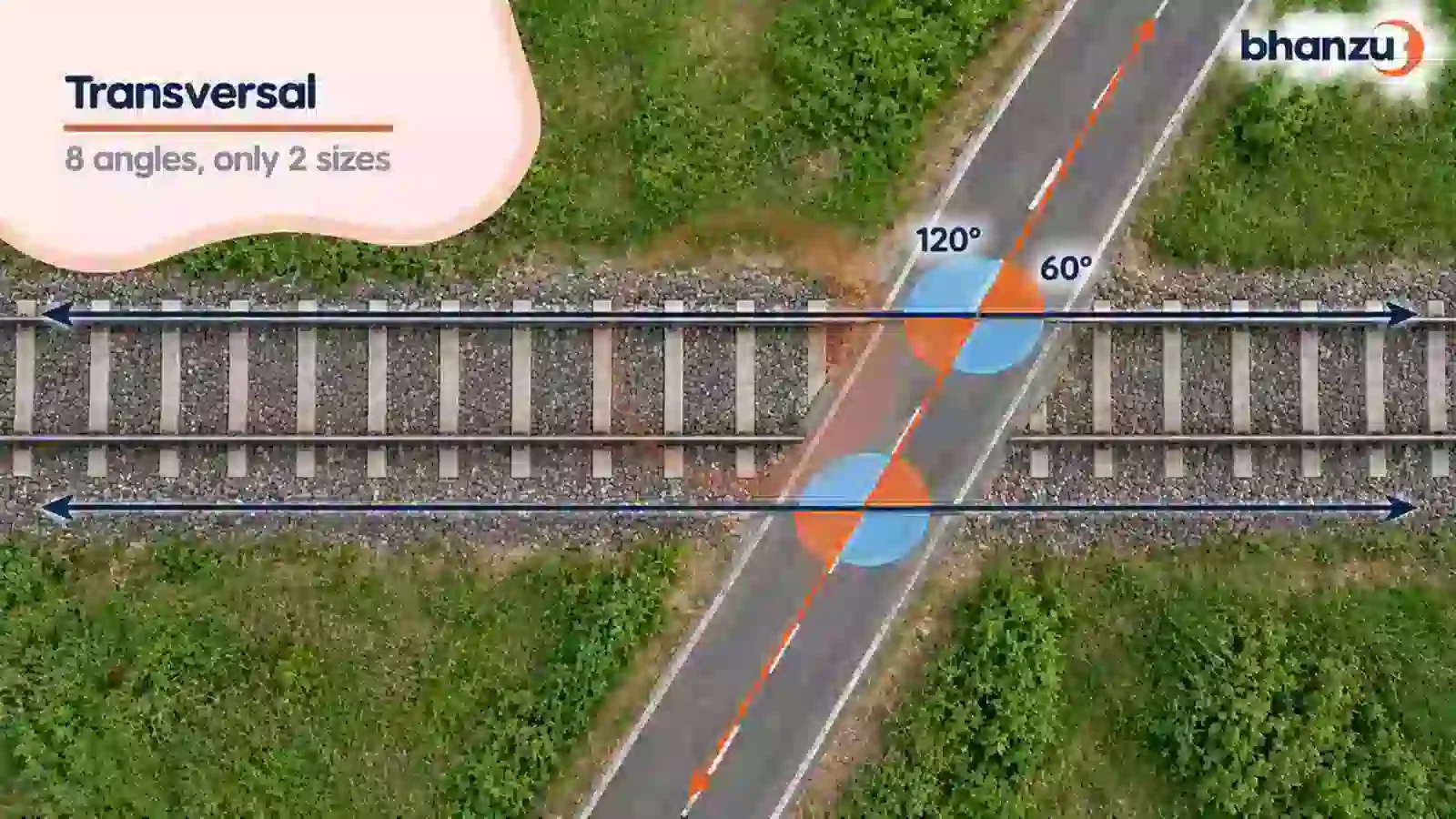
Corresponding | Same-position angles when a transversal cuts two lines | Equal if the lines are parallel |
A few relationships worth fixing in place:
A linear pair of angles is always supplementary, because the two angles together form a straight line. But not every supplementary pair is a linear pair: two angles in different parts of a figure can sum to 180° without sitting next to each other.
Vertical angles (also called opposite angles) are always equal, never supplementary to each other.
A pair cannot be both complementary and supplementary, since a sum cannot be both 90° and 180°.
Examples of Pairs Of Angles
These move from naming a pair to solving for an unknown across several pair types. Each problem statement is bold; the steps are plain.
Example 1
Two angles are complementary. One measures 35°. Find the other.
Complementary angles sum to 90°:
Final answer: 55°.
Example 2
Two angles form a linear pair. One is 4 times the other. Find both angles.
A first instinct is to use 90° because "linear" sounds like a right angle. Let's try it and watch it break: gives , so the angles would be 18° and 72°, which form a right angle — but a linear pair lies on a straight line, not a right angle.
A linear pair is supplementary, summing to 180°, not 90°. Redo it with the correct total:
Final answer: the angles are 36° and 144°.
Example 3
Two lines cross. One of the four angles is 105°. Find the other three.
The opposite (vertical) angle equals 105°.
Each adjacent angle forms a linear pair with the 105° angle, so:
Final answer: the four angles are 105°, 75°, 105°, and 75°.
Example 4
Angle A and angle B are supplementary. Angle A is 50° more than angle B. Find both.
Supplementary means the sum is 180°. Let angle B be , so angle A is :
Final answer: angle B is 65° and angle A is 115°.
Example 5
A transversal crosses two parallel lines. One angle is 72°. Find the corresponding angle on the other line.
Corresponding angles sit in the same position at each crossing. When the two lines are parallel, corresponding angles are equal.
Final answer: the corresponding angle is also 72°. If the lines were not parallel, the corresponding angles would differ; equality is the test for parallel lines.
Example 6
An open laptop screen makes a 110° angle with the keyboard base. The base sits flat on a table. What angle does the screen make with the table surface behind the hinge?
The screen, base, and table line form angles at the hinge. The screen-to-base angle (110°) and the screen-to-table-behind angle sit on the same straight line (the table edge through the hinge), so they form a linear pair.
A linear pair is supplementary:
Final answer: 70°. The hinge is doing the same job as a crossing point, and the two angles around it on the straight table edge must add to 180°.
Why Pairs Of Angles Matter: "Angle Rules Let You Measure Without Measuring"
The whole point of learning angle pairs is efficiency: measure one angle, and the rules hand you several more for free. A surveyor, a carpenter, or a robotics engineer rarely measures every angle in a structure. They measure a few, then use complementary, supplementary, vertical, and corresponding rules to deduce the rest.
Where the pairs earn their keep:
Construction and carpentry. A corner cut to 35° automatically leaves a 55° complement on the offcut; the two pieces fit a right angle without re-measuring.
Road and rail design. Where lines cross, vertical angles must match for the crossing to be true; corresponding angles confirm two roads run parallel.
Navigation and optics. Bearings and reflected light both rely on supplementary and equal-angle rules to predict direction without a protractor at every step.
The same reasoning, scaled up, is why the Antikythera mechanism and every gear train since relies on fixed angle relationships between meshing parts: get one pair wrong and the whole linkage binds. Angle pairs are the quiet bookkeeping that keeps built things square.
Common Mistakes With Pairs Of Angles
These errors come up the moment a figure carries more than one pair type at once.
Mistake 1: Mixing up complementary and supplementary
Where it slips in: Reaching for 90° when the pair is supplementary, or 180° when it is complementary.
Don't do this: Solving a linear-pair problem with a 90° total, as in the wrong start to Example 2.
The correct way: Complementary = corner = 90°; supplementary = straight = 180°. A quick memory hook: C comes before S in the alphabet, and 90 comes before 180. The rusher who reads "two angles add up" and grabs the first total that comes to mind is the one this catches.
Mistake 2: Assuming every supplementary pair is a linear pair
Where it slips in: Treating any two angles that sum to 180° as if they must sit next to each other on a line.
Don't do this: Claiming two 90° angles drawn in opposite corners of a figure form a linear pair just because they add to 180°.
The correct way: A linear pair must be adjacent and form a straight line. Supplementary is only the sum condition. Every linear pair is supplementary, but not every supplementary pair is a linear pair. The second-guesser who knows the sum is right but cannot tell whether the pair is "linear" should check for the shared arm and straight line.
Mistake 3: Calling vertical angles supplementary
Where it slips in: At a crossing, pairing the wrong two angles when applying the 180° rule.
Don't do this: Writing the opposite angles as summing to 180°.
The correct way: Opposite (vertical) angles are equal, not supplementary. The 180° rule applies to adjacent angles at the crossing. Decide first whether the two angles are across the vertex (equal) or side by side (180°). The memorizer who learned "angles at a crossing add to 180°" without the position qualifier applies it to the wrong pair.
Conclusion
Pairs of angles are two angles linked by a measure rule or a position rule.
Measure-based: complementary (90°) and supplementary (180°).
Position-based: adjacent, vertical (equal), linear pair (180° and adjacent), and corresponding (equal when lines are parallel).
Every linear pair is supplementary, but not every supplementary pair is a linear pair.
Sorting a pair into "sum rule" or "position rule" first is the fastest route to the answer.
Practice and Next Steps
Practice these problems to solidify your understanding:
Two angles are complementary; one is 28°. Find the other.
A linear pair has angles and . Find .
Two lines cross; one angle is 63°. Find all four angles.
A transversal cuts two parallel lines; a corresponding angle is 117°. Find its partner.
To work through more of these with a teacher, explore Bhanzu's geometry tutor, middle school math tutor, or math classes online. Want a guided tour of every angle pair on one diagram? Book a free demo class.
Read More
Opposite angles — the equal pairs formed straight across a crossing
Types of angles — acute, obtuse, right, straight, and reflex angles
Intersecting lines — the crossings where vertical and linear-pair angles appear
Alternate angles — the Z-pattern angles a transversal forms
Parallel lines cut by a transversal — every angle pair a transversal creates at once
Angle addition postulate — how adjacent angles combine into a larger angle
Was this article helpful?
Your feedback helps us write better content
Frequently Asked Questions
What are the main types of pairs of angles?
Can two angles be both adjacent and complementary?
Are all supplementary angles a linear pair?
Do corresponding angles have to be equal?
What is the difference between vertical angles and a linear pair?