What Are Points and Lines?
A point is an exact position or location in space. It has no size, no length, width, or thickness, just a place. We draw it as a small dot and name it with a capital letter, such as point . The dot on paper has width, but the point it represents does not; it is the idea of "exactly here."
A line is a straight, one-dimensional path made up of an unbroken, endless row of points, extending forever in both directions. Because it never ends, a line has no measurable length. It is named either by two points on it, written with a double arrow, or by a single lowercase letter such as line . The key relationship between the two ideas is this: a line is made of infinitely many points, and any two of those points are enough to name the whole line.
A third idea often joins them: a plane, a perfectly flat surface that extends forever in every direction and is made up of infinitely many points and lines. Point, line, and plane are the three undefined "building-block" terms that all of geometry rests on. (For the bounded piece between two points, see the line segment article; for the full point–line–ray–segment family, see lines in geometry.)
How Many Points Make a Line? The Incidence Rules
A question that comes up early and often is worth settling before anything else. How many points does it take to determine a line, and how many lines can pass through one point? The answers are a pair of simple rules geometers call incidence rules, the rules about which points lie on which lines.
Through any two distinct points, exactly one line passes. Two points fix a single line; there is no second straight line through both.
Through a single point, infinitely many lines pass. With only one point to hold, lines can fan out in every direction.
A line contains infinitely many points. Between any two points on a line sit endlessly more.
These rules sound obvious, but they are exactly the foundation later geometry leans on, every proof that "this line is unique" or "these lines meet at one point" traces back to them.
Collinear and Non-Collinear Points
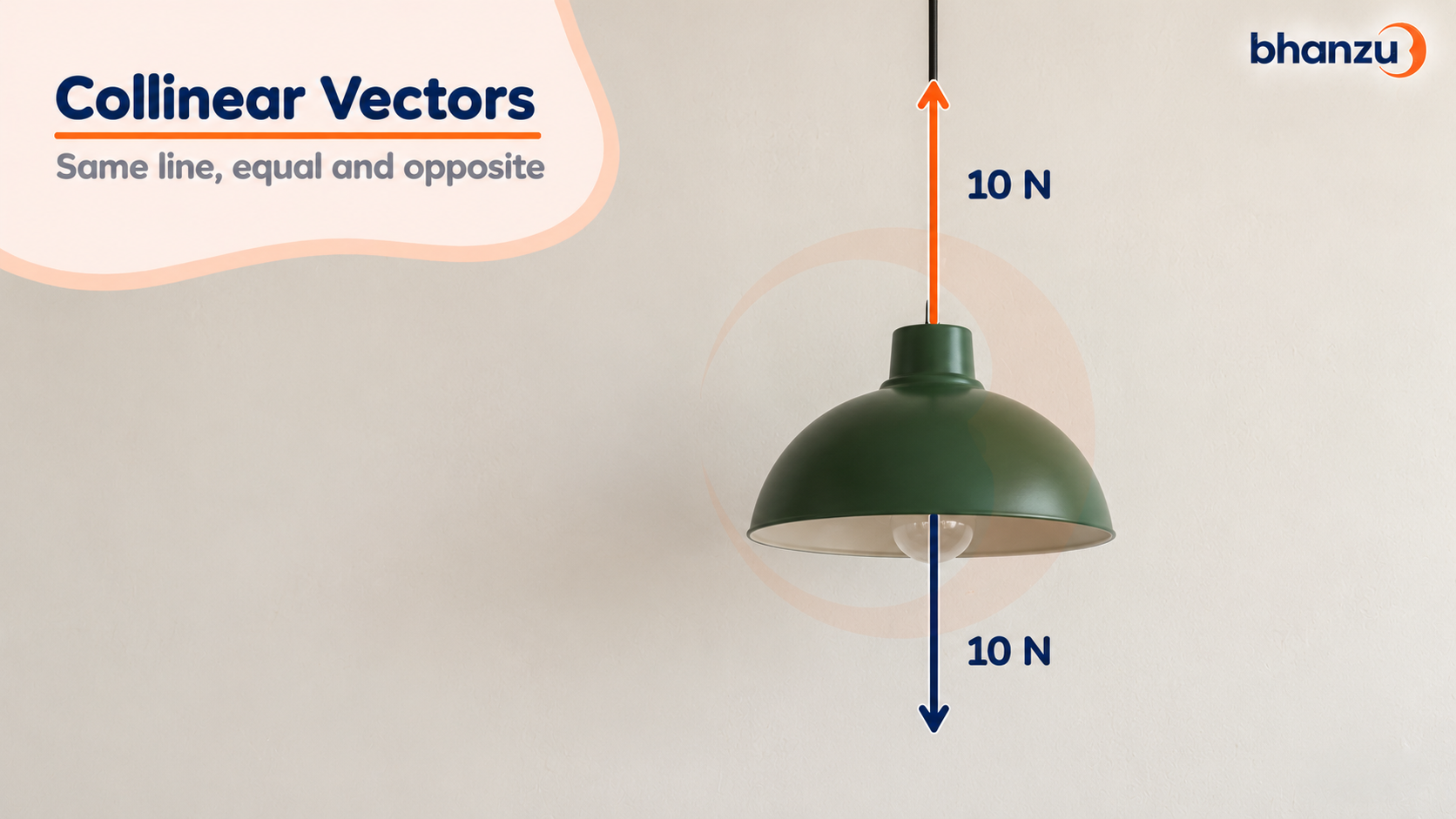
Once points and lines are clear, the most useful idea connecting them is collinearity. Points are collinear when they all lie on the same straight line; they are non-collinear when no single straight line passes through all of them.
Three points seated along the edge of a ruler are collinear. Three points placed at the corners of a triangle are non-collinear, since no straight line can touch all three at once. Two points are always collinear (a line always passes through them), so collinearity becomes interesting from three points onward.
Collinear points | Non-collinear points | |
|---|---|---|
Definition | All lie on one straight line | No single line passes through all |
Smallest interesting case | Three points on a line | Three points forming a triangle |
Everyday example | Students in one row of seats | Three corners of a tabletop |
How to Check Whether Points Are Collinear
When points are given as coordinates, the cleanest test is the slope method, and it follows straight from the straight-line idea: a straight line has one constant slope, so if three points sit on a line, the slope between each pair must match. For points , , :
If the slopes differ, the points bend away from a single line and are non-collinear. (Two other tests exist, the distance method and the area-of-triangle method, where zero area means collinear; the slope test is usually the quickest by hand.)
Examples of Points and Lines
With points, lines, incidence, and collinearity in place, here is the concept doing real work. The problems build from naming and counting up to a coordinate collinearity test.
Example 1 - How many lines can be drawn through two distinct points and ? Through a single point ?
Through two distinct points, exactly one line can be drawn. Through a single point, infinitely many lines can pass, fanning out in all directions.
Final answer: one line through two points; infinitely many through one point.
Example 2 - Are the points , , and collinear?
A tempting first move is to glance at the coordinates and say "the numbers all go up, so they're probably on a line," then move on without checking. That feeling is not a proof, and "the numbers increase" does not guarantee a constant slope. Test it properly with the slope method.
Compute the slope between consecutive pairs:
Both slopes are , so the points are collinear.
Final answer: collinear, common slope .
Example 3 - Are the points , , and collinear?
The slopes differ (), so the points are non-collinear.
Final answer: non-collinear.
Example 4 - Name the line that passes through points and in two different ways
It can be named (or , since order does not matter) using the two points, or by a single lowercase letter such as line .
Final answer: or line .
Example 5 - A row of chairs is lined up perfectly straight along a wall. Are the chair positions collinear, and what is the smallest number of them that already shows collinearity?
The chair positions all lie on one straight line, so they are collinear. Any two are trivially on a line; the idea becomes meaningful at three chairs, which is the smallest set that could have failed to be collinear but does not.
Final answer: collinear; three is the smallest interesting case.
Example 6 - Find the value of so that the points , , and are collinear.
For collinearity, the slope from to must equal the slope from to . First find the slope to :
Now set the slope to equal to it:
Final answer: .
Why Points and Lines Are the Ground Floor of Everything
Points and lines look like the most disposable idea in geometry, the part you rush past to reach the "real" shapes. They are in fact the layer everything else stands on, and they quietly run a surprising amount of the built and digital world.
Coordinate systems and maps. A GPS position is a point, , and a route is a chain of points joined by line segments; the whole of mapping is points and lines.
Computer graphics. Every image on a screen is built from points (pixels, vertices) connected by lines and edges; a 3D model is a cloud of points joined into a mesh.
Surveying and construction. Surveyors set out control points and connect them with straight lines to define boundaries and align structures; checking that markers are collinear keeps a wall or a road true.
Data and trends. Plotting measurements as points and asking whether they fall on a line is the start of reading any trend; near-collinear points signal a strong linear relationship.
The coordinate way of pinning a point to a pair of numbers and a line to an equation, which lets a slope test replace a ruler, traces back to the 1630s, when algebra and geometry were first joined, and it turned points and lines from drawings into things you can compute with.
Where Students Trip Up on Points and Lines
Mistake 1: Thinking a point has a tiny size
Where it slips in: A student treats the drawn dot as the point and reasons about its "width."
Don't do this: Assume a point takes up space because the dot does.
The correct way: A point has no size at all, no length, width, or thickness. The dot is only a marker for the position.
Mistake 2: Judging collinearity by appearance instead of slope
Where it slips in: Three plotted points look roughly lined up, and the rusher calls them collinear without checking.
Don't do this: Decide collinearity by how the points look on the grid.
The correct way: Compute the slope between pairs. Equal slopes mean collinear; "looks straight" is not a proof.
Mistake 3: Confusing "two points fix a line" with "one point fixes a line"
Where it slips in: A problem gives one point and asks for "the" line through it, and the memorizer answers as if it were unique.
Don't do this: Treat a single point as determining one line.
The correct way: Two distinct points determine exactly one line; a single point has infinitely many lines through it.
Key Takeaways
Points and lines are the two starting ideas of geometry: a point is a position with no size, a line is an endless straight row of points.
A line is made of infinitely many points, and two distinct points determine exactly one line.
Through a single point, infinitely many lines pass, the basic incidence rules of geometry.
Points are collinear when they share one straight line and non-collinear when they do not; test collinearity by checking that the slopes between pairs are equal.
The most common slip is judging collinearity by appearance instead of computing slopes.
Practice These Problems to Solidify Your Understanding
How many lines can be drawn through three non-collinear points, each pair joined?
Are the points , , and collinear? Justify using slopes.
Find so that , , and are collinear.
Answer to Question 1: three lines (one through each pair). Answer to Question 2: collinear, since slope and slope. Answer to Question 3: slope, so gives . If Question 2 gave you "non-collinear," check that you used the same subtraction order in both slopes (see Mistake 2).
Want a live Bhanzu trainer to walk your child through points, lines, and collinearity? Book a free demo class — online globally.
Was this article helpful?
Your feedback helps us write better content
Frequently Asked Questions
What is the difference between a point and a line?
Are two points always collinear?
How many lines can pass through one point?
What is a plane in geometry?
What does non-collinear mean?