Why Do We Need More Than One Name for an Arrow?
Two arrows can be the same length, point the same way, and still sit in completely different places on a page.
That single fact forces mathematics to name types of vectors. A vector carries only two facts: a magnitude (size) and a direction. Once you start comparing arrows, questions appear that need vocabulary. Do these two point the same way? Do they lie on one line, or just in one plane? Does this arrow have any length at all? Each answer has a name, and knowing the name tells you instantly what you can and cannot do with the vectors in a calculation.
What Are the Types of Vectors?
The types of vectors are the named categories that describe a vector by its magnitude, its direction, or its relationship to other vectors. The most important ones every student meets are:
Zero vector - magnitude 0, no defined direction, written .
Unit vector - magnitude exactly 1, used to record direction only.
Equal vectors - same magnitude and same direction.
Negative vector - same magnitude, opposite direction.
Parallel vectors - same or opposite direction, any magnitudes.
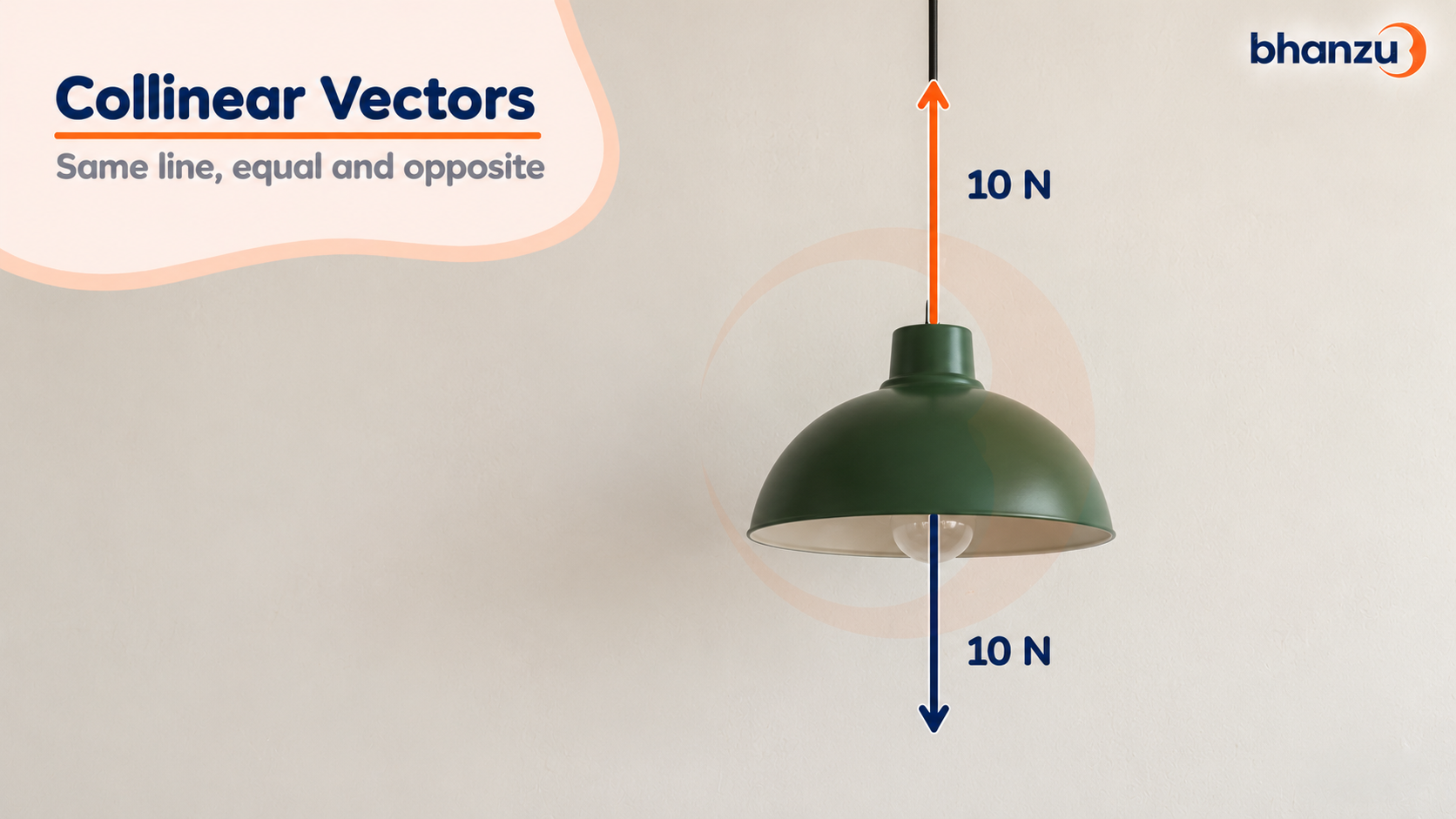
Collinear vectors - lie along the same line or parallel lines.
Coplanar vectors - lie in the same plane.
Position vector - drawn from the origin to a fixed point.
Each is defined precisely below, because in a calculation the type controls what is allowed: you can add any two vectors, but only parallel ones are scalar multiples of each other, and only a unit vector is safe to use as a pure direction.
What Are the Zero Vector and the Unit Vector?
These two are defined by magnitude alone.
Zero vector. The zero vector has magnitude 0 and no direction. It is the additive identity: adding it to any vector leaves that vector unchanged, so . In components it is .
Unit vector. A unit vector has magnitude 1 and exists to carry direction without size. Any nonzero vector has a unit vector pointing the same way, found by dividing by the magnitude:
The standard unit vectors , , point along the x-, y-, and z-axes, and they are the backbone of the components of a vector.
What Is the Difference Between Equal and Negative Vectors?
Both compare two vectors of the same magnitude, and the only difference is direction.
Equal vectors have the same magnitude and the same direction. Their positions on the page can differ — location is not part of a vector's identity. So drawn at the origin equals drawn anywhere else.
Negative vectors have the same magnitude but opposite direction. The negative of is written , and . Reversing a vector's sign flips the arrowhead end for end, which is developed fully under the negative of a vector.
If , then : every component changes sign.
What Are Parallel, Collinear, and Coplanar Vectors?
This trio is the one students most often mix up, because the definitions nest inside each other.
Parallel vectors. Two vectors are parallel when they point in the same or exactly opposite direction. Algebraically, and are parallel when one is a scalar multiple of the other: for some scalar . When they point the same way; when , opposite. Bhanzu keeps a fuller treatment under parallel vectors.
Collinear vectors. Vectors are collinear when they lie on the same straight line or on parallel lines. In practice collinear and parallel describe the same algebraic condition, ; the word "collinear" stresses that the supporting lines coincide or run parallel. See collinear vectors for the full test.
Coplanar vectors. Vectors are coplanar when they all lie in a single plane. Any two vectors are automatically coplanar; the idea becomes useful for three or more. Three vectors , , are coplanar exactly when their scalar triple product is zero:
The nesting to memorise: all collinear vectors are coplanar, but not all coplanar vectors are collinear - a line always lies inside a plane, but a plane holds far more than one line.
What Is a Position Vector?
A position vector locates a point in space relative to a fixed origin . Unlike a free vector, it does have a fixed tail - the origin. The position vector of a point is
Position vectors turn geometry into algebra: once every point is written as , distances, midpoints, and directions become component arithmetic. Bhanzu covers this in depth under position vector.
Are There Other Types of Vectors Worth Knowing?
Beyond the eight core types, a few more appear often enough to name:
Type | Defining condition |
|---|---|
Co-initial vectors | Share the same starting point (initial point) |
Like vectors | Parallel and pointing the same direction |
Unlike vectors | Parallel but pointing opposite directions |
Displacement vector | Represents change of position from one point to another |
Orthogonal (perpendicular) vectors | Meet at a right ∠; their dot product is 0 |
Free vector | Fixed magnitude and direction, no fixed location |
These extend the same idea - classify the arrow by magnitude, direction, or relationship. The way any of them is written on paper is covered under representation of a vector.
Where Are the Types of Vectors Used?
Naming the type is not bookkeeping - it decides which physics or engineering shortcut is legal.
Physics. A force resolved into perpendicular (orthogonal) components can be handled one axis at a time; recognising the right angle is what unlocks that.
Navigation. A displacement vector from start to finish summarises a whole winding route as one arrow.
Computer graphics. Surface directions are stored as unit vectors so lighting maths stays fast and predictable.
Statics. Checking whether three forces are coplanar decides whether they can balance in a single plane, which is the first test in a truss problem.
Building a vector sum in any of these fields relies on addition of vectors, which behaves differently depending on whether the vectors are parallel, perpendicular, or general. For the broader mathematics, the Euclidean vector entry gives the formal grounding.
Examples of Types of Vectors
Example 1
Classify .
Every component is zero, so the magnitude is .
Final answer: is the zero vector .
Example 2
Are and equal, because both "increase by the same pattern"?
Wrong path. A student notices each vector doubles its first component to get its second and concludes the vectors are equal.
Why it breaks. Equal vectors need the same components, not the same internal ratio. Here because and . What the shared ratio actually shows is that .
Correct. Since with , the vectors are parallel (and collinear), not equal.
Final answer: and are parallel, not equal.
Example 3
Find the unit vector in the direction of .
First the magnitude: . Then divide each component by 5.
Final answer: .
Example 4
Write the negative of .
Change the sign of every component.
Final answer: .
Example 5
Are and collinear?
Check whether one is a scalar multiple of the other. Dividing component by component: . The ratio is constant, so .
Final answer: Yes, and are collinear (with ).
Example 6
Are , , coplanar?
Compute the scalar triple product . Here , so .
Final answer: The triple product is 1, not 0, so the three vectors are not coplanar.
Where Do Students Trip Up on the Types of Vectors?
The most common confusion is treating "collinear" and "coplanar" as opposites, when one actually contains the other. Collinear is the stricter condition; every collinear set is automatically coplanar, so the safe habit is to test for collinearity first and only reach for the triple-product coplanarity test when the vectors clearly don't share a line.
Mistake 1: Confusing equal vectors with parallel vectors
Where it slips in: Deciding two vectors are equal because they run in the same direction.
Don't do this: Calling and equal because both point up and to the right.
The correct way: Equal needs identical components; same direction with different lengths is only parallel. The first-instinct error is reading "same direction" as "same vector" and forgetting that magnitude must match too.
Mistake 2: Thinking the zero vector has a direction
Where it slips in: Trying to find a unit vector for .
Don't do this: Writing , which divides by zero.
The correct way: The zero vector has no direction, so no unit vector exists for it. Any formula that divides by the magnitude excludes from the start.
Mistake 3: Assuming all coplanar vectors are collinear
Where it slips in: Reasoning that because three vectors lie in one plane, they must lie on one line.
Don't do this: Concluding coplanar collinear.
The correct way: The implication runs one way only - collinear vectors are always coplanar, but a plane holds infinitely many directions. This one-way nesting is the single most-tested idea in this topic; drawing the plane with several arrows fanning out fixes it in memory.
Conclusion
The types of vectors are named by magnitude (zero, unit) or by relationship (equal, negative, parallel, collinear, coplanar, position).
Equal vectors match in magnitude and direction; negative vectors match in magnitude but reverse direction.
Parallel and collinear share the algebraic test ; coplanar uses the scalar triple product .
All collinear vectors are coplanar, but not the reverse - the most-tested relationship here.
The zero vector has no direction, so it has no unit vector.
To take vectors further with a teacher, explore Bhanzu's geometry tutor or high school math tutor sessions, or browse math classes online for guided practice.
Read More
Practice These to Solidify Your Understanding
Work through these problems in order:
Classify and by relationship.
Find the unit vector in the direction of .
Are and collinear?
Answer to Question 1: Same magnitude, opposite direction, so ; they are negative vectors (and parallel/collinear). Answer to Question 2: , so . Answer to Question 3: , so yes, they are collinear.
Want a live Bhanzu trainer to work through vector classification with you? Book a free demo class.
Was this article helpful?
Your feedback helps us write better content
Frequently Asked Questions
What are the main types of vectors?
What is the difference between collinear and coplanar vectors?
Is a unit vector the same as an equal vector?
Can the zero vector be a unit vector?
How do you check if two vectors are parallel?