What Is Symmetry in Geometry?
In mathematics, symmetry describes a shape that is invariant under a transformation — meaning the shape looks identical before and after being moved, rotated, or reflected.
If you can perform a geometric transformation on a figure (flip it, rotate it, slide it) and the result is indistinguishable from the original, the figure has symmetry. The specific transformation determines what kind of symmetry.
A figure with no symmetry — like an irregular blob — is called asymmetric.
What Are the Types of Symmetry?
Five distinct types of symmetry appear in geometry. The first three are most common in school math; the last two appear in transformations and tessellations.
1. Reflection Symmetry (Line Symmetry)
A figure has reflection symmetry if there is a line — the line of symmetry (or axis of symmetry) — such that folding the figure along the line maps it exactly onto itself. The two sides are mirror images.
Examples. The letter A, the human face (approximately), butterflies, isosceles triangles. A square has 4 lines of symmetry — 2 through opposite vertices and 2 through midpoints of opposite sides. A circle has infinitely many lines of symmetry — any line through its centre.
2. Rotational Symmetry
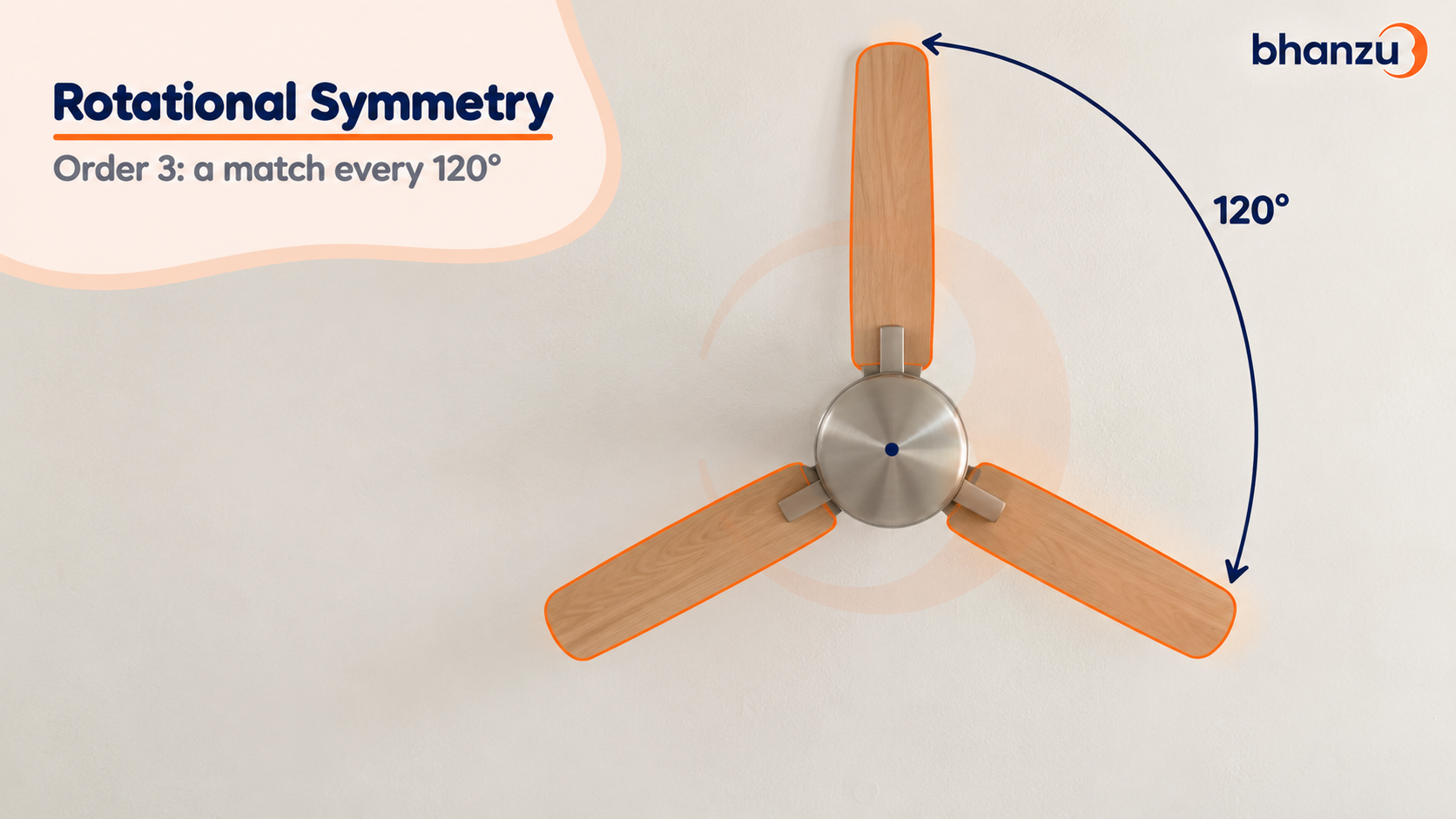
A figure has rotational symmetry if it looks the same after rotating it by some angle less than 360° around a fixed point (the centre of rotation).
The order of rotational symmetry is the number of times the figure maps onto itself in one full 360° rotation. The smallest angle that maps the figure onto itself is the angle of rotation.
Examples. An equilateral triangle has rotational symmetry of order 3 (rotates onto itself at 120°, 240°, 360°). A square has order 4 (rotates onto itself at 90°, 180°, 270°, 360°). A circle has infinite rotational symmetry — any angle works.
3. Point Symmetry (Origin Symmetry)
A figure has point symmetry if it looks the same after rotating it by exactly 180° around a centre point. Every point on the figure has a matching point the same distance from the centre but in the opposite direction.
Examples. The letter S, the letter Z, the letter N, a parallelogram (not in general a rectangle, which has more symmetry). The mathematical function has point symmetry about the origin.
Point symmetry is a special case of rotational symmetry — specifically rotational symmetry of order 2 with the centre as the point.
4. Translation Symmetry
A figure has translation symmetry if sliding it by a fixed vector — same distance, same direction, no rotation, no flip — produces an identical figure. Unlike reflection or rotation, translation symmetry requires the figure to extend infinitely (or to be a repeating pattern); a bounded shape cannot have translation symmetry on its own.
Examples. Wallpaper patterns, brick walls, tessellations, the infinite number line, periodic crystals. A row of identical fence posts has translation symmetry along the line of posts.
In physics, translation symmetry of space is what gives — by Noether's theorem — conservation of momentum.
5. Glide Reflection Symmetry
A glide reflection is the composition of a reflection across a line followed by a translation parallel to that line. A figure has glide symmetry if performing this combined move maps it onto itself.
Examples. Footprints in sand (left-then-right-then-left walking pattern) form a glide-symmetric trail. Many wallpaper and frieze patterns combine glide symmetry with translation.
Glide reflections are one of the four fundamental isometries of the Euclidean plane — alongside translation, rotation, and reflection — and they're essential for classifying the 17 wallpaper groups and 7 frieze groups.
How Do You Find the Lines of Symmetry in a Shape?
Take a polygon. To check if a line is a line of symmetry, ask: if I folded the shape along this line, would the two halves match perfectly? If yes, it's a line of symmetry.
Common shapes and their lines of symmetry:
Shape | Lines of Symmetry |
|---|---|
Scalene triangle | 0 |
Isosceles triangle | 1 (through the vertex angle) |
Equilateral triangle | 3 |
Rectangle (non-square) | 2 (vertical and horizontal through centre) |
Square | 4 |
Regular pentagon | 5 |
Regular hexagon | 6 |
Regular -gon | |
Circle | infinitely many |
Pattern: A regular polygon with sides has exactly lines of symmetry.
How Do You Find the Order of Rotational Symmetry?
Imagine rotating the figure around its centre. Count how many distinct positions during one full 360° turn produce a shape identical to the original. That count is the order.
Examples.
Equilateral triangle: rotates onto itself at 120°, 240°, 360° → order 3.
Square: rotates onto itself at 90°, 180°, 270°, 360° → order 4.
Regular pentagon: at 72°, 144°, 216°, 288°, 360° → order 5.
Regular -gon: order .
For regular polygons: order of rotational symmetry = number of sides.
Why Does Symmetry Matter? (The Real-World GROUND)
"Symmetry is what we see at a glance." — Blaise Pascal, Pensées, 1670.
Symmetry isn't a school-math curiosity. It's one of the deepest organising principles in physics and biology — and Emmy Noether proved why.
In 1915, the German mathematician Emmy Noether proved what is now called Noether's theorem: every symmetry in a physical system corresponds to a conservation law. Translation symmetry (the laws of physics work the same here and there) gives conservation of momentum. Time symmetry (laws don't change over time) gives conservation of energy. Rotation symmetry gives conservation of angular momentum. These are not coincidences — they are mathematical consequences of symmetry.
Symmetry shows up everywhere:
Snowflakes. Each snowflake has 6-fold rotational symmetry — a consequence of the molecular structure of ice.
Honeycomb. Bees build hexagonal cells with 6-fold rotational symmetry — the most efficient way to tile a plane with equal-area cells.
Architecture. The Taj Mahal is one of the most-photographed examples of bilateral (reflection) symmetry. The Pantheon in Rome has rotational symmetry.
Human face. Approximately bilateral — perfect facial symmetry is rare, but humans perceive more-symmetric faces as more attractive (a well-studied result in evolutionary psychology).
Crystallography. The 230 space groups classify every possible 3D crystal symmetry. Used in chemistry, materials science, and X-ray diffraction.
Molecular biology. DNA has helical symmetry. Many proteins have rotational or reflective symmetries that are functionally important.
Physics — particle physics. The Standard Model is built on symmetry groups (gauge symmetries). The Higgs boson was discovered (2012) at the LHC because the symmetry-breaking mechanism predicted it must exist.
The mathematical study of symmetry is called group theory — pioneered by Évariste Galois in the 1830s before his death in a duel at age 20. His work, ignored at the time, is now central to modern algebra and theoretical physics.
A Worked Example
How many lines of symmetry does a regular hexagon have?
The intuitive (wrong) approach. A student in a hurry counts only the lines through opposite vertices: 3 such lines.
Why it fails. They missed the lines through midpoints of opposite sides — also valid lines of symmetry.
The correct method. A regular hexagon has:
3 lines through opposite vertices.
3 lines through midpoints of opposite sides.
Total: 6 lines of symmetry. (Matching the rule that a regular -gon has lines of symmetry.)
At Bhanzu, our trainers walk through this wrong-path-first sequence intentionally — the rusher who counts only "the obvious" lines misses half the answer. Once the pattern "regular -gon → lines" is seen, counting becomes a check, not a search.
What Are the Most Common Mistakes With Symmetry?
Mistake 1: Counting only obvious lines of symmetry
Where it slips in: Regular polygons. Students count only vertex-through-vertex or only side-through-side lines.
Don't do this: Saying a square has only 2 lines of symmetry (the two diagonals OR the two midlines).
The correct way: A square has 4 lines of symmetry — 2 diagonals AND 2 midlines (horizontal and vertical through the centre). For regular polygons, the line count equals the number of sides.
Mistake 2: Confusing point symmetry with rotational symmetry
Where it slips in: Calling a parallelogram "rotationally symmetric" without specifying the order.
Don't do this: Stating that a parallelogram has rotational symmetry without qualification.
The correct way: A general parallelogram has rotational symmetry of order 2 — equivalent to point symmetry through the centre. A rectangle (a special parallelogram) also has order 2 rotationally but additionally has reflection symmetry — 2 lines of symmetry. A square has order 4 rotational AND 4 reflection. The second-guesser who asks "what's the order?" is asking the right question.
Mistake 3: Confusing the letter "S" or "N" as having reflection symmetry
Where it slips in: Pattern-matching letters that look "fancy" as symmetric.
Don't do this: Calling S, N, or Z reflection-symmetric.
The correct way: S, N, and Z have point symmetry (rotational order 2), not reflection symmetry. Letters with vertical reflection symmetry: A, H, I, M, O, T, U, V, W, X, Y. Letters with horizontal reflection symmetry: B, C, D, E, H, I, K, O, X. The memorizer who pattern-matches "curvy = symmetric" hits this.
The Mathematicians Who Shaped Symmetry Theory
Évariste Galois (1811–1832, France) — Founded group theory — the mathematical language of symmetry — in his teens before his death in a duel at age 20. His ideas, ignored for decades, are now central to modern algebra and the Standard Model of particle physics.
Emmy Noether (1882–1935, Germany) — Proved Noether's theorem (1915): every symmetry in a physical system corresponds to a conservation law. Einstein called her "the most significant creative mathematical genius thus far produced since the higher education of women began."
Felix Klein (1849–1925, Germany) — Proposed the Erlangen Program in 1872 — the idea that geometries are defined by their symmetry groups. This framework unified Euclidean, projective, hyperbolic, and other geometries into a single picture.
A Practical Next Step
Try these three before moving on to tessellations and transformations.
How many lines of symmetry does a regular pentagon have? What is its order of rotational symmetry?
Does the letter H have reflection symmetry? How many lines?
Identify whether a parallelogram (not a rectangle) has reflection, rotational, or point symmetry.
Also Read:
Was this article helpful?
Your feedback helps us write better content
Frequently Asked Questions
What is symmetry in simple words?
How many lines of symmetry does a square have?
What is rotational symmetry?
What is point symmetry?
Does a circle have symmetry?
What's the difference between reflection and rotational symmetry?