What Is a Pentagon?
A pentagon is a polygon with 5 sides and 5 vertices. The name comes from Greek penta (five) + gonia (angle).
Sum of interior angles of any pentagon:
This is true for any pentagon — convex or concave, regular or irregular.
Types of Pentagons
Regular Pentagon
All 5 sides equal length; all 5 angles equal (each 108°). The most symmetric pentagon. Five axes of symmetry; rotational symmetry of order 5.
Irregular Pentagon
Sides and/or angles unequal. Most pentagons in real-world geometry problems are irregular.
Convex Pentagon
All interior angles < 180°. All diagonals lie inside the pentagon. Most common type.
Concave Pentagon
At least one interior angle > 180° (a "dent"). At least one diagonal exits the pentagon.
Properties of a Regular Pentagon
All sides equal: each of length .
All interior angles equal: each .
All exterior angles equal: each .
Sum of interior angles: .
5 axes of symmetry — each through one vertex and the midpoint of the opposite side.
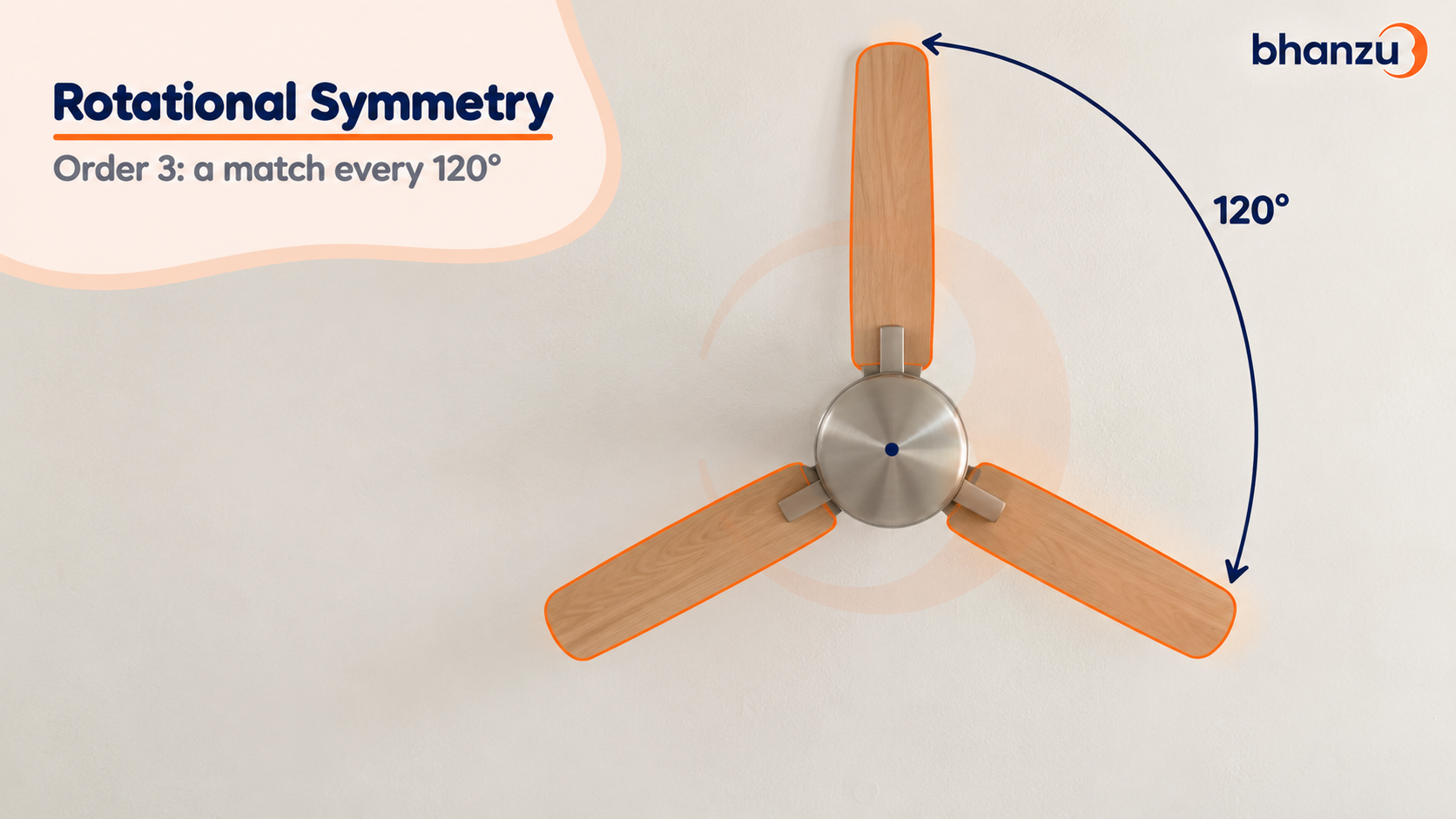
5-fold rotational symmetry — rotates onto itself every .
Diagonals form a pentagram (a 5-pointed star) — when all 5 diagonals are drawn.
Diagonal-to-side ratio is the golden ratio .
Area Formulas
Regular Pentagon — Exact Formula
The constant .
Practical form (rounded):
Regular Pentagon — Using Apothem
The apothem is the distance from the centre to the midpoint of a side.
Useful when the apothem is known directly.
Irregular Pentagon
No single formula. Divide into triangles (one common approach: connect each vertex to one chosen vertex, producing 3 triangles), compute each triangle's area, sum them.
Perimeter of a Pentagon
For any pentagon:
For a regular pentagon with side :
Three Worked Examples — Quick, Standard, Stretch
Quick — Perimeter
A regular pentagon has side cm. Find its perimeter.
cm.
Standard — Area Using Side
A regular pentagon has side m. Find its area.
Exactly: .
Stretch — Area Using Apothem
A regular pentagon has side cm and apothem cm. Find its area.
Why Does the Pentagon Matter? (The Real-World GROUND)
"The pentagon contains the golden ratio." — geometric truth.
Pentagons appear in nature, architecture, and science:
The Pentagon (US Department of Defense headquarters) is a regular-pentagon-shaped building, completed 1943.
Sea stars (starfish) have 5-fold radial symmetry — pentagonal.
Flowers — many flower species have 5 petals arranged in a pentagonal pattern (roses, hibiscus, lilies, columbines).
Pentaprisms — used in cameras and surveying instruments to deflect light by exactly 90° regardless of angle of incidence.
Crystalline structures — pentagonal symmetry was once thought impossible in crystals; Dan Shechtman's 1982 discovery of quasicrystals with 5-fold symmetry overturned that and won him the 2011 Nobel Prize in Chemistry.
Soccer balls — the classic 32-panel truncated icosahedron has 12 pentagonal panels (and 20 hexagonal).
Phi (the golden ratio) appears throughout the pentagon — diagonal-to-side ratio, apothem-to-side ratio, and inscribed pentagram all contain .
The Greek school of Pythagoras used the pentagram (five-pointed star inside a pentagon) as a secret symbol — partly because of the golden-ratio relationships inside it.
A Worked Example
Find the interior angle of a regular pentagon.
The intuitive (wrong) approach. A student divides by 5 to get .
Why it fails. is the sum of exterior angles, not interior. The exterior angle of a regular pentagon is (one-fifth of ), but the interior angle is different.
The correct method. Sum of interior angles . For a regular pentagon, each interior angle .
Check. Interior + exterior at each vertex = (linear pair). ✓.
What Are the Most Common Mistakes With Pentagons?
Mistake 1: Using triangle area formulas directly
The fix: A pentagon isn't a triangle. Use the regular pentagon formula or divide into triangles for irregular ones.
Mistake 2: Confusing interior and exterior angles
The fix: Interior angle = (regular pentagon). Exterior angle = . They're supplementary at each vertex.
Mistake 3: Forgetting that the formula assumes "regular"
The fix: The formula is for a regular pentagon. For irregular pentagons, divide into triangles.
Key Takeaways
A pentagon has 5 sides, 5 vertices, and interior angles summing to .
A regular pentagon has all sides equal and all angles .
Area of a regular pentagon: (or exactly ).
Perimeter of a regular pentagon: .
The golden ratio appears throughout the regular pentagon — diagonal-to-side ratio is exactly .
A Practical Next Step
Try these three before moving on to hexagons and higher polygons.
Find the perimeter of a regular pentagon with side cm.
Find the area of a regular pentagon with side m.
Find the exterior angle of a regular pentagon.
Also Read:
Was this article helpful?
Your feedback helps us write better content
Frequently Asked Questions
How many sides does a pentagon have?
What is the sum of interior angles of a pentagon?
What is each interior angle of a regular pentagon?
What is the area formula for a regular pentagon?
What is the perimeter of a regular pentagon?
How is the golden ratio related to the pentagon?