Two Forces Pointing The Same Way Can Lift A Bridge Or Buckle It
When two cables pull on a bridge deck along parallel lines, their forces simply add. Angle one cable a few degrees off, and the load no longer combines cleanly - a component pulls sideways and stress builds where the engineer did not plan for it. Knowing when two vectors are truly parallel is what keeps that addition honest.
What Are Parallel Vectors?
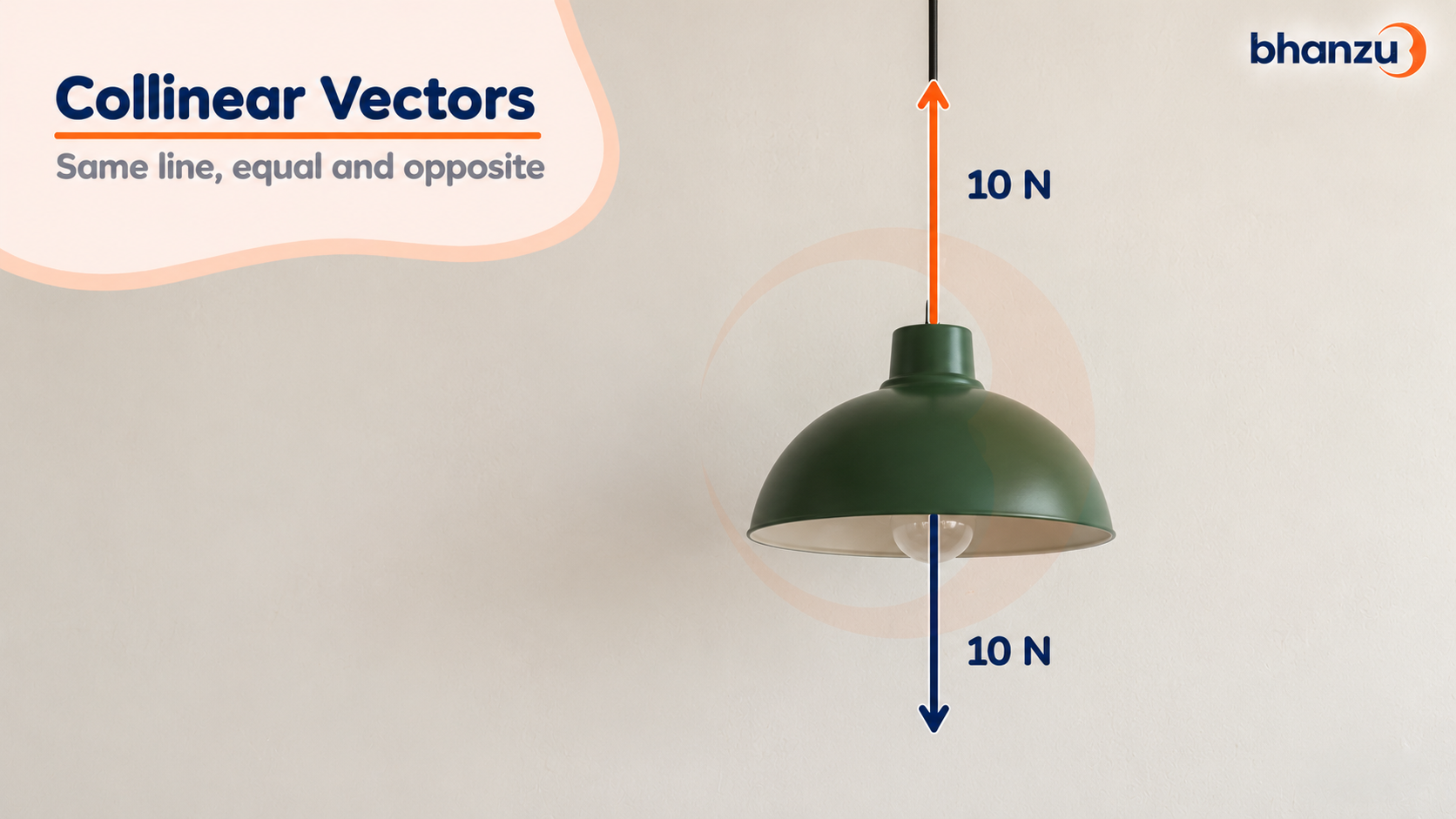
Two vectors are parallel when they lie along the same line or along parallel lines, pointing in either the same or exactly opposite directions. Formally, and are parallel if one is a scalar multiple of the other:
where is any non-zero real number (a scalar is just an ordinary number, with magnitude but no direction). A vector is a quantity with both magnitude and direction, usually drawn as an arrow. If the two point the same way; if they point in opposite directions and are called anti-parallel. Parallel vectors are also known as collinear vectors.
How Do You Tell If Two Vectors Are Parallel?
There are three equivalent tests, and which one you use depends on what the problem hands you. Each one is a different face of the same fact - the vectors share a direction.
Scalar-multiple test. If for some scalar , they are parallel. In components, check whether the ratios of matching components are all equal: for and , they are parallel when .
Cross-product test. Two vectors are parallel exactly when their cross product is the zero vector: . The cross product vanishes because the angle between them is 0° or 180°.
Angle test. The angle between parallel vectors is either 0° (same direction) or 180° (opposite). This connects to the angle between two vectors and the dot product, where .
The dot product alone is a weaker test - it tells you the angle, but you must still confirm it is 0° or 180°. The cleanest single check in coordinates is the cross-product test.
Examples of Parallel Vectors
Six worked cases, from a direct scalar check to finding an unknown that forces parallelism. The problem statement is bolded; the working is not.
Example 1
Determine whether and are parallel.
Check whether one is a scalar multiple of the other by comparing component ratios:
All three ratios equal 2, so .
Final answer: yes, they are parallel, with (same direction).
Example 2
A student checks whether and are parallel by computing the dot product, finds , and concludes they are not parallel. Find the error and the correct answer.
The tempting move is to treat a non-zero dot product as proof of non-parallelism. Watch it break: a zero dot product means perpendicular, not parallel, so the test has been read backwards. A non-zero dot product tells you nothing on its own here.
Use the scalar-multiple test instead:
Both ratios equal 3, so .
The vectors are parallel. The confusion between the reciprocal-style perpendicular test () and the parallel test () is the usual source of this slip.
Final answer: they are parallel; the dot product was the wrong test.
Example 3
Are and parallel? If so, same direction or opposite?
Compare component ratios:
Both ratios equal , so .
Because is negative, they point in opposite directions.
Final answer: parallel and anti-parallel (opposite directions).
Example 4
Use the cross product to confirm that and are parallel.
The cross product is:
The cross product is the zero vector.
Final answer: yes, parallel - confirmed by .
Example 5
Find the value of that makes parallel to .
For parallel vectors the component ratios must be equal:
Final answer: , giving .
Example 6
Find a unit vector parallel to .
A unit vector has magnitude 1 and points the same way as . First find the magnitude:
Then divide each component by the magnitude:
Final answer: the unit vector parallel to is .
Where Parallel Vectors Earn Their Keep
Parallel vectors do quiet, load-bearing work across physics and engineering. When forces act along the same line, they add as simple numbers - the reason a tug-of-war team pulling in one direction combines its strength cleanly, and the reason two misaligned cables do not. In 3D geometry, parallel direction vectors tell you when two lines never meet, and a zero cross product is the fast test for that. Computer-graphics engines check vector parallelism to decide whether a surface faces a light source. The idea reaches further too: a position vector scaled by a factor stays parallel to itself, which is what lets you slide a point along a fixed direction.
You can read a short account of the history of vectors and how the algebra of directed quantities took shape in the nineteenth century.
Common Mistakes With Parallel Vectors
Mistake 1: Using the dot-product-equals-zero test for parallelism
Where it slips in: Any coordinate problem where the student reaches for the first product they remember.
Don't do this: Set and call the vectors parallel. That condition is the test for perpendicular vectors. The perpendicular test () and the parallel test () get read as the same thing - and that swap is the most common source of wrong answers here.
The correct way: For parallel, use or . Save the dot product for angles and perpendicularity.
Mistake 2: Forgetting the anti-parallel case
Where it slips in: Problems where the scalar comes out negative.
Don't do this: Declare two vectors "not parallel" because is negative. A negative scalar still means parallel - just in the opposite direction.
The correct way: If all component ratios are equal, the vectors are parallel whatever the sign of . Report same-direction for and anti-parallel for .
Mistake 3: Comparing ratios when a component is zero
Where it slips in: Vectors like and , where a component is 0.
Don't do this: Write and treat it as undefined or as automatically equal.
The correct way: Handle zero components directly - if one vector has a zero in a slot, the other must too for parallelism, and the non-zero components must share a single ratio. Here and are parallel because .
Conclusion
Two vectors are parallel when one is a scalar multiple of the other: .
The cross-product test is the clean coordinate check: means parallel.
A positive scalar gives the same direction; a negative scalar gives anti-parallel vectors.
The dot-product-equals-zero test is for perpendicular vectors, not parallel ones.
In components, parallel vectors have equal ratios of matching components.
To take parallel vectors further with a teacher, explore Bhanzu's geometry tutor or high school math tutor sessions, or browse math help online.
A Practical Next Step
Test your understanding with these problems. Decide whether and are parallel (Answer to Question 1: yes, anti-parallel, since ), then find so that is parallel to (Answer to Question 2: ). If you get stuck choosing a test, return to the "How do you tell" section above. Want a live Bhanzu trainer to walk through vector problems? Book a free demo class -
Read More
Was this article helpful?
Your feedback helps us write better content
Frequently Asked Questions
What makes two vectors parallel?
Is a vector parallel to itself?
What is the difference between parallel and perpendicular vectors?
Are parallel vectors the same as collinear vectors?
Can the zero vector be parallel to another vector?