What Is Vector Addition?
Vector addition is the operation that combines two or more vectors into one resultant vector — a single vector that produces the same effect as the originals acting together. Because vectors carry direction, you cannot add their magnitudes the way you add ordinary numbers; you have to account for the angle between them.
There are three standard ways to do it, and they all agree on the answer: the triangle law, the parallelogram law, and the component method. The first two are geometric pictures; the third is the algebra you'll use most once vectors are in component form.
How Do You Add Two Vectors With The Triangle Law?
The triangle law of vector addition states that if two vectors are represented, in magnitude and direction, by two sides of a triangle taken in order, then their resultant is the third side taken in the opposite order.
In practice you place the tail of the second vector at the head of the first (the head-to-tail method), and the resultant runs from the tail of the first to the head of the second.
When the two vectors and meet at angle , the resultant's magnitude and direction are:
This magnitude formula comes from dropping a perpendicular from the head of to the line of and applying the Pythagorean theorem to the extended triangle — the term is what survives from squaring the projected pieces.
Variable glossary. and are the magnitudes; is the angle between the vectors when drawn from a common tail; is the resultant magnitude; is the angle the resultant makes with .
How Is The Parallelogram Law Different?
The parallelogram law of vector addition uses the same two vectors drawn from a common tail rather than head to tail. If and form two adjacent sides of a parallelogram, the resultant is the diagonal drawn from their shared starting point.
It produces the identical resultant as the triangle law — same magnitude, same direction — because the diagonal of the parallelogram and the closing side of the triangle are the same segment. Use the parallelogram picture when both vectors naturally start at one point (two forces tugging on a single ring); use the triangle picture when one motion follows another (a walk, then a second walk).
Adding Vectors With Components
In component form, addition is the easy part: add the matching components. For and ,
No angle, no cosine — just line up the terms and the terms. This is why component form is the workhorse: the geometric laws explain why the resultant looks the way it does, but the component method is fastest to compute. (If component form is new, start with the vectors overview.)
Examples of Vector Addition
Example 1
Add and using components.
Final answer: .
Example 2
Two forces of and act on a point at right angles. Find the resultant.
Wrong attempt. A student adds the magnitudes: . But the forces point in different directions, so plain addition can't be right — the resultant of two perpendicular forces is always shorter than their sum.
Correct. Use the triangle-law magnitude formula with , so :
Final answer: the resultant is .
Example 3
Find the magnitude of the resultant of () and () with between them.
Final answer: units. (Here — see trigonometric ratios if that value is unfamiliar.)
Example 4
Find in 3D for and .
Final answer: .
Example 5
A hiker walks east, then north. How far is the hiker from the start, and in what direction?
Place the second leg head-to-tail after the first (triangle law). The two legs are perpendicular.
Final answer: the hiker is from start, about north of east.
Example 6
Two equal-magnitude vectors of size point the same direction (). Find the resultant magnitude.
Final answer: . When (and only when) two vectors point the same way, their magnitudes add directly.
Why Vector Addition Matters: "Every Resultant Is A Real Combined Effect"
Vector addition isn't a notation trick — it's how the physical world combines influences that have direction. A plane's track over the ground is its airspeed vector plus the wind vector. A boat's path is its heading plus the current. The net force on a bridge joint is the sum of every cable's tension vector, and getting that sum right is the difference between a structure that stands and one that doesn't.
The general rule, captured by , contains every special case:
Same direction (): the magnitudes add, (Example 6).
Opposite directions (): they subtract, .
Perpendicular (): the cosine term vanishes and you get the Pythagorean result (Examples 2 and 5).
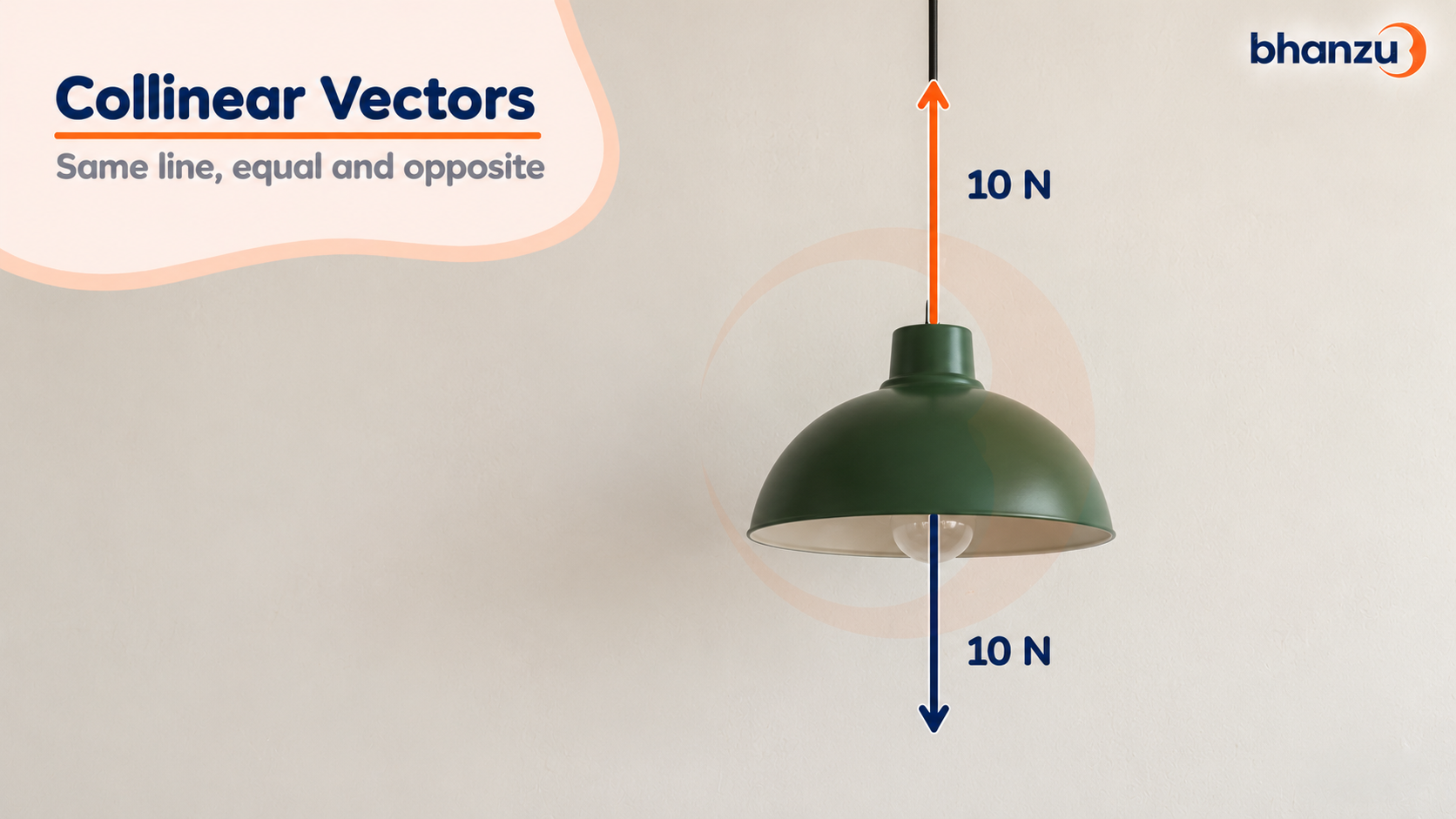
That single formula is also where vector addition meets collinear vectors — collinear vectors are exactly the or cases, the only times direction stops mattering.
What Are The Most Common Mistakes With Vector Addition?
Mistake 1: Adding magnitudes directly
Where it slips in: any problem with an angle between the vectors.
Don't do this: writing for perpendicular or angled vectors. The first instinct on two forces is to add the numbers and move on — but that answer is only correct when the vectors are parallel and pointing the same way.
The correct way: use , or break each vector into components and add component by component.
Mistake 2: Joining the vectors the wrong way
Where it slips in: drawing the triangle-law diagram.
Don't do this: placing both vectors tail-to-tail and then reading the side between the heads as the resultant. The rusher draws the arrows from a common point out of habit and reads off the wrong segment.
The correct way: for the triangle law, the second vector's tail goes at the first vector's head; the resultant runs from the very first tail to the very last head. (Tail-to-tail is the parallelogram setup, where the resultant is the diagonal — not the side between the heads.)
Mistake 3: Sign errors when components are negative
Where it slips in: adding vectors that point into different quadrants.
Don't do this: dropping a negative sign on a leftward or downward component. The most common source of a wrong resultant here is a sign that quietly flips when a component points the negative way.
The correct way: write every component with its sign explicitly before you add, and keep the column and the column separate so a stray minus has nowhere to hide.
The swimmer in the opening is the everyday version of Mistake 1: adding to get feels right and is wrong — the current and the heading are perpendicular, so the true speed is . The same error scaled up is how a navigator who ignores a crosswind ends up miles off course, arithmetic intact.
Conclusion
Vector addition combines two vectors into a single resultant that carries their joint effect.
The triangle law (head to tail) and the parallelogram law (common tail, diagonal) give the same answer.
The component method — add matching components — is the fastest in practice.
The resultant magnitude is , which collapses to the Pythagorean result when the vectors are perpendicular.
The biggest mistake is adding magnitudes directly; that only works when the vectors point the same way.
A Practical Next Step
Practice these problems to solidify your understanding: take any two vectors, add them once with the component method and once with the triangle-law formula, and confirm both give the same magnitude. If the formula route trips you up, return to Example 3 and check your value. Then look at how the reverse operation works in the projection vector article.
Want a live Bhanzu trainer to walk through more vector-addition problems? Book a free demo class.
Was this article helpful?
Your feedback helps us write better content
Frequently Asked Questions
Can you do vector addition with three or more vectors at once?
Is vector addition commutative, and does the order matter?
When does ?
What is the resultant of two equal and opposite vectors?