What Is the Negative of a Vector?
The negative of a vector is a vector, written , that has the same magnitude as but points in the opposite direction. It is the vector you add to to get the zero vector:
Think of a displacement from point to point . The vector points from to ; its negative points from back to . Same length, reversed arrow. This is why the negative of a vector is sometimes called the reverse or opposite vector, and why it belongs to the wider family of vectors alongside equal, unit, and parallel vectors.
Magnitude: unchanged, so .
Direction: reversed by exactly .
Sum with the original: the zero vector, .
The Vector That Perfectly Cancels the Trip You Just Took
Walk 5 km due east, then walk the negative of that journey, and you land exactly where you started - every metre undone.
That "undoing" trip is the negative of a vector, and it captures something a plain number cannot: the same size, but the opposite direction. A negative vector is not "smaller" or "less than zero" the way a negative number is; it is a full-strength vector that simply faces the other way. Getting that distinction right is the key to vector subtraction, equilibrium of forces, and displacement problems.
How Do You Find the Negative of a Vector?
You multiply the vector by the scalar , which flips the sign of every component while leaving its size alone.
In component form: if , then
In unit-vector form: if , then
Each component simply changes sign. A component that was positive becomes negative and one that was negative becomes positive, which geometrically rotates the whole arrow through without stretching or shrinking it.
Why Does the Negative of a Vector Have the Same Magnitude?
Because multiplying by only reverses direction — it never scales length. The magnitude of is
For , each component is squared, so the minus signs vanish:
The two magnitudes are identical. This is exactly why is a genuine "same size, opposite way" partner of , and not a shrunken or negative-length object - vectors have no such thing as a negative length.
What Are the Properties of the Negative of a Vector?
The negative of a vector follows a compact set of rules, all of which make it the additive inverse of the original.
Equal magnitude: , since reversing direction never changes length.
Opposite direction: points exactly away from .
Additive inverse: , which is the defining property.
Double negative: , because reversing twice returns the original.
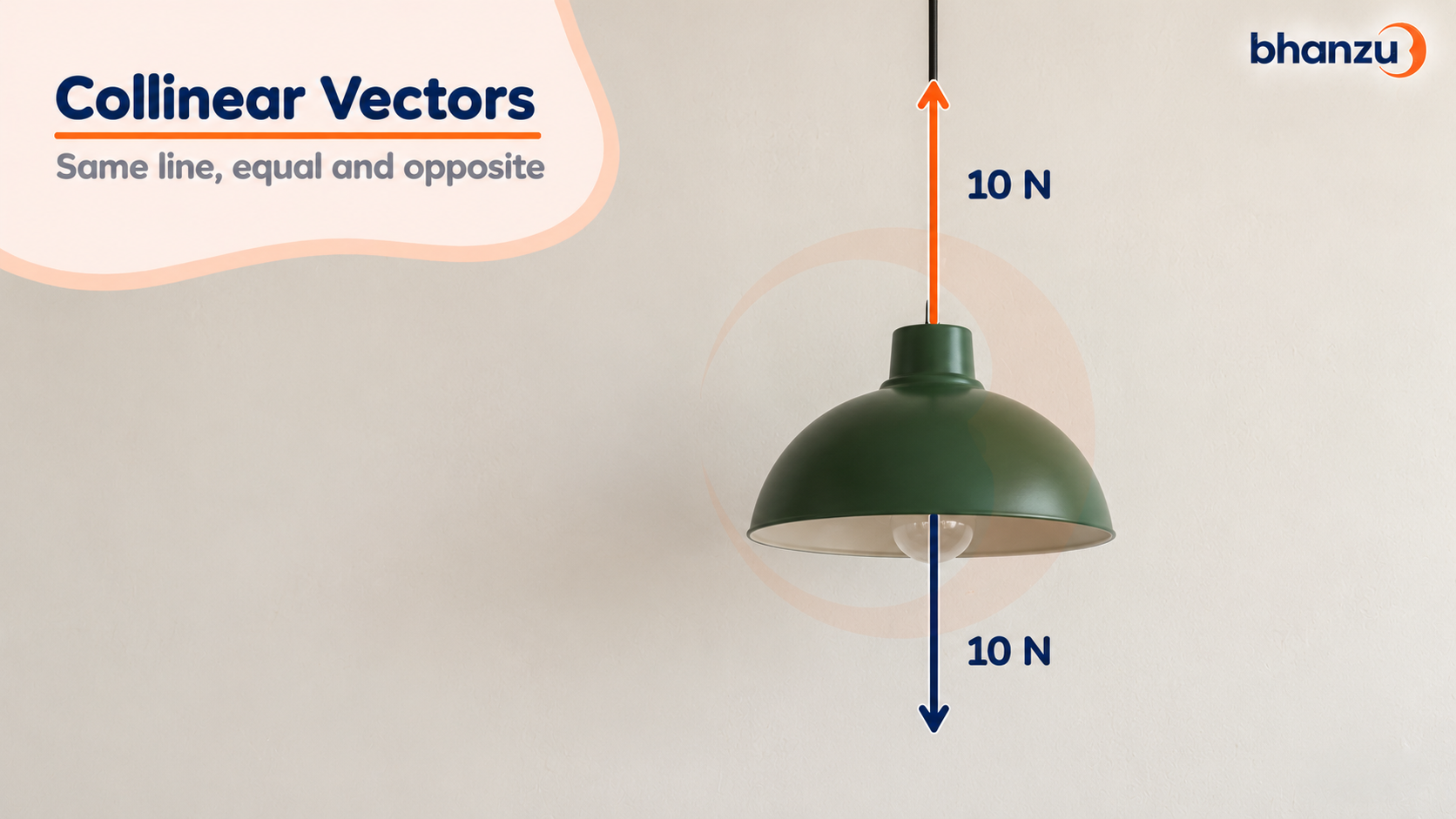
Collinear: and lie along the same straight line, just facing opposite ways.
Scalar rule: for any scalar , the relation holds.
Zero vector: the negative of the zero vector is itself, .
Is a Negative Vector the Same as a Negative Number?
No, and this is the confusion worth clearing up early. A negative number like is smaller than zero on a number line. A negative vector is not "less than zero" - it has a positive magnitude just like the original. The minus sign in is an instruction about direction, not size. Saying a vector "is negative" is loose; what is negative is the scalar applied to it, which reverses its heading.
Examples of the Negative of a Vector
Example 1
If , find .
Flip the sign of each component.
Final answer: .
Example 2
A student is asked for the negative of and writes - where did it go wrong?
Wrong path. The student flips only the first term and leaves the untouched, perhaps thinking "it is already negative, so leave it."
Why it breaks. The negative of a vector multiplies every component by . Leaving unchanged means the result is not the true opposite; adding it to would not give . Check: .
Correct. Change the sign of each component, including the one that is already negative: Check: . True.
Final answer: .
Example 3
Given , write .
The vector is the negative of , because it retraces the same path in reverse.
Final answer: .
Example 4
If is the negative of , find .
The negative of is . Match components: So .
Final answer: .
Example 5
Verify that for .
Here . Add component by component:
Final answer: the sum is the zero vector, confirming is the additive inverse of .
Example 6
In parallelogram , name a vector that is the negative of .
In a parallelogram, opposite sides are equal in length and opposite in direction. The side points the same way as , so it is equal, not negative. The side runs opposite to along the same length.
Final answer: (equivalently, ).
Where Does the Negative of a Vector Earn Its Keep?
The negative of a vector is how the physical world expresses "the exact opposite" — a push met by an equal pull, a trip retraced, a force balanced.
Displacement and navigation. The return leg of any journey is the negative of the outbound displacement; the two sum to zero net displacement when you arrive home.
Forces in equilibrium. When an object sits still, the forces on it cancel in opposing pairs — each balancing force is the negative of another, summing to .
Vector subtraction. Subtracting is adding the negative: . Every subtraction of vectors quietly uses a negative vector under the hood, which connects directly to addition of vectors.
The idea that direction carries a sign is central to how physics is written. A Euclidean vector always stores both magnitude and direction, and reversing the direction - the negative - is the operation behind action-reaction pairs and balanced systems. A negative vector is also always collinear with the original, since both lie along the same straight line, just pointing opposite ways.
What Are the Most Common Mistakes With the Negative of a Vector?
Mistake 1: Flipping only some components
Where it slips in: When a vector already has a negative component.
Don't do this: Writing the negative of as , leaving the alone.
The correct way: Multiply every component by , so becomes . The rusher who flips just the leading term produces a vector that does not cancel the original. A quick check: the true negative must add to .
Mistake 2: Thinking a negative vector has negative or smaller magnitude
Where it slips in: Carrying number-line intuition over to vectors.
Don't do this: Saying is "less than" or has negative length.
The correct way: Magnitude is always non-negative, and . The minus sign changes direction, not size. The memoriser who equates "" with "smaller" lands here — anchor it on the picture of two equal arrows facing opposite ways.
Mistake 3: Confusing the negative vector with an unrelated equal vector
Where it slips in: In parallelogram and polygon problems.
Don't do this: Calling the negative of when it actually points the same way.
The correct way: The negative must point in the opposite direction along the same line, like or . Same direction means equal, opposite direction means negative. In physics, this is the difference between two forces adding up and two forces cancelling - treating a same-direction force as its opposite is the modelling version of the same slip, and it is exactly the reversal that a true Euclidean vector tracks through its sign.
Conclusion
The negative of a vector has the same magnitude as but points in the exact opposite direction.
You find it by multiplying every component by : if , then .
Its magnitude is unchanged, , because squaring removes the sign.
A negative vector is not a "negative number" — the minus sign flips direction, not size.
The original and its negative always sum to the zero vector, which is what makes vector subtraction work.
To take vectors further with a teacher, explore Bhanzu's geometry tutor or a high school math tutor, or browse math classes online for guided vector practice.
Read More
Practice These to Solidify Your Understanding
Work through these problems in order:
Find the negative of .
If , write and state its magnitude.
If is the negative of , find .
Answer to Question 1: . Answer to Question 2: , magnitude . Answer to Question 3: , , so .
Want a live Bhanzu trainer to work through vector operations with you? Book a free demo class.
Was this article helpful?
Your feedback helps us write better content
Frequently Asked Questions
How do you find the negative of a vector?
What is the magnitude of a negative vector?
Is a negative vector a real vector?
Is the negative of a vector the same as reversing its direction?
What do a vector and its negative add up to?