

Verified Author
Madhukar V
Math Columnist & Analyst
Bhanzu
I see mathematics as more than just numbers and formulas—it is a way of thinking, questioning, and understanding the world around us. I work at the intersection of mathematics, EdTech, technology, and AI-powered learning, I enjoy exploring how mathematical ideas can be made simple, meaningful, and relatable. Through my articles, I aim to present mathematics with curiosity and a practical perspective, helping readers see the beauty and relevance behind every concept in a Bhanzu way.
15
Articles
5
Topics
1
Degree
📋Editorial Standards: All articles by Madhukar V are reviewed for accuracy and aligned with Bhanzu's editorial guidelines. Content is based on expertise in Statistics and Probability and formal education at DSI.
🎓 Education & Qualifications
Bachelor of Engineering
DSI · 2016
📚 Topics Covered
Articles by Madhukar V
(15)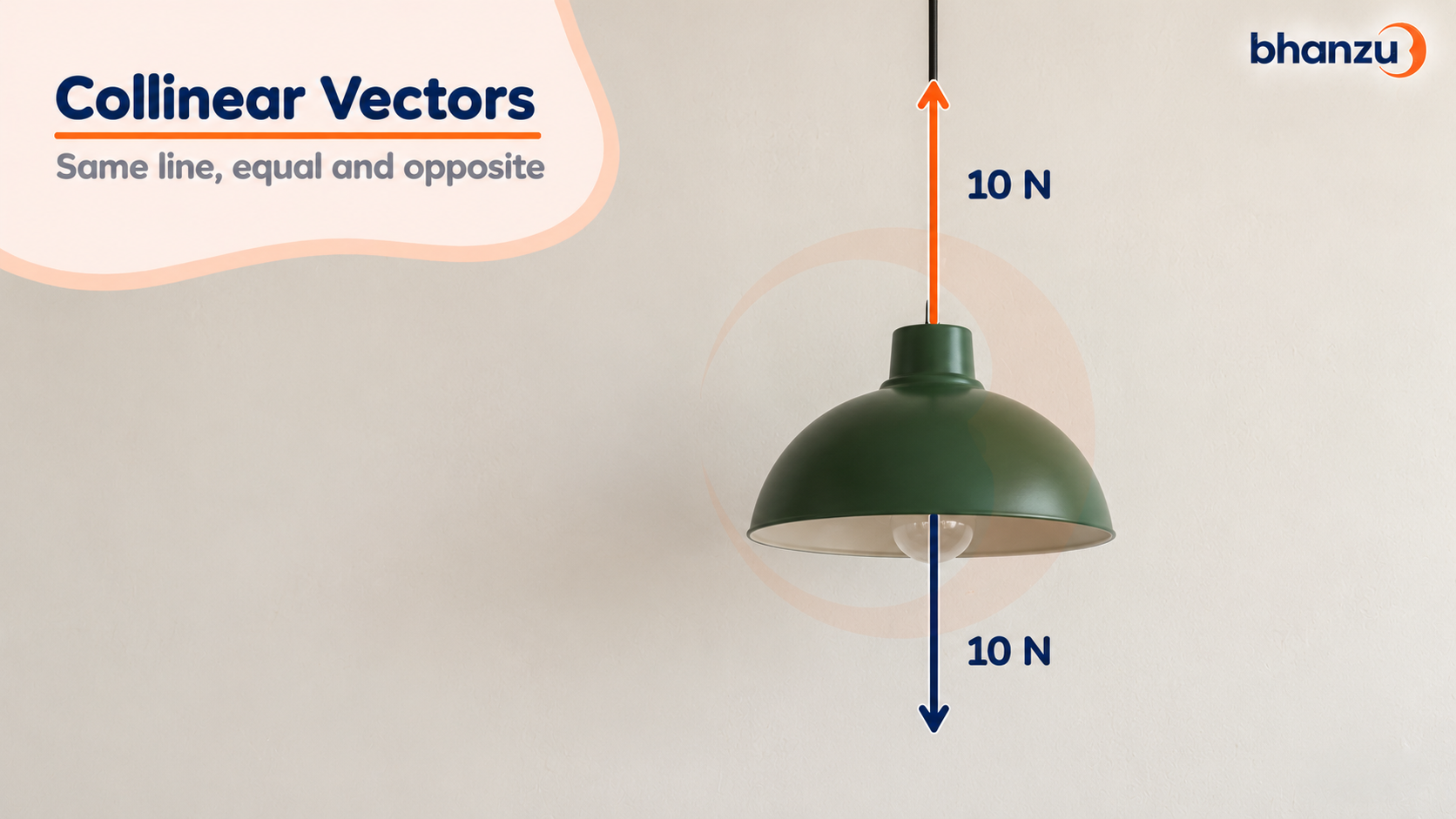
Collinear Vectors — Definition, Conditions, Examples
Collinear vectors are vectors that lie along the same line — which means one is always a scalar multiple of the other, a = k,b. This article covers the three tests for collinearity (scalar multiple, equal coordinate ratios, zero cross product), how collinear differs from parallel and coplanar, and worked examples.

Rotational Symmetry - Order & Angle of Rotation
Rotational symmetry means a shape maps exactly onto itself when turned about its centre by some angle smaller than a full turn. The order counts how many times it matches in one 360° rotation, and the angle of rotation is 360°/(order); this guide gives the definitions, six worked examples, and the traps that produce a wrong order.
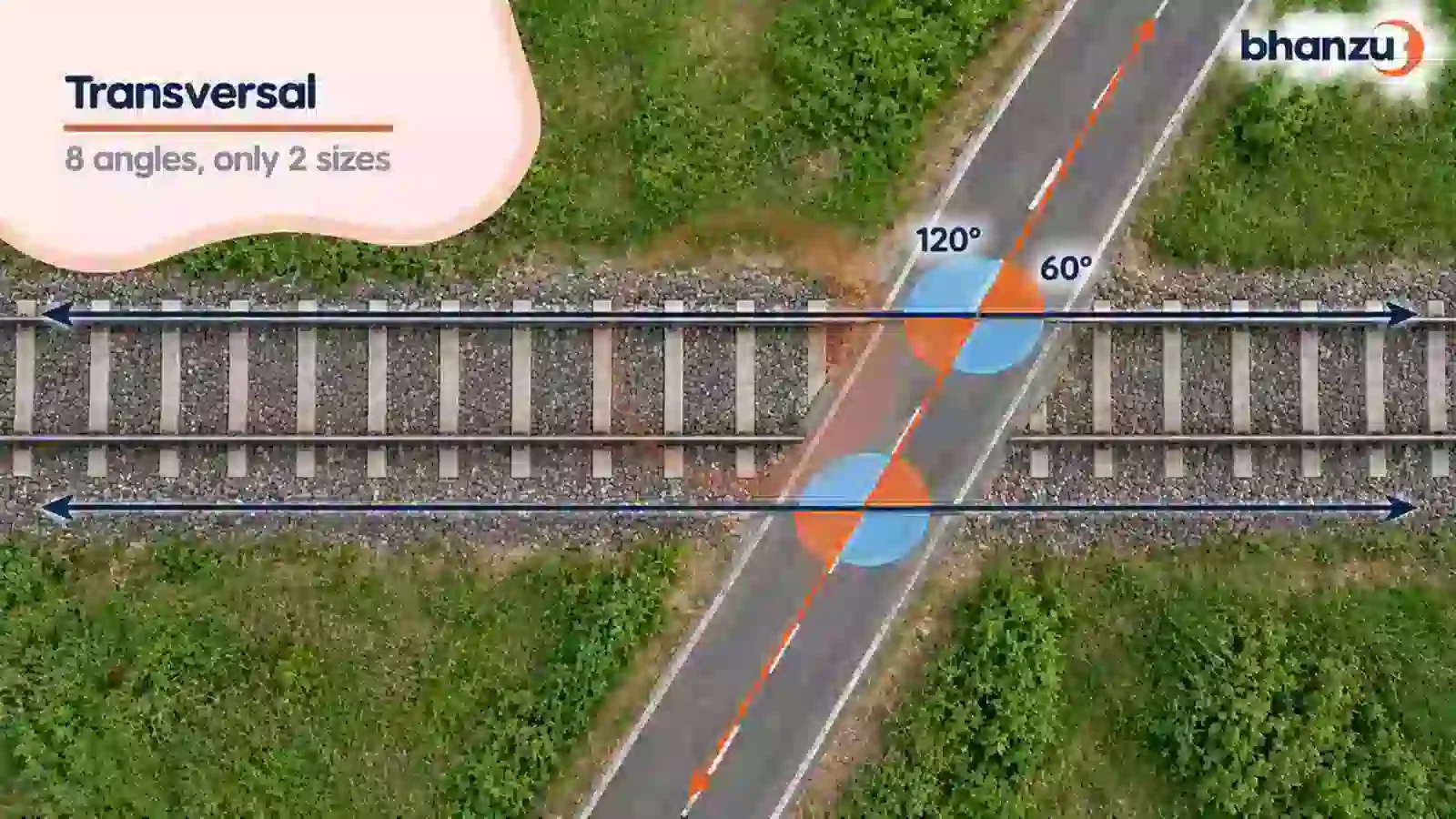
What Is a Transversal - All 8 Angles and Pair Relationships
A transversal is a line that crosses two or more other lines at distinct points. When the transversal crosses two parallel lines, exactly 8 angles form — grouped into four named pair-relationships (corresponding, alternate interior, alternate exterior, co-interior).
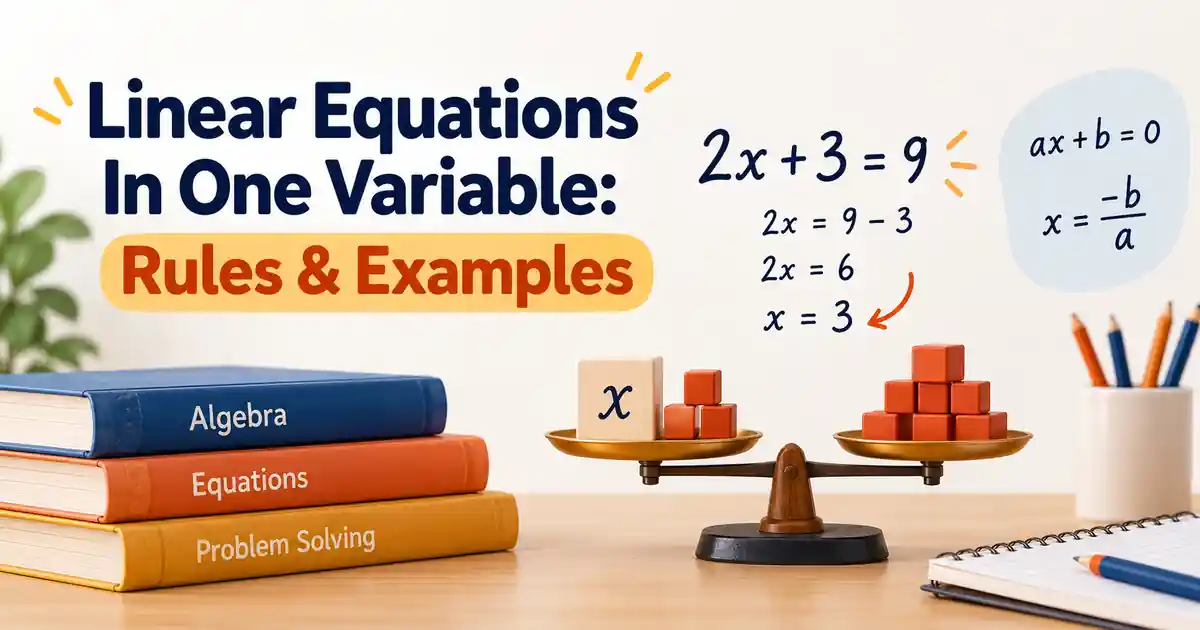
Linear Equations In One Variable: Rules & Examples
Linear equations in one variable can be written in the form ax + b = 0. If a ≠ 0 there is exactly one solution, x = -b/a; if a = 0, there is no solution (b ≠ 0) or every number is a solution (b = 0).
Integration of Logarithmic Functions With Examples
The integral of ln x is xln x - x + C, by integration by parts. This guide to integration of logarithmic functions extends that move to other bases, linear insides, powers and definite integrals.
Infinite Limits: Definition, Asymptotes and Examples
An infinite limit means f(x) grows without bound as x approaches a, so the graph has a vertical asymptote there. This guide covers infinite limits, sign analysis, asymptotes and limits at infinity.
Roots In Polynomial Expressions: Full Guide
Roots in polynomial expressions are the values of x that make the polynomial equal zero, so a root of P(x) is any x with P(x) = 0. A number r is a root exactly when (x - r) is a factor, and by the Fundamental Theorem of Algebra a degree-n polynomial has exactly n roots when you count multiplicity and allow complex numbers.
Tan 7pi/6 : Exact Value 1/√3 Explained
The value of tan 7π/6 is exactly 1/(√3), or in rationalised form (√3)/3, which is about 0.5774. This article shows why the answer is positive (the angle lands in the third quadrant), how the reference angle (π)/6 produces the value, and how the unit circle confirms it, with a tangent table, worked examples, and the mistakes to sidestep.
Semicircle Formulas — Area, Perimeter, Diameter
The semicircle formulas are: area = 1/2π r², arc length = π r, perimeter = π r + 2r = r(π + 2), and diameter = 2r. This article gives every semicircle formula, why each comes from the full-circle analogue, three worked examples spanning Quick to Stretch, and the single most common mistake students make — forgetting the diameter when computing perimeter.
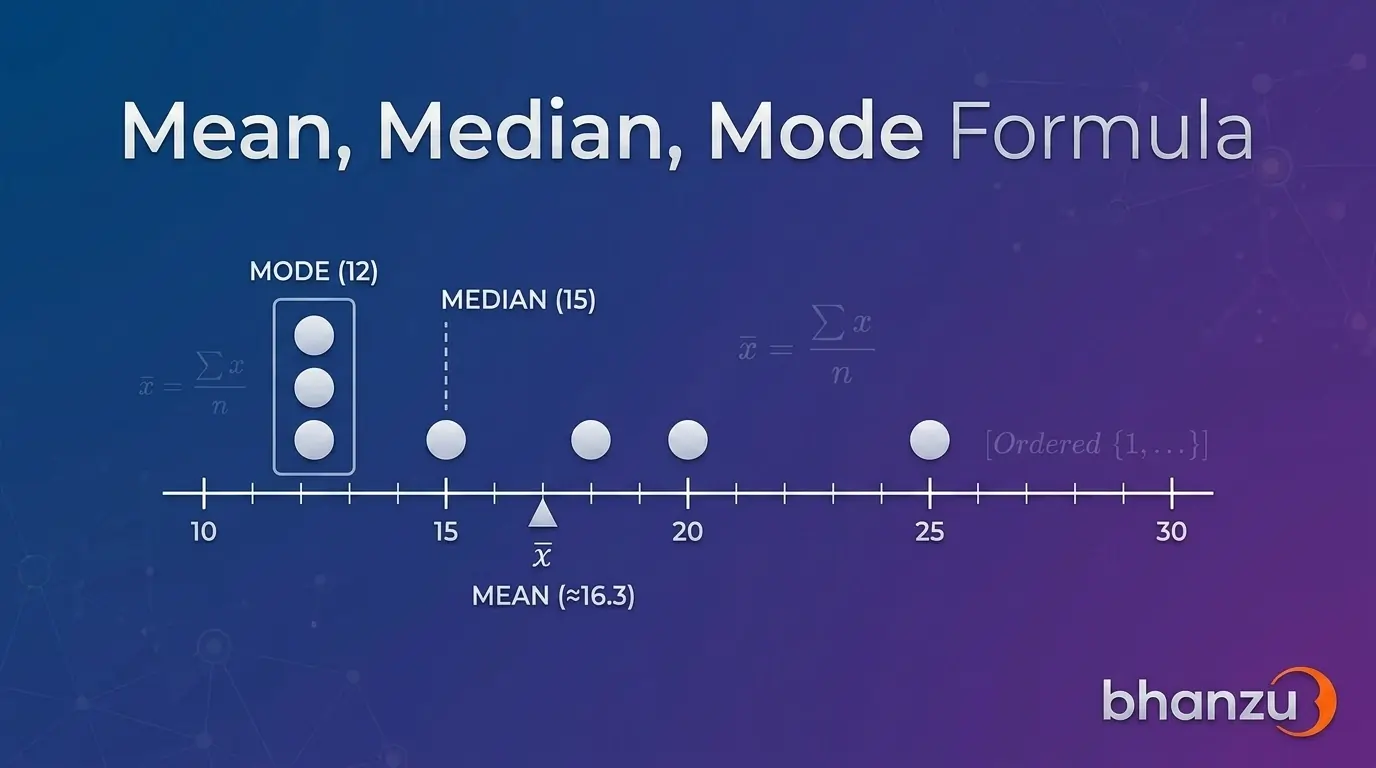
Mean, Median, Mode Formula - Differences, Use, and Examples
The mean is the average of all values (Σx / n), the median is the middle value when data is ordered, and the mode is the value that appears most often. Use the mean for symmetric data, the median for skewed data with outliers, and the mode for categorical data. For moderately skewed distributions, the three are linked by Karl Pearson's empirical relation: Mode = 3 Median − 2 Mean.
Volume Of Solids Of Revolution: Disk, Washer, Shell
The volume of solids of revolution is the volume you get when a flat region is rotated about a straight line, and integration adds up the thin pieces the spin creates. Three formulas do the whole job: the disk method V = π∫ₐ b [R(x)]²,dx when the solid is solid through the middle, the washer method V = π∫ₐ b ([R(x)]² - [r(x)]²),dx when there is a hole, and the cylindrical shell method V = 2π∫ₐ b x,h(x),dx when it is easier to slice parallel to the axis. Which one you pick depends on the axis of rotation and whether the region touches it.
Washer Method: Volume Of Revolution Formula
The Washer Method finds the volume of a solid of revolution that has a hole through it, by slicing the solid into thin rings (washers) perpendicular to the axis of rotation. Each ring has an outer radius R and an inner radius r, so its area is π(R² - r²), and the volume is V = π∫ₐ b (R² - r²),dx. Use it when the region being revolved does not touch the axis, so a gap is left in the middle.
Velocity and Acceleration: Calculus Derivatives
Velocity and acceleration are what you get when you differentiate a position function. If s(t) gives position, then velocity is the first derivative v(t) = s'(t) (a signed rate that carries direction), speed is its size |v(t)|, and acceleration is the second derivative a(t) = v'(t) = s''(t). Integration runs the chain backwards: v = ∫ a,dt and s = ∫ v,dt, each fixed by an initial condition.
Coefficient - Definition, Types, and Math Examples
A coefficient is the number that multiplies a variable in an algebraic expression — in 3x, the coefficient is 3. This article covers the formal definition, the four types of coefficients, how to identify them in any expression, the rule for variables with no visible number, and the most common mistakes when picking out the coefficient.
Properties of Logarithms - Laws, Formulas, Proofs
The properties of logarithms are seven identities that simplify logarithmic expressions: the product rule (log b(xy) = log b x + log b y), quotient rule (log b(x/y) = log b x - log b y), power rule (log b(xⁿ) = n log b x), change-of-base formula, and three special values (log b 1 = 0, log b b = 1, log b bⁿ = n).