What Are The Lines Of Symmetry Of A Rhombus?
A line of symmetry is a straight line that folds a shape into two halves that land exactly on top of each other, each half a mirror image of the other. For a rhombus — a quadrilateral with all four sides equal in length — there are precisely two such lines, and each one lies along a diagonal.
Picture the rhombus as a diamond standing on one point. Its long diagonal runs top to bottom; its short diagonal runs side to side. Fold along either diagonal and the two triangular halves settle perfectly onto each other. Fold along any other line — a horizontal midline, a vertical midline, a slanted line through the centre — and the halves overhang. Only the diagonals pass the fold test.
The reason is baked into the shape. In a rhombus the two diagonals are perpendicular bisectors of each other: they cross at and each cuts the other exactly in half. A diagonal therefore reflects each half of the rhombus onto the other, which is exactly what a mirror line does. If you want the underlying reflection rule in full, see reflection symmetry and the broader idea of line symmetry.
Why Exactly Two, And Where They Run
Two conditions decide whether a candidate line is a genuine line of symmetry:
Equal distance. Every point on one side has a partner the same distance from the line on the other side.
Perpendicular match. The segment joining a point to its mirror partner crosses the line at a right angle.
A rhombus satisfies both conditions along each diagonal and along nothing else:
Diagonal 1 (vertex to opposite vertex). Reflects the left half onto the right half. Line of symmetry.
Diagonal 2 (the other vertex pair). Reflects the top half onto the bottom half. Line of symmetry.
Horizontal / vertical midlines. Split the area evenly but produce a lopsided fold. Not lines of symmetry.
So the count is 2, both along the diagonals — no more, no fewer, for any rhombus that is not also a square.
Examples Of Rhombus Lines Of Symmetry
These build from stating the count, through the square comparison, to the coordinate check. One of them walks through a tempting wrong answer first.
Example 1
How many lines of symmetry does a rhombus have, and where are they?
A rhombus has 2 lines of symmetry.
Both run along the diagonals — one from the top vertex to the bottom vertex, the other from the left vertex to the right vertex.
Each diagonal folds the rhombus into two matching halves, which is exactly the mirror-line test, so each diagonal is a line of symmetry.
Example 2
Does a rhombus have 4 lines of symmetry like a square? Watch a tempting answer first.
The tempting answer is 4: two diagonals plus the horizontal and vertical midlines, since a square has all four and a rhombus looks like a "leaning square."
Test a midline by folding. Take a rhombus that is clearly not a square — a long thin diamond. Fold it along the horizontal line through the midpoints of the two slanted sides. The top point pokes out well past the bottom point; the halves do not overlap. The midline fails.
The correct count is 2. A square earns 4 lines only because its angles are all , which makes its midlines work as mirror lines too. A rhombus has equal sides but slanted angles, so its midlines fail and only the diagonals survive. Equal sides do not buy you a square's symmetry.
Example 3
A rhombus has diagonals of length 6 cm and 8 cm. Do both diagonals still act as lines of symmetry?
Yes. The lengths being different does not matter.
Symmetry along a diagonal depends only on the diagonals being perpendicular bisectors of each other, which is true in every rhombus regardless of the individual lengths.
Fold along the 8 cm diagonal and the two halves match; fold along the 6 cm diagonal and the two halves match. Both are lines of symmetry, so the count stays 2.
Example 4
Reflect the rhombus vertex at across the vertical diagonal lying on the y-axis. Where does it land?
Place the rhombus centre at the origin with one diagonal on the y-axis. Reflecting across the y-axis (the line ) flips the sign of the x-coordinate and leaves the y-coordinate unchanged.
The vertex at maps to the opposite vertex at , confirming that the vertical diagonal reflects one side of the rhombus onto the other.
Example 5
How does the rhombus's symmetry compare with its rotational symmetry?
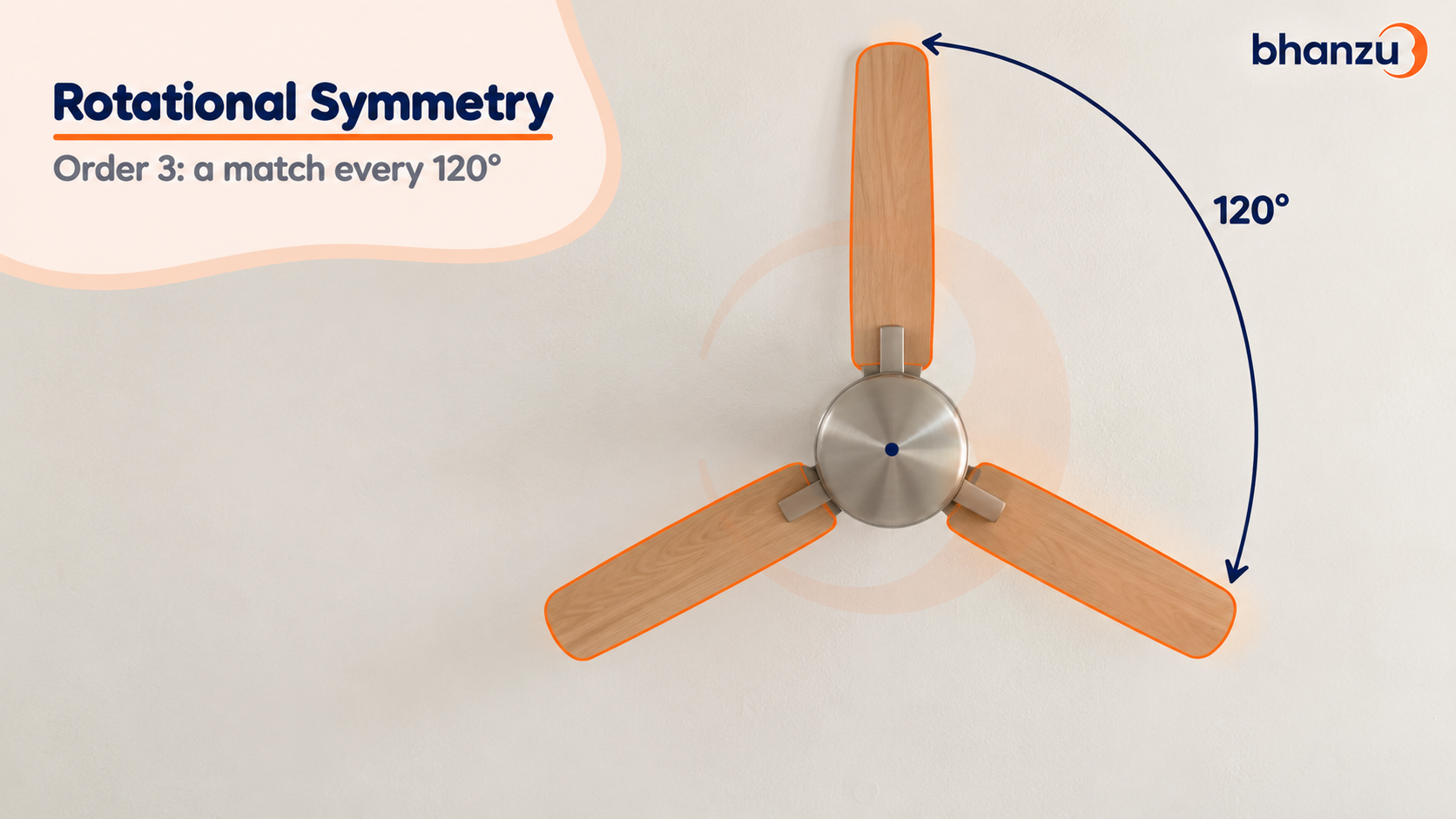
A rhombus has 2 lines of symmetry (reflection) and rotational symmetry of order 2.
Order 2 means that during one full turn of , the rhombus lands back on itself twice: once at and once at . Turn it only and it does not match — that is why it is order 2, not order 4.
Reflection symmetry and rotational symmetry are separate properties; a rhombus happens to carry both.
Example 6
A kite has all four sides in two equal pairs. Does it have the same 2 lines of symmetry as a rhombus?
No. A kite has only 1 line of symmetry, along the diagonal that joins the two vertices between the unequal sides.
A rhombus is a special kite in which all four sides are equal, and that extra equality gives it a second line of symmetry along the other diagonal. So the jump from a kite to a rhombus is a jump from 1 line of symmetry to 2. This is the difference between a kite and a rhombus written in symmetry terms.
Why Rhombus Symmetry Matters — "The Diamond that Pays for its Own Strength"
The rhombus earns its two lines of symmetry from a single structural fact: its diagonals cross at right angles and bisect each other. That perpendicular crossing is not just a geometry curiosity — it is why diamond-shaped bracing shows up everywhere load has to be spread evenly.
Structure and bracing. Rhombic and diamond lattices distribute force along their diagonals, which is exactly the axis their symmetry runs along. A truss braced in diamonds carries load symmetrically down both diagonals, so no single joint takes an uneven share.
Crystals and materials. Many crystals grow in rhombic cells because the symmetric packing minimises energy. The rhombus shape is nature's way of tiling a plane with equal-length edges.
Where the maths is going. Once you can locate a shape's mirror lines, you can predict its reflections without redrawing anything. Reflecting across a diagonal preserves every length and angle, which connects rhombus symmetry to congruence and, more broadly, to the wider study of symmetry in geometry. The Alhambra tilings in Spain are a famous real-world catalogue of exactly these reflection axes at work across rhombic tiles.
The two lines of symmetry and the perpendicular diagonals are the same fact seen twice — one from the folding side, one from the crossing side.
Mistakes To Watch For With Rhombus Symmetry
Mistake 1: Giving a rhombus 4 lines of symmetry
Where it slips in: counting symmetry lines straight after studying the square, when the "equal sides" of a rhombus feel square-like.
Don't do this: add the horizontal and vertical midlines to the two diagonals to reach 4.
The correct way: apply the fold test to a midline. On a non-square rhombus the halves overhang, so the midline fails. The most common first instinct is to import the square's count of 4; the fix is to fold a genuinely slanted rhombus and watch the midline break. The count is 2.
Mistake 2: Thinking the diagonals are lines of symmetry only when they are equal
Where it slips in: problems that give two different diagonal lengths, like 6 cm and 8 cm.
Don't do this: decide that because the diagonals differ in length, they cannot both be mirror lines.
The correct way: a diagonal is a line of symmetry because it perpendicularly bisects the rhombus, not because it equals the other diagonal. Different lengths still give 2 lines of symmetry. Equal diagonals would make the shape a square, which is a different case.
Mistake 3: Confusing lines of symmetry with rotational symmetry
Where it slips in: questions that ask for "the symmetry" of a rhombus without saying which kind.
Don't do this: answer "2" and assume it covers everything, or mix up "2 lines of symmetry" with "order 2 rotation" as if they were the same statement.
The correct way: name the two separately — 2 lines of symmetry (reflection) and order 2 (rotation). The same confusion sinks students on parallelograms in the real world: a general parallelogram has 0 lines of symmetry but still has order-2 rotation, so reporting "it's symmetric" without saying which kind gives the wrong answer. Keep the two ideas on separate tracks.
Key Takeaways
A rhombus has 2 lines of symmetry, both running along its diagonals.
The diagonals work as mirror lines because they are perpendicular bisectors of each other, crossing at .
Midlines fail the fold test on any non-square rhombus, so the count is 2, not 4.
Diagonals of different lengths still give 2 lines of symmetry — length does not matter, perpendicular bisection does.
Reflection symmetry (2 lines) and rotational symmetry (order 2) are separate properties a rhombus both carries.
To take rhombus lines of symmetry further with a teacher, explore Bhanzu's geometry tutor sessions, a middle school math tutor for shapes and symmetry, or general math classes online.
Try These Problems
Practice these problems to solidify your understanding. Work through them and check the answers below.
How many lines of symmetry does a rhombus with diagonals 5 cm and 12 cm have, and where do they run?
A square is a special rhombus. How many lines of symmetry does it gain over an ordinary rhombus, and why?
Reflect the rhombus vertex at across the horizontal diagonal lying on the x-axis.
Answer to Question 1: 2 lines of symmetry, both along the diagonals; the different lengths do not change the count. Answer to Question 2: It gains 2 (going from 2 to 4), because its right angles make the two midlines work as mirror lines. Answer to Question 3: .
Want a live Bhanzu trainer to walk through more symmetry problems? Book a free demo class.
Read More
Was this article helpful?
Your feedback helps us write better content
Frequently Asked Questions
How many lines of symmetry does a rhombus have?
Why does a rhombus have only 2 lines of symmetry and not 4?
Are the diagonals of a rhombus its lines of symmetry?
Does a rhombus have rotational symmetry too?
Do a rhombus and a square have the same lines of symmetry?