What Is Reflection Symmetry?
Reflection symmetry is the property a shape has when you can draw a straight line through it so that one half is the exact mirror image of the other. That line is the mirror line (or line of symmetry), and reflection symmetry goes by several names you will meet in different textbooks: line symmetry, mirror symmetry, and bilateral symmetry all mean the same thing.
The test is simple to picture. Fold the shape along the candidate line. If the two halves land perfectly on top of each other with no overhang, the line is a genuine line of symmetry and the shape has reflection symmetry. If any part sticks out, it is not.
Reflection symmetry is one member of the wider family of symmetry in mathematics, and it sits alongside its cousins in symmetry in geometry. What makes reflection symmetry specific is the mirror line: it is about flipping across a line, not turning around a point.
For an Example: A butterfly you fold down the middle proves it: the two wings land exactly on top of each other.
The mirror-line rule, precisely
Two conditions must both hold for a line to be a line of symmetry:
Equal distance. Every point on one side has a partner point on the other side, exactly as far from the line.
Perpendicular match. The line joining a point to its mirror partner crosses the mirror line at a right angle, .
The mirror line can run in any direction - vertical, horizontal, or slanted. A shape can have no lines of symmetry (a scalene triangle), one (an isosceles triangle), several (a rectangle has 2), or many (a regular pentagon has 5, and a circle has infinitely many). Counting them correctly is the skill most problems test.
Shape | Lines of symmetry | Where they run |
|---|---|---|
Scalene triangle | 0 | none |
Isosceles triangle | 1 | vertex to base midpoint |
Equilateral triangle | 3 | each vertex to opposite side |
Rectangle | 2 | horizontal and vertical midlines |
Square | 4 | 2 midlines and 2 diagonals |
Regular pentagon | 5 | each vertex to opposite side midpoint |
Circle | infinite | any diameter |
For the rectangle specifically, note that the two diagonals are not lines of symmetry even though they split it into equal areas - a common trap covered in the mistakes below.
Examples Of Reflection Symmetry
These build from spotting a mirror line up to reflecting a point across an axis. One of them shows a wrong turn worth walking through.
Example 1
Does the capital letter A have reflection symmetry, and where is the mirror line?
Picture the letter A. A single vertical line down its centre splits it so the left stroke mirrors the right stroke, and the crossbar matches on both sides.
Fold along that vertical line and the halves land on each other. So yes, A has reflection symmetry, with one vertical line of symmetry.
By contrast, the letter R has none - no line you draw makes its two sides match.
Example 2
How many lines of symmetry does a rectangle have? Watch a tempting answer first.
The tempting answer is 4: the two midlines plus the two diagonals, since a rectangle looks balanced along all four.
Test the diagonal by folding. Fold a non-square rectangle along a diagonal, and the two triangular halves do not land on each other - one is longer and thinner than the other. The diagonal splits the rectangle into two equal areas, but they are not mirror images, so it fails the fold test.
The correct count is 2: only the horizontal midline and the vertical midline are true lines of symmetry. Equal area is not the same as mirror-image match - that is the whole point of the rule.
Example 3
How many lines of symmetry does a regular hexagon have?
For any regular polygon, the number of lines of symmetry equals the number of sides. A hexagon has 6 sides, so it has 6 lines of symmetry: 3 run from each vertex to the opposite vertex, and 3 run from each side's midpoint to the opposite side's midpoint.
Example 4
Reflect the point across the y-axis. Where does it land?
Reflecting across the vertical y-axis (the line ) flips the sign of the x-coordinate and leaves the y-coordinate unchanged.
The image point is , sitting the same distance from the y-axis on the opposite side.
Example 5
Reflect the point across the x-axis.
Reflecting across the horizontal x-axis (the line ) flips the sign of the y-coordinate and leaves x unchanged.
The distance to the x-axis, 5 units, is preserved, so the mirror rule holds.
Example 6
Which of these has reflection symmetry: the letter S, the letter H, the number 8?
Test each with the fold.
The letter H has 2 lines of symmetry - a vertical line and a horizontal line both make the halves match.
The number 8 also has 2 lines of symmetry, vertical and horizontal.
The letter S has none - no straight fold makes its curves overlap. (It does have rotational symmetry, which is a different property.)
Why Reflection Symmetry Matters - "Nature builds In Mirror Pairs"
Reflection symmetry is one of the first patterns humans ever noticed, because living things wear it. Faces, butterfly wings, leaves, and the human body are all built as mirror pairs - biologists call it bilateral symmetry, and it is thought to signal health and balance, which is why we read symmetric faces as attractive.
Biology and perception. Most animals are bilaterally symmetric, with a left side that mirrors the right. Reflections of mountains in a still lake are the everyday version of the same idea.
Design and engineering. Architects use reflection symmetry to make buildings feel stable and balanced; a symmetric facade distributes visual weight evenly, the same reason a symmetric bridge distributes physical load evenly.
Where the maths is going. In coordinate geometry, reflecting a point across the x-axis or y-axis is a formal transformation with a clean rule, which leads into congruence: a shape and its mirror image are always congruent because reflection preserves every length and angle. That connects reflection symmetry to the line symmetry of a rectangle and beyond, into functions whose graphs are symmetric about the axis of symmetry.
The reason reflection preserves shape is exactly the mirror-line rule: equal distances and perpendicular matches mean no length is stretched and no angle is bent.
Mistakes To Watch For With Reflection Symmetry
Mistake 1: Thinking any line through the middle is a line of symmetry
Where it slips in: counting lines of symmetry for rectangles, parallelograms, and irregular shapes.
Don't do this: count a diagonal of a rectangle, or the "middle" line of a parallelogram, as a line of symmetry.
The correct way: apply the fold test - the two halves must be mirror images, not just equal areas. Students first meeting reflection symmetry often assume every line that cuts a shape into two equal pieces is a line of symmetry, which over-counts rectangles and parallelograms every time.
Mistake 2: Confusing reflection symmetry with rotational symmetry
Where it slips in: shapes like the letter S, the number 8, or a parallelogram that "look symmetric" but flip differently.
Don't do this: call the letter S line-symmetric because it looks balanced.
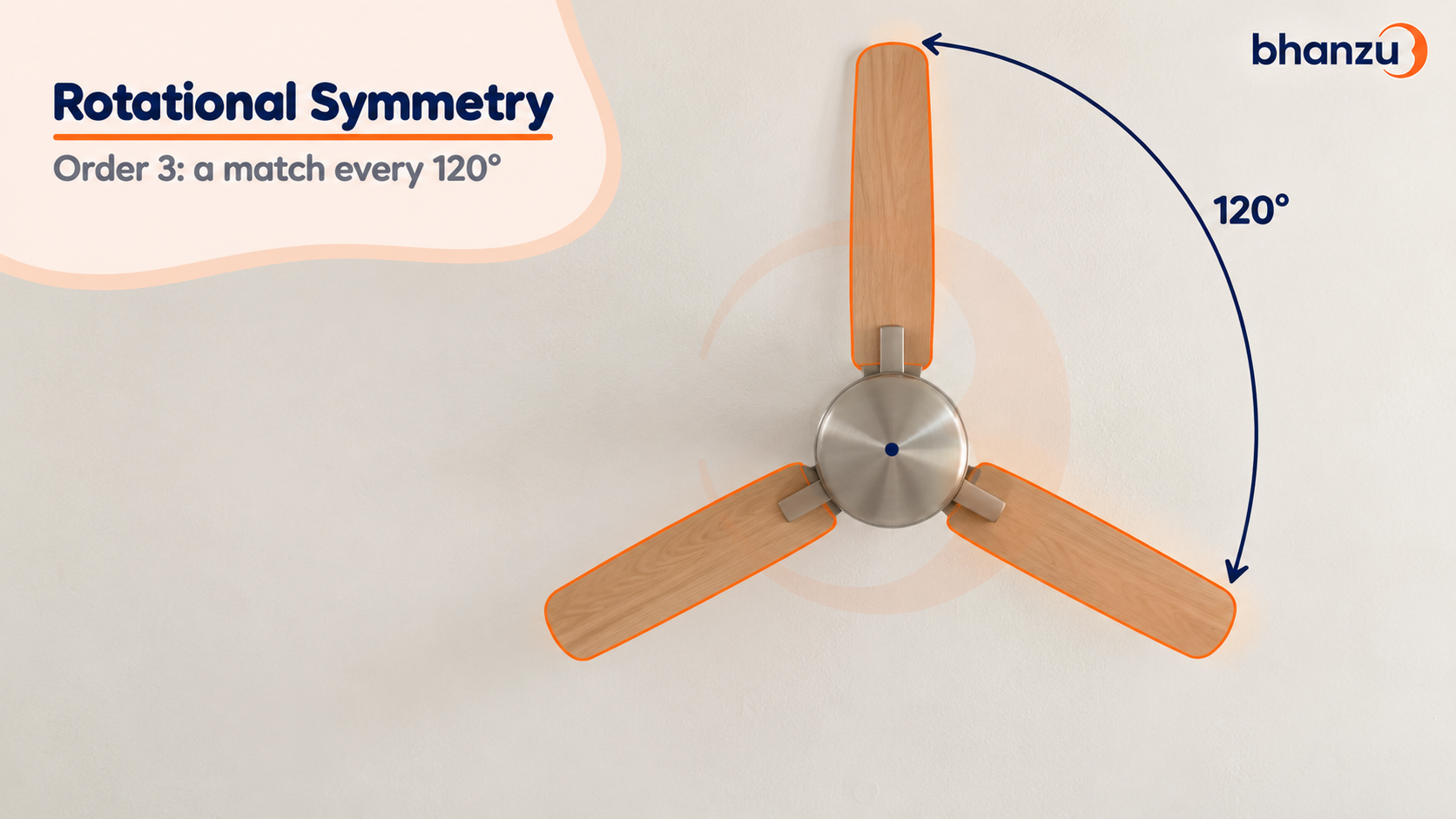
The correct way: reflection symmetry needs a line that produces a mirror image; rotational symmetry needs a point the shape can turn around. The letter S has rotational symmetry (turn it and it looks the same) but no reflection symmetry. Keep the two tests separate.
Mistake 3: Assuming every shape has symmetry
Where it slips in: irregular shapes, scalene triangles, and most everyday objects.
Don't do this: hunt for a line of symmetry on a scalene triangle and force one that doesn't exist.
The correct way: accept that many shapes have zero lines of symmetry. This matters in the real world: the Citicorp Center tower in New York was found in 1978 to be dangerously weak precisely because its off-centre, non-symmetric bracing carried wind loads unevenly - engineers had to secretly reinforce it. Asymmetry has real consequences; do not paper over it by inventing a line of symmetry.
Key Takeaways
Reflection symmetry means a mirror line (line of symmetry) splits a shape into two mirror-image halves.
The mirror-line rule: matching points sit at equal distance and their join is perpendicular to the line.
Reflection symmetry, line symmetry, mirror symmetry, and bilateral symmetry are the same thing.
For a regular polygon, lines of symmetry = number of sides; a rectangle has 2, not 4 (diagonals fail the fold test).
Reflecting across the y-axis sends to ; across the x-axis, to .
To take reflection symmetry further with a teacher, explore Bhanzu's geometry tutor sessions, an elementary math tutor for shapes and mirror lines, or general math classes online.
A Practical Next Step
Practice these problems to solidify your understanding. Work through them and check the answers below.
How many lines of symmetry does an equilateral triangle have, and where do they run?
Reflect the point across the y-axis.
Does the letter Z have reflection symmetry? Explain using the fold test.
Answer to Question 1: 3 lines - each runs from a vertex to the midpoint of the opposite side. Answer to Question 2: . Answer to Question 3: No. No straight fold makes the letter Z overlap itself; it has rotational symmetry only.
Want a live Bhanzu trainer to walk through more reflection symmetry problems? Book a free demo class.
Read More
Was this article helpful?
Your feedback helps us write better content
Frequently Asked Questions
What is reflection symmetry in simple words?
Is reflection symmetry the same as line symmetry?
How is reflection symmetry different from rotational symmetry?
How do you find the number of lines of symmetry in a regular polygon?
Can a shape have no line of symmetry?