How Many Lines Of Symmetry Does A Parallelogram Have?
A general parallelogram has zero lines of symmetry. A parallelogram is a quadrilateral with two pairs of parallel sides; a line of symmetry is a fold line that maps the shape exactly onto itself, one half a mirror image of the other. For a parallelogram that is not also a rectangle, rhombus, or square, no such line exists.
This surprises most students, because a parallelogram looks balanced. The trap is that "balanced" and "symmetric" are different. A line can cut a parallelogram into two pieces of equal area and still fail to be a line of symmetry, because equal area does not mean mirror image.
Every candidate fails the fold test:
Horizontal midline - folds the top edge onto the bottom, but the slant sends one side sliding past the other. Fails.
Vertical midline - same problem in the other direction. Fails.
Either diagonal - splits the area in half, but the two triangles are not mirror images across the diagonal; they are rotations of each other. Fails.
With no line surviving, the count is 0. If you want the underlying rule for what makes a fold line a mirror line, see line symmetry and reflection symmetry.
The Key Insight: Rotation Is Not Reflection
Here is the fact that unlocks the whole topic. A parallelogram has point symmetry, not line symmetry.
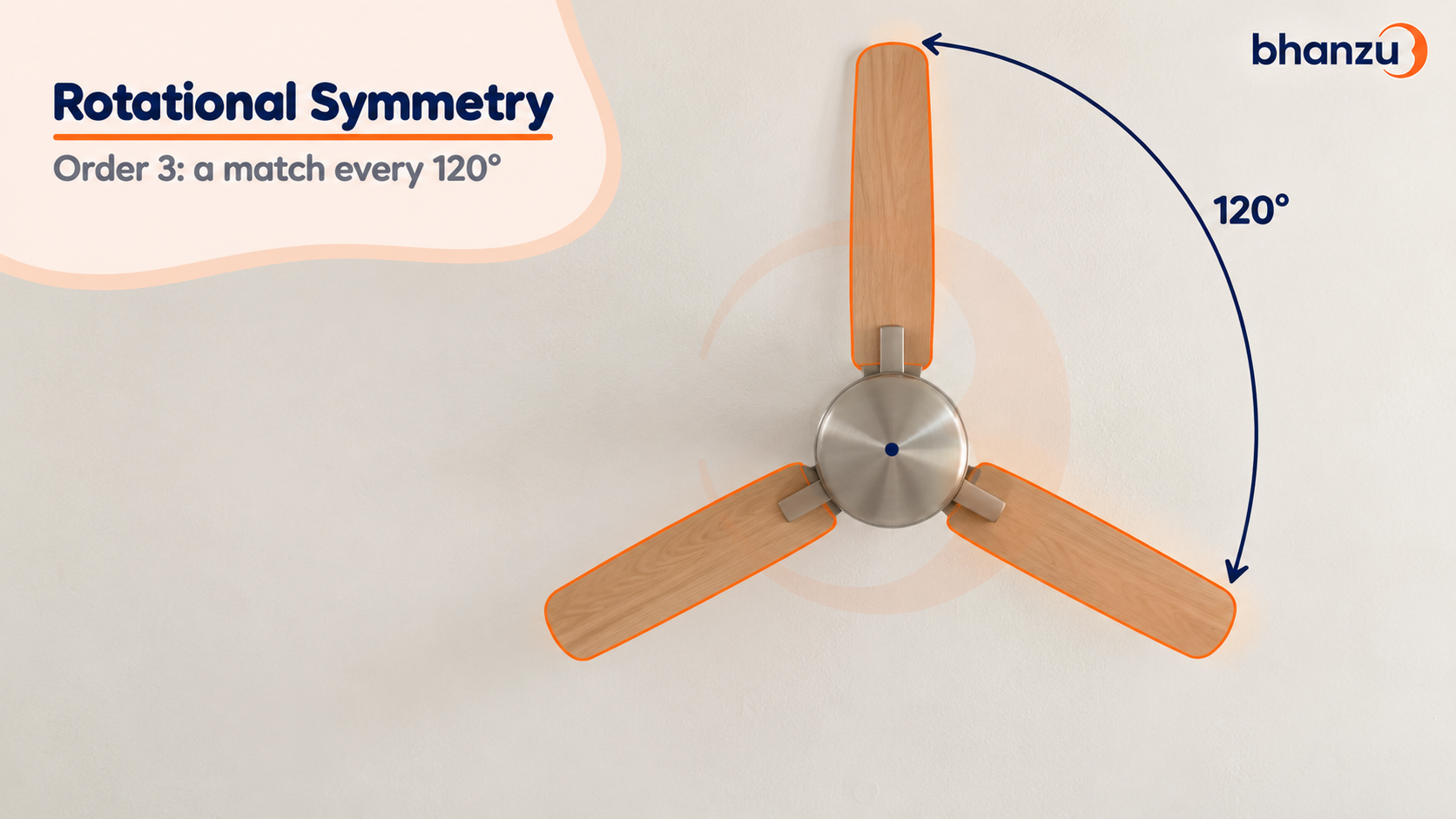
Point (rotational) symmetry — turn the parallelogram about its centre and it lands exactly on itself. This is order 2: it matches at and again at .
Line (reflection) symmetry — fold it across a line and the halves match. A general parallelogram cannot do this.
So when a parallelogram "looks symmetric," what your eye is catching is the rotation, not a mirror line. Naming which symmetry you mean is the entire skill here.
Examples Of Lines Of Symmetry In A Parallelogram
These build from the plain count, through the diagonal trap, to how special parallelograms recover their symmetry. One example walks a wrong turn first.
Example 1
How many lines of symmetry does a general parallelogram have?
A general parallelogram has 0 lines of symmetry.
No fold line - horizontal, vertical, or diagonal - divides it into two mirror-image halves.
The only symmetry it has is rotational symmetry of order 2, which is not a line of symmetry.
Example 2
Is a diagonal of a parallelogram a line of symmetry? Follow the tempting answer first.
The tempting answer is yes: a diagonal cuts the parallelogram into two triangles of equal area, so it feels like a mirror line.
Test it by folding. Fold the parallelogram along a diagonal. The upper triangle flips over and does not land on the lower triangle - it overhangs on one side and falls short on the other. The two triangles are congruent, but they are related by a rotation, not a reflection.
So the diagonal is not a line of symmetry. This is the single most common mistake on this topic: equal area is not mirror image. The count stays at 0.
Example 3
A rectangle is a parallelogram. How many lines of symmetry does it have, and why more than zero?
A rectangle has 2 lines of symmetry: the horizontal midline and the vertical midline.
A rectangle is a parallelogram whose angles are all . Those right angles line the sides up so that the midline fold makes the halves match. The slant that broke the general parallelogram is gone, so two midlines survive.
The diagonals of a rectangle are still not lines of symmetry, though - only the midlines are. That matches the lines of symmetry in a rectangle count of exactly 2.
Example 4
A rhombus is also a parallelogram. How many lines of symmetry does it have?
A rhombus has 2 lines of symmetry, both along its diagonals.
A rhombus is a parallelogram with all four sides equal. That equality makes the diagonals perpendicular bisectors of each other, so each diagonal becomes a mirror line.
Notice the flip from the rectangle: a rectangle's symmetry lines are its midlines, a rhombus's are its diagonals. See rhombus lines of symmetry for the full walkthrough.
Example 5
How many lines of symmetry does a square have, and how does it combine the rectangle and rhombus cases?
A square has 4 lines of symmetry.
A square is a parallelogram that is both a rectangle (right angles) and a rhombus (equal sides). It therefore inherits the rectangle's 2 midlines and the rhombus's 2 diagonals.
The square is the most symmetric member of the parallelogram family precisely because it satisfies both special conditions at once.
Example 6
Rank the parallelogram family by number of lines of symmetry.
From fewest to most, here is the whole family with their mirror lines drawn in:
General parallelogram - 0
Rectangle - 2 (midlines)
Rhombus - 2 (diagonals)
Square - 4 (midlines and diagonals)
Every one of them has rotational symmetry of at least order 2. What separates them is which extra conditions - right angles, equal sides, or both - unlock line symmetry on top of that rotation.
Why This Matters - "Symmetry Is A Promise About Balance"
The reason a general parallelogram has no line of symmetry is not a quirk - it is what "parallelogram" means once you strip away the special cases. Understanding it teaches a habit that carries into far harder mathematics: never assume symmetry from appearance; test it.
Engineering and load. A truly symmetric structure spreads load evenly across its mirror line. A parallelogram frame has no such line, so a force applied to one corner does not mirror across to the other - it shears. This is exactly why racking (a rectangle deforming into a parallelogram under sideways force) is a failure mode engineers brace against.
Physics of shear. A parallelogram is what you get when you push the top of a rectangle sideways - a shear transformation. Shear destroys reflection symmetry while preserving area, which is the geometric heart of why the diagonals split equal areas but not mirror images.
Where the maths is going. Classifying quadrilaterals by their symmetry is your first taste of group theory - the study of a shape's full set of symmetries. Rotations and reflections behave differently, and a parallelogram is the clean case where you have one without the other. The collapse of the Hyatt Regency walkway is a real-world reminder that a structure that only looks balanced is not the same as one that is.
The whole topic reduces to one sentence: a parallelogram is balanced by rotation, not by reflection.
Mistakes To Watch For Lines Of Symmetry In A Parallelogram
Mistake 1: Counting the diagonals as lines of symmetry
Where it slips in: the moment a problem shows the two diagonals cutting the parallelogram into equal-area triangles.
Don't do this: conclude that because the areas are equal, each diagonal is a line of symmetry, and report 2 lines.
The correct way: fold along the diagonal and watch the halves overhang. The two triangles are congruent by rotation, not reflection. The first instinct is always to equate equal area with mirror image; the fix is the fold test. A general parallelogram has 0 lines of symmetry.
Mistake 2: Confusing rotational symmetry with line symmetry
Where it slips in: questions phrased as "does a parallelogram have symmetry?" without saying which kind.
Don't do this: say "yes, it's symmetric" and leave it, or report the order-2 rotation as though it were a line of symmetry.
The correct way: state both separately - 0 lines of symmetry but rotational symmetry of order 2. The habit of saying "symmetric" loosely is what trips people; name the kind every time.
Mistake 3: Assuming every special parallelogram has the same symmetry lines
Where it slips in: memorising "rectangle has 2, rhombus has 2" and treating the two 2s as the same.
Don't do this: tell a student the rectangle's symmetry lines are its diagonals, or the rhombus's are its midlines.
The correct way: a rectangle's 2 lines are its midlines; a rhombus's 2 lines are its diagonals. They both total 2, but the lines sit in completely different places. In the real world this is the same slip that makes people assume any quadrilateral with "some symmetry" behaves like a square - it does not, and misjudging where a shape's balance line sits is how a design ends up loaded off-axis.
Key Takeaways
A general parallelogram has 0 lines of symmetry - the key insight of the whole topic.
Its diagonals give equal areas but not mirror images, so they are not lines of symmetry.
It does have rotational symmetry of order 2 ( turn), which is point symmetry, not line symmetry.
Special parallelograms recover line symmetry: rectangle 2 (midlines), rhombus 2 (diagonals), square 4 (both).
The lesson that transfers: test symmetry with the fold, never assume it from how balanced a shape looks.
To take lines of symmetry in a parallelogram further with a teacher, explore Bhanzu's geometry tutor sessions, a middle school math tutor for quadrilaterals and symmetry, or general math classes online.
Try These Problems
Practice these problems to solidify your understanding. Work through them and check the answers below.
How many lines of symmetry does a general (non-special) parallelogram have?
A parallelogram's diagonals cross and split it into four triangles. Does that make the diagonals lines of symmetry? Explain.
Order these by number of lines of symmetry: rhombus, square, general parallelogram, rectangle.
Answer to Question 1: 0. Answer to Question 2: No. The diagonals divide it into equal-area triangles that are rotations, not reflections, of each other, so they fail the fold test. Answer to Question 3: General parallelogram (0), rectangle and rhombus (2 each), square (4).
Want a live Bhanzu trainer to walk through more symmetry problems? Book a free demo class.
Read More
Was this article helpful?
Your feedback helps us write better content
Frequently Asked Questions
How many lines of symmetry does a parallelogram have?
Why does a parallelogram have no line of symmetry?
Does a parallelogram have any symmetry at all?
Which parallelograms do have lines of symmetry?
Is a diagonal of a parallelogram a line of symmetry?