What Is an Exterior Angle of a Triangle?
An exterior angle of a triangle is the angle formed between one side of the triangle and the extension of an adjacent side. At each vertex you can extend a side in one of two directions, so a triangle has six exterior angles in total — but we usually work with one per vertex, three in all.
Every exterior angle pairs with the interior angle right beside it. Together they sit on a straight line, so they form a linear pair and add to 180°. The two interior angles away from the exterior angle — the ones it does not touch — are called the remote interior angles (or opposite interior angles).
This builds directly on the interior angles of a triangle, and it is one of the standard properties of a triangle.
The Exterior Angle Theorem
The headline result, the exterior angle theorem, states:
An exterior angle of a triangle equals the sum of its two remote interior angles.
In symbols, if the exterior angle at is and the remote interior angles are and :
There is also an exterior angle inequality: any exterior angle is strictly greater than either one of its remote interior angles (since it equals their sum, it must beat each one alone).
A Short Proof
The proof uses two facts you already know, side by side.
First, the triangle sum theorem:
Second, the linear pair along the extended side:
Both right-hand sides are 180°, so set the left-hand sides equal:
Subtract from both sides:
The exterior angle equals the sum of the two remote interior angles.
The Sum of Exterior Angles of a Triangle
Take one exterior angle at each of the three vertices and add them:
Here is why. Each exterior angle is minus its adjacent interior angle. Add the three:
This 360° result is not special to triangles — the exterior angles of any convex polygon, one per vertex, total 360°.
Exterior Angle of a Triangle Formulas
A short opener: there are two ways to find an exterior angle, depending on what you know.
From the adjacent interior angle (linear pair): .
From the two remote interior angles (the theorem): .
Sum of all three (one per vertex): always .
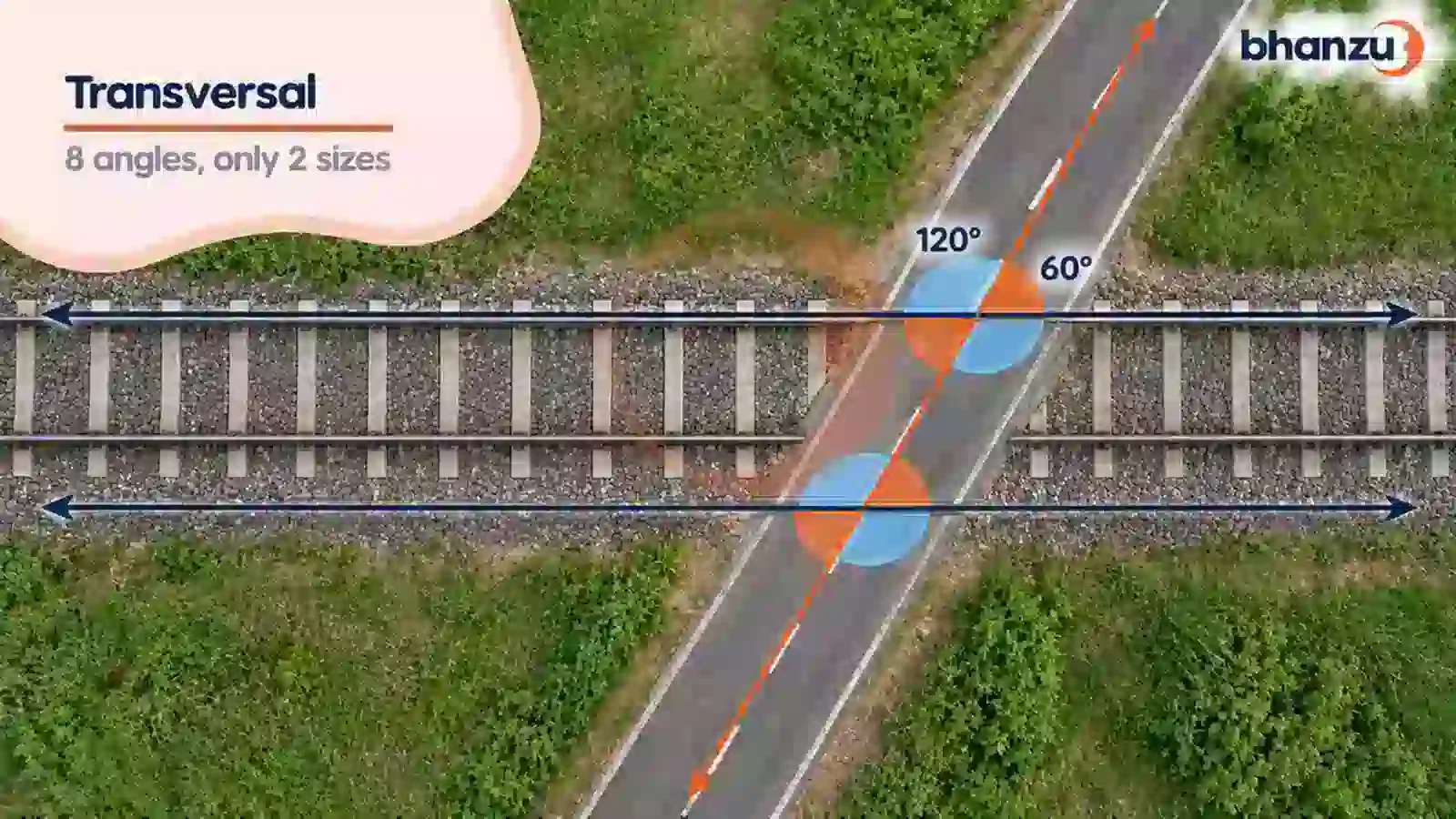
The link to parallel-line geometry runs deep — when a transversal cuts parallel lines, the alternate angles it creates are the same machinery that makes the exterior angle theorem work.
Examples of Exterior Angles of Triangle
Example 1
A triangle has remote interior angles of 50° and 70°. Find the exterior angle at the third vertex.
By the exterior angle theorem:
Final answer: 120°.
Example 2 (the most common slip, walked through)
The interior angle adjacent to an exterior angle is 56°. The exterior angle is reported as 56°. Is that right?
Wrong attempt. A reflex is to copy the adjacent interior angle straight across: "the angle next to it is 56°, so the exterior angle is 56° too."
Why it breaks. The exterior angle and its adjacent interior angle form a straight line — they are supplementary, not equal. Setting them equal would mean two angles on a straight line each measuring 56°, totalling only 112°, not 180°.
Correct. Use the linear pair:
Final answer: 124° — the adjacent angle is the exterior angle's supplement, never its twin.
Example 3
An exterior angle of a triangle is 130°. One remote interior angle is 85°. Find the other remote interior angle.
By the theorem, the two remote interior angles sum to the exterior angle:
Final answer: 45°.
Example 4
Two interior angles of a triangle are 40° and 75°. Find the exterior angle at the third vertex two ways.
Way 1 — the theorem. The remote interior angles for the third vertex are the two given angles:
Way 2 — the linear pair. First the third interior angle: . Then:
Final answer: 115° (both routes agree).
Example 5
The exterior angles of a triangle, one per vertex, are , , and . Find .
The three exterior angles sum to 360°:
Final answer: , so the exterior angles are 80°, 120°, and 160°.
Example 6
In a triangle, an exterior angle equals 3 times one remote interior angle, and the other remote interior angle is 40°. Find the exterior angle.
Let the first remote interior angle be . The exterior angle is , and by the theorem it equals the sum of the remotes:
So the exterior angle is .
Final answer: 60°.
Why the Exterior Angle Theorem Matters
"An exterior angle is greater than either remote interior angle."
That inequality is Proposition 16 of Book I of Euclid's Elements — and Euclid proved it before he had the full angle-sum result, because it was the load-bearing step for proving lines parallel. The exterior angle is a measuring tool: it lets you pin down two unknown angles from one you can actually see.
Where it earns its keep:
Navigation and bearings. A ship turning at a waypoint sweeps through the exterior angle of its course triangle; the turn angle is the exterior angle, and it equals the two remote heading changes combined.
Roof and frame geometry. A carpenter reading the splay where a rafter meets an extended ridge is reading an exterior angle — far easier to measure on-site than the tight interior corner.
Polygon angle sums. Because every convex polygon's exterior angles total 360°, you can find any regular polygon's interior angle in one step: each exterior angle is , so each interior angle is .
This last use connects exterior angles straight to the types of triangle and beyond, to every polygon a student will meet later.
Where Students Trip Up on Exterior Angles
Mistake 1: Setting the exterior angle equal to the adjacent interior angle
Where it slips in: Reading an exterior angle off a diagram with the adjacent interior angle marked.
Don't do this: Copy the adjacent interior angle as the exterior angle.
The correct way: The exterior angle and the adjacent interior angle are supplementary — subtract from 180°. They are equal only in the degenerate case where both are 90°.
The first-instinct error is treating "the angle right next to it" as the answer. The fix is to always ask which two angles add to 180° here — the adjacent pair sits on a straight line, so it is them.
Mistake 2: Adding all three interior angles instead of just the two remote ones
Where it slips in: Applying the exterior angle theorem.
Don't do this: Set the exterior angle equal to the sum of all three interior angles (which would give 180°, always wrong).
The correct way: The exterior angle equals only the two remote interior angles — the two it does not touch. Leave out the adjacent one.
The second-guesser does this most: they correctly recall "exterior equals a sum of interior angles" but lose track of which ones, so they sweep in all three to be safe. Name the adjacent angle first and exclude it; the remaining two are the remotes.
Mistake 3: Treating all six exterior angles as distinct when summing to 360°
Where it slips in: Computing the exterior angle sum.
Don't do this: Add all six exterior angles and expect 360°.
The correct way: The 360° sum uses one exterior angle per vertex — three of them. The other three are vertically opposite and equal, so adding all six gives 720°.
Key Takeaways
An exterior angle of a triangle is formed by extending a side and equals the sum of the two remote interior angles.
Each exterior angle is supplementary to its adjacent interior angle (they add to 180°).
The three exterior angles, one per vertex, always sum to 360°.
The proof combines the triangle sum (180°) with the straight-line linear pair (180°).
The most common error is confusing the exterior angle with its adjacent interior angle — they are supplements, not equals.
A Practical Next Step
Practice these problems to solidify your understanding. Question 1: Remote interior angles 35° and 95° — find the exterior angle. Question 2: An exterior angle is 140° with one remote interior 65° — find the other. Question 3: Three exterior angles are , , and — find each. If you get stuck on Question 1, return to "The Exterior Angle Theorem" and add only the two angles the exterior angle does not touch.
Want a live Bhanzu trainer to walk through more exterior-angle problems? Book a free demo class.
Was this article helpful?
Your feedback helps us write better content