What the Triangle Sum Theorem States
In any triangle ABC, the measures of the three interior angles add to a straight angle:
In words: the three interior angles of a triangle always sum to 180 degrees. This is also called the triangle angle sum theorem or the angle sum property of a triangle, and it works for every triangle — acute, right, or obtuse — with no exceptions inside ordinary flat geometry. The most common everyday use is the reverse direction: if you know two of the angles, the third is just 180° minus their sum.
In school this appears as NCERT Class 9, Chapter 6 (Lines and Angles) and under CCSS-M 8.G.A.5, and it is the angle-side companion to the congruence rules — SSS, AAS, and the rest — that come right after it.
Why the Theorem Is True — A Proof With a Parallel Line
Before leaning on a rule, it is worth seeing why it has to be true, and this proof needs just one extra line.
Start by drawing, through vertex A, a line DE parallel to the opposite side BC. The line through A is straight, so the three angles sitting along it — ∠DAB, ∠BAC, and ∠EAC — together make a straight angle:
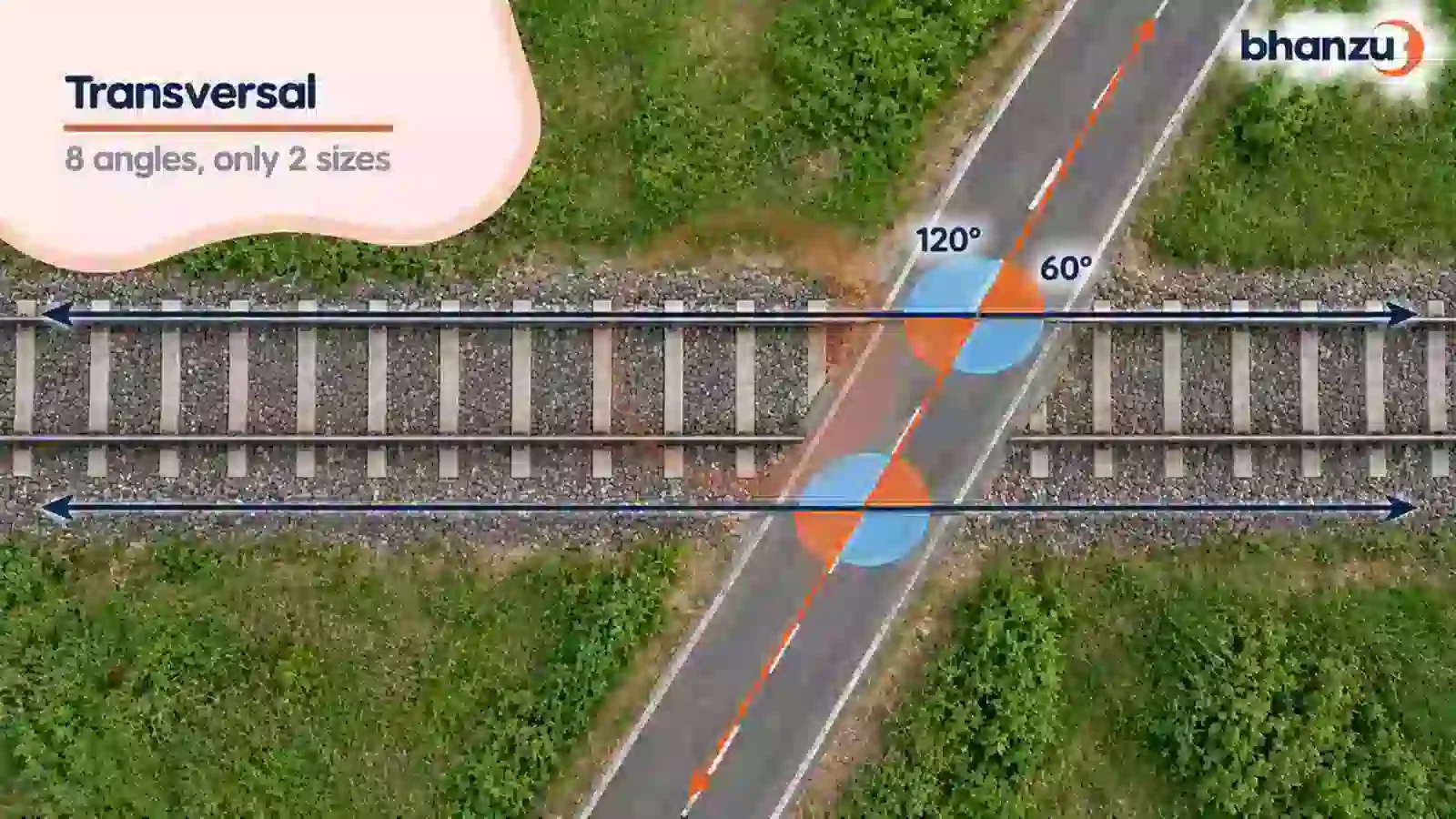
Now use the parallel lines. Treat AB as a transversal cutting DE and BC: ∠DAB and ∠ABC are alternate interior angles, so they are equal. Treat AC as a transversal the same way: ∠EAC and ∠ACB are alternate interior angles, so they are equal too:
∠DAB = ∠ABC = ∠B
∠EAC = ∠ACB = ∠C
Substitute those into the straight-angle equation. The middle angle ∠BAC is just ∠A, so:
The parallel line did all the work — it copied angles B and C up to vertex A, where they lined up beside angle A to fill a straight line. (The proof leans on the parallel postulate, which is exactly why the result is special to flat space — more on that below.)
The Exterior Angle Link — A Useful Spin-Off
The same construction gives a second result almost for free. Extend side BC past C to make an exterior angle at C. Because the interior angles add to 180° and the interior angle at C plus its exterior angle also add to 180° (they sit on a straight line), the exterior angle must equal the other two interior angles combined:
This is the exterior angle theorem, and it is a favourite shortcut in problems: instead of finding the third interior angle first, you read the exterior angle straight off the two remote interior angles. Cuemath, GeeksforGeeks, and Study.com all pair these two results, and so do we — they come from the same straight line.
Why the Total Is Exactly 180° — and Where It Breaks
A natural question, and one students genuinely ask: why 180 and not some other number? The honest answer is that 180° is a consequence of the flat plane we draw on. The proof above used a line parallel to BC, and parallel lines that never meet are a property of Euclidean (flat) geometry. Change the surface and the total changes:
On a sphere (elliptic geometry) a triangle's angles sum to more than 180° — draw one with two corners on the equator and one at the north pole and you can get three right angles, totalling 270°.
On a saddle (hyperbolic geometry) the angles sum to less than 180°.
So 180° is not a cosmic constant — it is the signature of flatness. For every triangle you will draw in school, on paper or a screen, the plane is flat and the total is locked at 180°.
Examples of the Triangle Sum Theorem
With the statement and proof in hand, here is the theorem solving real problems. They move from a one-step subtraction up to an algebraic ratio.
Example 1 - Two angles of a triangle measure 50° and 60°. Find the third angle
The three add to 180°, so the third angle is what is left:
Final answer: 70°.
Example 2 - A right triangle has one angle of 90° and another of 90°. Find the third angle
Wrong attempt. A student reads "right triangle" and "another of 90°" and writes the third angle as . An angle of 0° is no angle at all — the two stated 90° angles already use up the entire 180°, leaving nothing for a third corner. That is the signal something is off: a triangle cannot have two right angles, because two of them alone reach the full 180° and a triangle needs three positive angles.
Correct reading. A right triangle has exactly one 90° angle. If the second given angle is, say, 90° it was a misread — a valid right triangle pairs the 90° with two acute angles. With a 90° and a 35°, for instance:
Final answer: the two non-right angles of a right triangle are acute and add to 90°. In Bhanzu's Grade 8 cohort at the McKinney TX center, the "two right angles" slip shows up in roughly three out of ten first attempts on word problems that don't draw the figure — the fix is to sketch the triangle before writing any equation.
Example 3 - The three angles of a triangle are in the ratio 2 : 3 : 4. Find each angle
Let the angles be 2x, 3x, and 4x. They sum to 180°:
So the angles are , , and .
Final answer: 40°, 60°, 80° (check: they add to 180°).
Example 4 - In triangle ABC, ∠A = ∠B and ∠C = 80°. Find ∠A
The two equal angles plus 80° make 180°, so , giving .
Final answer: ∠A = ∠B = 50°. (This is an isosceles triangle — equal angles sit opposite equal sides.)
Example 5 - An exterior angle of a triangle is 110°, and one remote interior angle is 45°. Find the other remote interior angle
By the exterior angle theorem, the exterior angle equals the two remote interior angles added:
Final answer: 65°.
Example 6 - In triangle ABC, ∠A = (2y + 10)°, ∠B = (3y − 20)°, and ∠C = (y + 30)°. Find y and each angle
Add all three and set the sum to 180°:
So , giving ∠A ≈ 63.3°, ∠B ≈ 60°, ∠C ≈ 56.7°.
Final answer: ; the three angles are about 63.3°, 60°, and 56.7° (sum 180°).
Why the Triangle Sum Theorem Matters
A rule earns its place by what it unlocks, and this one sits underneath a surprising amount of geometry.
Polygon angles. Split any polygon into triangles from one vertex: an n-sided polygon breaks into (n − 2) triangles, so its interior angles sum to . The pentagon's 540° and the hexagon's 720° both come straight from the triangle's 180°.
The congruence rules. Once you know two angles, the triangle sum theorem hands you the third for free — which is precisely the step that turns an AAS configuration into an ASA one, and why two triangles with two matching angles automatically share the third.
Surveying and construction. Surveyors close a traverse by checking that measured angles sum correctly; a roof truss is cut to angles that must total 180° per triangular panel or the frame won't sit true. An error here is not abstract — a bridge or roof built on mis-summed angles carries a real structural cost.
Navigation on a curved Earth. Long-range navigation and geodesy have to correct for the fact that a triangle drawn across the globe sums to more than 180° — the flat-plane rule is the baseline they adjust away from.
For a Class 9 student, this is the hinge of the whole angles chapter: nail the 180° rule and the exterior-angle shortcut, and polygon angles plus the congruence proofs stop feeling like separate topics.
Where Students Trip Up on the Triangle Sum Theorem
Mistake 1: Forgetting the angles must each be positive
Where it slips in: A student subtracts two given angles from 180° and accepts a zero or negative result without questioning it.
Don't do this: Write a third angle of 0° (or a negative number) and move on as if the triangle exists.
The correct way: Every interior angle of a triangle is strictly between 0° and 180°. A zero or negative result means the two given angles were wrong or misread — the rusher who skips the sketch is the one who lets this through.
Mistake 2: Adding an exterior angle into the interior sum
Where it slips in: A figure shows an exterior angle, and the student adds it to the two interior angles, expecting 180°.
Don't do this: Treat the exterior angle as a third interior angle.
The correct way: The exterior angle is not one of the three interior angles. Use the exterior angle theorem — exterior angle = sum of the two remote interior angles — or first convert it to its interior partner (interior = 180° − exterior).
Mistake 3: Assuming a non-flat surface still gives 180°
Where it slips in: A problem set on a globe, a map projection, or a "triangle on a sphere" is solved with the flat 180° rule.
Don't do this: Apply ∠A + ∠B + ∠C = 180° to a triangle drawn on a curved surface.
The correct way: The 180° total is a flat-plane (Euclidean) fact. On a sphere the sum exceeds 180°; on a saddle it falls short. Check the surface before reaching for the rule.
Key Takeaways
The triangle sum theorem says the three interior angles of any triangle add to 180°: ∠A + ∠B + ∠C = 180°.
The cleanest proof draws a line through one vertex parallel to the opposite side, then uses alternate interior angles to fill a straight angle.
The exterior angle theorem is a direct spin-off: an exterior angle equals the two remote interior angles combined.
The 180° total is a flat-plane fact — on a sphere it exceeds 180°, on a saddle it falls short.
Every interior angle is strictly between 0° and 180°, so a zero or negative "third angle" means an input was wrong.
Practice These Problems to Solidify Your Understanding
Two angles of a triangle are 38° and 97°. Find the third angle.
The angles of a triangle are in the ratio 1 : 2 : 3. Find all three.
An exterior angle of a triangle measures 125°, and one remote interior angle is 70°. Find the other remote interior angle.
Answer to Question 1: 45°. Answer to Question 2: 30°, 60°, 90°. Answer to Question 3: 55°. If Question 2 gave you anything other than a right triangle, re-check that 6x = 180° gives x = 30°.
Want a live Bhanzu trainer to walk your child through the Class 9 angles chapter and the triangle sum theorem? Book a free demo class — online globally.
Also Read:
Was this article helpful?
Your feedback helps us write better content