How Far Apart Are Two Rails That Never Meet?
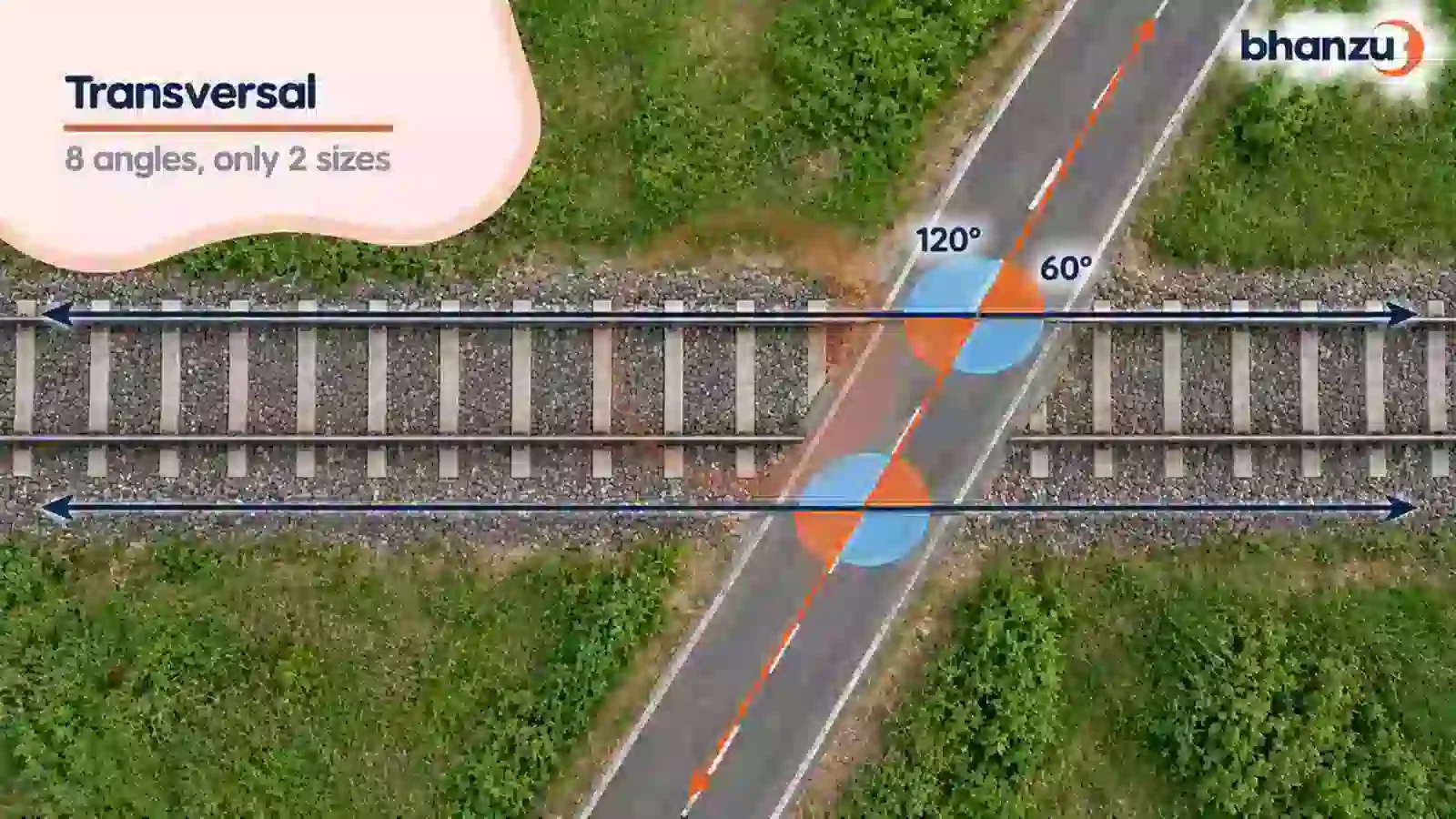
Railway tracks run parallel for miles, and the exact gap between them decides whether a train stays on.
Two parallel lines never touch, yet the space between them is a single fixed number — the same whether you measure at the start of the track or a kilometre down. Finding that number is not guesswork; coordinate geometry gives you one clean formula that returns the perpendicular distance from the two lines' equations alone.
What Is The Distance Between Two Parallel Lines?
The distance between two parallel lines is the perpendicular distance from any point on one line to the other line. Because parallel lines keep a constant gap, this perpendicular distance is the same no matter which point you pick - so it is a single well-defined value for the pair.
This is a special case of the broader problem of the distance between two lines. General lines might intersect (distance zero) or, in 3D, be skew. The parallel case is the clean one: the lines share a direction, so there is a fixed shortest gap you can name with a formula.
What Is The Formula For The Distance Between Two Parallel Lines?
Write both lines with identical coefficients and :
Then the perpendicular distance between them is:
The variable key, because the whole formula hinges on the coefficients being shared:
Symbol | Meaning |
|---|---|
The coefficients of and — must be the same in both equations | |
The constant terms of the two lines | |
The absolute value, so distance stays positive | |
The normalising factor from the line's direction |
Where Does The Distance Formula Come From?
Pick any point on the first line — the simplest is where it meets an axis. Then apply the point-to-line distance formula, , from that point to the second line. Since the point satisfies , the numerator becomes . The perpendicular-distance formula collapses straight into the parallel-lines result.
How Do You Calculate The Distance Between Two Parallel Lines?
The method is four steps, and step 1 is the one everyone skips.
Make the coefficients of and identical in both equations - scale one line if you must.
Read off and , the two constant terms.
Compute and .
Divide to get .
Why Must The Coefficients Match Before You Use The Formula?
Because the formula assumes both lines point the same way, written with the same and . If one line reads and the other , they are parallel - same slope - but their coefficients differ. Plugging the raw constants gives nonsense. Scale the second down to first, then , line up. Skipping this is the fastest way to a wrong answer.
How Do You Find The Distance When Lines Are In Slope-Intercept Form?
When the lines are given as and (same slope ), the distance is:
This is the same formula in disguise. Rewriting as gives , , so . Same machinery, different clothing.
What Are The Properties Of The Distance Between Two Parallel Lines?
It is constant. The gap is the same at every point along the lines - that is what "parallel" guarantees.
It is the perpendicular gap, always measured at a right angle, never along a slant.
It is zero only if the lines are identical (same , , and ).
Order does not matter, because the absolute value makes .
Examples of Distance Between Two Parallel Lines
Example 1
Find the distance between and .
Coefficients already match: , , , .
Final answer: units.
Example 2
Find the distance between and .
The quick instinct is to grab the constants straight away: , then divide by , giving . But the two lines have different coefficients - versus - so this pairs mismatched equations. The answer is not trustworthy.
The fix is to match coefficients first. Divide the second line by 2: . Now , , , :
Final answer: units.
Example 3
Find the distance between and .
Final answer: units, or about units.
Example 4
Find the distance between the parallel lines and .
Same slope , intercepts , :
Final answer: units.
Example 5
A line parallel to passes through the point . Find the distance between them.
First get the second line's equation. Parallel means same coefficients: . Substitute : , so .
Final answer: unit.
Example 6
Find the distance between and .
Final answer: units. (The triple keeps the arithmetic clean.)
Where Is The Distance Between Parallel Lines Used?
The constant-gap idea runs through anything built on parallel guides.
Rail and road design: track gauge and lane width are parallel-line distances that must hold to millimetres.
Circuit boards: the spacing between parallel copper traces controls whether signals interfere.
Manufacturing: tolerance bands are drawn as parallel lines a set distance apart.
The concept generalises: in three dimensions the same "constant perpendicular gap" reasoning extends to parallel planes, and the shortest-distance idea carries into skew-line problems. You are learning the plane version of a tool that scales up. For the full technical background, see the standard treatment of the distance between two parallel lines.
Where Do Students Trip Up On This?
Mistake 1: Using the formula before matching coefficients
Where it slips in: whenever the two equations have proportional but unequal coefficients ( versus ).
Don't do this: reading and straight off equations whose and differ.
The correct way: scale one equation so both share the same and , then subtract constants. The exact misstep is grabbing the constants before normalising - checking that and genuinely match first is what prevents it.
Mistake 2: Forgetting the absolute value
Where it slips in: when comes out negative.
Don't do this: reporting a negative distance.
The correct way: distance is always positive, so is mandatory. A negative "distance" is a signal you dropped the bars.
Mistake 3: Confusing this with the point-to-point distance
Where it slips in: treating "distance between lines" like the gap between two labelled points.
Don't do this: picking one point on each line and using the distance between two points along a slant.
The correct way: the distance between parallel lines is perpendicular, not slant. This confusion between "gap between lines" and "gap between two chosen points" is where the two close ideas get swapped - and a slant measurement always overstates the true gap.
Conclusion
The distance between two parallel lines is , the constant perpendicular gap.
Match the coefficients and before reading the constants — that single step prevents most wrong answers.
The slope-intercept version is the same formula rewritten.
To build this skill with a teacher, explore Bhanzu's geometry tutor, a high school math tutor, or ongoing math tutoring.
A Practical Next Step
Practice these problems to solidify your understanding: take any pair of parallel lines with mismatched coefficients, normalise them, and compute the distance both ways to prove the slope-intercept and standard forms agree. If step 1 still trips you, rewrite both lines with matching and before touching the formula.
Want a live Bhanzu trainer to walk through more parallel-line problems? Book a free demo class.
Read More
Was this article helpful?
Your feedback helps us write better content
Frequently Asked Questions
Can direction ratios be negative?
How many direction ratios does a single line have?
Is a direction ratio the same as a direction cosine?
Do direction ratios have units?