Why "The Distance Between Two Lines" Is Only One Number When The Lines Never Meet
Ask for the distance between two lines and the first surprise is that the answer only makes sense in special cases. If two lines cross, the distance is zero - they touch. If they run parallel, there is one fixed gap. And in three dimensions two lines can miss each other entirely without being parallel, leaving a single shortest bridge between them. Getting the right number means first knowing which case you are in.
The distance between two lines is the length of the shortest segment connecting them, and it is always measured perpendicular to both lines. Two lines fall into three cases: intersecting (distance ), parallel (a constant perpendicular gap), and - in 3D only - skew (non-parallel lines that never meet, joined by a unique common perpendicular). This builds directly on the distance of a point from a line; for the plane it lives in, see coordinate geometry.
By the end you will identify the case, apply the right formula, and compute the distance for parallel lines in the plane and skew lines in space.
The Parallel-Lines Formula (2D)
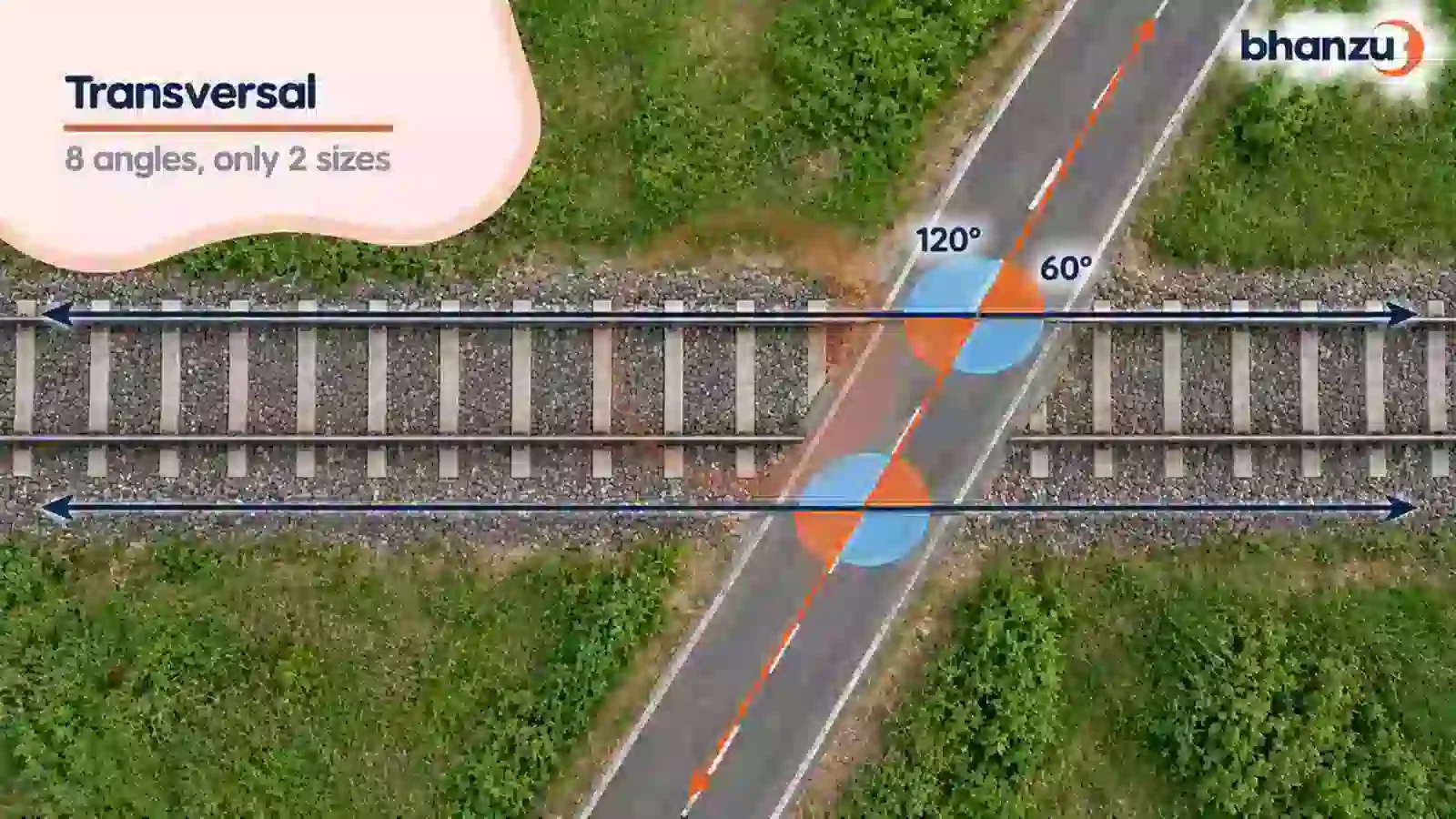
Two lines are parallel when they have the same slope and never meet. Their perpendicular distance is the same everywhere, so you can measure it at any convenient point.
Write both lines with identical and coefficients:
Then the distance is:
Here and are the shared coefficients of and , and are the two constants. The absolute value keeps the distance positive regardless of order, and normalises for the line's direction. If the lines are given in slope form and , rewrite as , giving:
The formula only works once both lines share the same and . If one is written and the other , scale the second to first.
The Skew-Lines Formula (3D)
In three dimensions, two non-parallel lines that never intersect are skew. There is exactly one segment perpendicular to both - the common perpendicular - and its length is the distance.
Write the lines in vector form, with position vectors and direction vectors :
Then:
The cross product is a vector perpendicular to both lines' directions; the dot product in the numerator projects the gap between the lines onto that common perpendicular. If , the directions are parallel and you must use the parallel formula instead. These vector operations extend coordinate geometry into 3D; the companion point-to-line distance handles the single-point case.
Examples Of The Distance Between Two Lines
Six worked cases, from a clean parallel pair to a full skew-line computation.
Example 1
Find the distance between and .
The coefficients , match, so the lines are parallel. , . units.
Example 2
Find the distance between and .
Wrong path first: plug straight in with , , , , giving . That is wrong, because the two lines do not share the same and ( versus ). Scale the second line by : , so and . Now , , , . units. The lesson: match the coefficients before applying the formula.
Example 3
Find the distance between the parallel lines and .
Rewrite both as : and . Now , , , . units.
Example 4
Two lines cross at the point . What is the distance between them?
If two lines intersect, they share at least one point. At that shared point the gap between the lines is zero. So the distance between two intersecting lines is . The perpendicular-distance formulas apply only to parallel or skew lines, never to intersecting ones.
Example 5
Find the distance between the skew lines and .
Directions: , . Cross product: . Its magnitude: . Gap vector: . Numerator: . unit.
Example 6
Are the lines with directions and skew?
Notice , so the directions are parallel. Their cross product is , so the skew formula cannot be used (its denominator would be zero). Parallel lines are never skew; use the parallel-distance approach with a point on each line instead. This check — computing the cross product first — tells you which formula applies.
Where the distance between lines earns its keep: "the shortest bridge that never touches"
The perpendicular distance between lines is not a textbook trick. It answers a concrete question that appears wherever two straight paths must be kept apart.
The defining idea. The distance is the shortest possible connection, and it is always perpendicular because any slanted connection is longer. That "shortest perpendicular bridge" is what a designer computes to guarantee clearance.
Real-world stakes. In road, rail, and pipeline design, engineers must verify that two straight routes at different heights - an overpass above a highway, a pipe crossing beneath another - keep a required minimum clearance. Those routes are often skew lines in 3D, and the common-perpendicular distance is exactly the clearance that must exceed a safety threshold. The same skew-line distance appears in robotics for collision avoidance and in molecular geometry for the closest approach of two bonds. The general principle sits under analytic geometry.
Where it goes next. The line-to-line distance generalises the point-to-line distance, and it extends further to distances involving planes. The common thread across all of them is the same: the shortest distance is measured along a perpendicular.
That is why the perpendicular is not optional decoration - it is the distance, and identifying it correctly is the whole task.
Common Mistakes With The Distance Between Two Lines
Mistake 1: Applying the parallel formula without matching the coefficients
Where it slips in: Lines written with different and multiples.
Don't do this: Use and directly, reading , .
The correct way: Scale one equation so both have identical and first (Example 2), then read . The rusher who plugs in the raw constants gets a distance off by the scale factor.
Mistake 2: Measuring a slanted gap instead of the perpendicular one
Where it slips in: Estimating the distance from a graph by eye.
Don't do this: Read the vertical or horizontal gap between the lines as "the distance."
The correct way: The distance is always the perpendicular segment, which is shorter than any slanted gap. Use the formula, not a diagonal ruler reading. The second-guesser who measures the vertical drop between two slanted lines overstates the true perpendicular distance.
Mistake 3: Using the skew formula on parallel lines
Where it slips in: 3D problems where the directions turn out to be multiples of each other.
The correct way: Compute first. If it is , the lines are parallel and the skew formula's denominator vanishes - switch to the parallel method (Example 6). If it is non-zero and the lines do not intersect, they are skew and the cross-product formula applies.
Conclusion
The distance between two lines is the shortest, always-perpendicular segment joining them.
Two lines are intersecting (distance ), parallel (constant gap), or skew (3D only, a common perpendicular).
Parallel lines: , after matching the and coefficients.
Skew lines: , using the cross product.
Always check the case first: a zero cross product means parallel, not skew.
To take line-distance problems further with a teacher, explore Bhanzu's geometry tutor, our high school math tutor sessions, or math tutoring online. To watch a trainer set up a skew-line distance in 3D live, you can book a free demo class.
A practical next step
Work through the exercises below. Identify the case (parallel or skew) before choosing the formula.
Find the distance between and . (Answer to Question 1: units.)
Find the distance between the skew lines and . (Answer to Question 2: , gap , numerator , denominator , so unit.)
Read More
Skew lines - non-parallel, non-intersecting lines in 3D, defined in full.
Parallel and perpendicular lines - the two relationships behind the distance cases.
Vectors - the objects the skew-line formula operates on.
Parallel lines - why parallel lines keep a constant gap.
Cross product of two vectors - the operation that builds the common perpendicular.
Intersecting lines - the case where the distance is zero.
Was this article helpful?
Your feedback helps us write better content
Frequently Asked Questions
What is the distance between two lines?
What is the formula for the distance between two parallel lines?
What is the distance between two intersecting lines?
How do you find the distance between skew lines?
Can two lines in a plane be skew?