What Is the Symmetry of a Circle?
The symmetry of a circle means the circle can be folded or turned so that it lands exactly on top of itself. A circle has two kinds of symmetry at once: line symmetry (also called reflection symmetry), where a fold leaves the two halves matching, and rotational symmetry, where a turn about the centre leaves the shape unchanged. A circle has the most of both of any shape.
The reason both are unlimited is the same: every point on a circle is exactly the same distance (the radius - shown in Read More) from the centre. Because the definition of a circle treats every direction equally, no direction is special, and that even-handedness is what produces endless symmetry.
How Many Lines of Symmetry Does a Circle Have?
A circle has an infinite number of lines of symmetry. Any straight line drawn through the centre splits the circle into two halves that are perfect mirror images, so each such line is a line of symmetry — and you can draw a line through the centre at any angle you like, so there is no limit.
Each of these lines is a diameter of the circle. Fold the circle along any diameter and the two semicircles land exactly on each other. Since a circle has infinitely many diameters, it has infinitely many lines of symmetry - this is the property no polygon shares. A square has , a regular hexagon has , but a circle has no ceiling.
Does a Circle Have Rotational Symmetry?
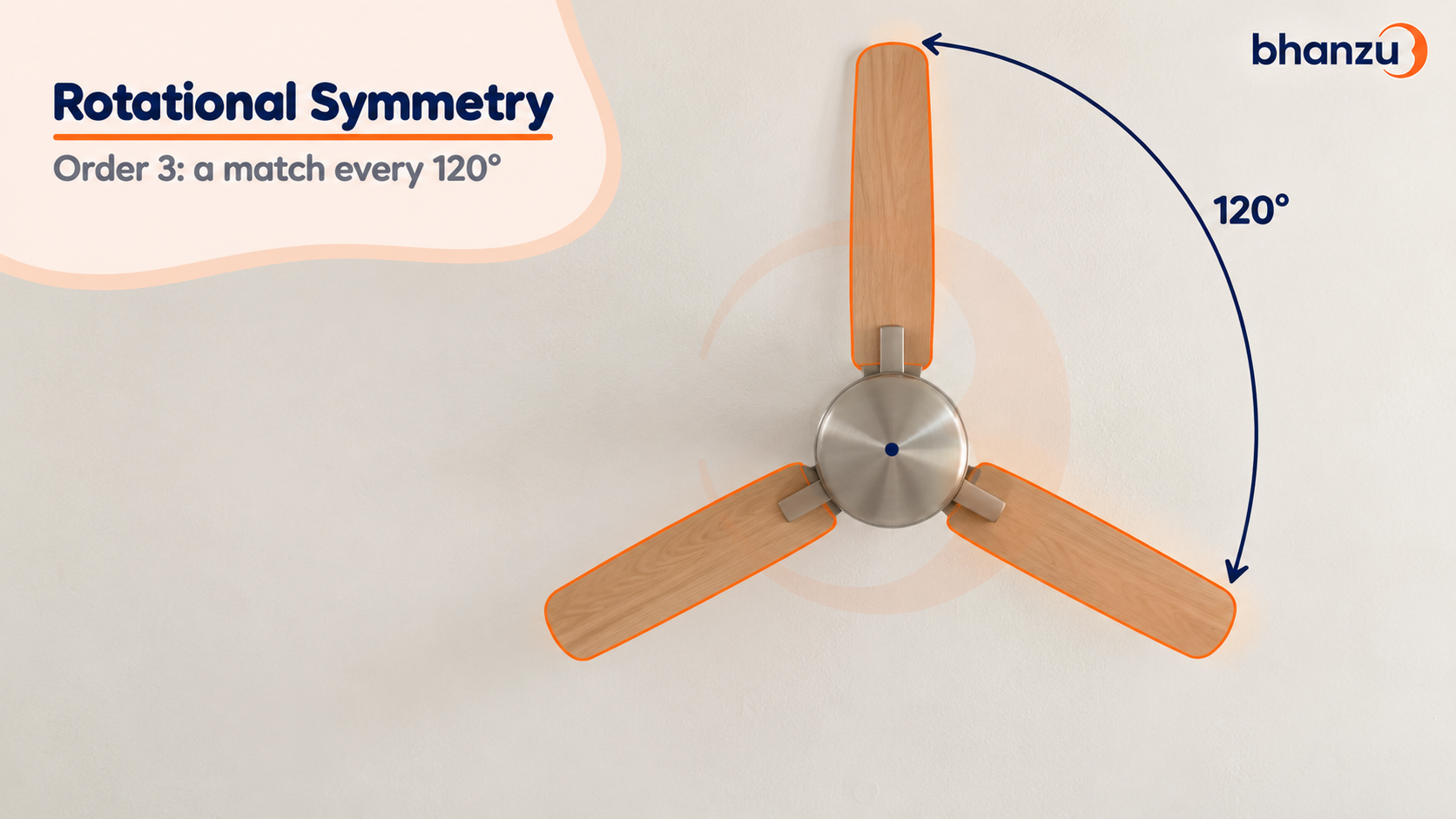
Yes - a circle has infinite rotational symmetry. Rotational symmetry means a shape looks the same after being turned about a fixed point by less than a full turn. Spin a circle about its centre by any angle at all - one degree, forty-five degrees, any amount - and it lands on itself unchanged.
Because every angle works, the order of rotational symmetry of a circle is described as infinite. Compare that with a shape that has finite rotational symmetry: a square looks the same only after turns of , , , and — order . A circle has no such fixed list; it matches itself continuously. It also has point symmetry about the centre, since a turn is one of the infinitely many turns that work.
Is a Radius a Line of Symmetry?
No. A radius runs from the centre only to the edge, so it is half of a line of symmetry, not a whole one. A line of symmetry must be a full diameter, passing right through the centre and reaching the circle on both sides.
This is the single most common trip-up, so it is worth stating plainly: fold along a radius and the circle does not land on itself, because a radius stops at the centre. Extend that radius through the centre to the far side - now it is a diameter, and the fold works. Every line of symmetry of a circle is a diameter; a lone radius is not.
What Are the Properties of the Symmetry of a Circle?
The symmetry of a circle can be summed up in a short list of properties, all flowing from the fact that every point is the same distance from the centre.
Infinitely many lines of symmetry. Every line through the centre - that is, every diameter - is a line of symmetry, and there is no limit to how many can be drawn.
Every line of symmetry is a diameter. A line of symmetry must pass through the centre; a chord that misses the centre, and a radius on its own, are not lines of symmetry.
Infinite rotational symmetry. A turn of any angle about the centre maps the circle onto itself.
Order of rotational symmetry is infinite. There is no smallest turn that works, so the order cannot be pinned to a finite number.
Point symmetry about the centre. A turn about the centre is one of the turns that work, so the circle also has point symmetry.
The centre is the fixed point. All lines of symmetry meet at the centre, and it is the single point about which every rotation is taken.
Most symmetric of all plane shapes. No polygon matches a circle: a square has lines of symmetry and a regular hexagon has , but the circle's count has no ceiling.
Examples of the Symmetry of a Circle
Six short cases, from counting lines to comparing shapes. The problem statement is bolded; the reasoning is not.
Example 1
How many lines of symmetry does a circle have?
Any line through the centre divides the circle into two matching halves, and lines through the centre can be drawn at any angle.
Final answer: infinitely many lines of symmetry.
Example 2
A student says a circle has exactly 360 lines of symmetry, one for each degree. Is that correct?
The tempting move is to count one line per degree and stop at . Watch it break: between the line at and the line at you can still draw a line at , and between those another at , without ever running out. Fixing the count at assumes angles come in whole steps, but they do not.
Because a line through the centre can point in any direction - including every fraction of a degree - the number of lines has no limit.
Final answer: not ; a circle has infinitely many lines of symmetry.
Example 3
What is the order of rotational symmetry of a circle?
A shape's order of rotational symmetry counts how many turns (within one full rotation) leave it looking the same. A circle matches itself after a turn of any angle.
Final answer: infinite order of rotational symmetry.
Example 4
Does a semicircle have the same symmetry as a circle?
A semicircle is half a circle, cut along a diameter. Folding it works along only one line - the perpendicular from the midpoint of the straight edge through the arc.
Final answer: a semicircle has just line of symmetry and no rotational symmetry, far less than a full circle.
Example 5
Is the horizontal line through the centre of a circle a line of symmetry?
A horizontal line through the centre is a diameter, and folding along it maps the top half onto the bottom half exactly.
Final answer: yes - like every diameter, it is a line of symmetry.
Example 6
Between a circle and a regular hexagon, which has more lines of symmetry, and by how much?
A regular hexagon has lines of symmetry (one through each pair of opposite vertices and one through each pair of opposite edge-midpoints). A circle has infinitely many.
Final answer: the circle has infinitely more - its count has no upper limit while the hexagon stops at .
Why Does a Circle Have Infinite Symmetry?
The endless symmetry of a circle is not a quirk; it is a restatement of what a circle is. A circle is the set of all points a fixed distance from a centre. That definition names the centre and the distance but says nothing about direction - every direction is treated the same. When a shape has no preferred direction, no fold or turn can distinguish one orientation from another, so all folds through the centre and all turns about it succeed.
This is why the circle sits at the heart of design and engineering wherever "the same from every angle" matters: wheels and gears turn smoothly because their rotational symmetry means no angle is a bump; ripples spread outward as circles because water disturbed at a point has no reason to favour one direction; lenses and dishes are circular so light or signal arriving from around the axis is treated evenly. You can read how rotational symmetry is defined and classified across shapes, from finite orders up to the circle's continuous case.
What Are Common Mistakes With the Symmetry of a Circle?
Mistake 1: Treating a radius as a line of symmetry
Where it slips in: Counting or drawing the lines of symmetry of a circle.
Don't do this: Draw a line from the centre to the edge and call it a line of symmetry. A learner who pictures the line "starting at the middle" stops at the centre and never extends it to the other side.
The correct way: A line of symmetry must be a full diameter, crossing the centre and meeting the circle at both ends. Always extend the line right through to the far side.
Mistake 2: Giving a finite count like 4, 8, or 360
Where it slips in: "How many lines of symmetry does a circle have?"
Don't do this: Answer with a whole number. The learner who has just counted a square's lines or a hexagon's carries the habit over and picks a number for the circle too.
The correct way: The correct answer is "infinite." A circle is not a polygon; its lines of symmetry are not tied to vertices or edges, so there is nothing to count up to.
Mistake 3: Confusing line symmetry with rotational symmetry
Where it slips in: Describing "the symmetry" of a circle as a single thing.
Don't do this: Report only the folding (line) symmetry and forget the turning (rotational) symmetry, or the other way round. The learner names one and assumes the question is answered.
The correct way: State both - infinite lines of symmetry and infinite rotational symmetry (plus point symmetry) - because a circle carries every kind at once.
Conclusion
The symmetry of a circle includes both line symmetry and rotational symmetry, and both are infinite.
A circle has infinitely many lines of symmetry, and every one is a diameter through the centre.
A circle has infinite rotational symmetry: it matches itself after a turn of any angle.
A radius is not a line of symmetry; only a full diameter is.
All of this follows from one fact - every point of a circle is the same distance from the centre.
To take the symmetry of a circle further with a teacher, explore Bhanzu's geometry tutor or middle school math tutor sessions, or browse math classes online.
A Practical Next Step
Work through these to lock in the ideas. First, draw a circle and sketch five different lines of symmetry through the centre, then explain why you could keep going (Answer to Question 1: every line through the centre is a diameter, and there are infinitely many). Next, state the order of rotational symmetry of a circle and of a square (Answer to Question 2: infinite for the circle, for the square). If you get stuck on the radius-versus-diameter point, return to that section above. Want a live Bhanzu trainer to walk through symmetry with diagrams? Book a free demo class.
Read More
Was this article helpful?
Your feedback helps us write better content
Frequently Asked Questions
How many lines of symmetry does a circle have?
Does a circle have rotational symmetry?
What is the order of rotational symmetry of a circle?
Is every chord of a circle a line of symmetry?
Does a circle have point symmetry?