Why Do Two Angles Sharing a Side Always Total a Straight Line?
Slide a book across a slanted desk and its corner angles never change their pairwise sum, no matter how far you push it. That fixed sum is the quiet rule behind every parallelogram.
What Are the Adjacent Angles of a Parallelogram?
The adjacent angles of a parallelogram are any two angles that lie next to each other and share a common side. In parallelogram , the four pairs of adjacent angles are and , and , and , and and . Each pair is supplementary, meaning the two angles add up to .
This is the defining property to remember: in a parallelogram, adjacent angles are supplementary. Adjacent angles are also called consecutive angles because they follow one another around the shape. If you already know how adjacent angles behave in general, the parallelogram simply pins their sum at exactly a straight line.
Why Does the Sum Come Out to 180°?
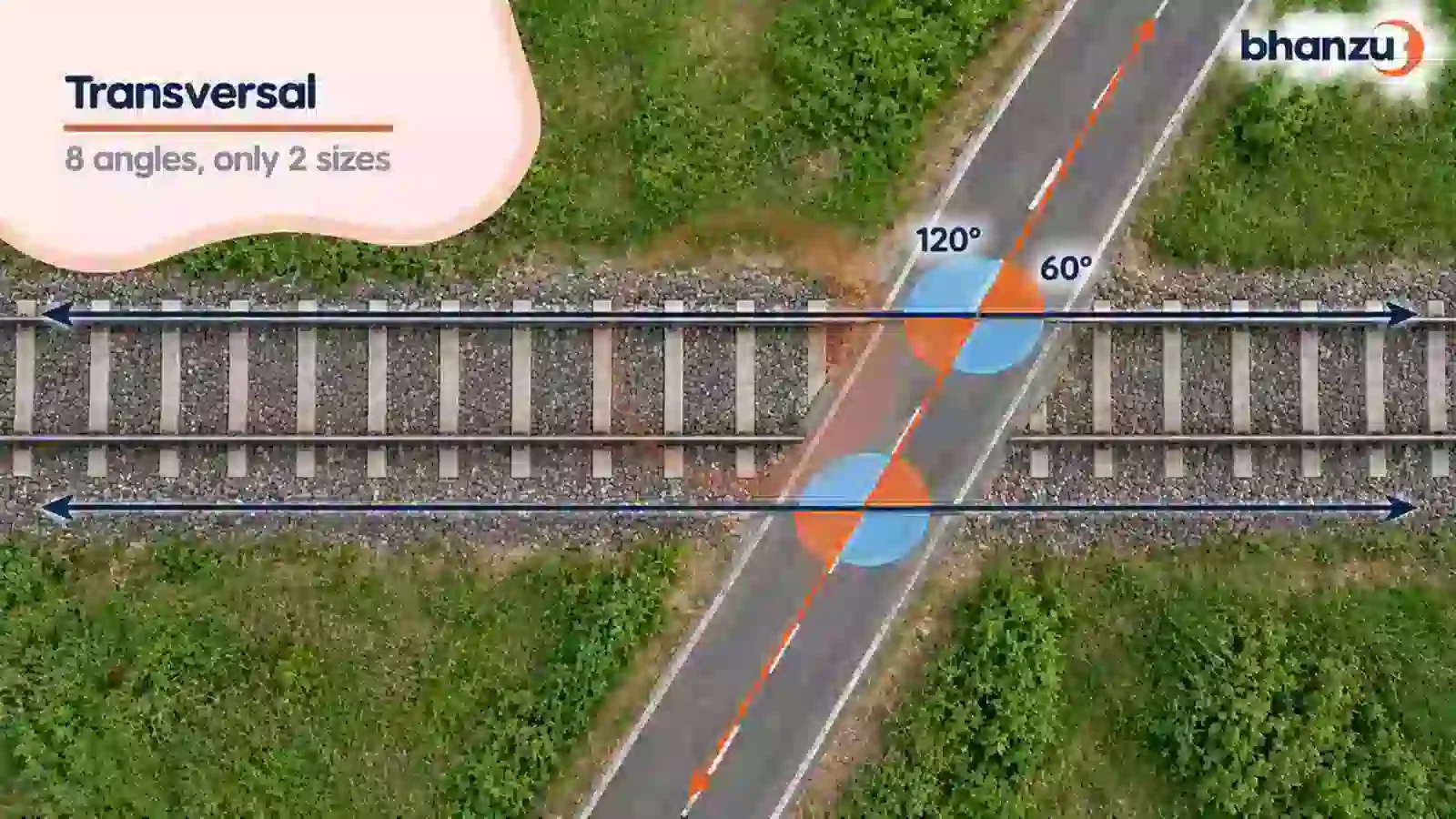
The reason sits inside the parallel sides. In a parallelogram, opposite sides are parallel, so each side acts as a transversal cutting a pair of parallel lines. The angles and then become co-interior angles, also known as consecutive interior angles, on the same side of that transversal. Co-interior angles on parallel lines are supplementary, which forces
The same argument runs along every side, so all four consecutive pairs behave identically. This is one of the core properties of a parallelogram, and it follows directly from the parallel-line structure rather than from any measurement.
What Are the Properties of the Adjacent Angles of a Parallelogram?
Every pair of adjacent angles in a parallelogram obeys the same short list of rules. Keeping them together turns most exam questions into a matter of picking the right line.
They are supplementary. Each adjacent pair sums to a straight angle, so .
There are four pairs. In parallelogram the pairs are and , and , and , and and .
They are unequal in general. Because they add to without being forced to each, one is usually acute and the other obtuse. They become equal only when the parallelogram is a rectangle.
They are also called consecutive angles, since each pair follows the next around the figure while sharing one side.
Adjacent and opposite behave oppositely. Adjacent angles are supplementary, whereas opposite angles are equal. Knowing any single angle therefore fixes all four.
Examples of Adjacent Angles of a Parallelogram
Example 1
In parallelogram , . Find its adjacent angle .
Adjacent angles are supplementary, so .
.
Final answer: .
Example 2
Two adjacent angles of a parallelogram are in the ratio . Find both angles. (Wrong path first.)
Wrong attempt. A student reasons that opposite angles are equal, so the two ratio parts must be equal too, and writes , which gives . That collapses the shape and is obviously wrong - a parallelogram cannot have zero-degree angles.
The break. The error is treating the ratio pair as opposite angles. Angles in the ratio are unequal, so they cannot be opposite (opposite angles are equal). They must be adjacent, which means they are supplementary, not equal.
Correct. Let the angles be and . Since they are adjacent,
So the angles are and .
Final answer: and .
Example 3
One angle of a parallelogram is and its adjacent angle is . Find .
Final answer: , giving angles and .
Example 4
In parallelogram , . Find all four angles.
(given).
Adjacent angle .
Opposite angles are equal, so and .
Final answer: .
Example 5
An adjacent angle pair is and . Find each angle.
The angles are and .
Final answer: and . A quick check: .
Example 6
A parallelogram has one angle equal to . What can you say about its adjacent angle, and what does this make the shape?
Adjacent angle . Every angle then works out to , so all four are right angles. A parallelogram with four right angles is a rectangle. When students first meet this, the instinct is to look for a special new rule - but it is the same supplementary rule doing the work, just with a right angle as the input.
Final answer: the adjacent angle is , and the parallelogram is a rectangle.
Where Does This Rule Show Up Outside the Classroom?
The supplementary-adjacent-angle rule is what makes a parallelogram hold its shape while it moves. Because the angle pairs must always total , the linkage flexes smoothly instead of jamming.
Pantograph linkages - the sketching and lifting arms that copy or scale drawings rely on a parallelogram frame whose adjacent angles shift together, keeping the drawing surfaces parallel. The mechanism is described in the standard account of the pantograph.
Scissor lifts and folding gates - each cell is a parallelogram; as it opens, one angle grows while its neighbour shrinks so the pair still sums to .
Adjustable desk lamps - the arm stays level because opposite bars stay parallel, which is exactly the condition that keeps adjacent angles supplementary.
This is the destination worth seeing early: the rule is not a memorised fact for a worksheet, it is the geometric reason parallelogram machines work at all.
Where Do Students Trip Up on Adjacent Angles?
Mistake 1: Treating adjacent angles as equal
Where it slips in: Right after learning that opposite angles of a parallelogram are equal, students carry "equal" over to the adjacent pair.
Don't do this: Setting and concluding both are the same value.
The correct way: Opposite angles are equal; adjacent angles are supplementary. The first pair you meet in a diagram is usually adjacent, so reach for , not .
Mistake 2: Confusing supplementary with complementary
Where it slips in: Word problems that say "the angles add up to a straight line."
Don't do this: Using as the target sum because the word "supplementary" gets swapped with "complementary."
The correct way: Supplementary means ; complementary means . Adjacent angles of a parallelogram are always supplementary. The habit that fixes this is to write the target sum as on the page before substituting any numbers - the exact first-instinct swap between the two words disappears once the target is committed to paper.
Mistake 3: Assuming a specific angle without justification
Where it slips in: Diagrams that "look like" a rectangle.
Don't do this: Reading an angle as just because the figure looks upright.
The correct way: Only use the values you are given or can derive. A parallelogram's adjacent angles are each only when it is a rectangle - otherwise one is acute and the other obtuse. This is the same trap that shows up in real drafting: a technician who eyeballs a linkage angle instead of measuring it can build a frame that binds, the physical version of assuming an angle that was never actually .
Conclusion
The adjacent angles of a parallelogram are the pairs that share a side, and each pair is supplementary, summing to .
The rule follows from parallel sides: each side is a transversal, making adjacent angles co-interior and therefore supplementary.
Opposite angles are equal; adjacent angles are supplementary - mixing the two is the most common error.
When adjacent angles are both , the parallelogram is a rectangle.
The rule is what lets parallelogram linkages like pantographs and scissor lifts flex without losing their parallel structure.
Practice These to Solidify Your Understanding
Work through three quick problems, then check the answers. (1) One angle of a parallelogram is ; find its adjacent angle. (2) Adjacent angles are in the ratio ; find both. (3) An adjacent pair is and ; solve for .
Answer to Question 1: . Answer to Question 2: and . Answer to Question 3: , giving and .
To go deeper with a teacher, explore Bhanzu's geometry tutor or middle school math tutor, and for broader support try math classes online. Want a live Bhanzu trainer to walk through more parallelogram problems? Book a free demo class —
Read More
Was this article helpful?
Your feedback helps us write better content