One Angle Tells You All Four
Tell a builder a single corner of a leaning gate frame, and they can name the other three without measuring. A parallelogram is that predictable.
That predictability is not luck. It comes from two rules about the angles, and those two rules come from one fact: a parallelogram has two pairs of parallel sides. Everything else about its angles follows from what parallel lines do when a third line crosses them.
What Are the Angles of a Parallelogram?
A parallelogram is a four-sided figure (a quadrilateral) with both pairs of opposite sides parallel. Label its corners ∠A, ∠B, ∠C, ∠D in order around the shape. Those four interior angles obey three rules:
Opposite angles are equal: ∠A = ∠C and ∠B = ∠D.
Adjacent angles are supplementary: any two angles sharing a side add to 180° (for example ∠A + ∠B = 180°). These are also called consecutive angles.
All four angles sum to 360°, as in every quadrilateral.
"Opposite" angles sit across the shape from each other and never share a side. "Adjacent" (or consecutive) angles share a side. Holding those two words apart is most of the battle — they behave in opposite ways, and the most common mistakes come from swapping them. A parallelogram is one member of the wider quadrilaterals family, and these angle rules are what set it apart from a general four-sided shape.
Why Do Adjacent Angles Of A Parallelogram Add To 180°?
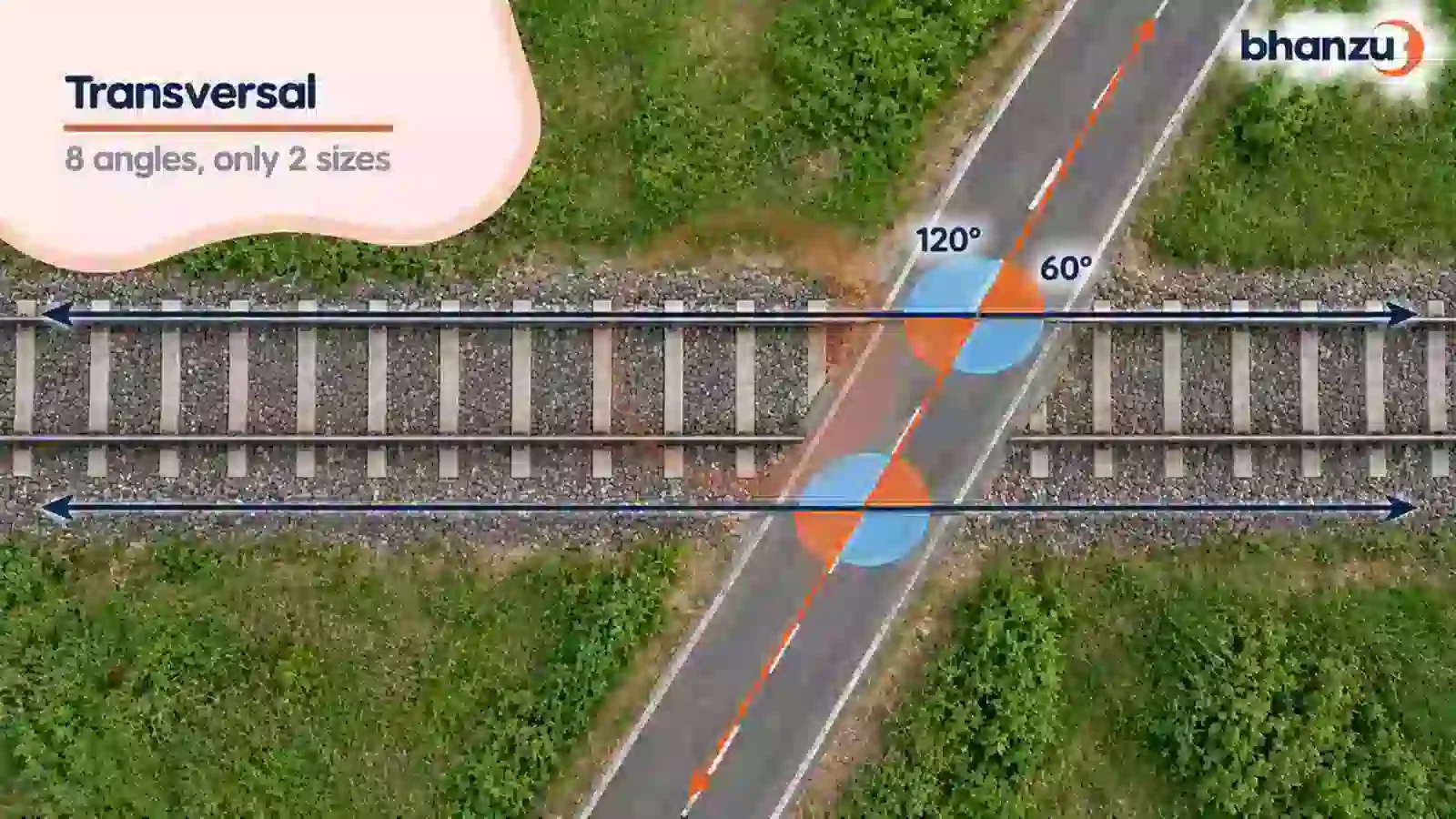
This is the question that unlocks the topic. Side AD crosses the two parallel sides AB and DC, acting as a transversal. ∠A and ∠D are then co-interior angles (same-side interior angles) between parallel lines — and co-interior angles always sum to 180°. So ∠A + ∠D = 180°. The supplementary rule is not a separate fact to memorise; it is the parallel-line rule wearing a parallelogram's name.
The Two Theorems, Proved
The two angle rules each have a short proof, and seeing the proof means you can rebuild the rule rather than recall it.
Theorem 1: Opposite angles are equal
Statement: In a parallelogram, opposite angles are equal — ∠A = ∠C and ∠B = ∠D.
Proof. Draw the diagonal AC, splitting parallelogram ABCD into triangles ABC and CDA.
Since AB is parallel to DC and AC is a transversal, ∠BAC = ∠DCA (alternate interior angles).
Since AD is parallel to BC and AC is a transversal, ∠BCA = ∠DAC (alternate interior angles).
AC is common to both triangles.
By the ASA (angle-side-angle) rule the two triangles are congruent, so the matching angles ∠B and ∠D are equal. Drawing the other diagonal the same way gives ∠A = ∠C. The diagonal turns one statement about a four-sided shape into two statements about triangles you already understand.
Theorem 2: Adjacent angles are supplementary
Statement: Any two adjacent angles of a parallelogram sum to 180°.
Proof. Take side AD as a transversal crossing the parallel sides AB and DC. Angles ∠A and ∠D are co-interior angles (on the same side of the transversal, between the parallel lines). Co-interior angles between parallel lines are supplementary, so:
The same argument on every side gives ∠A + ∠B = 180°, ∠B + ∠C = 180°, and ∠C + ∠D = 180°. This is the rule that powers nearly every "find the missing angle" problem.
Can you find all the angles of a parallelogram if you know just one? Yes — and this is what makes the shape so useful. The opposite angle equals the one you know, and the two adjacent angles are each minus it. One measurement fixes all four, which is exactly why a builder can name a gate's corners from a single reading.
Examples of Angles of a Parallelogram
The examples build from a one-step lookup to an algebraic setup. Angles are in degrees.
Example 1
One angle of a parallelogram is 70°. Find the other three.
The opposite angle equals it: 70°. The two adjacent angles are supplementary:
So the four angles are 70°, 110°, 70°, 110°.
Example 2
∠A of parallelogram ABCD is 65°. A student says ∠B must also be 65° because "opposite angles are equal." Find ∠B correctly.
The claim sounds right but breaks on a check: ∠A and ∠B share side AB, so they are adjacent, not opposite. If both were 65°, the four angles would total , and pairing them wrong gives no consistent figure. Adjacent angles are supplementary, not equal:
Opposite angles are equal (∠C = ∠A = 65°), but ∠B is adjacent to ∠A, so it is the supplement. The four angles are 65°, 115°, 65°, 115°.
Example 3
Two adjacent angles of a parallelogram are in the ratio 2 : 3. Find all four angles.
Adjacent angles sum to 180°, so let the angles be and :
The adjacent pair is and . By the opposite-angle rule, the four angles are 72°, 108°, 72°, 108°.
Example 4
In parallelogram ABCD, ∠A = and ∠C = . Find and ∠A.
∠A and ∠C are opposite, so they are equal:
Then ∠A = .
Example 5
In parallelogram ABCD, ∠A = and ∠B = . Find and both angles.
∠A and ∠B are adjacent, so they are supplementary:
So ∠A = and ∠B = . Check: , as required.
Example 6
The smallest angle of a parallelogram is one-third of its adjacent angle. Find all four angles.
Let the smallest angle be ; its adjacent angle is . They are supplementary:
The adjacent angle is . The four angles are 45°, 135°, 45°, 135° — exactly the "one angle tells you all four" promise from the start of the article.
Why the Angle Rules Matter
The angle rules of a parallelogram are the reason parallel-sided structures stay rigid and predictable.
Construction and engineering — gates, trusses, and the parallel-arm linkages on lamps and cranes keep their shape because opposite angles track each other; if one corner shifts, the rules tell you exactly how the others respond.
Design and tiling — parallelogram tiles tessellate without gaps precisely because adjacent angles are supplementary, so they close up around a point.
Coordinate geometry — when you check whether four plotted points form a parallelogram, the angle relationships (alongside the side ones) are the test.
The deeper point is that a parallelogram's angles are not four free choices — fixing one fixes all four. That constraint is what makes the shape useful: predictability is a feature. The reasoning rests on the parallel-postulate work of Euclid, whose treatment of parallel lines and transversals in the Elements is exactly the machinery these proofs use.
Where Parallelogram Angle Problems Go Wrong
Mistake 1: Treating adjacent angles as equal
Where it slips in: Any problem naming two angles by adjacent corners, where the equal-opposite-angles rule is the one front of mind.
Don't do this: Set ∠A = ∠B because "a parallelogram has equal angles."
The correct way: Check whether the two angles share a side. If they do, they are adjacent and supplementary (sum to 180°); only angles across the shape are equal. The first-instinct error is applying "opposite angles are equal" to an adjacent pair — naming the corners in order, A-B-C-D, makes which is which obvious.
Mistake 2: Mixing up the parallel-line angle pairs
Where it slips in: The proofs and any problem that leans on a transversal, where alternate, corresponding, and co-interior angles look interchangeable.
Don't do this: Call co-interior angles "equal" (they are supplementary) or alternate angles "supplementary" (they are equal).
The correct way: Alternate interior angles are equal; co-interior (same-side) angles are supplementary. Theorem 1 uses the equal pair; Theorem 2 uses the supplementary pair. The second-guesser who knows both facts but can't recall which applies should picture the Z-shape (alternate, equal) versus the C-shape (co-interior, supplementary).
Mistake 3: Assuming a parallelogram has right angles
Where it slips in: Sketching from memory, or assuming the diagonals meet at 90°.
Don't do this: Treat a parallelogram like a rectangle, forcing 90° corners or perpendicular diagonals.
The correct way: A general parallelogram is slanted — its angles are 90° only in the special case of a rectangle (see properties of a rectangle). Its diagonals bisect each other but are not perpendicular unless it is also a rhombus. The memorizer who pictures only the rectangle version misses every slanted case.
Conclusion
The angles of a parallelogram follow two rules: opposite angles are equal, and adjacent (consecutive) angles are supplementary.
All four angles sum to 360°, so knowing one angle fixes the other three.
Both rules are proved from parallel lines — a diagonal gives congruent triangles (opposite equal); a transversal gives co-interior angles (adjacent supplementary).
The most common mistake is treating adjacent angles as equal instead of supplementary.
The right-angle case is just the rectangle, a special parallelogram.
Practice and Next Steps
Work through these problems to solidify your understanding, then check each against the rules above.
One angle of a parallelogram is 115°. Find the other three angles.
Two adjacent angles of a parallelogram are in the ratio 4 : 5. Find all four angles.
In parallelogram ABCD, ∠A = and ∠C = . Find and ∠B.
To work through parallelogram proofs with a teacher who shows where each rule comes from, explore Bhanzu's geometry tutor, our middle school math tutor, or math tutoring. Want a live Bhanzu trainer to walk through more parallelogram problems? Book a free demo class.
Read More
Parallelograms — the full shape, its sides, diagonals, and definition.
Properties of parallelogram — every property in one place, beyond just the angles.
Rhombus — the parallelogram with four equal sides and perpendicular diagonals.
Trapezium — a quadrilateral with one pair of parallel sides, compared to the parallelogram.
Properties of a triangle — the triangles a parallelogram's diagonal splits it into.
Was this article helpful?
Your feedback helps us write better content