What Is The Subtraction Property of Equality?
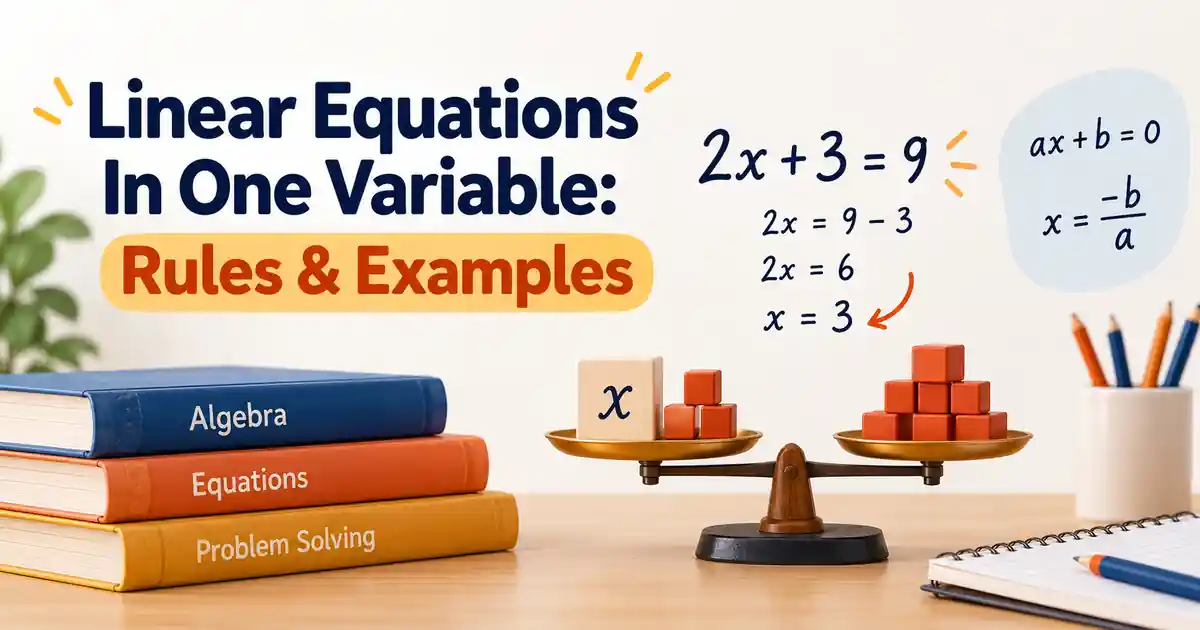
The subtraction property of equality states that when the same quantity is subtracted from both sides of an equation, the two sides remain equal. Formally: if , then , for any numbers , , and .
The key word is both. The property does not say you may subtract from one side; it says that whatever you subtract from one side, you must subtract from the other to preserve the equality. It is one of the properties of equality - the small set of balance rules that let you transform an equation without breaking it.
What Is The Formula For The Subtraction Property of Equality?
The formula is short:
Variable glossary:
Symbol | Meaning |
|---|---|
the quantity on the left side of the equation | |
the quantity on the right side (equal to ) | |
the number subtracted from both sides |
That is the whole rule. Its power comes from choosing cleverly: pick the number that cancels an unwanted term, and the variable you want is left standing alone.
How Does The Subtraction Property Solve Equations?
The property is how you undo addition. If a variable has something added to it, subtract that something from both sides and it disappears from the variable's side.
Take . The has added to it. Subtract from both sides:
The and cancel on the left, isolating ; the right side does the arithmetic. This is the single most common first move in solving an equation, and it works because subtracting equally from both sides never disturbs the balance.
Examples of the Subtraction Property of Equality
Example 1
Solve .
Subtract from both sides:
Final answer: . Check: . Correct.
Example 2
Solve .
The instinct, seeing a smaller number on the right, is to subtract the instead of the - or to "just know" the answer is a small positive number. Try the wrong path: subtracting gives , which has not isolated at all and leaves more work. And the expectation of a positive answer is itself a trap. To isolate , you must remove what is added to it, which is :
Final answer: . Two lessons here: subtract the term attached to the variable (the ), not whatever number looks convenient, and do not assume the answer is positive. Check: . Correct.
Example 3
A two-column proof step. In a proof you have reached the line and separately know . Show that .
Subtract from both sides of the first equation:
Then, since , the result is . The justification cited at the subtraction step is the subtraction property of equality; the final replacement uses the substitution property.
Final answer: . This segment-subtraction move is exactly how the property earns its place in geometry proofs.
Example 4
Solve with a fraction: .
Subtract from both sides:
Final answer: . Fractions change nothing about the property - the same number, , comes off both sides.
Example 5
Solve ... carefully. Here the variable is being subtracted, which needs a touch more care.
First subtract from both sides to start isolating the term:
Find a common denominator of on the right:
Then multiply both sides by :
Final answer: . Check: . Correct.
Example 6
A word problem. A bag had some marbles. After marbles were added, it held . How many were there to start?
Let be the starting count. Adding gave :
Subtract from both sides:
Final answer: marbles. Translating "after adding " into and then subtracting to undo it is the property solving a real question.
Why Subtraction And Addition Are One Principle In Two Directions
"Whatever leaves one side must leave the other, or the balance breaks."
The subtraction property of equality has a mirror twin: the addition property of equality, which says if then . They are not two unrelated rules to memorise. They are the same balance principle pointed in opposite directions - one adds equally to both sides, the other removes equally from both sides. Together they let you move any added or subtracted term across the sign, which is most of what solving a linear equation requires.
Seeing them as one idea is what stops the memorizer from freezing. A student who learns "subtract to cancel addition, add to cancel subtraction" as two separate facts has twice as much to forget. A student who holds the balance image needs only to ask: what is on this side that I want gone, and how do I remove it equally from both? The convention that you "move a term to the other side and flip its sign" is just these two properties applied quickly - and a teacher who cannot explain why the sign flips is teaching a trick instead of the reason.
The balance idea is old and deep. The very word algebra comes from the Arabic al-jabr, meaning "restoration" or "the reunion of broken parts", from the title of a 9th-century work by al-Khwarizmi describing exactly this kind of balancing of two sides of an equation. The subtraction property is one of the oldest moves in the subject, named or not.
Tripping Points To Avoid
Mistake 1: Subtracting from only one side
Where it slips in: The hurried first step of solving an equation.
Don't do this: Turn into by deleting the and leaving the right side untouched.
The correct way: Subtract from both sides. The whole property is the word "both"; removing from one side alone is the most common way students break an equation while thinking they are solving it. Picture the scale tilting the instant you take weight off only one pan.
Mistake 2: Subtracting the wrong term
Where it slips in: Equations where more than one number is present, like .
Don't do this: Subtract whichever number is smaller or more convenient instead of the term actually attached to the variable.
The correct way: Subtract the number that is being added to the variable - that is the one that cancels. In , the is attached to , so is what comes off both sides. The rusher who grabs the nearest number is exactly the student who ends up further from the answer, not closer.
Mistake 3: Sign errors when the result is negative
Where it slips in: Cases like where the answer is negative.
Don't do this: Compute as because "you can't subtract a bigger number", or quietly flip the answer to positive.
The correct way: . Equations do not promise positive solutions. Subtract carefully and let the sign fall where it does; the check at the end will confirm it. The second-guesser who distrusts a negative answer often "corrects" a right answer into a wrong one.
Practice Questions on the Subtraction Property of Equality
Subtract the term attached to the variable from both sides. Answers follow.
Solve .
Solve .
Solve .
In a proof you have and know . Show , naming the property at each step.
A jar gained coins and then held . How many coins were there to start?
Answers:
Subtract : . Check: .
Subtract : . Check: .
Subtract : .
Subtract from both sides (subtraction property): ; then gives (substitution property).
; subtract : coins.
Key Takeaways
The subtraction property of equality says if , then .
It keeps an equation balanced, which is why you may subtract a term from both sides to isolate a variable.
It is the mirror of the addition property; together they move terms across the sign.
Always subtract from both sides, choose the term attached to the variable, and let negative answers stand.
The property works identically with fractions, negatives, and segment lengths in proofs.
A Practical Next Step
Now solve on your own, subtracting from both sides and checking that you are comfortable landing on a negative answer. If the balance idea still feels like a trick, draw the scale for one equation and physically picture the weights coming off both pans. The mirror-image addition property of equality, the substitution property, and the reflexive property complete the toolkit of equality rules you will use in every proof and every equation you solve.
At Bhanzu, our trainers teach equation-solving from the balance-scale picture first, so students understand why a term comes off both sides instead of memorising "move it across and flip the sign." Want a live trainer to work through more equation-solving problems? Book a free demo class.
Was this article helpful?
Your feedback helps us write better content