What Does "Solve for x" Mean?
To solve for means to find the value (or values) of that make the equation true. Geometrically, you're finding where the left side equals the right side.
The four legal moves that preserve equality:
Add the same quantity to both sides.
Subtract the same quantity from both sides.
Multiply both sides by the same non-zero quantity.
Divide both sides by the same non-zero quantity.
Every algebraic solving step is one of these four — or a combination. Master those, and you can solve almost any equation.
The General Process
For any equation:
Simplify each side separately — combine like terms, distribute, clear fractions.
Move all -terms to one side, all constants to the other.
Isolate by undoing operations in reverse order of how they were applied.
Check by substituting back into the original equation.
The four steps look the same regardless of equation type — the specifics differ.
How to Solve for x in a Linear Equation
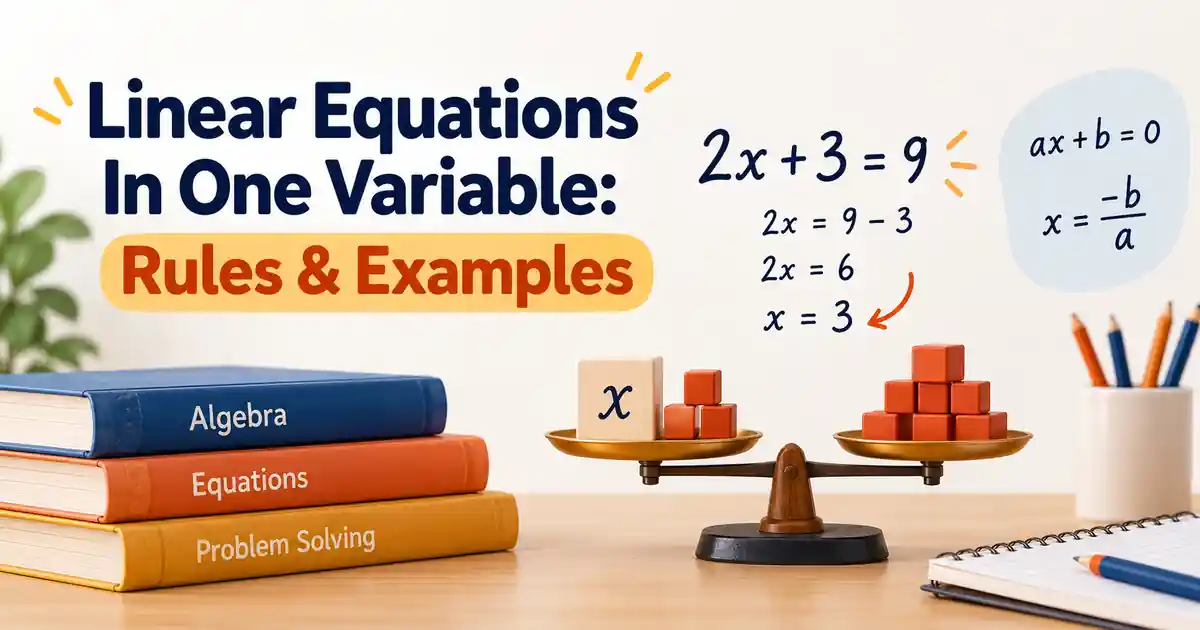
A linear equation has to the first power: .
Worked example. Solve .
Step 1: Subtract from both sides → . Step 2: Add to both sides → . Step 3: Divide both sides by → . Step 4: Check. and ✓.
How to Solve for x in a Quadratic Equation
A quadratic equation has as its highest power: . Three methods:
Method 1: Factoring
Find numbers that multiply to give and add to give .
Example. Solve .
Look for two numbers multiplying to and adding to : those are and . So , giving or .
Method 2: Quadratic Formula
Works for any quadratic. Use when factoring isn't obvious.
Method 3: Completing the Square
Rewrite the quadratic as a perfect square plus a constant. Useful for understanding the formula's derivation; less common for routine problem-solving.
How to Solve for x in a Radical Equation
A radical equation has inside a square root (or higher root): .
Process. Isolate the radical, then square (or cube) both sides to eliminate it.
Worked example. Solve .
Step 1: Square both sides → . Step 2: Subtract → . Step 3: Check (essential — squaring can introduce extraneous roots). ✓.
How to Solve for x in a Rational Equation
A rational equation has in a denominator: .
Process. Multiply both sides by the common denominator to clear the fractions, then solve as a linear or polynomial equation.
Worked example. Solve .
Step 1: Cross-multiply → , i.e., . Step 2: Solve → , so . Step 3: Check doesn't make any denominator zero () ✓.
Three Worked Examples — Quick, Standard, Stretch
Quick — Linear
Solve .
Distribute: . Subtract : . Add 8: .
Standard — Quadratic
Solve .
Use the quadratic formula with :
Stretch — Rational + Quadratic
Solve .
Cross-multiply: . So , giving .
Check: at , denominator ✓; left side ✓.
Why Does Solving for x Matter? (The Real-World GROUND)
"Algebra is the intellectual instrument for converting questions into answers." — adapted.
Solving for — finding the value of an unknown — is the operational core of applied mathematics:
Physics. Solving for the time a projectile lands, for the resistance in a circuit, for the period of a pendulum — all are solve-for- problems.
Economics. Equilibrium prices, break-even quantities, optimal allocations — all reduce to solving equations for an unknown.
Engineering. Designing for a specific load, dose, or tolerance is the question "what value of makes this equation balance?"
Computer science. Numerical algorithms (Newton's method, bisection) are sophisticated automations of solve-for-.
The systematic solve-for- method comes from Al-Khwarizmi's 820 CE Al-Jabr — the book whose title gave us algebra. His central insight was that moving terms across an equals sign (al-jabr = "restoration") gives a systematic way to isolate unknowns.
Learn more: Equation in Math
A Worked Example
Solve .
The intuitive (wrong) approach. A student "deals with the first" and divides both sides by :
The work goes nowhere useful — fractions everywhere, equation not simpler.
Why it fails. Operations should be undone in reverse order of how they were applied. The was added to last, so subtract first. The multiplied first, so divide last.
The correct method. Step 1: → . Step 2: → .
Check. ✓.
What Are the Most Common Mistakes With "Solve for x"?
Mistake 1: Doing the same operation to one side only
Where it slips in: Adding to one side and forgetting the other.
Don't do this: in one line that started as .
The correct way: Every operation on the left must be done on the right too. Show the move explicitly: .
Mistake 2: Forgetting to check for extraneous roots in radical equations
Where it slips in: Solving and writing without checking.
Don't do this: Treating as a valid solution.
The correct way: Substitute back: . The equation has no solution because square roots are non-negative.
Mistake 3: Dividing by zero implicitly
Where it slips in: Cancelling from both sides without noting that .
Don't do this: From , dividing by to get .
The correct way: Don't divide by — instead, conclude OR . Dividing loses the root .
Key Takeaways
"Solve for " means isolate using the four legal moves (add, subtract, multiply, divide both sides).
Method depends on equation type: linear, quadratic, radical, rational, exponential — each has a specific approach.
Undo operations in reverse order of how they were applied.
Check for extraneous roots when squaring both sides or multiplying by expressions containing .
Always verify by substituting back into the original equation.
A Practical Next Step
Try these three before moving on to systems of equations.
Solve .
Solve by factoring.
Solve and check for extraneous roots.
If problem 3 felt tricky, square both sides: , so . Check: ✓. Want a Bhanzu trainer to walk through more solve-for- problems? Book a free demo class — online globally.
Was this article helpful?
Your feedback helps us write better content