What Does "On the Same Base and Between the Same Parallels" Mean?
Before the theorem, two phrases need pinning down, because most confusion starts here.
On the same base means both figures share one common side, used as the base for each.
Between the same parallels means the sides opposite the base both lie on a single second line that is parallel to the base. Because the two boundary lines are parallel, the perpendicular distance between them, the height, is identical for every figure sitting between them.
So the setup quietly forces two figures to share both the same base and the same height. Once you see that, the equal-area result stops being surprising.
What Is the Theorem for Parallelograms on the Same Base and Between the Same Parallels?
The theorem states: parallelograms on the same base and between the same parallels are equal in area.
This is Proposition 35 in Book I of Euclid's Elements. It does not say the parallelograms are congruent (they are usually different shapes); it says the area they enclose is identical. Since the area of a parallelogram is base height, and both the base and the height are shared, equal area is exactly what you would hope for. The proof below makes that airtight without assuming the area formula.
How Do You Prove Parallelograms on the Same Base Are Equal in Area?
Take two parallelograms and on the same base , with all lying on one line parallel to (so both tops sit on the same upper parallel). Order along that top line is is not needed; what we use is the pair of congruent triangles.
Step 1: set up two triangles.
Look at and , formed by the slanted sides. (Equivalently, many textbooks use and ; the argument is the same.)
Step 2: match a pair of sides.
, because they are opposite sides of parallelogram , and opposite sides of a parallelogram are equal.
Step 3: match two pairs of angles.
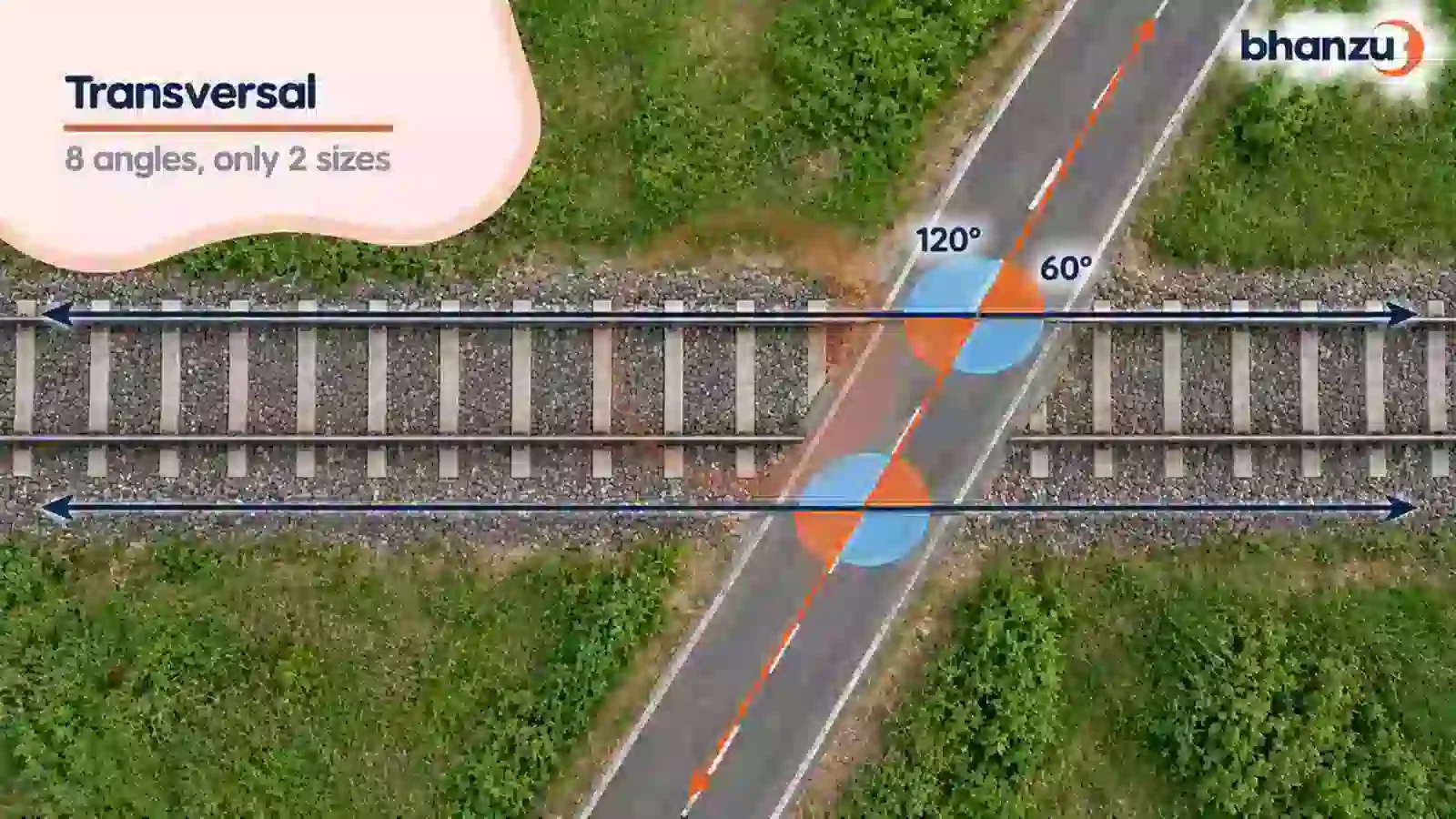
: these are corresponding angles, since cut by the transversal along the top line.
: corresponding angles, since (opposite sides of the two parallelograms all lie between the same parallels) cut by the same transversal.
Step 4: conclude congruence.
With two angles and the included-pattern side matching, by the ASA criterion (angle-side-angle). If you want the criterion itself, see the ASA congruence rule and the wider idea of congruence in triangles. Congruent triangles have equal area, so:
Step 5: add and subtract the common piece.
Both parallelograms contain the same middle region. Adding the equal triangles to that common region rebuilds each parallelogram:
Since the two triangles are equal and the common region is shared:
The theorem is proven. You can read Euclid's original phrasing of this result in Elements Book I, Proposition 35.
What Is the Triangle Corollary?
A direct consequence: if a triangle and a parallelogram sit on the same base and between the same parallels, the triangle's area is half the parallelogram's.
The reason is that a diagonal splits a parallelogram into two congruent triangles, each half its area, and each such triangle shares the base and lies between the same parallels. This corollary is the bridge to the companion result for triangles on the same base and between the same parallels, and both live under the umbrella theorem same base and between the same parallels.
Examples of Parallelograms on the Same Base and Between the Same Parallels
The set runs from a direct area comparison to a corollary calculation.
Example 1
Two parallelograms share base 10 cm and lie between the same parallels 6 cm apart. Compare their areas.
Each area is base height:
Final answer: both equal 60 cm², regardless of how much either one leans.
Example 2
A student says one parallelogram must be larger because its slanted sides are longer. Check this.
The instinct is that longer sides mean more area. Test it. Area of a parallelogram is base perpendicular height, not base slant side. Leaning the shape lengthens the slant sides but leaves the base and the height untouched, so the area cannot change. The longer sides are a distraction; only base and height enter the area.
For a base of 8 cm and height of 5 cm, every such parallelogram has area:
Final answer: 40 cm² for all of them, long slant sides included.
Example 3
Parallelogram has area 84 cm². Parallelogram is on the same base and between the same parallels. Find its area.
By the theorem, equal base and equal parallels force equal area.
Final answer: cm².
Example 4
A triangle and a parallelogram share a base of 12 cm and lie between the same parallels 9 cm apart. Find each area.
Parallelogram: cm².
Triangle (half the parallelogram, by the corollary): cm².
Final answer: parallelogram 108 cm², triangle 54 cm².
Example 5
Two parallelograms on the same base have areas that a student measured as 72 cm² and 75 cm². What can you conclude?
If they truly share the same base and the same parallels, the theorem forces equal areas. A 72 vs 75 gap means one condition failed: most likely the tops do not lie on a single parallel line, so the heights differ.
Final answer: the two figures are not between the same parallels; re-check that both tops sit on one line parallel to the base.
Example 6
Parallelogram (base 15 cm, height 8 cm) and parallelogram share base between the same parallels. Find the area of , where lies on the far parallel.
Both parallelograms have area cm². Triangle shares base and lies between the same parallels, so it is half:
Final answer: 60 cm².
Students meeting this for the first time almost always want to compare the slant sides, because those are the lengths that visibly change. Redirecting attention to the fixed base and fixed height is the single move that makes the theorem click.
Why Does This Theorem Matter?
"Shearing a shape sideways never changes its area." That principle reaches well beyond parallelograms.
Area without a height formula. The theorem lets you compare or transfer areas by sliding shapes between fixed parallels, the reasoning behind deriving the area of polygons by rearrangement.
Engineering shear. When a stack of layers slides sideways under load (a "shear" deformation), each layer keeps its footprint area; the total volume is preserved even as the block leans.
Land division. A slanted plot and an upright plot on the same road frontage, reaching the same back line, hold equal area, which matters when fields are split fairly.
The deeper principle, that area depends on base and height rather than on how a figure is slanted, is the same insight Cavalieri built his method of indivisibles on. You can read the historical framing of Euclid's equal-area figures in Elements Book I, Proposition 35, already linked in the proof above.
What Are the Most Common Mistakes With This Theorem?
Mistake 1: Using the slant side as the height
Where it slips in: When computing the area of a leaning parallelogram directly.
Don't do this: Writing area = base slant side.
The correct way: Area = base perpendicular height, the straight-across distance between the parallels. The slant side is always longer than the height and gives too large an answer.
Mistake 2: Forgetting the "same parallels" condition
Where it slips in: When two parallelograms share a base but their tops are not on one line.
Don't do this: Declaring the areas equal just because the bases match.
The correct way: Confirm both figures lie between the same pair of parallels. Same base alone is not enough; the heights must match too. The check that fixes this is asking whether both top edges rest on a single line parallel to the base.
Mistake 3: Confusing "equal area" with "congruent"
Where it slips in: When students expect the two parallelograms to be identical shapes.
Don't do this: Assuming equal area means the figures can be laid exactly on top of each other.
The correct way: Equal area means they enclose the same amount of space; the shapes are almost always different. Congruent is a stronger, separate condition.
Conclusion
Parallelograms on the same base and between the same parallels are equal in area.
The shared base and shared parallels force the same base and the same height.
The proof pairs two congruent triangles (ASA) and a common region.
A triangle on the same base between the same parallels is half the parallelogram (the corollary).
Equal area does not mean congruent; the shapes usually differ.
To work through this proof with a teacher, explore Bhanzu's geometry tutor or a high school math tutor, with more support at math classes online.
Where Should You Practice This Theorem Next?
Try these three to test the base-and-height reasoning.
Two parallelograms on a 14 cm base lie between parallels 5 cm apart. Find each area.
A parallelogram of area 96 cm² shares a base and parallels with a triangle. Find the triangle's area.
One parallelogram on a shared base measures 60 cm² and another on the same base measures 66 cm². Explain what must be different.
State the base and the perpendicular height before computing anything. To have a live trainer build the congruent-triangle proof with you, you can book a free demo class with Bhanzu.
Read More
Was this article helpful?
Your feedback helps us write better content