What Does Intersect Mean?
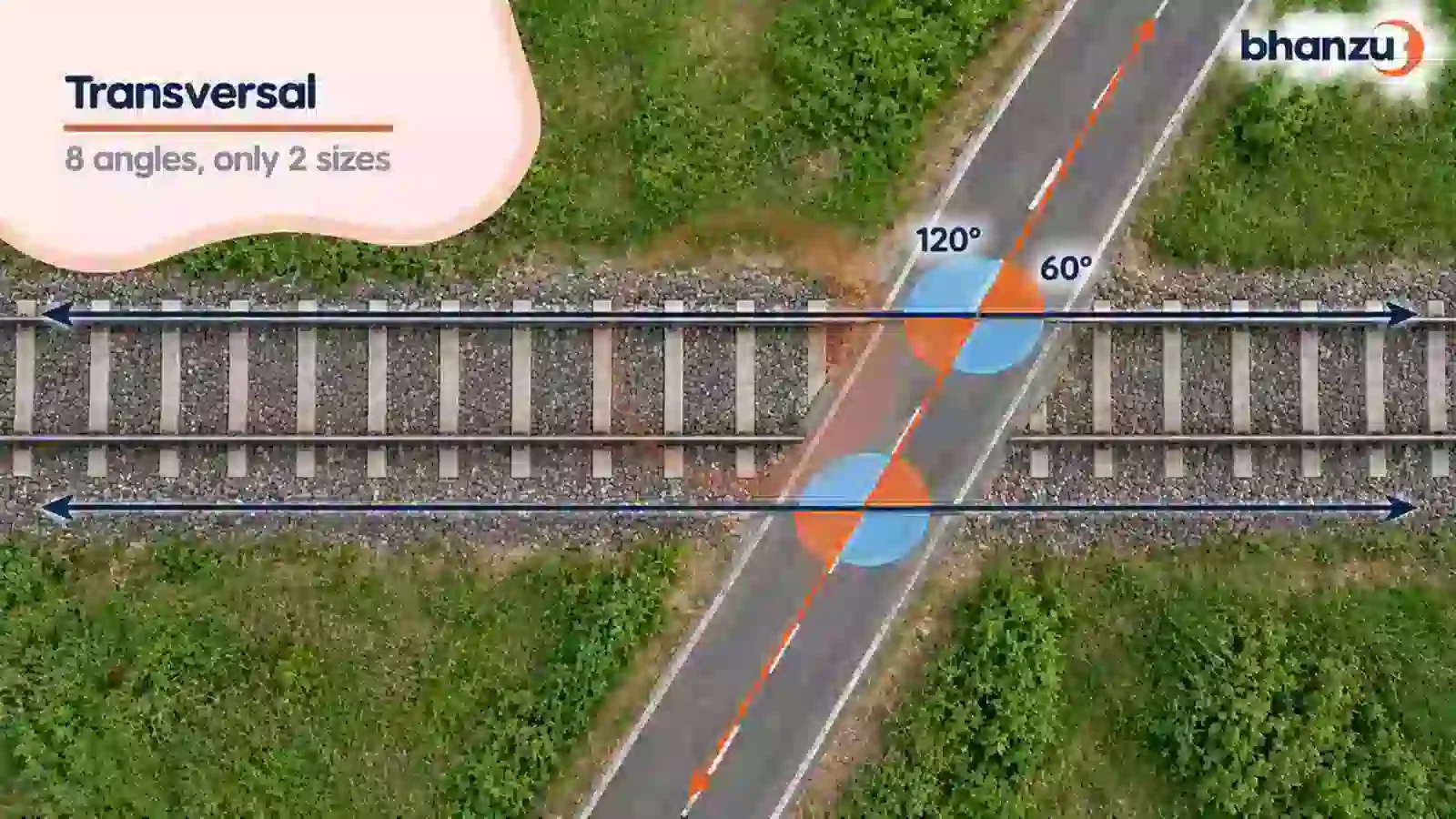
In everyday language, two roads intersect where they cross. Mathematics keeps that exact idea: to intersect is to meet, cross, or share something in common. What is shared depends on the objects:
Two lines intersect at a point - a single shared location.
Two curves intersect at one or more points where they cross.
Two sets intersect in the elements they both contain.
The common thread is "what do these two things have in common?" For lines and curves the answer is a point (an pair); for sets the answer is a collection of shared members. Two lines that cross are intersecting lines, and the algebra of finding exactly where they meet is developed under intersection of two lines.
What Is a Point of Intersection?
A point of intersection is the single location where two lines cross. Because it lies on both lines, its coordinates satisfy both line equations at the same time. That is the key idea behind every method: the intersection point is the simultaneous solution of the two equations.
Geometrically, two straight lines in a plane have exactly one of three relationships: they cross once (one point of intersection), they are parallel lines and never meet (no point), or they are the same line and meet everywhere (infinitely many points, called coincident lines).
How Do You Find the Point of Intersection of Two Lines?
Given two lines in general form:
their point of intersection is:
Here is what each symbol means:
- the coefficients of the first line's equation.
- the coefficients of the second line's equation.
- the shared denominator; when it equals zero the lines are parallel and there is no single intersection point.
You do not have to memorise the formula. The everyday method is substitution or elimination: solve one equation for a variable, plug it into the other, solve for the remaining variable, then back-substitute. Both routes give the same . The denominator's warning is important: if , division fails, which is the algebra's way of saying the lines never cross at a single point.
How Do You Find Where Two Curves Intersect?
Two curves - or a line and a curve - intersect wherever they take the same value. The method is to set the equations equal and solve. If a line is and a curve is , then at any intersection:
Solve this for (it may be a quadratic, giving up to two solutions), then substitute each back to get the matching . Unlike two straight lines, curves can meet at more than one point: a line can cut a parabola in two places, touch it in one (a tangent), or miss it entirely. The number of real solutions to the combined equation tells you how many intersection points there are.
What Is the Intersection of Sets?
For sets, "intersect" shifts from points to members. The intersection of two sets and , written , is the set of all elements that belong to both and :
For example, if and , then , only the members common to both. The keyword is "and": an element must be in both sets to survive the intersection. If two sets share nothing, their intersection is the empty set, , and they are called disjoint. On a Venn diagram, is the overlapping region.
When Do Two Lines Not Intersect?
Not every pair of lines meets at a point. Two lines in a plane fail to have a single intersection point in two cases:
Parallel lines. They have the same slope but different intercepts, so they run alongside each other forever without meeting. Algebraically, but the lines are not identical.
Coincident lines. They are actually the same line written two ways, so they "meet" at every point - infinitely many intersections.
When three or more lines all pass through one common point, that point is a point of concurrency; the point of concurrency in a triangle (like the centroid) is a classic example. The gap between two parallel lines never changes, which is why distance between two lines is a well-defined constant for them.
What Are the Types of Intersections?
Pulling the cases together, intersections come in a few distinct types:
Single-point intersection. Two non-parallel lines, or a tangent touching a curve once.
Multiple-point intersection. A line cutting a curve twice, or two curves crossing several times.
No intersection. Parallel lines, or a line that misses a curve entirely (no real solution).
Infinite intersection. Coincident lines, or identical curves, sharing every point.
Set intersection. Shared elements (), which may be non-empty or empty (disjoint sets).
Where Is Intersection Used?
Finding where things meet is one of the most applied ideas in mathematics:
Break-even analysis. In business, the intersection of a cost line and a revenue line is the break-even point.
Navigation and GPS. A position is fixed by intersecting distance circles or bearing lines from known points.
Engineering and design. Structural members, pipes, and roads are laid out by computing where lines and curves cross.
Computer graphics and games. Ray tracing and collision detection constantly test where a line intersects a surface.
Logic and databases. Set intersection powers search filters - results matching condition A and condition B.
Examples of Intersect
Example 1
Find the point of intersection of and .
Set them equal: , so and . Then .
Final answer: the lines intersect at .
Example 2
Find where the lines and meet.
Add the equations: , so . Substitute back: , so .
Final answer: the point of intersection is .
Example 3
A student is asked where and intersect and reports the point .
Wrong path. The student sets the equations equal, gets , and reads off a -value from one line.
Why it breaks. Solving gives , which is false. Both lines have slope but different intercepts, so they are parallel and never meet - there is no point of intersection to report.
The rescue. When the equation collapses to a false statement, conclude the lines are parallel. Equal slopes with different intercepts means no intersection.
Final answer: the lines are parallel; there is no point of intersection.
Example 4
Find the intersection points of the line and the parabola .
Set equal: , so , which factors as . Thus or . The matching -values: at , ; at , .
Final answer: the curves intersect at and .
Example 5
If and , find .
Keep only the elements in both sets. Both contain and .
Final answer: .
Example 6
Using the formula, find the intersection of and .
Here and . The denominator is .
Final answer: the lines intersect at .
Where Do Students Trip Up on Intersection?
The most common misstep is not recognising the no-solution case: when the variables cancel and leave a false statement, the lines are parallel, not "solved." A second is mixing up set intersection (, "and") with set union (, "or"). Naming what kind of object is intersecting - lines, curves, or sets - before you start keeps the right method in view.
Mistake 1: Missing the parallel (no-solution) case
Where it slips in: Two lines with equal slopes are set equal and the -terms cancel.
Don't do this: Forcing a point out of "."
The correct way: A false statement means no solution - the lines are parallel and do not intersect. A true statement like "" means the lines are coincident, with infinitely many intersection points.
Mistake 2: Confusing intersection with union of sets
Where it slips in: Being asked for and listing every element from both sets.
Don't do this: Writing when only some elements are shared.
The correct way: Intersection () keeps only the shared elements ("and"); union () keeps everything from both ("or"). For , , .
Mistake 3: Reporting only one intersection for a curve
Where it slips in: Solving a line-and-parabola problem and stopping at the first -value.
Don't do this: Giving one point when the quadratic has two roots.
The correct way: A line can cut a curve in two places. Solve the full quadratic, and report every real solution as a separate intersection point.
Conclusion
To intersect means to cross or overlap; the intersection is the shared point (lines, curves) or shared elements (sets).
Two lines meet at one point of intersection, found by solving their equations simultaneously.
Curves are handled by setting equations equal - they can meet at zero, one, or several points.
The intersection of sets keeps only the elements in both; parallel lines and disjoint sets have no intersection at all.
To take intersection problems further with a teacher, explore Bhanzu's geometry tutor or high school math tutor sessions, or browse math classes online for guided practice.
Read More
Practice These to Solidify Your Understanding
Work through these problems in order:
Find the point of intersection of and .
If and , find .
Find the intersection points of and .
Answer to Question 1: , ; point . Answer to Question 2: . Answer to Question 3: ; points and .
Want a live Bhanzu trainer to walk through more intersection problems with you? Book a free demo class.
Was this article helpful?
Your feedback helps us write better content