Why Is Geometry Everywhere Once You Start Looking?
Look at a honeybee's comb and you find thousands of perfect hexagons, built with no ruler and no protractor.
Bees settled on the hexagon because it tiles a flat space with the least wax for the most storage, and that is geometry in daily life working long before anyone wrote it down. Once you notice one pattern, the rest appear fast: the circle of a clock, the right angle of a doorway, the parabola of a thrown ball. Geometry is not a subject locked in a textbook; it is the hidden grammar of the physical world, and reading it changes how you see an ordinary room.
What Is Geometry in Daily Life?
Geometry in daily life is the practical application of the study of shapes, sizes, angles, and positions to the objects, spaces, and activities we deal with every day. It ranges from recognising the shapes around us to using measurement and spatial reasoning to build, navigate, and design.
At its core, geometry answers questions of form and space: how big, what shape, at what angle, how far apart. These questions come up whenever you tile a floor, park a car, cut a cake, or read a map. The formal subject is geometry; its everyday face is the constant, mostly unnoticed use of that reasoning to get real tasks done.
Where Do You See Geometry in Nature?
Nature is the oldest geometry teacher, and its patterns are strikingly regular.
Hexagons in honeycombs and snowflakes - the most efficient way to fill space or pack ice.
Spheres in raindrops, bubbles, and oranges - the shape that holds the most volume for the least surface.
Spirals in shells, sunflowers, and galaxies - growth that keeps the same shape as it scales.
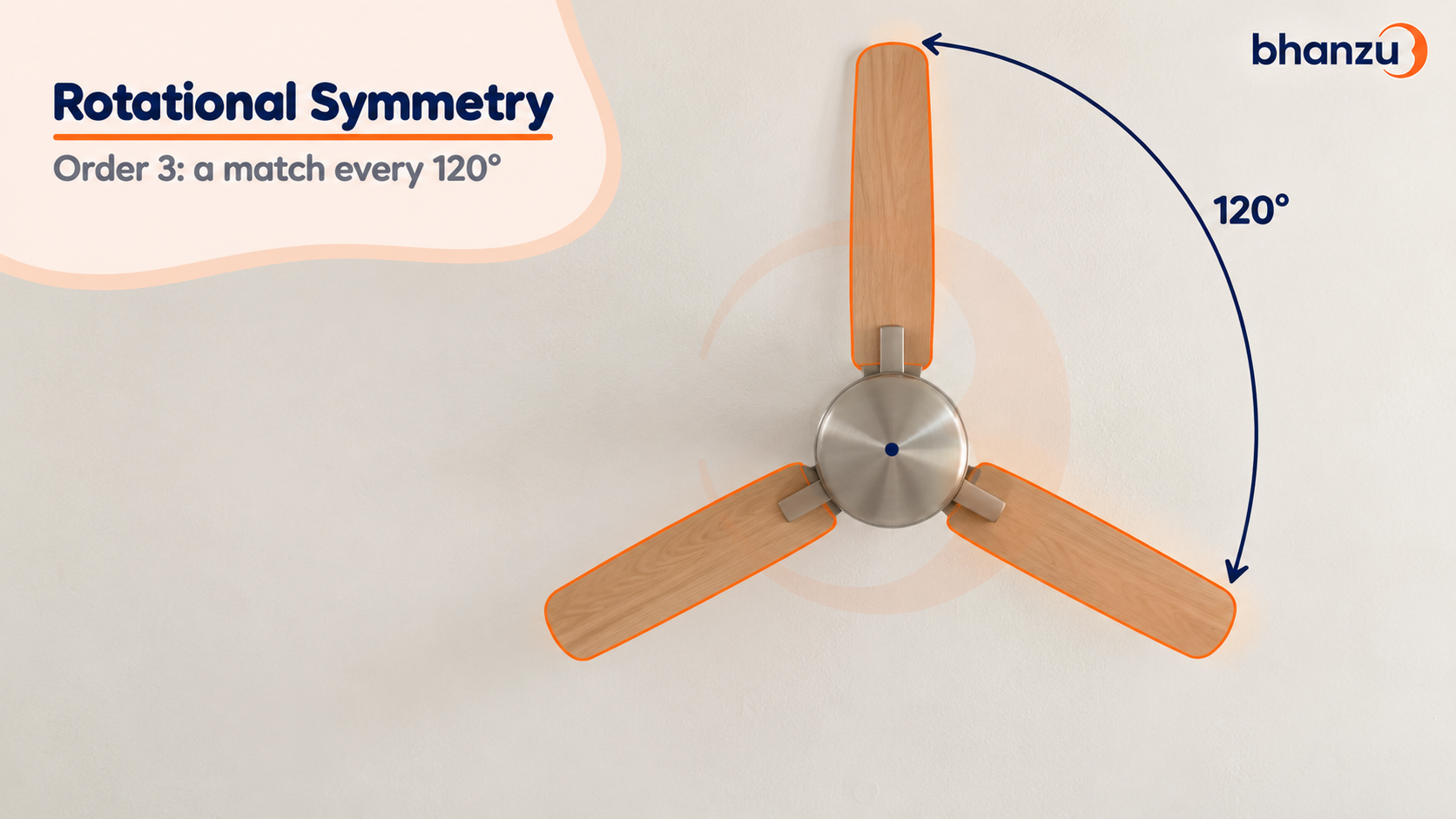
Symmetry in leaves, butterflies, and flowers - mirror balance that helps growth and function.
The mirror balance in a leaf or a butterfly is exactly symmetry in geometry, and the honeycomb's efficiency is a real theorem, described in the honeycomb conjecture.
How Is Geometry Used in Architecture and Construction?
Every building standing today rests on geometric reasoning.
Triangles carry weight in roof trusses and bridges because a triangle cannot be pushed out of shape.
Right angles keep walls vertical and floors level.
Arches and domes distribute load along curved lines so the structure carries far more weight than a flat beam.
Scale drawings let architects test a design on paper before a single brick is laid.
The load-bearing strength of a triangle is why bracing everywhere uses this shape; the different forms it takes are covered in types of triangles.
How Is Geometry Used in Technology and Design?
Screens, games, and machines all run on coordinate geometry.
Computer graphics place every pixel and 3D model using coordinates and vectors.
GPS navigation fixes your position by measuring distances from satellites - pure spatial geometry,
Robotics plans an arm's path through space using angles and coordinates.
Product design uses 3D shapes to model everything from phone cases to car bodies before manufacturing.
Where Does Geometry Appear in Sports and Games?
Angles and trajectories decide who wins.
A basketball shot follows a parabolic arc; the release angle sets the range.
A billiards player uses angle of reflection to plan a bank shot.
A football pass is aimed along a line to where the receiver will be.
A running track is built from straight segments and semicircular ends of fixed radius.
How Is Geometry Used in Art and Everyday Objects?
Design leans on geometry for both beauty and function.
Perspective drawing uses vanishing points and lines to create depth on a flat page.
Tiling and patterns repeat 2D shapes to cover walls and floors with no gaps.
Packaging uses cylinders, cuboids, and cones to store goods efficiently.
Logos and typography balance shapes for a clean, readable look.
Examples of Geometry in Daily Life
A pattern worth noticing: people mix up which measurement a real task needs - length, area, or volume - far more often than they get the arithmetic wrong.
Example 1
A square kitchen tile has a side of cm. What area does one tile cover?
Area of a square is side squared.
Final answer: .
Example 2
A pizza has a diameter of cm. You buy a "family" pizza of diameter cm for double the price. Is it a fair deal?
Wrong path. Doubling the diameter looks like double the pizza, so double the price seems fair.
Why it breaks. Pizza is measured by area, not diameter, and area grows with the square of the radius, . Doubling the diameter multiplies the area by , not .
Correct. Small: . Family: . The family pizza has times the area for times the price.
Final answer: the family pizza is the better deal - four times the food, twice the cost. (See area of a circle.)
Example 3
A wheelchair ramp rises m over a horizontal run of m. What is its slope?
Slope is rise over run.
Final answer: a slope of about , or in , the standard accessible ramp gradient.
Example 4
A bicycle wheel has a radius of cm. How far does it travel in one full turn?
One turn covers the circumference, .
Final answer: about cm, or m, per turn.
Example 5
A room measures m by m. How much carpet is needed to cover the floor?
Floor area of a rectangle is length times width.
Final answer: of carpet.
Example 6
A cylindrical water tank has a radius of m and a height of m. What volume does it hold?
Volume of a cylinder is .
Final answer: about , or roughly litres.
Why Does Geometry in Daily Life Matter?
"Geometry is the science of correct reasoning on incorrect figures" - a rough sketch is enough because the logic behind it is exact. That exactness is why geometry underpins the built world.
It makes structures safe. Bridges and buildings stand because their geometry distributes force correctly.
It saves resources. Efficient shapes, like the honeycomb's hexagon, use the least material for the most function.
It powers modern tech. Maps, screens, and navigation all reduce the world to coordinates and angles.
Understanding geometry in daily life turns a passive observer into someone who can measure, predict, and build - the difference between guessing a ramp's steepness and knowing it. A broad view of the field lives in the Wikipedia entry on geometry.
What Are Common Misconceptions About Everyday Geometry?
The errors here are less about calculation and more about choosing the wrong tool for the task.
Mistake 1: Confusing area with perimeter
Where it slips in: Buying carpet, fencing, or paint.
Don't do this: Using the perimeter (distance around) when the task needs the area (surface covered).
The correct way: Fencing a garden needs the perimeter; carpeting it needs the area. Ask what is being covered versus what is being bordered. Students who rush past this step order too little carpet and too much fencing, or the reverse.
Mistake 2: Assuming bigger diameter means proportionally bigger size
Where it slips in: Comparing pizzas, TVs, or pipes.
Don't do this: Treating a doubled length as a doubled area or volume.
The correct way: Area scales with the square of length, and volume with the cube. A cm pizza is four times a cm one, not twice. In the real world, this scaling error is why a misjudged model - the square-cube law - makes small prototypes behave differently from full-size builds.
Mistake 3: Ignoring the third dimension
Where it slips in: Estimating how much a container holds.
Don't do this: Using floor area to judge capacity.
The correct way: Capacity depends on volume, which needs height too. A wide shallow box and a tall narrow box can share a floor area yet hold very different amounts.
Practice: Spot the Geometry Around You
Try these with objects near you.
A dinner plate has a radius of cm. Find its circumference.
A wall is m long and m high. How much paint area is that?
A shoebox is cm by cm by cm. Find its volume.
Answer to Question 1: cm. Answer to Question 2: . Answer to Question 3: .
Conclusion
Geometry in daily life is the everyday use of shapes, angles, and spatial reasoning, from honeycombs to GPS.
Nature favours efficient shapes: hexagons, spheres, spirals, and symmetry.
Architecture relies on triangles for strength and right angles for stability.
Technology, sports, and art all reduce real problems to coordinates, angles, and trajectories.
Choosing the right measurement - length, area, or volume - matters more than the arithmetic itself.
To take geometry in daily life further with a teacher, explore Bhanzu's geometry tutor or middle school math tutor sessions, or browse math classes online for guided practice.
Read More
Want a live Bhanzu trainer to explore real-world geometry with your child? Book a free demo class.
Was this article helpful?
Your feedback helps us write better content
Frequently Asked Questions
What is geometry in daily life?
Where do we use geometry without noticing?
Why are hexagons so common in nature?
How is geometry used in technology?
Which shapes appear most often in daily life?