Why Did One Postulate Trouble Mathematicians for 2,000 Years?
For over two thousand years, mathematicians tried to prove one stubborn assumption.
Euclid's first four postulates read like plain common sense: you can draw a line between two points, extend it, draw a circle, and all right angles are equal. The fifth postulate is different. It is long, technical, and not obviously self-evident, so from the start mathematicians suspected it was really a theorem hiding among the axioms, provable from the other four. Every attempt failed, and the failure turned out to be the most productive dead end in the history of mathematics: it gave birth to entirely new geometries.
What Is Euclid's Fifth Postulate?
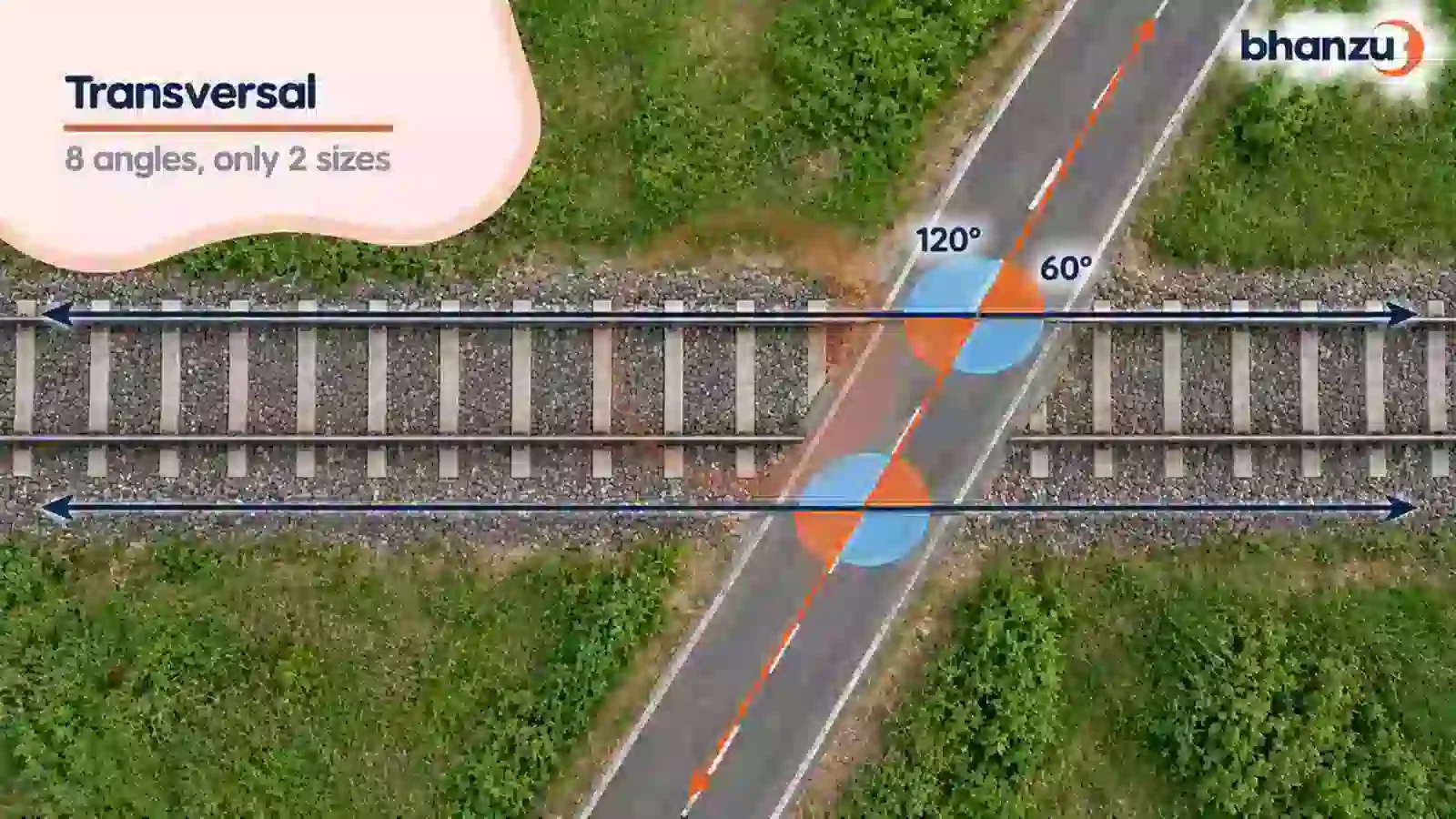
Euclid's fifth postulate states that if a straight line (a transversal) falls on two straight lines and makes the two interior angles on the same side together less than two right angles (), then the two straight lines, extended far enough, meet on that same side. In symbols, if the co-interior angles are and with
then the two lines converge and meet on the side of the smaller angle sum. If instead , the lines never meet - they are parallel.
This is the fifth and final postulate in Euclid's Elements, and it stands apart from the first four both in length and in how much it assumes. It sits at the heart of the euclids axioms and postulates that make up the foundation of the whole euclids geometry system.
What Is Playfair's Axiom, the Simpler Version?
Playfair's axiom is the modern, easier-to-state form of the fifth postulate: through a point not on a given line, exactly one line can be drawn parallel to that line. It is logically equivalent to Euclid's original - assuming one lets you prove the other - but it is far easier to picture.
Most textbooks teach this version because it speaks directly about parallel lines instead of about angle sums on a transversal. The key word is exactly one: not zero, not many. That single number is what non-Euclidean geometries later changed.
How Is the Fifth Postulate Different From the First Four?
The first four postulates are short and immediately believable; the fifth is long, conditional, and needs lines extended "indefinitely" to check. That difference is why it drew suspicion.
Postulate 1: A straight line can be drawn between any two points.
Postulate 2: A finite straight line can be extended continuously.
Postulate 3: A circle can be drawn with any centre and radius.
Postulate 4: All right angles are equal to one another.
Postulate 5: The parallel postulate above.
The first four can be confirmed on a small patch of paper. The fifth talks about what happens infinitely far away, where you cannot check by drawing. That un-checkable quality is exactly what made mathematicians want to derive it from the other four rather than simply assume it.
Why Couldn't the Fifth Postulate Be Proved?
The fifth postulate couldn't be proved from the other four because it is independent of them - it adds genuinely new information that the first four do not contain. For centuries this was only suspected. Many "proofs" were published and accepted for years, until each was found to smuggle in an assumption that was itself secretly equivalent to the fifth postulate.
The resolution came in the early 19th century. Working independently, Carl Friedrich Gauss, János Bolyai, and Nikolai Lobachevsky showed the postulate could not be derived by constructing consistent geometries in which the first four postulates hold but the fifth does not. If such a geometry has no contradictions, the fifth postulate cannot be a logical consequence of the first four. In 1868 Eugenio Beltrami proved these new geometries were logically consistent, settling the matter for good.
What Is Non-Euclidean Geometry?
Non-Euclidean geometry is any geometry that keeps Euclid's first four postulates but replaces the fifth with a different parallel rule. Changing how many parallels exist through a point produces two famous alternatives.
Hyperbolic geometry. Through a point not on a line, there are at least two parallels. Space curves away from itself like a saddle; the interior angles of a triangle sum to less than . Developed by Lobachevsky and Bolyai.
Elliptic (spherical) geometry. Through a point not on a line, there are no parallels - every pair of lines meets. Space curves like a sphere; a triangle's angles sum to more than . Developed by Bernhard Riemann.
Far from being a curiosity, elliptic geometry describes navigation on the Earth's surface, and the curved geometry Riemann built became the mathematical language of Einstein's general relativity, where gravity is the curvature of space-time. This is the destination the "failed" proofs led to.
Examples of the Fifth Postulate in Action
Example 1
A transversal crosses two lines making co-interior angles of 85° and 95°. Are the lines parallel?
Add the co-interior angles: . Since the sum equals , the lines neither converge nor diverge.
Final answer: yes, the lines are parallel.
Example 2
A transversal makes co-interior angles of 100° and 95°. A student says the lines are parallel because both angles are "close to 90°." Is that right?
Wrong path. The student eyeballs the two angles, sees both near a right angle, and concludes the lines run parallel.
Why it breaks. The fifth postulate does not care whether each angle looks like a right angle; it cares about their sum. Here , which is greater than , so the lines are not parallel.
The rescue. Because the sum exceeds on this side, the interior angles on the other side sum to . By the fifth postulate, the lines meet on that other side.
Final answer: not parallel; the lines meet on the side where the angle sum is .
Example 3
How many lines through an external point are parallel to a given line in Euclidean geometry?
Playfair's axiom answers this directly.
Final answer: exactly one.
Example 4
How many parallels exist through an external point in hyperbolic geometry?
Hyperbolic geometry replaces "exactly one" with "at least two."
Final answer: at least two (in fact, infinitely many).
Example 5
On a sphere, do two "straight lines" (great circles) ever stay parallel?
Every pair of great circles - like two meridians of longitude - crosses at the poles. This is elliptic geometry.
Final answer: no; on a sphere there are no parallel lines.
Example 6
A transversal makes co-interior angles and on the same side. For what are the two lines parallel?
For parallels, the co-interior angles sum to :
So the angles are and .
Final answer: ; the angles and sum to , so the lines are parallel.
Where Do Students Trip Up on the Fifth Postulate?
The most common misstep is treating the fifth postulate as a statement you can prove, when its whole historical point is that it must be assumed. Naming it as an independent axiom, not a theorem, is what keeps the logic straight.
Mistake 1: Thinking the postulate can be proved from the others
Where it slips in: When a student assumes every geometric fact must have a proof.
Don't do this: Trying to derive the fifth postulate from the first four - the exact task that failed for two millennia.
The correct way: Accept it as an independent axiom of Euclidean geometry. The independence was itself proved in the 19th century, so a "proof" of the postulate from the other four is known to be impossible.
Mistake 2: Checking one angle instead of the angle sum
Where it slips in: When deciding whether two lines are parallel from a transversal.
Don't do this: Comparing whether each co-interior angle looks like .
The correct way: Add the two co-interior angles; the lines are parallel only when the sum is exactly . Focusing on the sum rather than each single angle is the habit that fixes most parallel-line errors, and it connects straight to how a transversal marks equal and supplementary angle pairs.
Mistake 3: Assuming triangle angles always sum to 180°
Where it slips in: When the surface is curved rather than flat.
Don't do this: Claiming a triangle's angles must total everywhere.
The correct way: The triangle sum depends on the fifth postulate. On the curved Earth, a triangle drawn from the North Pole down to the equator and back can have three right angles totalling .
The Mathematicians Behind the Fifth Postulate
Euclid (active c. 300 BCE, Alexandria, Egypt) stated the postulate in his Elements, the most influential mathematics text ever written. His decision to list the parallel property as an assumption, rather than force a proof, was itself a mark of deep insight.
Nikolai Lobachevsky (1792–1856, Russia) and János Bolyai (1802–1860, Hungary) independently built hyperbolic geometry by denying the fifth postulate, showing it was not a logical necessity. Bernhard Riemann (1826–1866, Germany) later developed the elliptic case and the curved-space framework that underlies modern physics.
Conclusion
Euclid's fifth postulate, the parallel postulate, says a transversal making co-interior angles summing to less than forces the two lines to meet on that side.
Playfair's equivalent form: through a point not on a line, exactly one parallel exists.
It differs from the first four postulates by being long, conditional, and not self-evident.
Two thousand years of attempts to prove it failed because it is logically independent of the other four.
Denying it produced hyperbolic geometry (many parallels) and elliptic geometry (no parallels), which describe curved space and underpin general relativity.
To go deeper into Euclidean geometry with a teacher, explore Bhanzu's geometry tutor or high school math tutor sessions, or browse math classes online for structured study.
Read More
Practice These to Solidify Your Understanding
Work through these problems in order:
A transversal makes co-interior angles of 110° and 70°. Are the two lines parallel?
State how many parallels pass through an external point in Euclidean, hyperbolic, and elliptic geometry.
Co-interior angles are and . Find so the lines are parallel.
Answer to Question 1: , so yes, the lines are parallel. Answer to Question 2: Euclidean: exactly one; hyperbolic: at least two; elliptic: none. Answer to Question 3: .
Want a live Bhanzu trainer to unpack Euclidean and non-Euclidean geometry with you? Book a free demo class.
Was this article helpful?
Your feedback helps us write better content