What Are Collinear Points?
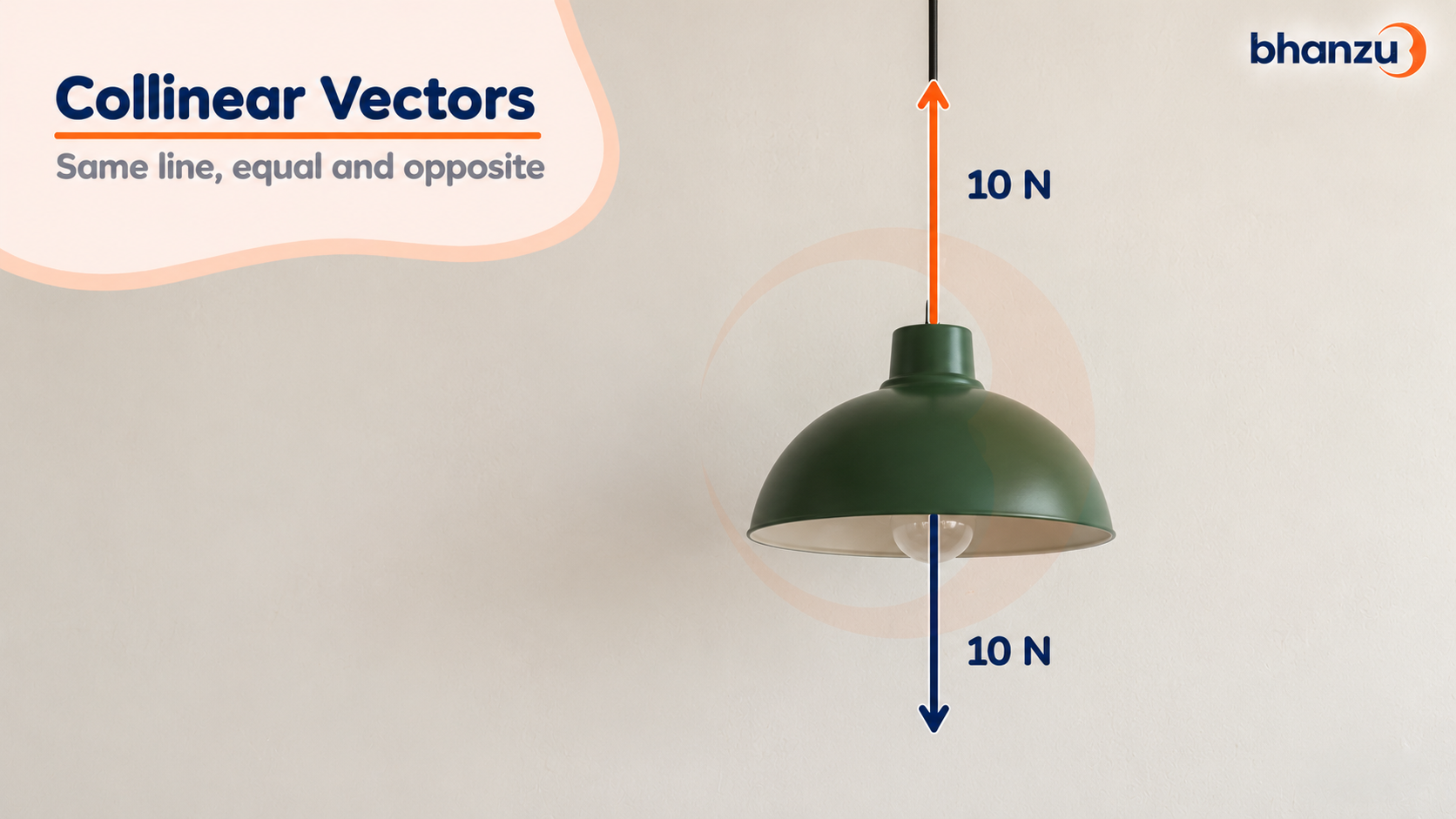
Collinear points are a set of three or more points that all lie on the same straight line. The word splits into col- ("together") and -linear ("line"): points sitting together on one line. Any two points are trivially collinear, since a single straight line always passes through any pair, so the idea only becomes a real question once you have three or more.
The points do not need to be evenly spaced or close together. As long as one ruler laid on the page touches every point at once, they are collinear. Stretch them across a kilometre or bunch them in a centimetre; the only thing that matters is that no point strays off the line.
Collinear vs Non-Collinear Points
Points that do not all fall on one line are non-collinear points. Three non-collinear points are special: they are exactly what you need to define a triangle, and to fix a single flat plane. That connection runs deep, since the cleanest test for collinearity, coming up next, asks whether three points form a triangle at all.
Collinear: , , all lie on the line .
Non-collinear: , , form a right triangle, so they bend away from any single line.
One quick note on a neighbouring word readers often mix in: collinear is about a line, while coplanar is about a plane. Collinear points are always coplanar (a line sits inside a plane), but coplanar points need not be collinear. Keep "line" tied to collinear.
How Do You Prove That Points Are Collinear?
There are three standard methods, and each one is really the same idea checked a different way: if the points were collinear, a certain "bend" measurement would come out to zero. Pick whichever fits the information you have.
Method 1: The Slope Test
This is the most-used method and the most intuitive. The slope of the segment between two points measures its steepness, the rise over the run:
If three points , , lie on one straight line, then walking from to has the same steepness as walking from to , because a straight line has one fixed slope everywhere. So the test is:
When the two slopes match, there is no change in direction at , no bend, and the three points are collinear. If the slopes differ, the path turns at , and the points are non-collinear. (For a refresher on computing , see Slope of a Line.)
Method 2: The Area-of-Triangle Test
Three non-collinear points form a triangle with some positive area. Three collinear points are squashed flat onto a line, so the "triangle" they would form has zero area. That gives a clean test using the coordinate area formula:
Plug in the three points. If the area equals , the points are collinear; if it is anything positive, they form a real triangle and are non-collinear. This method is often the fastest by hand because it is one formula, with no need to compute and compare two separate slopes.
Method 3: The Distance Test
If three points lie on a line in the order , , , then travelling to and then to covers exactly the same ground as going straight from to :
Compute the three lengths with the distance formula, . If the two shorter lengths add up to the longest, the points are collinear; if the sum overshoots, the path bends and they are not. This test needs care about which point is in the middle, which is why slope and area are usually quicker.
Examples of Collinear Points
With the definition and the three tests in place, here is the concept doing real work. The problems run through each method, then push into a wrong-path slip and a parameter problem.
Example 1 - Are , , and collinear? Use the slope test
Slope of . Slope of . The slopes match, so there is no bend at .
Final answer: collinear.
Example 2 - Check whether , , and are collinear
A common first move is to compute the slope of , get , see "2" and stop, declaring the points collinear from one slope alone. Test that shortcut: a single slope only describes the segment ; it says nothing about where sits. You must check a second segment that shares a point.
Done correctly: slope of . Now both segments through have slope , so the points are collinear.
Example 3 - Use the area test on , ,
The area is , so no triangle forms.
Final answer: collinear.
Example 4 - Use the distance test on , ,
. . .
Check: . The two shorter pieces add to the longest.
Final answer: collinear.
Example 5 - Are , , and collinear? Use the slope test
Slope of first pair . Slope of second pair . The slopes differ, so the path bends.
Final answer: non-collinear.
Example 6 - Find the value of so that , , and are collinear
Use the slope test, setting the two slopes through equal. Slope from to is . Slope from to is . Set them equal:
Final answer: .
Where Collinearity Matters
Collinearity is the rule behind anything that has to line up straight, so it shows up wherever "is it aligned?" is a real question with consequences.
Surveying and construction. Setting out a straight road, fence, or pipeline means driving stakes that are collinear; one misplaced stake bends the route and wastes material.
Computer graphics and GPS. Mapping software simplifies a wiggly road into fewer points by deleting any point that is nearly collinear with its neighbours, since a near-zero triangle area means that point adds no real bend.
Astronomy. A syzygy is when the Sun, Earth, and Moon line up collinearly, the configuration that produces eclipses; predicting one is, at heart, predicting collinearity in space.
Physics and engineering. Forces acting along one line, or three pin-joints meant to sit in a straight strut, rely on collinearity to behave as designed; a strut whose joints drift off-line buckles under load.
The coordinate methods that let us test collinearity with slopes and areas trace back to René Descartes and his 1637 union of algebra and geometry, the framework underneath every coordinate proof you will write.
Where Students Lose the Mark on Collinear Points
Mistake 1: Checking only one slope
Where it slips in: A student computes the slope of , likes the number, and declares all three points collinear.
Don't do this: Treat a single segment's slope as proof for a third point that segment never touched.
The correct way: Collinearity needs two segments that share a point to have equal slopes, slope = slope . One slope only describes one segment.
Mistake 2: Forgetting the absolute value (or the ) in the area formula
Where it slips in: Using the area test, a student writes the area as a raw signed expression and misreads a negative as "not zero."
Don't do this: Skip the modulus bars and judge collinearity off a signed value.
The correct way: The collinearity test is whether the bracketed expression equals ; the and the absolute value affect the area's magnitude, not the zero-check. If the bracket is , the points are collinear.
Mistake 3: Misordering points in the distance test
Where it slips in: A student adds the two distances from the endpoints to a middle point but picks the wrong point as the middle one.
Don't do this: Assume the order the points were listed in is the order they sit on the line.
The correct way: The longest of the three distances must be , the full span; the other two must add up to it. If no pairing gives "two short + longest," the points are non-collinear.
The Short Version
Collinear points are three or more points lying on a single straight line; any two points are always collinear.
The slope test checks that slope = slope (no bend at the shared point).
The area test checks that the triangle the points would form has zero area.
The distance test checks that the two shorter segments add up to the longest, .
Three non-collinear points instead define a triangle and fix one plane.
Work Through These Problems to Solidify Your Understanding
Are , , and collinear? Use the slope test.
Use the area test on , , and .
Find so that , , and are collinear.
Answer to Question 1: collinear; both slopes equal . Answer to Question 2: non-collinear; the bracketed expression is , so the area is positive. Answer to Question 3: , since equal slopes through give . If Question 1 gave "non-collinear," recheck the slope subtraction order.
Want a live Bhanzu trainer to walk your child through collinearity proofs and coordinate geometry? Book a free demo class — online globally.
Also Read:
Was this article helpful?
Your feedback helps us write better content