The Alternate Interior Angles Theorem — Statement
The alternate interior angles theorem states:
If a transversal crosses two parallel lines, then each pair of alternate interior angles is congruent (equal in measure).
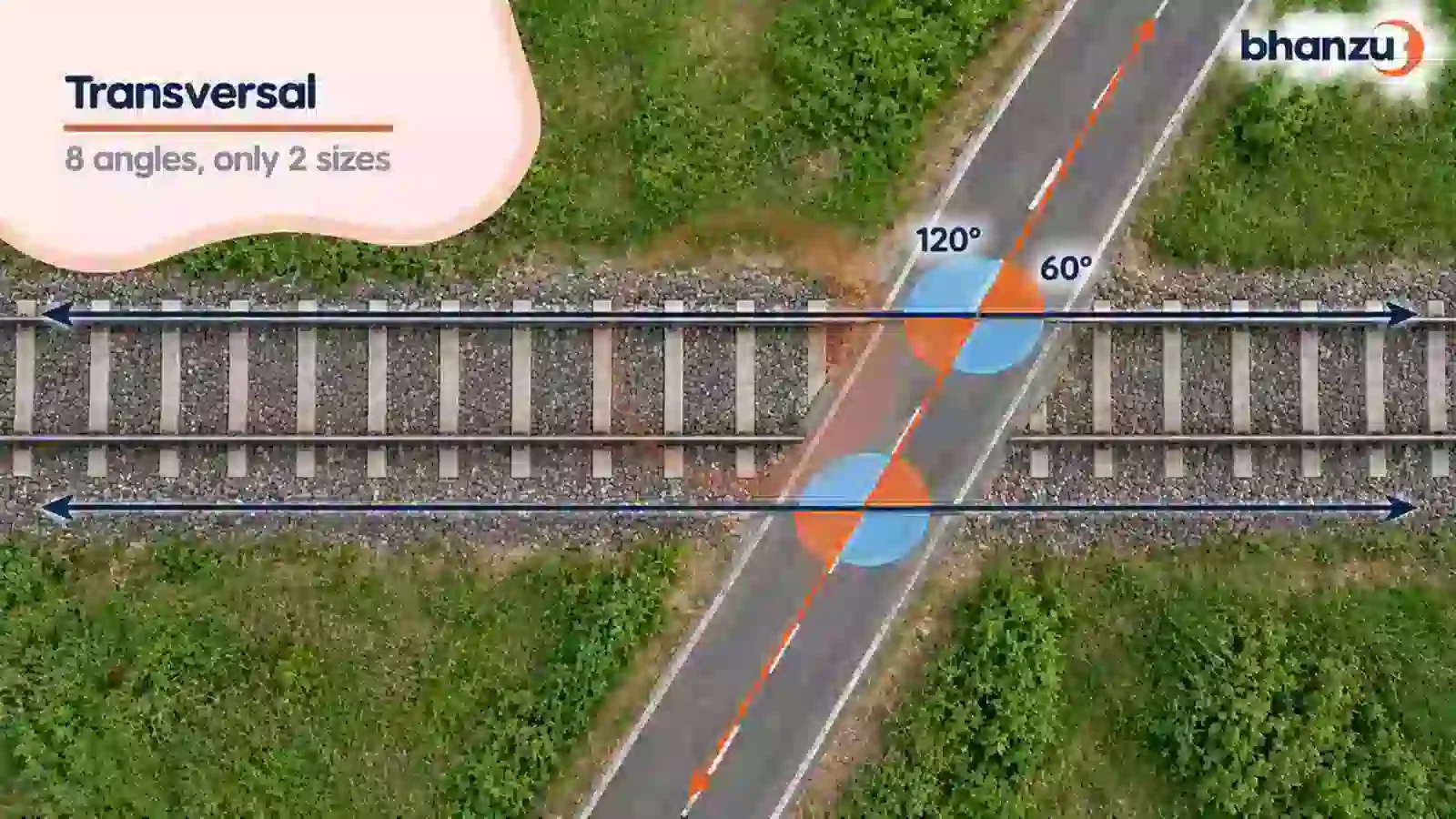
In the figure, lines and are parallel and transversal cuts them. The two alternate interior pairs are and , and and — both pairs lie between the parallel lines and on opposite sides of the transversal. The theorem promises:
The parallel condition is doing the work. Drop it — let the two lines tilt toward each other — and the alternate interior angles are generally unequal, and the theorem says nothing at all. (For why the pair is called "alternate interior" in the first place, the full definition lives in Alternate Interior Angles.)
How Do You Prove the Alternate Interior Angles Theorem?
The proof is short because it stands on two facts you already have about parallel lines: corresponding angles are equal, and vertical angles are equal. Chain them and the result drops out.
Given: Lines , cut by transversal . Angles numbered to as in the figure.
To prove: (one alternate interior pair).
Step | Statement | Reason |
|---|---|---|
1 | Vertical angles are equal (at the upper crossing) | |
2 | Corresponding angles are equal (lines parallel) | |
3 | Transitivity: both equal |
Step 1 uses that and are vertical angles at point , so they are equal. Step 2 uses the corresponding angles postulate — when the lines are parallel, angles in the same position at each crossing ( at and at ) are equal. Since equals and equals , the two must be equal to each other:
The same two-step chain proves the other pair, . The theorem is proved. Notice it borrows the corresponding-angles fact as a starting point — that is the postulate the parallel-lines unit accepts first, and most parallel-line theorems are built on top of it.
The Converse of the Alternate Interior Angles Theorem
The theorem runs both directions, and the reverse is the half a surveyor actually uses. The converse states:
If a transversal crosses two lines and a pair of alternate interior angles is congruent, then the two lines are parallel.
So the angle pair is a two-way tool. Forward: parallel lines give equal alternate interior angles. Backward: equal alternate interior angles prove the lines are parallel. The converse is what lets you establish parallelism instead of assuming it.
Proving the converse. Suppose (a pair of alternate interior angles is given equal), and we want to show .
Step | Statement | Reason |
|---|---|---|
1 | Vertical angles are equal | |
2 | Given | |
3 | From steps 1 and 2 (both equal ) | |
4 | Converse of the corresponding angles postulate (equal corresponding angles parallel) |
The converse leans on the converse of the corresponding-angles postulate: if a transversal makes a pair of corresponding angles equal, the lines it crosses must be parallel. We turned the given alternate interior equality into a corresponding-angle equality, then invoked that converse. Many textbooks (including the page this article competes with) state the converse but skip this proof — it is worth seeing once.
The Co-Interior Angles Theorem (the Supplementary Cousin)
The interior strip holds a second pair that behaves oppositely, and naming it keeps the two from blurring together. Co-interior angles (also called same-side interior or consecutive interior angles) lie between the two lines on the same side of the transversal. The co-interior angles theorem states:
If a transversal crosses two parallel lines, each pair of co-interior angles is supplementary — they add to .
A one-line proof: and are co-interior. By the alternate interior angles theorem, . But and sit on a straight line, so . Substitute :
So the same-side pair is supplementary while the opposite-side (alternate) pair is equal. Mixing the two up is the single most common error on this topic, and it has its own entry in the mistakes section.
Examples of Alternate Interior Angles Theorem
With the theorem, its proof, and the converse in place, here is the rule applied. The problems build from a direct read-off to an algebraic solve and finish with a converse check.
Example 1 - A transversal crosses two parallel lines. One alternate interior angle measures . By the theorem, what does its alternate interior partner measure?
The lines are parallel, so by the alternate interior angles theorem the pair is congruent. The partner measures .
Example 2 - Two parallel lines are cut by a transversal. One alternate interior angle is and its partner is . Find and each angle.
A first instinct is to set the two expressions to add to , treating the pair like the supplementary co-interior pair: , giving and . Check that against the theorem. These are alternate interior angles, on opposite sides of the transversal, so the theorem says they are equal, not supplementary. The supplementary set-up is the wrong tool.
The correct way sets them equal:
Each angle is .
Example 3 - Lines and are parallel. One alternate interior angle is and the angle vertically opposite its partner is . Find .
Vertical angles are equal, so the partner alternate interior angle is also . By the theorem the pair is equal, so , giving .
Example 4 - A transversal crosses lines and , and a pair of alternate interior angles both measure . Are and parallel?
Yes — by the converse of the theorem. Equal alternate interior angles force the two lines to be parallel; the matching pair is the proof, with no further measurement needed.
Example 5 - Two parallel lines are cut by a transversal. A co-interior pair measures and . Find .
Co-interior angles between parallel lines are supplementary (the co-interior angles theorem), so they add to :
This is the pair you do add to — the opposite of the alternate interior pair in Example 2.
Example 6. In a proof, you have shown that a transversal makes , a pair of alternate interior angles. What can you conclude about the two lines, and which result lets you say it?
Because a pair of alternate interior angles is equal, the converse of the alternate interior angles theorem lets you conclude the two lines are parallel. This is the step that proves lines parallel inside larger geometry proofs.
Why the Theorem and Its Converse Matter Together
The reason this theorem earns a named place in every geometry course is that it and its converse together turn parallelism into something you can both use and prove, and that two-way power shows up far beyond the textbook.
Proving lines parallel without extending them. Two lines might meet only kilometres away, or never. The converse lets a surveyor or drafter confirm parallelism from a single measured angle pair, instead of extending the lines to see whether they cross.
The triangle angle sum proof. Showing that a triangle's angles add to uses this theorem directly: draw a line through one vertex parallel to the opposite side, and the two base angles reappear inside as alternate interior angles. That proof is unavailable without this theorem.
Bridges, trusses, and frames. Diagonal braces cross parallel chords, and the repeated equal angle keeps load paths predictable; an engineer relies on the theorem holding exactly, not approximately, across every crossing.
CAD and drafting constraints. Software that locks two edges "parallel" is enforcing the converse — equal alternate interior (or corresponding) angles — every time you constrain a sketch.
For a Grade 8 student, this is often the first place a theorem and its converse both pay off, which is exactly why it anchors the parallel-lines unit before any harder proof arrives.
Where Students Trip Up on the Alternate Interior Angles Theorem
Mistake 1: Treating the angles as supplementary instead of equal
Where it slips in: The student sees two angles in the interior strip and reaches for the "add to " rule that belongs to the co-interior pair.
Don't do this: Write for an alternate interior pair.
The correct way: Check the side of the transversal first. Opposite sides means alternate interior, so the theorem makes them equal. Same side means co-interior, so they are supplementary. Position decides which theorem applies.
Mistake 2: Using the theorem when the lines are not parallel
Where it slips in: A figure shows two lines that look roughly parallel but carry no parallel marks, and the student sets the alternate interior angles equal anyway.
Don't do this: Assume "looks parallel" means "is parallel" and apply the theorem.
The correct way: The theorem needs the lines to be given parallel (matching arrowheads or a stated condition). Without that, the angles are not guaranteed equal. The rusher, who jumps straight to the equation, loses marks here most often. (If instead you are given the angles equal and asked about the lines, that is the converse — and then you may conclude the lines are parallel.)
Mistake 3: Confusing the theorem with its converse
Where it slips in: A proof asks the student to state which result justifies a step, and they cite the theorem when the step actually used the converse (or vice versa).
Don't do this: Say "by the alternate interior angles theorem, the lines are parallel" — the forward theorem starts from parallel lines; it does not conclude them.
The correct way: Forward theorem: parallel lines equal angles. Converse: equal angles parallel lines. Match the direction of your reasoning to the right name. The second-guesser who keeps swapping the two usually has not separated "what is given" from "what is to prove."
Key Takeaways
The alternate interior angles theorem states that a transversal crossing two parallel lines makes each pair of alternate interior angles congruent.
The proof chains two facts: vertical angles are equal, and corresponding angles are equal under parallel lines.
The converse runs backward: equal alternate interior angles prove the two lines are parallel — the half used to establish parallelism.
The co-interior (same-side) pair is supplementary, adding to — the opposite behaviour to the alternate (opposite-side) pair.
Always confirm the parallel condition before applying the forward theorem, and match the theorem-versus-converse direction to your reasoning.
Practice These Problems to Solidify Your Understanding
Two parallel lines are cut by a transversal. One alternate interior angle is and its partner is . Find and each angle.
A transversal crosses two lines, and a pair of alternate interior angles both measure . Are the lines parallel, and which result tells you?
Between two parallel lines, a co-interior pair measures and . Find .
Answer to Question 1: set equal, , so and each angle is . Answer to Question 2: yes, by the converse of the alternate interior angles theorem (equal alternate interior angles force the lines parallel). Answer to Question 3: co-interior angles are supplementary, so , giving . If Question 1 gave a value near a sum, you used the co-interior (supplementary) rule on an alternate pair by mistake (see Mistake 1).
Want a live Bhanzu trainer to walk your child through the alternate interior angles theorem and parallel-line proofs? Book a free demo class — online globally.
Was this article helpful?
Your feedback helps us write better content