What Are One-Variable Linear Equations And Inequations?
One-variable linear equations and inequations are first-degree statements about a single unknown, usually called . In an equation the two sides are set equal; in an inequation (also called an inequality) the two sides are compared with , , , or . "Linear" means the variable appears only to the power one, with no , no , and no in a denominator.
The two objects sit side by side:
Equation: , with . Example: .
Inequation: (or , , ). Example: .
The single letter that changes, the becoming a , changes the kind of answer you get. Solve and you land on one number, . Solve and you get every number past , written . One is a single point; the other is a whole range.
Throughout this article we use one running equation and one running inequation:
Same left side, same right side. The only difference is the relation symbol, and that difference is the whole topic.
How Do You Solve A One-Variable Linear Equation?
To solve a linear equation, isolate the variable on one side using inverse operations, doing the same thing to both sides at every step. The goal is to get alone.
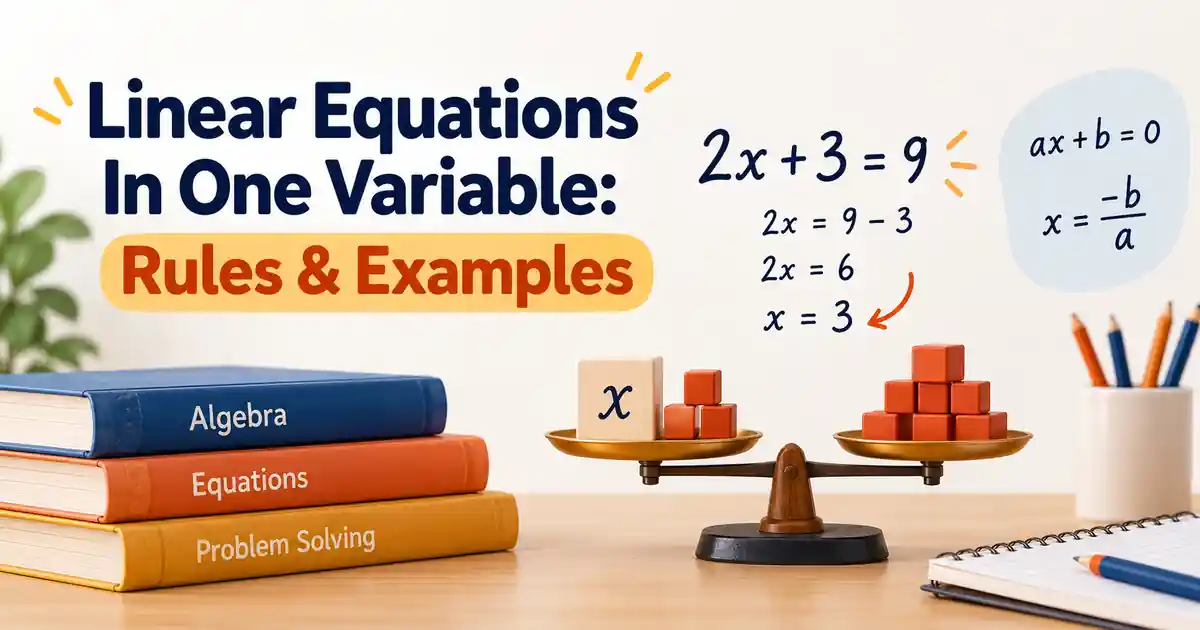
Example 1: Solve .
Add to both sides to undo the subtraction:
Divide both sides by to undo the multiplication:
Final answer: . Because a linear equation is degree one, it has exactly one solution.
Always check by substituting back: , which matches the right side. For more one-variable equation practice, see solving linear equations and the step-by-step routine at solve for x.
When the variable appears on both sides, gather the terms first. Solve by subtracting from both sides to get , then finish as above to reach .
How Do You Solve A One-Variable Linear Inequation?
To solve a linear inequation, use the same steps as an equation, with one extra rule: if you multiply or divide both sides by a negative number, reverse the inequality sign. Adding or subtracting never flips it.
Example 2: Solve .
Add to both sides (no flip, this is addition):
Divide both sides by , a positive number (no flip):
Final answer: . Not a single value, but every number greater than .
Now watch what a negative coefficient does.
Example 3: Solve .
Subtract from both sides (no flip):
Divide both sides by . This is where the rule fires, so the becomes :
Final answer: . The sign flipped because we divided by a negative number. For a fuller treatment, see linear inequalities and the broader idea at inequalities.
Why Do You Flip The Sign When Multiplying Or Dividing By A Negative?
This is the one rule that separates inequations from equations, so it is worth seeing why it is true, not just memorising it.
Start with a statement everyone accepts: . Multiply both sides by . If you kept the sign the same you would write , which is false, because sits to the left of on the number line. The true statement is .
Multiplying by a negative reflects both numbers across zero, and reflection reverses their left-to-right order, so the inequality must reverse too.
The rule in one line:
Add or subtract the same amount on both sides: the sign stays the same.
Multiply or divide by a positive number: the sign stays the same.
Multiply or divide by a negative number: the sign flips.
An equation never needs this rule because has no direction to reverse. Equality reads the same forwards and backwards, so reflecting both sides across zero leaves it untouched.
How Do You Show The Solution On A Number Line?
An inequation is answered by a range, and the clearest way to show a range is a number line. The boundary point gets a circle, and the type of circle tells the reader whether that endpoint is included.
Open circle (hollow) for or : the endpoint is not part of the solution.
Closed circle (filled) for or : the endpoint is part of the solution.
Then shade the side that satisfies the inequality. For , place an open circle at and shade everything to the right. For , place a closed circle at and shade everything to the left.
How Do You Write Solutions In Interval Notation?
Interval notation is a compact way to write the same range a number line shows. A round bracket means "not included" (matching an open circle) and a square bracket means "included" (matching a closed circle). Infinity always takes a round bracket, because you can never reach it.
Table: The three ways to write the same one-variable solution.
Inequation | Number line | Interval notation |
|---|---|---|
open circle at , shade right | ||
closed circle at , shade left | ||
closed at , open at |
The last row is a range hemmed in on both sides, the kind you meet in a compound inequality. For the full set of rules and edge cases, see interval notation.
A linear equation does not need interval notation. Its answer is a single number, so is already the tidiest form there is.
What Is The Difference Between A Linear Equation And A Linear Inequation?
They are built from the same parts and solved by almost the same steps, so the differences are precise and few.
Table: Equation versus inequation in one variable.
Feature | Linear equation | Linear inequation |
|---|---|---|
Relation symbol | ||
Standard form | (or ) | |
Number of solutions | Exactly one | A range (infinitely many) |
How the answer is shown | A single value | A number line or interval |
Flip rule on or by a negative | Not needed | Sign flips |
Read the table top to bottom and the story is clear. Change the symbol from to an inequality and three things follow: the answer becomes a range, you need a number line to show it, and you inherit the flip rule. Everything else, the isolating steps, the inverse operations, the balance, stays identical.
Why Do Inequations Give A Range Instead Of A Single Answer?
An equation asks a sharp question: which single value makes these two sides exactly balance? Balance is a knife-edge, so usually only one value works. An inequation asks a looser question: which values make the left side bigger (or smaller) than the right? Being bigger is not a knife-edge; once a number is past the boundary, every number further along stays past it too.
That is the conceptual reason the answer opens into a range:
The boundary value is where the two sides are equal, the same point the matching equation would find.
On one side of that boundary the inequality is true; on the other side it is false.
So the solution is a whole half of the number line, not a point.
This is why and share the number as their pivot. Solving the inequation is really solving the equation to find the boundary, then deciding which side of it makes the comparison true.
Who Invented Linear Equations And The Inequality Signs?
The methods came long before the symbols. People were solving for an unknown quantity for over a thousand years before anyone wrote a neat "" on a page.
Two more figures shaped the notation and the inequalities:
Thomas Harriot (1560–1621, England) introduced the signs and for "less than" and "greater than," which appeared in his work Artis Analyticae Praxis, published in 1631 after his death.
Pierre Bouguer (1698–1758, France) is credited with the combined signs and around 1734, joining the strict inequality with a line for "or equal to."
Where Are One-Variable Linear Equations And Inequations Used In The Real World?
The two objects answer two everyday questions: exactly how much? and at least or at most how much?
Budgets and money: an equation finds the exact price that fits a total; an inequation finds every spending amount that stays within a limit, as in "spend at most 500."
Speed and safety limits: a speed limit is an inequation (), a whole range of legal speeds, not one required speed.
Manufacturing tolerances: a bolt must be "within" a size range, written as a compound inequation, so parts fit together reliably.
Grades and thresholds: "you need at least 40 marks to pass" is the inequation , while "you scored exactly the class average" is an equation.
Medicine and safe dosing: a safe dose falls between a minimum and a maximum, again a range described by inequations.
Equations pin down the one right value; inequations map out the safe or allowed zone around it. Together they cover both the precise and the permissible, which is why they appear across finance, engineering, and science alike.
What Are The Most Common One-Variable Linear Equation And Inequation Mistakes?
These three errors account for most lost marks on this topic, verified against Lumen Learning's inequality chapter, Krista King Math, and a 2023 error-analysis study of student inequality work in the Journal of Advanced Sciences and Mathematics Education.
Forgetting to flip the sign when dividing or multiplying by a negative.
Where it slips in:
A student solves and writes , treating the inequation exactly like an equation and leaving the sign untouched.
Don't do this:
Do not carry the same inequality symbol through a division or multiplication by a negative number. That step reverses the order of the two sides.
The correct way:
Flip the symbol the moment you divide or multiply by a negative. gives , with becoming .
Writing a single value where an inequation needs a range.
Where it slips in:
A student solves , reaches the boundary, and writes as the final answer, as if it were an equation.
Don't do this:
Do not stop at the boundary value for an inequation. The boundary is where the two sides are equal, which is precisely the value the inequality excludes when the symbol is strict.
The correct way:
Keep the inequality symbol in the answer. gives , a range, which you can also write as or draw on a number line.
Confusing open and closed circles on the number line.
Where it slips in:
A student draws a filled circle for , or a hollow circle for , mixing up which endpoints belong to the solution.
Don't do this:
Do not let the arrow direction decide the circle. The circle style depends only on whether the symbol includes equality.
The correct way:
Use an open circle for and (endpoint excluded), and a closed circle for and (endpoint included). Then shade toward the values that make the statement true.
Practice Problems On One-Variable Linear Equations And Inequations
Solve each, then read the answer beside it. For inequations, give the range and its interval form.
Solve .
(Answer: .)Solve .
(Answer: .)Solve .
(Answer: .)Solve .
(Answer: , or .)Solve .
(Answer: flip the sign; , or .)Solve and show the boundary.
(Answer: , or ; open circle at , shade right.)
Where Should You Go Next After One-Variable Linear Equations And Inequations?
Several natural doors open from here into the rest of algebra.
Two step equations. Drill the isolating routine on equations that need exactly two inverse moves, the backbone of every problem above.
Compound inequality. Learn to solve ranges hemmed in on both sides, like , using the interval skills from this article.
Linear equations in two variables. Move from a point on a line to a line itself, where the single unknown becomes a pair.
If your child is building these foundations, a live Bhanzu trainer teaches equations and inequations side by side, starting from why an inequation answers with a range, in the Bhanzu algebra program.
Was this article helpful?
Your feedback helps us write better content