
Learn math through
stories & curiosity
Expert guides for parents, students and math enthusiasts. Algebra to Olympiads — we've got you covered.
Trending Articles
Most-read posts on the blog
100+ Vocabulary Activities for Kids: Pre-K to 8th Grade
Phonics vs Phonemic Awareness: Key Differences and Examples
How To Teach Red Words: Steps For Tricky Words
Phonics vs Whole Language: What the Research Says
Prepositions For Kids: What They Are, A Word List And Examples
Types of Sentences for Kids: 4 Kinds and 4 Structures
How To Improve Vocabulary For Kids: 7 Research-Backed Ways
History of Calculus: Timeline From Archimedes to Newton
Washer Method: Volume Of Revolution Formula
Volume Of Solids Of Revolution: Disk, Washer, Shell
Velocity and Acceleration: Calculus Derivatives
Types Of Discontinuity: Removable, Jump & Infinite
Transformations Of Functions: Rules & Examples
Taylors Theorem: Formula, Remainder & Examples
Tangent Line Equations: Formula, Steps & Examples
Table of Integrals: Standard Formulas & Examples
100+ Vocabulary Activities for Kids: Pre-K to 8th Grade
Phonics vs Phonemic Awareness: Key Differences and Examples
How To Teach Red Words: Steps For Tricky Words
Phonics vs Whole Language: What the Research Says
Prepositions For Kids: What They Are, A Word List And Examples
Types of Sentences for Kids: 4 Kinds and 4 Structures
How To Improve Vocabulary For Kids: 7 Research-Backed Ways
History of Calculus: Timeline From Archimedes to Newton
Washer Method: Volume Of Revolution Formula
Volume Of Solids Of Revolution: Disk, Washer, Shell
Velocity and Acceleration: Calculus Derivatives
Types Of Discontinuity: Removable, Jump & Infinite
Transformations Of Functions: Rules & Examples
Taylors Theorem: Formula, Remainder & Examples
Tangent Line Equations: Formula, Steps & Examples
Table of Integrals: Standard Formulas & Examples
The goal was never to make kids faster at math — it was to make them fall in love with it. Speed is a byproduct of genuine understanding.

Explore by Topic
Dive into the subject you love most
Algebra
Variables, equations, and the language of math
Coefficient - Definition, Types, and Math Examples
A coefficient is the number that multiplies a variable in an algebraic expression — in 3x, the coefficient is 3. This article covers the formal definition, the four types of coefficients, how to identify them in any expression, the rule for variables with no visible number, and the most common mistakes when picking out the coefficient.
Properties of Logarithms - Laws, Formulas, Proofs
The properties of logarithms are seven identities that simplify logarithmic expressions: the product rule (log b(xy) = log b x + log b y), quotient rule (log b(x/y) = log b x - log b y), power rule (log b(xⁿ) = n log b x), change-of-base formula, and three special values (log b 1 = 0, log b b = 1, log b bⁿ = n).
Roots In Polynomial Expressions: Full Guide
Roots in polynomial expressions are the values of x that make the polynomial equal zero, so a root of P(x) is any x with P(x) = 0. A number r is a root exactly when (x - r) is a factor, and by the Fundamental Theorem of Algebra a degree-n polynomial has exactly n roots when you count multiplicity and allow complex numbers.
Geometry
Shapes, proofs, and spatial thinking
What is Semicircle: Area, and Perimeter Formula
A semicircle is exactly half a circle, formed by cutting along a diameter. Its area is (π r²)/2, but its perimeter is π r + 2r — not half the circle's perimeter, because the straight diameter edge counts too. This article covers both formulas, the angle in a semicircle, and worked examples.
Collinear Vectors — Definition, Conditions, Examples
Collinear vectors are vectors that lie along the same line — which means one is always a scalar multiple of the other, a = k,b. This article covers the three tests for collinearity (scalar multiple, equal coordinate ratios, zero cross product), how collinear differs from parallel and coplanar, and worked examples.
Rotational Symmetry - Order & Angle of Rotation
Rotational symmetry means a shape maps exactly onto itself when turned about its centre by some angle smaller than a full turn. The order counts how many times it matches in one 360° rotation, and the angle of rotation is 360°/(order); this guide gives the definitions, six worked examples, and the traps that produce a wrong order.
Trigonometry
Angles, waves, and circular harmony
Tan 7pi/6 : Exact Value 1/√3 Explained
The value of tan 7π/6 is exactly 1/(√3), or in rationalised form (√3)/3, which is about 0.5774. This article shows why the answer is positive (the angle lands in the third quadrant), how the reference angle (π)/6 produces the value, and how the unit circle confirms it, with a tangent table, worked examples, and the mistakes to sidestep.
Sin A Cos B Formula : Derivation & Examples
Sin A cos B equals 1/2[sin(A+B) + sin(A-B)], a product-to-sum identity that turns a product of a sine and a cosine into a sum of two sines. This article covers the formula, its derivation from the angle-sum and angle-difference identities, six worked examples, the mistakes students make, and why the identity matters for integration.
Sin Double Angle Formula : Derivation, Identities, and Examples
The sin double angle formula is sin 2x = 2sin x cos x, which rewrites the sine of a doubled angle using the sine and cosine of the original angle. This article covers the formula, its derivation from the angle-sum identity, the tangent form, six worked examples, the mistakes to avoid, and where doubling an angle actually matters.
Parenting
Raising confident, curious young mathematicians
Math Formulas
Every essential formula, explained and derived
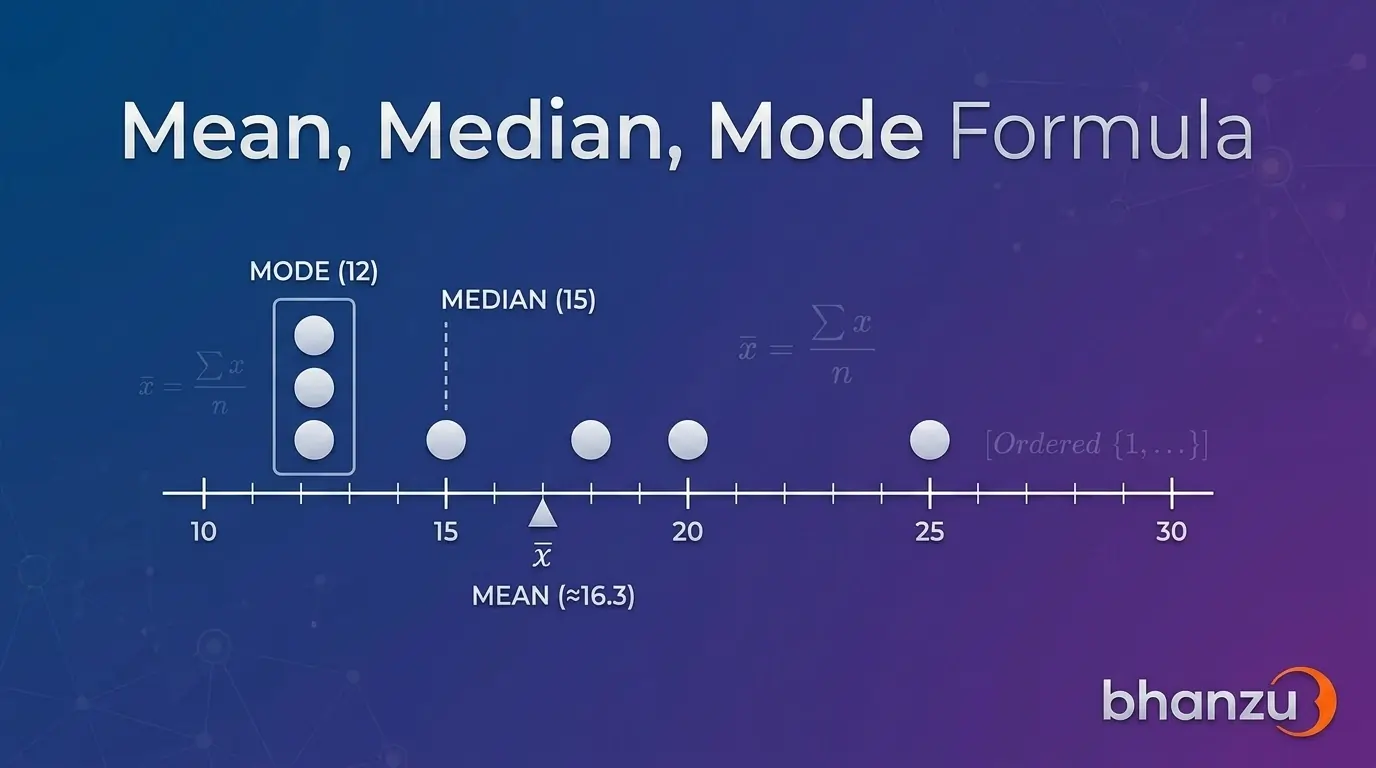
Mean, Median, Mode Formula - Differences, Use, and Examples
The mean is the average of all values (Σx / n), the median is the middle value when data is ordered, and the mode is the value that appears most often. Use the mean for symmetric data, the median for skewed data with outliers, and the mode for categorical data. For moderately skewed distributions, the three are linked by Karl Pearson's empirical relation: Mode = 3 Median − 2 Mean.
Percentile Formula – Definition, Calculation, Examples
The percentile formula tells you where a value stands in a dataset: P = (number of values below x)/N × 100. This article covers both directions — finding the percentile of a value, and finding the value at a given percentile — with worked examples, the percentile-versus-percentage distinction, and the mistakes that trip students up.
Maths Formulas for Class 10 — Chapter-Wise List
The maths formulas for class 10 span the full board syllabus — real numbers, polynomials, linear and quadratic equations, arithmetic progressions, triangles, coordinate geometry, trigonometry, circles, mensuration, statistics, and probability. This hub lists every formula by chapter, explains where each one comes from, and works one example per cluster so the formulas connect instead of floating loose.
Math Terms
Crystal-clear definitions with worked examples
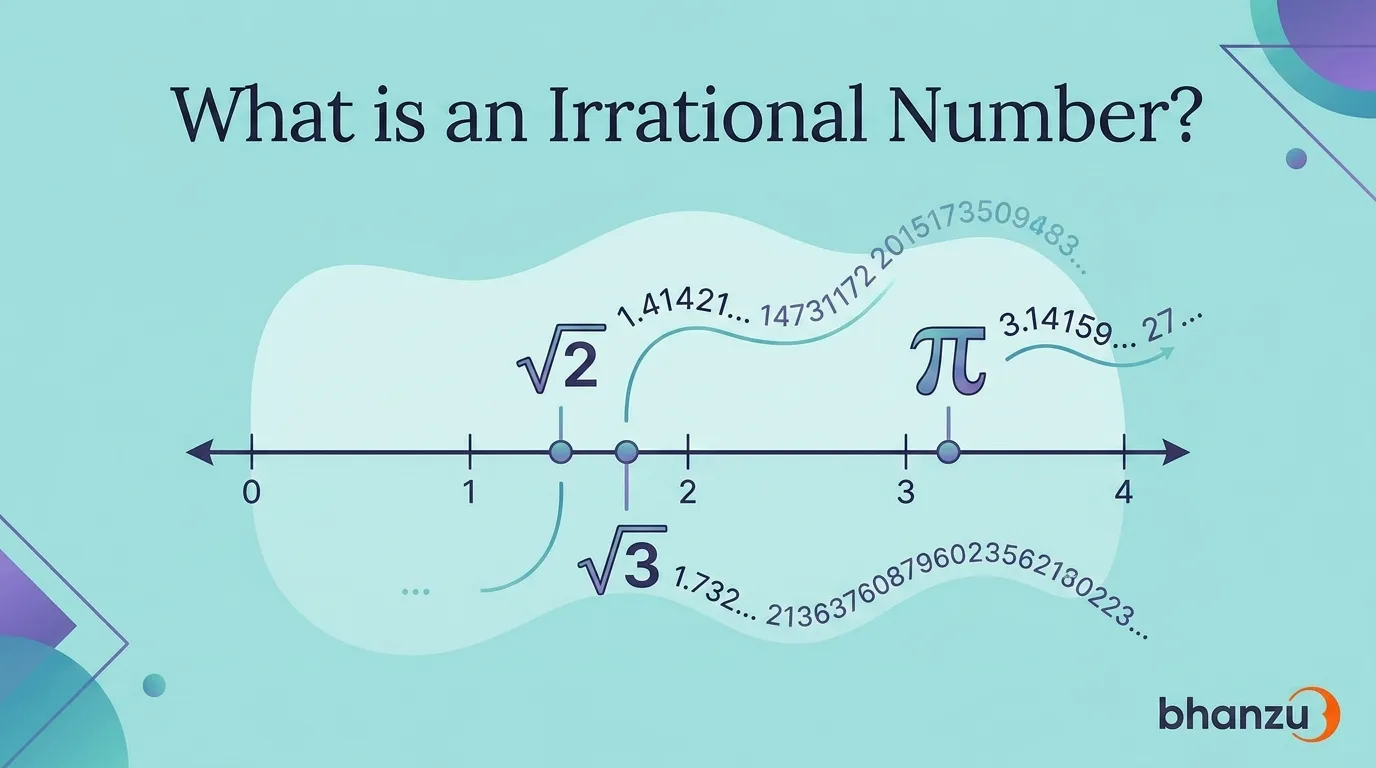
What is an Irrational Number? Examples & Properties
An irrational number is a real number that cannot be written as a ratio of two integers (p/q form), and its decimal expansion never terminates and never repeats. Common examples include √2, π, e, and the golden ratio φ.
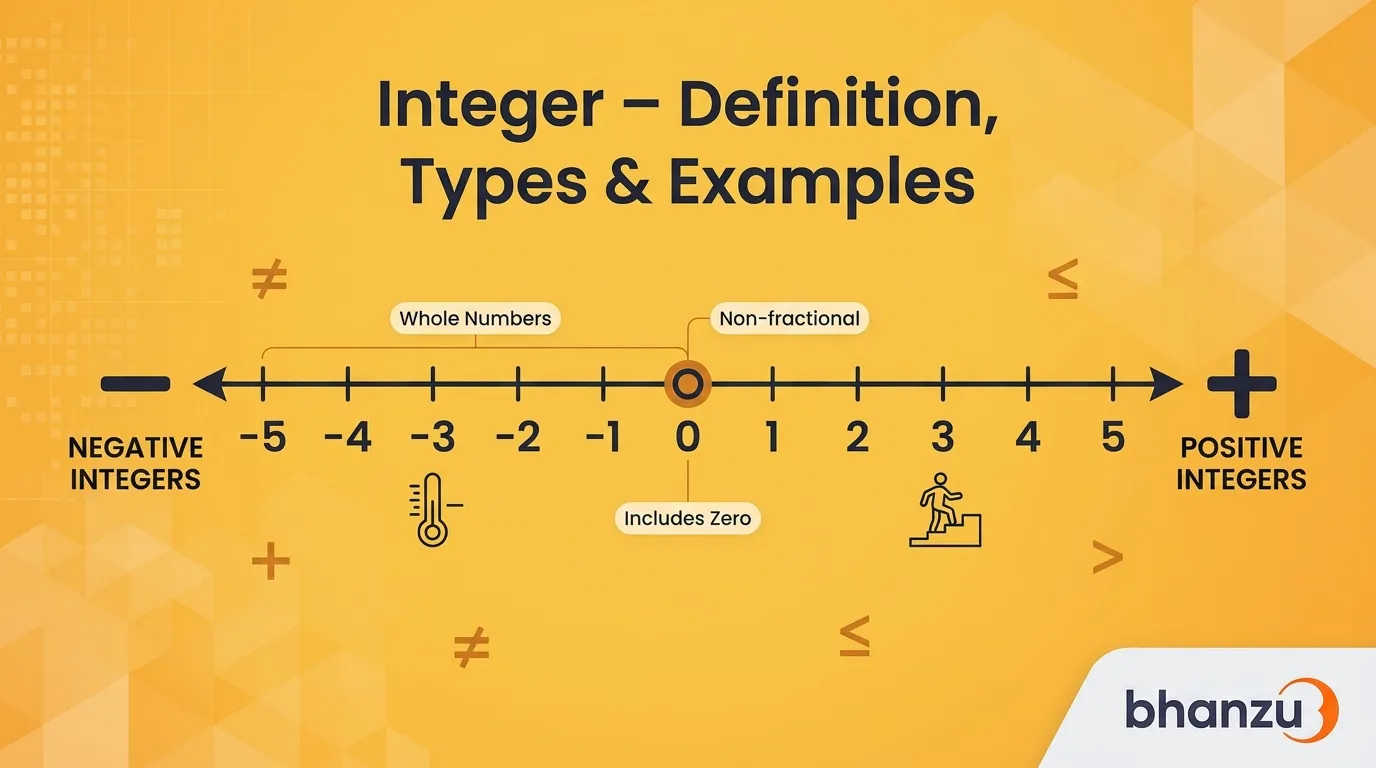
What is An Integer – Types, Examples & Properties
An integer is a whole number - positive, negative, or zero - with no fractional or decimal part, written as the set ℤ = {..., −3, −2, −1, 0, 1, 2, 3, ...}. Integers follow closure, commutative, associative, distributive, identity, and additive inverse properties, and form the foundation for arithmetic, the number line, and all rational numbers.
Radius of a Circle: Definition, Formula, Examples
The radius of a circle is the distance from its centre to any point on the boundary, and it is exactly half the diameter. This article covers the definition, the three formulas for finding the radius, how it ties to the circle equation, six worked examples, and the common mistakes.
Help your child go from fearing math to loving it
Live, personalized classes from instructors trained by the World's Fastest Human Calculator. Join 70,000+ students who learn math the curious way.