What The Average Formula Is?
The average formula finds a single number that represents an entire set of values. The most common kind of average is the arithmetic mean.
Average Formula:
Or, using symbols:
Variable key
Symbol | Meaning |
|---|---|
The average (mean) of the data set | |
The individual values in the data set | |
The total count of values | |
Summation symbol, meaning "add everything up" |
In compact summation notation: .
How To Use The Average Formula, Step By Step
Three steps, in order:
Add every value in the data set. This gives the sum.
Count how many values you added. This gives .
Divide the sum by . The result is the average.
That is the entire procedure. Everything else (weighted averages, moving averages, grouped data) is a variation on those three steps.
Worked Examples of Average Formula
Example 1: Average of five test scores
A student's scores in five tests are 78, 92, 64, 88, and 73. Find the average.
Step 1. Add the values.
Step 2. Count the values.
Step 3. Divide.
Final answer: The average score is 79.
The average sits between the lowest score (64) and the highest (92). This is always true for the arithmetic mean. If your computed average lies outside the range of the data, you have made a mistake somewhere in step 1.
Example 2: Average daily temperature
A city records the following midday temperatures over a week (in °C): 31, 33, 30, 29, 34, 32, 31. What was the average daily temperature?
Final answer: The average temperature was approximately 31.4 °C.
The answer carries a unit. An average of seven temperatures is itself a temperature, not a plain number.
Example 3: Weighted average
A student's overall grade is calculated from three components: homework (20%), midterm (30%), and final exam (50%). The student scores 85, 70, and 92. Find the overall grade.
The plain average is wrong here. Computing ignores the fact that the final is worth more than the homework. This is where the weighted average formula takes over:
Plugging in:
Final answer: The overall grade is 84.
The weighted average and the plain average are the same formula in disguise. The plain average is just a weighted average where every weight equals 1.
Why The Average Formula Has The Form It Has?
The formula looks obvious in hindsight. It was not obvious when astronomers first worked it out.
Before the late 1500s, when an astronomer measured the same star several times and got slightly different readings, the standard practice was to pick the best-looking measurement and discard the rest. The Danish astronomer Tycho Brahe broke that habit. He recorded every observation, then began averaging them.
Why does it work? Errors in opposite directions cancel out, and random noise gets diluted by the sum, so the averaged value sits closer to the truth than any single reading. That single move (do not throw measurements away, average them) is the seed of modern statistics.
The intuitive reason the formula works is balancing. Picture the data points as weights placed along a number line: the mean is the balance point, the place where the seesaw would tip neither left nor right. Values above the mean pull one way and values below pull the other.
Mathematicians & History Behind The Average
[MATHEMATICIANS & HISTORY CALLOUT]
Title: The astronomer who refused to throw data away
Mathematician: Tycho Brahe (1546–1601)
Date and place: Late 1500s, Uraniborg observatory, Denmark.
The story: Tycho built the most precise astronomical instruments of his century and used them to record star positions with stubborn repetition. Where his contemporaries discarded "bad" readings, Tycho kept everything and averaged.
His data tables, inherited by his assistant Johannes Kepler after Tycho's death in 1601, were so accurate that Kepler could detect Mars' elliptical orbit. That single discovery overturned 1,400 years of circle-based astronomy.
Why it matters: Averaging was not invented as a maths technique. It was invented as a way to wrestle truth out of imperfect measurement, and that is still what it does today.
A small handful of other figures shaped how we use the average:
Adolphe Quetelet (1796–1874): Belgian astronomer and statistician who applied averaging to people, not stars. He invented the "average man" and what later became the BMI. [EXT-LINK: Quetelet biography on Britannica]
Carl Friedrich Gauss: connected averaging to the bell-curve distribution of errors, giving the mean its formal place in probability theory.
Common Mistakes With The Average Formula
1. Forgetting one value in the sum.
Where it slips in: Long lists. The eye skips a number while adding, or a calculator entry gets missed. The student then divides by the correct count , but the numerator is short, and the average looks plausible but is wrong by a small amount.
Don't do this: Add quickly and trust the total.
The correct way: Add the list twice, once forward and once backward. If the two totals match, the sum is right.
2. Dividing by the wrong .
Where it slips in: Mixing up what got added with what got counted. A student adds six values but writes because they forgot a repeated entry. Or they add five values but divide by 6 because the question mentioned a sixth value that was not actually given.
Don't do this: Eyeball the count.
The correct way: After adding, count the addends one more time before dividing. The denominator is the number of values that went into the sum, not the number of values mentioned in the question.
3. Treating a weighted average like a plain average.
Where it slips in: Grade calculations, portfolio returns, batting averages, and anywhere different items count differently. The student averages the components as if they were equal, ignoring the weights, and gets an answer that is close to right but quietly wrong.
Don't do this: Compute when the components have different weights.
The correct way: Multiply each value by its weight, sum the products, then divide by the sum of the weights. Use the weighted formula whenever the items being averaged are not equally important.
4. Mixing units before averaging.
Where it slips in: Datasets where some entries are in metres and others in centimetres, or some in minutes and others in seconds. Averaging without converting first produces a number that has no real meaning.
Don't do this: Add 1.5 m to 80 cm and divide by 2.
The correct way: Convert everything into the same unit first. 1.5 m = 150 cm, so the average is cm.
A real-world version of the units mistake
In September 1999, NASA lost the Mars Climate Orbiter (a $125 million spacecraft) because one engineering team supplied thrust data in pound-force seconds while the navigation team's software expected newton-seconds, and no one converted.
The averaged trajectory corrections were silently wrong, and the orbiter entered the Martian atmosphere at the wrong altitude and burned up. The mistake a student makes on a worksheet is the same mistake that crashed a spacecraft.
Average, Mean, Median, Mode: A Quick Distinction
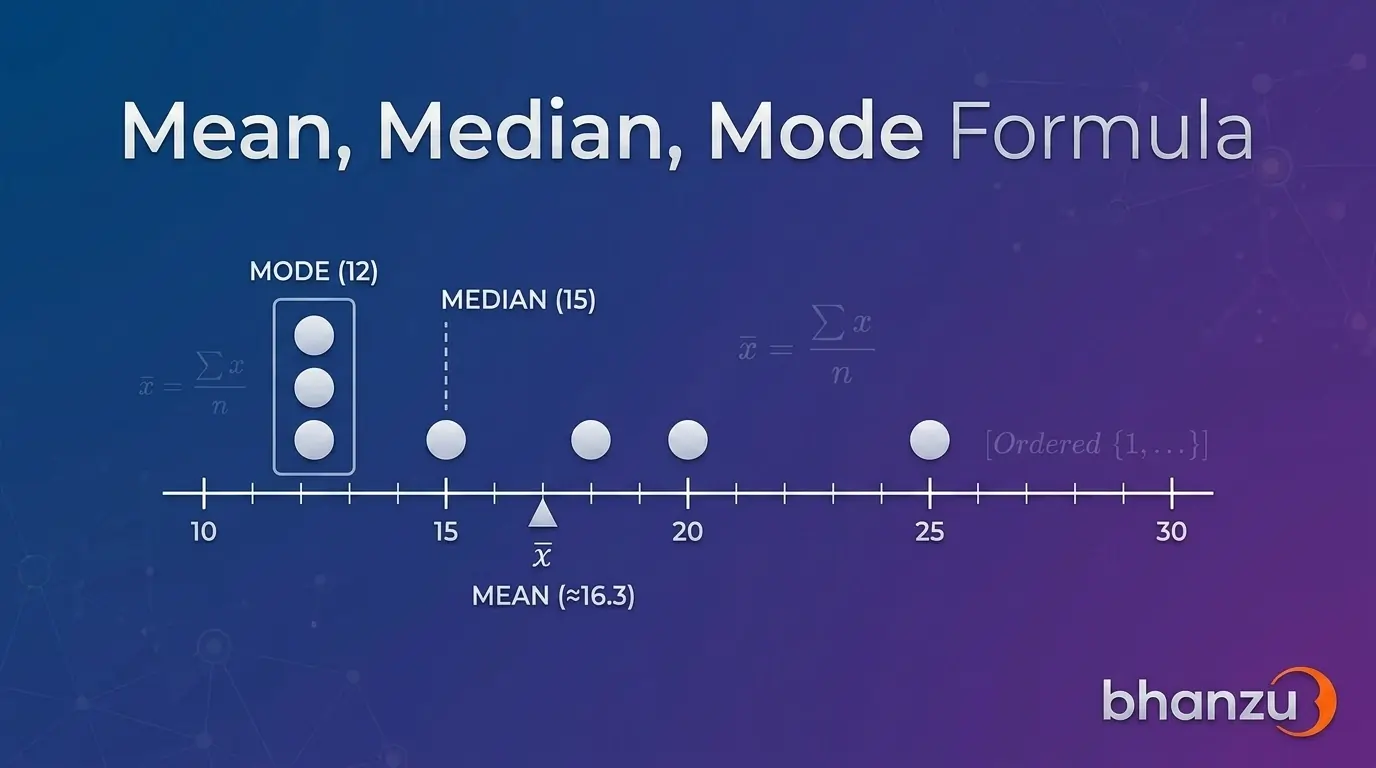
In everyday speech, "average" usually means the arithmetic mean. In statistics, mean, median, and mode are three different ways to describe the centre of a data set.
Measure | What it does | When to use |
|---|---|---|
Mean (arithmetic average) | Sum ÷ count | Data is roughly symmetric and has no extreme outliers |
Median | Middle value when sorted | Data is skewed or has outliers (e.g., income, house prices) |
Mode | Most frequent value | Categorical data, or finding the typical choice |
For most school-level problems, "average" means mean. If a question gives you the salaries on a street and asks for "the average household income", check whether median is the more honest answer.
Where The Average Formula Goes Next
The arithmetic mean is the front door to a much larger room. Three doors open from here:
Median and mode. The other two measures of central tendency, needed when the mean is misleading. [LINK: mean median mode formula]
Standard deviation. Once you have the mean, the next question is how spread out the values are around it. That is what standard deviation measures, and it builds directly on top of the average formula.
Weighted and moving averages. The natural extensions, used in finance (moving averages of stock prices), in physics (weighted means in error analysis), and in every machine-learning model that minimises a mean squared error.
For students working through statistics in a structured way, Bhanzu's data-handling track walks the path from arithmetic mean to standard deviation in eight short sessions, with a live trainer.
Was this article helpful?
Your feedback helps us write better content