Key Points
- Qualitative research asks why and how, and collects words, observations and images from a small, purposefully chosen group.
- Quantitative research asks how many and how much, and collects numbers from larger samples that can be analysed with statistics.
- Qualitative research gives depth and explanation, while quantitative research gives estimates that can be generalised to a population.
- Neither approach is better in general, because the research question decides which kind of evidence can answer it.
- Mixed methods combine both, often using interviews to shape a survey and then interviews again to explain surprising numbers.
Two Ways of Knowing Something
A survey can tell you that 60 percent of students in a school dislike their homework. It cannot tell you why.
For the reason, you have to ask them, listen and look for patterns in what they say. Those two activities are the two great families of research, and the difference between them is not just numbers against words but what kind of question each can answer.
What Is Qualitative Research?
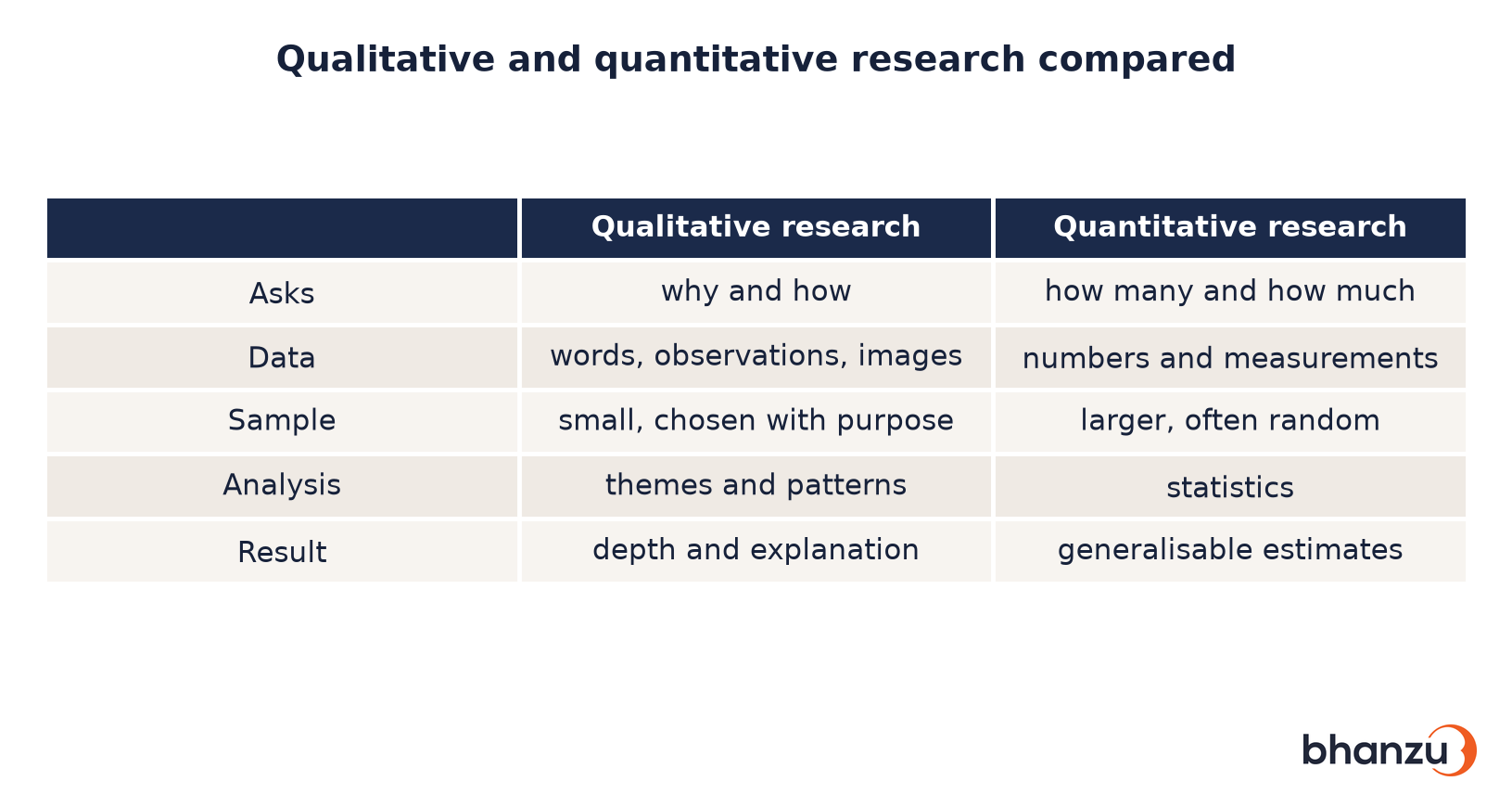
Qualitative research collects non-numerical information to understand experiences, reasons and meanings. Its data is words, observations, images and recordings.
It usually works with a small group chosen on purpose, because the aim is depth rather than a figure for a whole population. The analysis looks for themes, ideas that recur across what people say or do.
Try It Yourself
Use the sampling simulator to see Difference Between Qualitative and Quantitative Research at work: drag, change the numbers and watch what happens.
What Is Quantitative Research?
Quantitative research collects numerical data to measure how common, how large or how related things are. Its data is counts, measurements and scores.
It usually works with larger samples, often chosen at random, so that results can be generalised to a population. The analysis uses statistics, such as averages, percentages and tests of significance.
What Is the Difference Between Qualitative and Quantitative Research?
Five differences cover nearly every comparison.
- The question. Qualitative asks why and how; quantitative asks how many, how much and how often.
- The data. Qualitative collects words and observations; quantitative collects numbers.
- The sample. Qualitative uses small, purposeful groups; quantitative uses larger, often random samples.
- The analysis. Qualitative finds themes; quantitative calculates statistics.
- The result. Qualitative gives depth and explanation; quantitative gives estimates that generalise.
How Do You Choose Between Them?
Start from the question.
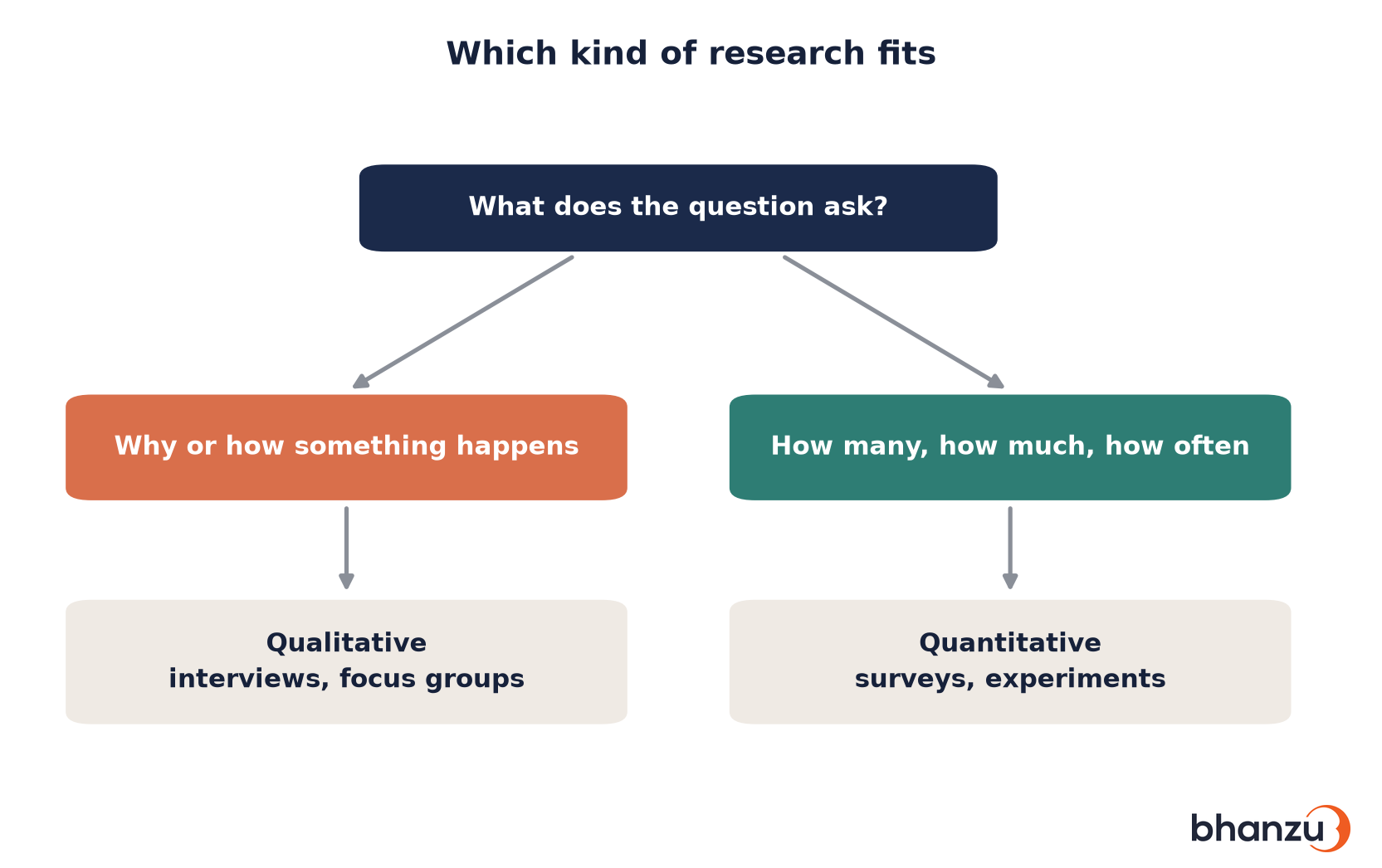
If the question asks for a number, the answer needs quantitative data. If it asks for reasons, experiences or meanings, the answer needs qualitative data. Many real questions need both, which is why researchers often combine them.
Examples of the Difference Between Qualitative and Quantitative Research
Example 1
A school wants to know what percentage of students walk to school. Which approach fits?
Quantitative. The question asks for a proportion, and a survey of students answers it directly.
Example 2
A researcher interviews 12 students about exam stress and concludes that 75 percent of all students feel stressed. What is wrong?
Nine of twelve is 75 percent, so the arithmetic holds.
The problem is the sample. Twelve students chosen for interviews are a qualitative sample, picked for depth rather than at random.
They can reveal what exam stress feels like and what causes it. They cannot estimate how common it is across all students. That needs a large random sample.
Example 3
A teacher asks why some students stop reading for pleasure at age 12. Which approach fits?
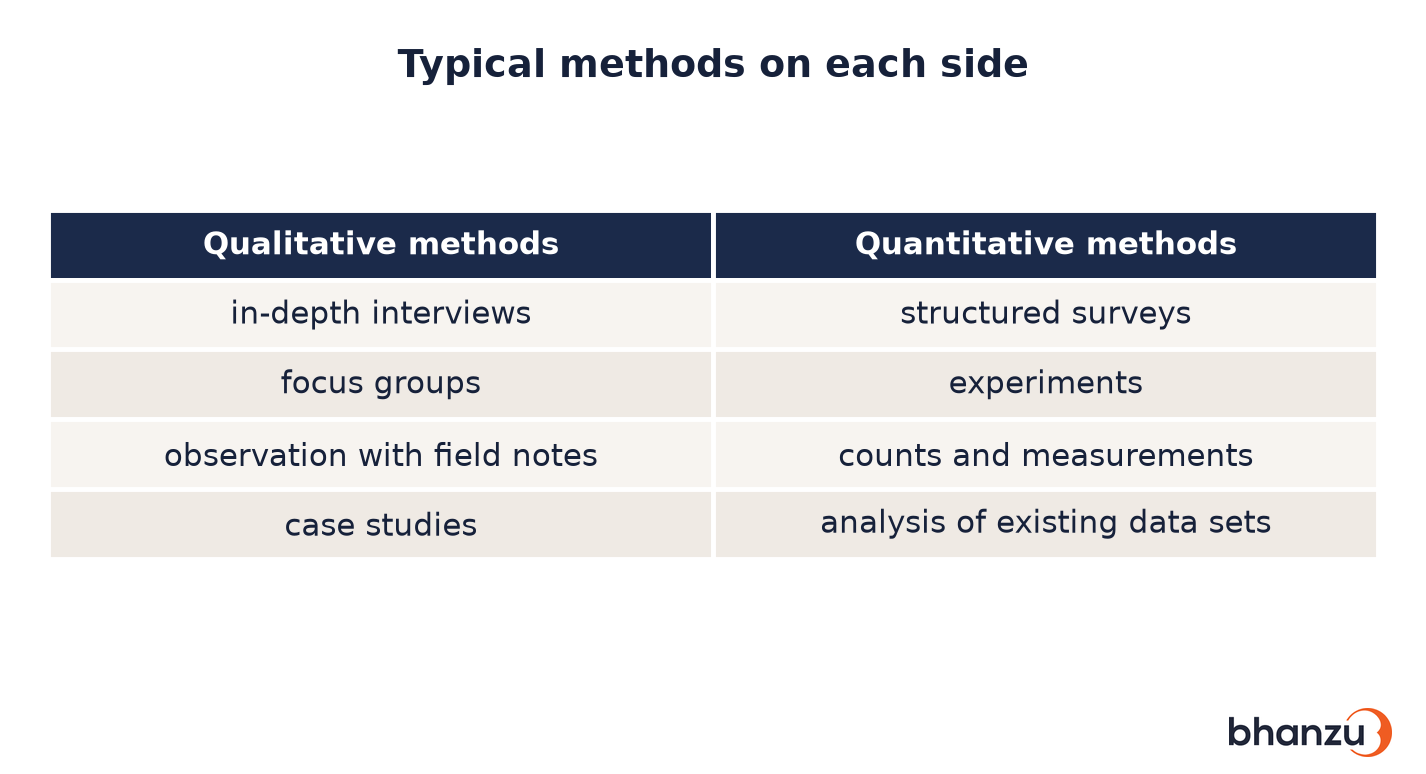
Qualitative. The question asks for reasons, and interviews or focus groups let students explain in their own words.
Example 4
Classify each as qualitative or quantitative data: test scores, interview transcripts, hours of sleep, diary entries.
Test scores and hours of sleep are quantitative. Interview transcripts and diary entries are qualitative.
Example 5
A survey finds that 40 percent of parents rarely check homework. What qualitative follow-up would help?
Interviews with some of those parents to learn why, such as working hours, uncertainty about the material, or a belief that children should work independently. The number shows the size of the pattern; the interviews explain it.
Example 6
A study tests whether a new teaching method raises test scores, comparing two groups. Which approach is this?
Quantitative, specifically an experiment. The outcome is measured in scores and compared using statistics.
Why Researchers Combine Both
Using both approaches together is called mixed methods, and it is common because each covers the other's blind spot.
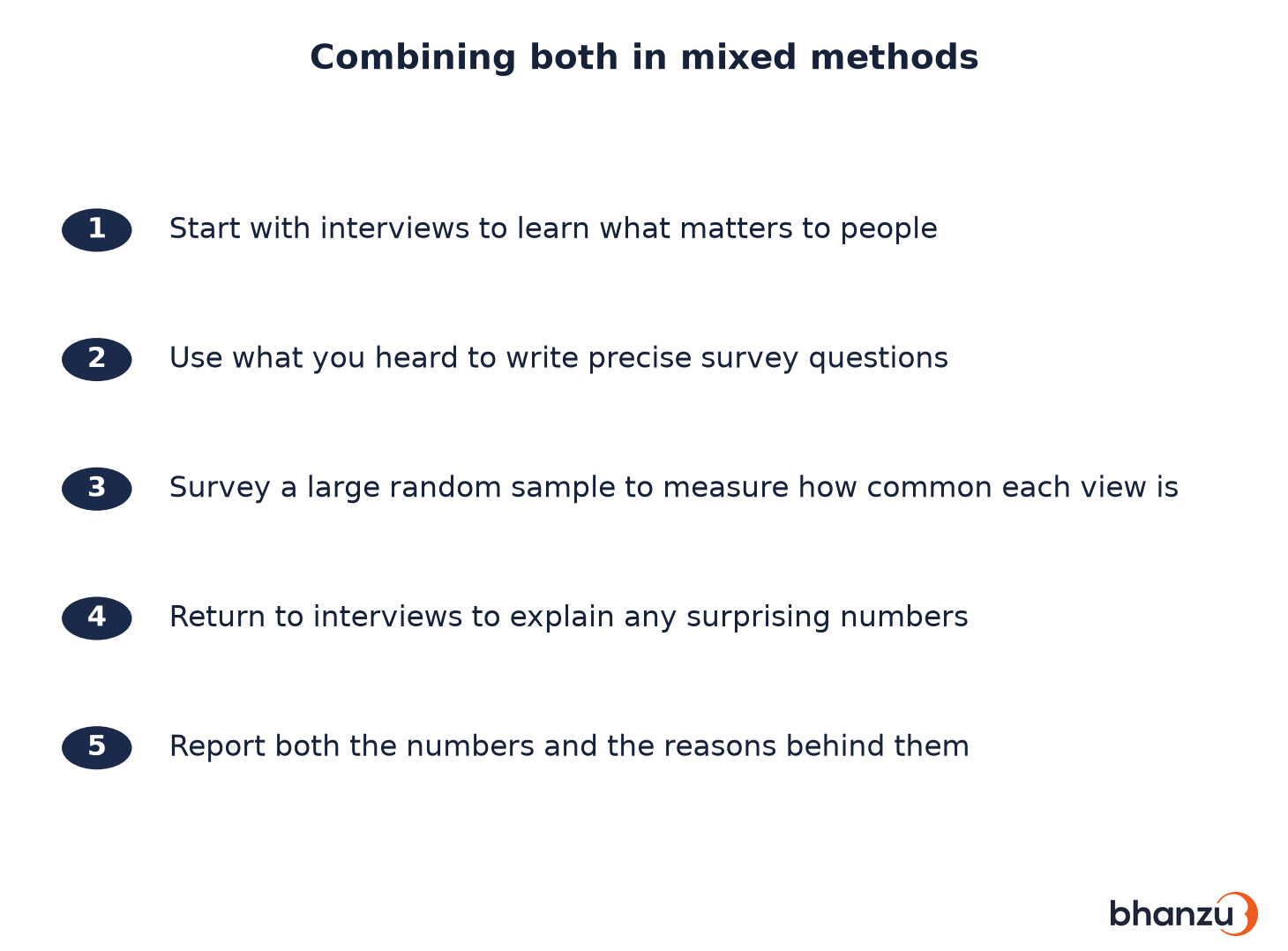
- Interviews improve surveys. Talking to people first reveals which questions and answer options matter.
- Surveys test interviews. A pattern heard in a few interviews can be checked for how widespread it is.
- Interviews explain numbers. A surprising survey result often makes sense only after people describe their reasons.
- Reports become complete. Decision-makers get both the size of an issue and the reasons behind it.
Official statistics are overwhelmingly quantitative. The US Census Bureau's Income in the United States: 2025 report gives a median household income of $87,460, estimated from a large sample survey. A number like that shows how incomes are distributed, while explaining how households experience them is a qualitative question.
What Most Guides Get Wrong About This Difference
Two points are often missing.
The first is that the difference is about the question, not the data type. Guides frame qualitative research as words and quantitative research as numbers. Example 2 shows why that is incomplete: a qualitative sample can produce a percentage, but the percentage cannot be trusted, because the sample was chosen for depth rather than representativeness.
The second is that qualitative research has its own standards of rigour. It is sometimes described as softer or less scientific. Done properly, it uses systematic collection, careful recording and transparent analysis of themes. The standards differ from statistical ones, but they are standards.
Where Students Trip Up on Qualitative and Quantitative Research
Mistake 1: Generalising from a qualitative sample
Where it slips in: Reporting interview findings, as in Example 2.
Don't do this: Turning a dozen interviews into a percentage for a whole population.
The correct way: Report the themes and reasons the interviews reveal, and use a large random sample to estimate how common they are.
Students turn interview counts into percentages because a percentage feels more scientific, even when the sample cannot support one.
Mistake 2: Using a survey to answer a why question
Where it slips in: Projects asking for reasons, as in Example 3.
Don't do this: Offering five fixed options for why students stop reading.
The correct way: Use open questions or interviews first, so that reasons you did not anticipate can appear.
Mistake 3: Calling all numerical data quantitative research
Where it slips in: Classifying studies.
Don't do this: Assuming a study with numbers in it is automatically quantitative.
The correct way: Check the design. Quantitative research uses samples and measures designed for statistical analysis.
The consequence of the first mistake appears in news coverage of small studies. A headline that most people feel a certain way, based on a handful of interviews, spreads a claim the research was never designed to support.
Key Takeaways
- The difference between qualitative and quantitative research lies in the question, the data, the sample, the analysis and the result.
- Qualitative research explains why and how through words; quantitative research measures how many through numbers.
- A qualitative sample cannot support population percentages, however neat the arithmetic.
- Mixed methods combine both so that numbers come with their reasons.
- To work through data handling with a teacher, explore Bhanzu's high school math tutor sessions or math classes online.
Read More
- Data Collection Methods
- Methods of Sampling
- Categorical Data
- Descriptive Statistics
- Inferential Statistics
Research Behind This Article
- US Census Bureau, Income and Poverty: income data and reports (2026). census.gov
- US Census Bureau, Decennial Census of Population and Housing (2026). census.gov
- US Bureau of Labor Statistics, Occupational Employment and Wages Summary, May 2025 (2026). bls.gov
- NIST/SEMATECH, e-Handbook of Statistical Methods, 7.2.2 Are the data consistent with the assumed process mean? (2022). itl.nist.gov
- NIST/SEMATECH, e-Handbook of Statistical Methods, 1.3.5.6 Measures of Scale (2022). itl.nist.gov
Quick Quiz: Check Yourself
Three levels, fresh numbers every time, instant feedback with the working.
Was this article helpful?
Your feedback helps us write better content
Frequently Asked Questions
What is the difference between qualitative and quantitative research?
Which is better, qualitative or quantitative research?
What are examples of qualitative research methods?
What are examples of quantitative research methods?
What is mixed methods research, and how does it use the difference between qualitative and quantitative research?