Key Points
- Data collection methods fall into two families: primary data, collected by you for your question, and secondary data, collected earlier by someone else.
- The four main primary methods are surveys, interviews, observation and experiments, and only experiments can establish cause and effect.
- Secondary data is cheaper and faster but was gathered for another purpose, so it may not measure exactly what your question needs.
- A badly worded question produces data that is precise and wrong, because no later calculation can repair a flawed measurement.
- Running a small trial before full collection catches confusing questions and missing categories while they are still cheap to fix.
The Decision That Comes Before Every Number
Every statistic starts as a decision about who to ask, what to ask and how to record it. By the time a mean or a percentage is calculated, those decisions are already fixed, and the arithmetic can only work with what was gathered.
That is why collection matters more than calculation. A perfect analysis of badly collected data produces a confident wrong answer.
What Are Data Collection Methods?
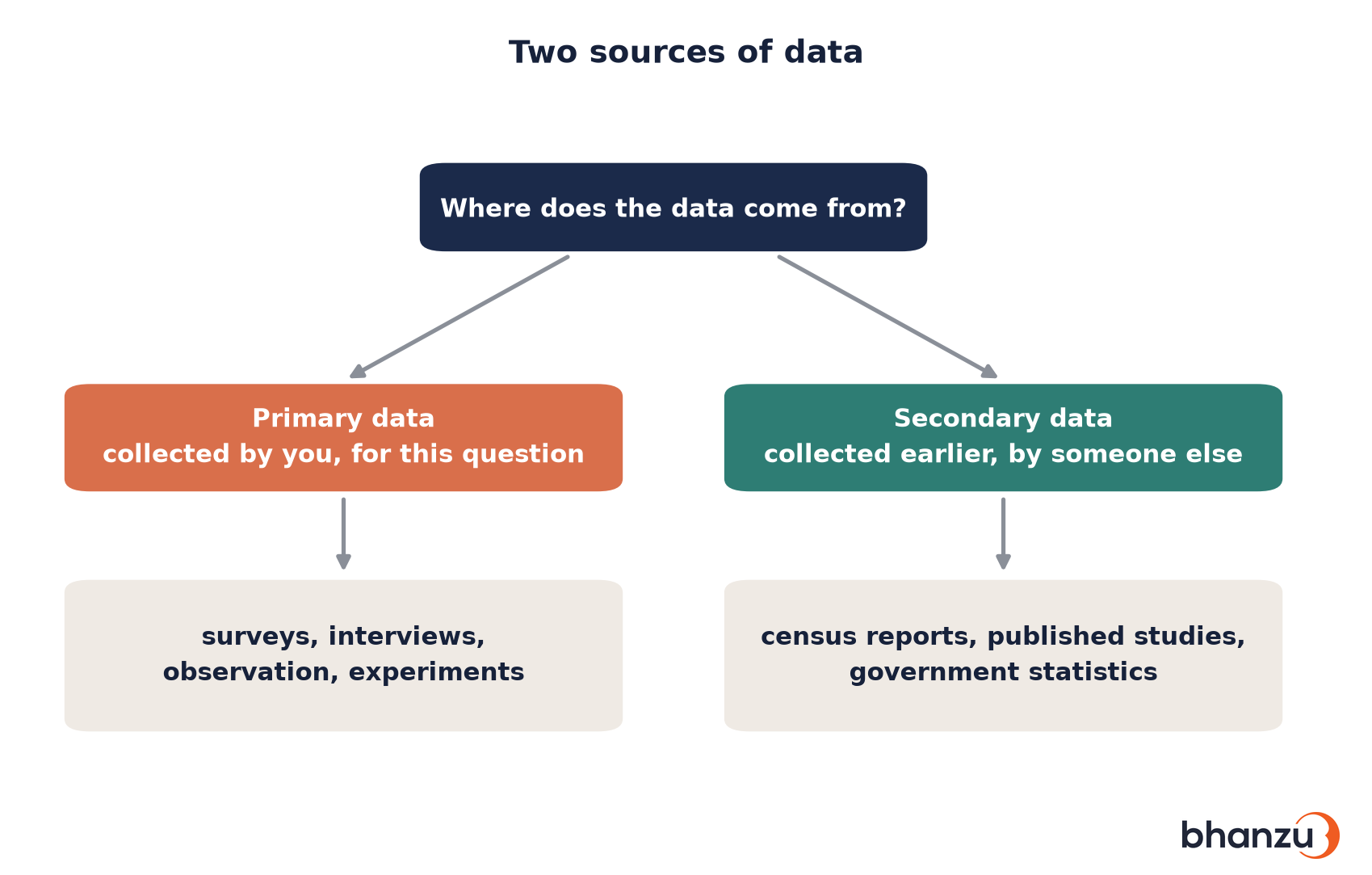
Data collection methods are the ways information is gathered to answer a question. They fall into two families.
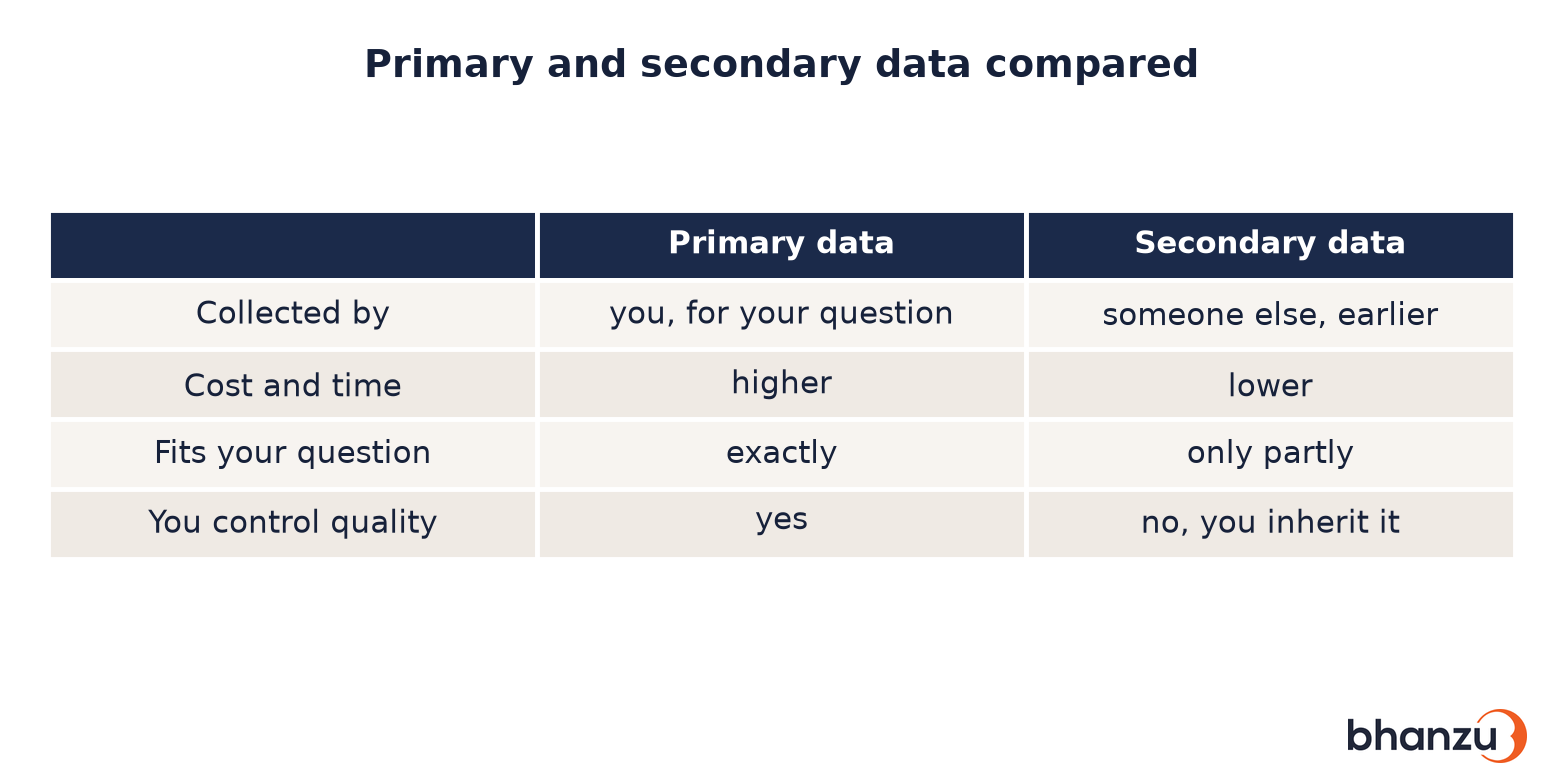
Primary data is collected first-hand for the question at hand. You design the survey, run the experiment or make the observations yourself, so the data fits your question exactly.
Secondary data was collected earlier by someone else for their own purpose. Census reports, published research and government statistics are all secondary data when you reuse them. It is faster and cheaper to obtain, but it measures what its original collectors needed, which may not match what you need.
Try It Yourself
Use the sampling simulator to see Data Collection Methods at work: drag, change the numbers and watch what happens.
What Are the Main Primary Methods?
Four methods cover nearly all first-hand collection, and each trades something for something else.
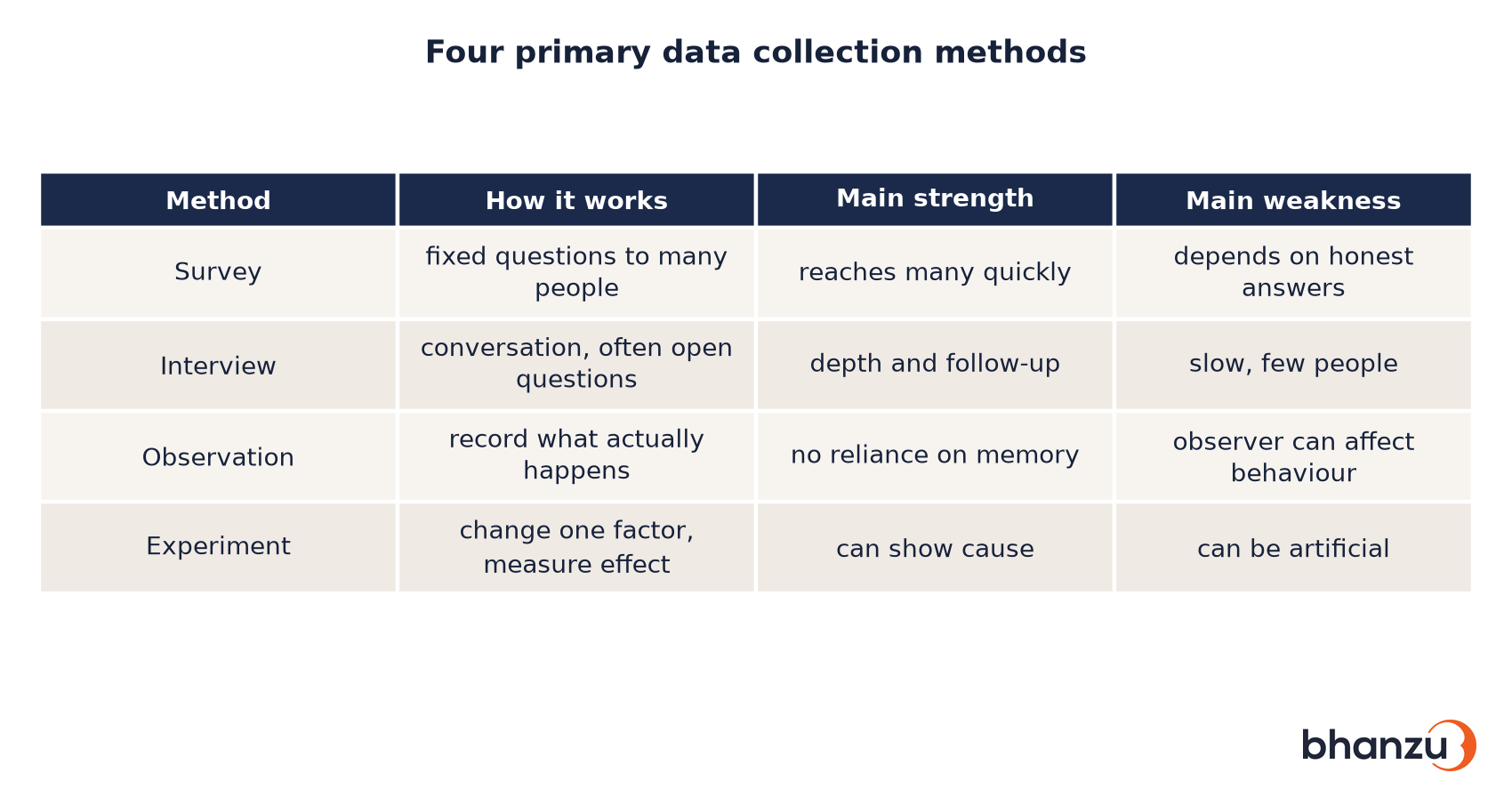
- Surveys ask the same fixed questions of many people. They reach large groups quickly but depend on respondents answering honestly and accurately.
- Interviews are conversations, often with open questions. They give depth and allow follow-up, but they are slow and reach few people.
- Observation records what actually happens rather than what people report. It avoids relying on memory, though being watched can change behaviour.
- Experiments deliberately change one factor and measure the effect. They are the only method that can establish cause and effect, because everything else is held constant.
That last point decides many research designs. A survey can show that students who sleep more score higher; only an experiment that changes sleep and holds everything else steady can show that sleep causes the difference.
How Do You Plan a Data Collection?
Work backwards from the question, not forwards from a method you already like.
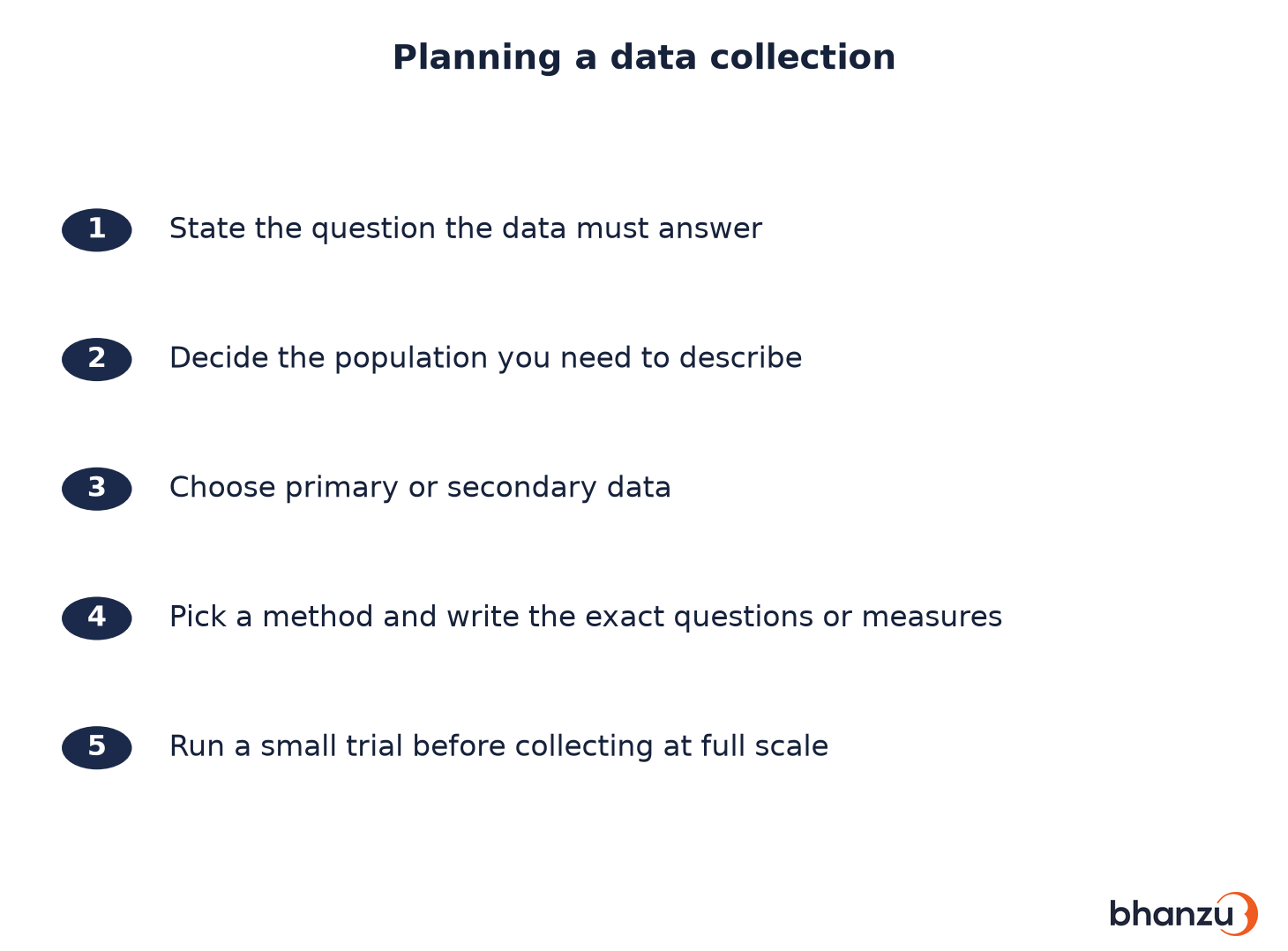
The trial run is the step most often skipped and most often regretted. A short pilot with a handful of people reveals confusing questions, missing answer options and categories that overlap, while fixing them still costs nothing.
Examples of Data Collection Methods
Example 1
A teacher wants to know how many students in her class walk to school. Which method fits?
A survey, or simply a show of hands. The population is small and fixed, the question has a clear answer, and counting is enough.
Example 2
A researcher asks "Don't you agree that homework is too long?" and finds 80 percent agree. What went wrong?
The result looks decisive, and the arithmetic is correct.
The question leads the respondent towards agreement. Phrased neutrally, as "How do you feel about the length of homework?", the answers could be quite different. A leading question produces data that is precise and wrong, and no calculation afterwards can recover the true opinion.
Example 3
A school wants to know whether a new reading programme improves scores. Which method can answer this?
An experiment. Assign the programme to some classes and not others, keep everything else as similar as possible, and compare the results. Only by controlling the other factors can the difference be credited to the programme.
Example 4
A student needs national population figures for a project. Should she collect them herself?
No. Official census data is secondary data that already answers the question far more completely than any individual could. The 2020 US Census counted 331,449,281 residents, a figure no personal survey could approach.
Example 5
A shop counts how many customers enter each hour by standing at the door. Which method is this, and what is one risk?
Observation. One risk is that the counter misses people during busy periods, which undercounts exactly the hours the shop most wants to understand.
Example 6
Why might a questionnaire about exercise habits overstate how often people exercise?
Respondents tend to report what they believe they should do rather than what they actually do. This is social desirability bias, and it is a weakness of any method that relies on self-report. Observation or activity tracking avoids it.
Why Collection Decides Everything Downstream
Statistical methods assume the data was gathered properly, and they cannot check that assumption for you.
- Bias is invisible in the numbers. A leading question or an unrepresentative sample produces figures that look exactly like good ones.
- Missing categories cannot be recovered. If an answer option was never offered, the data contains no trace of the people who would have chosen it.
- Cause needs control. Only an experiment, which controls other factors, can support a claim that one thing causes another.
- The question sets the method. Asking how many points to a survey; asking why points to interviews; asking whether something works points to an experiment.
Official statistics take this seriously. The US Census Bureau's Income in the United States: 2025 report states that its figures come from the Current Population Survey Annual Social and Economic Supplement, and publishes separate documentation of sampling and non-sampling error alongside the headline median of $87,460.
What Most Guides Get Wrong About Data Collection
Two things usually go unsaid.
The first is that method choice limits the conclusion. Guides list surveys, interviews and observation as interchangeable options and leave the choice to convenience. They are not interchangeable.
A survey can establish an association; only an experiment can establish cause. Choosing the method is choosing which kinds of claim the data will be able to support.
The second is that collection errors survive every later step. A guide that moves straight from collecting data to calculating averages implies the data is now trustworthy. Example 2 shows otherwise: a leading question produces a clean 80 percent that tells you about the question, not about the respondents.
Where Students Trip Up on Data Collection
Mistake 1: Writing leading questions
Where it slips in: Designing a questionnaire, as in Example 2.
Don't do this: Asking "Don't you agree that...?" or "How much do you enjoy...?"
The correct way: Ask neutrally, and offer balanced answer options. A question should not suggest which answer is expected.
Students write leading questions without meaning to, because they already know the answer they expect and the wording quietly carries it.
Mistake 2: Claiming cause from a survey
Where it slips in: The conclusion of a survey-based project.
Don't do this: Concluding that more sleep causes higher marks because the two were associated in a survey.
The correct way: Report the association, and note that an experiment would be needed to establish cause.
Mistake 3: Using secondary data without checking its definitions
Where it slips in: Projects built on published statistics.
Don't do this: Assuming a published figure measures exactly what your question needs.
The correct way: Read how the original collectors defined their terms. "Household", "employed" and "income" each have precise definitions that may differ from everyday use.
The real-world cost of a collection error appears in the history of opinion polling. Polls that reached only people with landline telephones, or only people willing to answer, have repeatedly misjudged results, because the people they missed differed from those they reached. The calculations were correct; the collection was not.
Key Takeaways
- Data collection methods split into primary data, gathered for your question, and secondary data, gathered earlier by others.
- Surveys, interviews, observation and experiments each trade reach, depth, accuracy and control differently.
- Only an experiment can establish cause, because it controls the other factors.
- Collection errors such as leading questions cannot be repaired by any later calculation.
- To work through data handling with a teacher, explore Bhanzu's middle school math tutor sessions or math classes online.
Read More
- Methods of Sampling
- Census
- Difference Between Qualitative and Quantitative Research
- Tally Marks
- Frequency Distribution
Research Behind This Article
- US Census Bureau, First 2020 Census Data Release Shows U.S. Resident Population of 331,449,281 (2021). census.gov
- US Census Bureau, Decennial Census of Population and Housing (2026). census.gov
- US Census Bureau, Income and Poverty: income data and reports (2026). census.gov
- US Bureau of Labor Statistics, Occupational Employment and Wages Summary, May 2025 (2026). bls.gov
- NIST/SEMATECH, e-Handbook of Statistical Methods, 1.3.5.6 Measures of Scale (2022). itl.nist.gov
Quick Quiz: Check Yourself
Three levels, fresh numbers every time, instant feedback with the working.
Was this article helpful?
Your feedback helps us write better content
Frequently Asked Questions
What are the main data collection methods?
What is the difference between primary and secondary data collection methods?
Which data collection method can show cause and effect?
What is a pilot study?
Why are leading questions a problem?