At a Glance — The Comparison Table
Aspect | Supplementary Angles | Complementary Angles |
|---|---|---|
Sum | ||
Letter cue | S for Supplementary and S for Straight line | C for Complementary and C for Corner |
Shape they form when placed adjacent | A straight line (linear pair) | A right angle (corner) |
Possible type combinations | Acute + obtuse, or two right angles | Two acute angles (never one of them can be ) |
Notation | ||
Example pair | and | and |
Where they appear in formulas | Linear pair theorem, triangle exterior angle, co-interior angles on a transversal | Right-triangle non-right angles, complementary trigonometric identities () |
Can the two angles be equal? | Yes — and | Yes — and |
Must they share a side? | No — they only need to sum to | No — they only need to sum to |
The single letter cue — Corner / Straight — is the most reliable mnemonic teachers use. Students who memorise the sums first ( vs ) often swap them under exam pressure; students who remember the shape almost never do.
What Are Supplementary Angles?
Two angles are supplementary when their measures add to exactly . If , the pair is supplementary. Either angle on its own is called the supplement of the other.
Supplementary angles do not have to be adjacent. in one diagram and in a totally different diagram are still supplementary to each other. When two supplementary angles are adjacent and share a side, the non-shared rays form a straight line — that special case is called a linear pair.
What Are Complementary Angles?
Two angles are complementary when their measures add to exactly . If , the pair is complementary. Either angle on its own is called the complement of the other.
Like supplementary angles, complementary angles don't need to be adjacent. When they are adjacent and share a side, the non-shared rays form a right angle (a corner).
Because the sum is , both angles must be acute — neither can be or larger. This is the asymmetry between the two pair types: supplementary angles can include obtuse, right, or even straight components (in the degenerate case); complementary angles are always two acutes.
Three Worked Examples, From Quick to Stretch
Quick. Find the supplement of .
The supplement is what you add to to reach . So supplement .
Standard (Wrong path first). An angle measures . Find (a) its complement and (b) its supplement.
Wrong path. A student writes both as because supplementary is the more-heard word, and gets the supplement right () — then writes the complement the same way and gets for the complement too.
Diagnosing the error. The complement uses , not . Mixing the two equations is the most common slip in this topic. The Corner/Straight mnemonic catches it before the algebra: the complement makes a corner with , so the missing piece of a corner is what we want.
Correct path.
(a) Complement: . (Sanity check: . ✓)
(b) Supplement: . (Sanity check: . ✓)
In the Bhanzu Grade 6 weekend cohort, this complement-supplement mix shows up in roughly five out of every ten students on first attempt. The fix that lasts is the diagram: draw the angle, then ask the student to complete the corner (complement) and complete the straight line (supplement) on the same diagram.
Stretch. Two supplementary angles are in the ratio . Find each angle, then find the complement of the smaller one (if it has one).
Let the two angles be and . They are supplementary, so:
So the angles are and .
Check: . ✓
Now the complement of the smaller angle: has complement . The smaller angle does have a complement (because it is acute).
The larger angle, , does not have a complement in the strict sense — its "complement" would be , which is not a valid angle measure. (Some textbooks allow negative complements; most school curricula treat complement as defined only for acute angles.)
Where Each Pair Type Shows Up
Supplementary angles
Linear pairs — whenever a line is crossed by another line, the two angles on the same side of the crossing line form a linear pair (sum ).
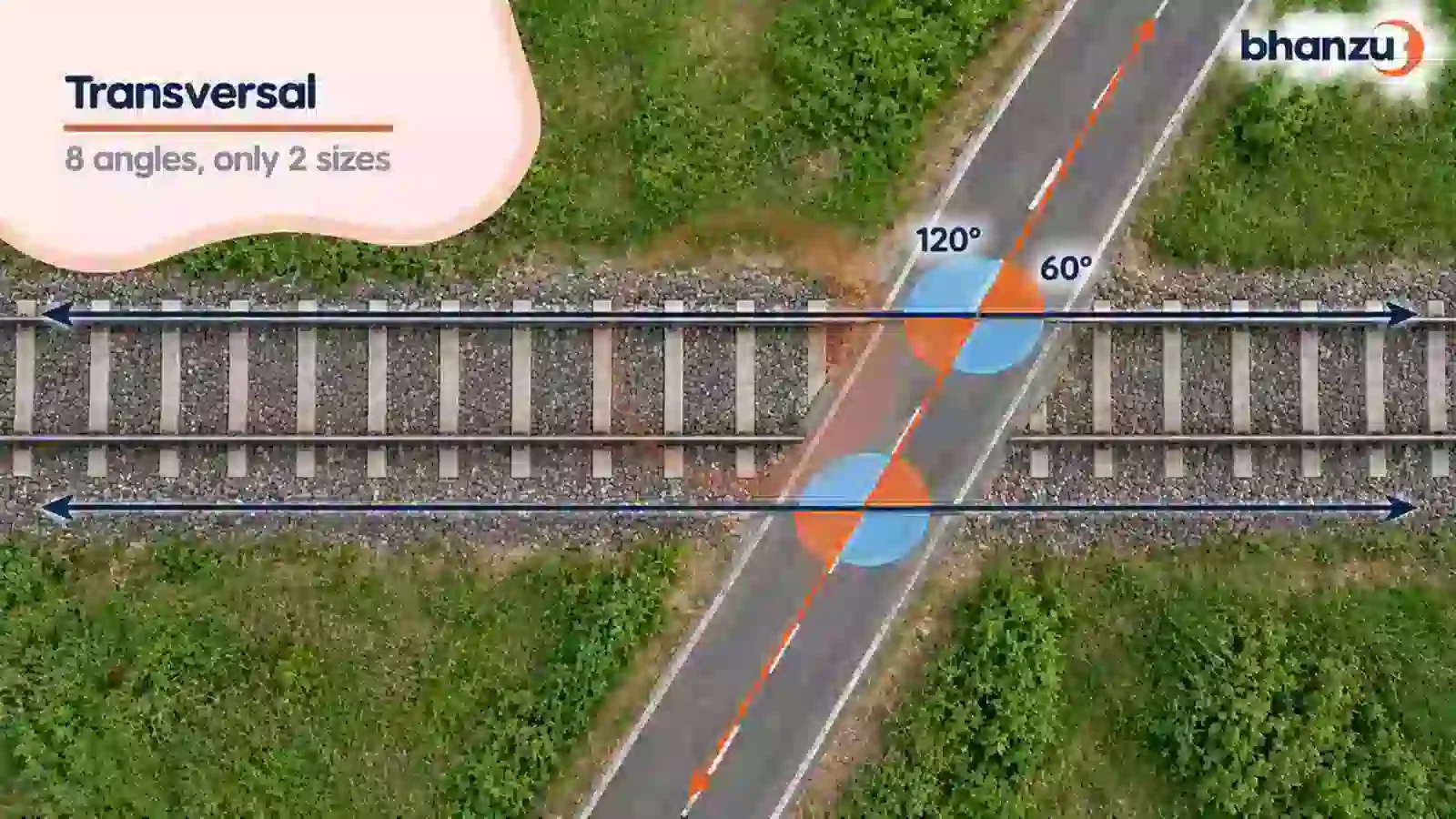
Co-interior (allied) angles on a transversal — when a transversal crosses two parallel lines, the pair of angles on the same side of the transversal between the parallels are co-interior and supplementary.
Cyclic quadrilateral angles — opposite angles of a cyclic quadrilateral (one inscribed in a circle) are supplementary.
Triangle exterior-angle thinking — an exterior angle plus its interior angle along the same side form a linear pair, so they are supplementary.
Complementary angles
Right-triangle non-right angles — the two non-right angles of any right triangle are always complementary. If one is , the other is .
Trigonometric complement identities — . The complement in "complementary" is exactly this — the angle that completes a right angle gives the co-function.
Constructions — any time you bisect a right angle, you create two complementary angles.
The trigonometric link is the historical reason the word co-sine exists: it is the sine of the co-mplementary angle.
Common Errors When Working With Supplementary and Complementary Angles
1. Mixing the sums — using when is meant.
Where it slips in: The two words start with different letters but are easy to swap under time pressure. A student writes when the problem asked for the complement of .
Don't do this: Memorise only the numbers ( vs ). They detach from the words.
The correct way: Complementary forms a Corner (). Supplementary forms a Straight line (). Reach for the shape, then the number falls out.
2. Assuming complementary angles must be acute by definition — and then forgetting the constraint.
Where it slips in: A student is asked for the complement of and writes .
Don't do this: Apply the formula blindly. Negative angles aren't standard.
The correct way: The complement is defined only for angles . An angle of has no complement in standard usage. The supplement is well-defined for any angle in .
3. Confusing "supplementary" with "adjacent."
Where it slips in: A student assumes supplementary angles must share a side.
Don't do this: Treat the pair-name as a position-name.
The correct way: The pair-name (supplementary, complementary) is about the sum. The position-name (adjacent, linear pair) is about whether they share a side. A pair of angles in two completely different diagrams can be supplementary to each other if their measures sum to .
The Bhanzu Grade 6 trainer-floor habit is to ask, "Do these need to touch?" before computing anything. The answer is no — and once the student internalises that, the pair-name questions become straightforward.
Bhanzu's Approach to Complement-Supplement Confusion
In a Bhanzu Grade 6 geometry session, the first ten minutes on this topic are spent on the Corner / Straight mnemonic, with the trainer drawing the two shapes and asking the student to label them. The numbers come second. Across cohorts since 2023, students who learn the mnemonic first miss the complement-supplement swap on subsequent assessments at roughly half the rate of students who learned the formulas first. The Level 0 diagnostic flags this misconception before the angle-chapter session starts.
Conclusion
Supplementary angles sum to ; complementary angles sum to .
The mnemonic Complementary–Corner / Supplementary–Straight is more reliable than memorising the numbers alone.
Complementary angles must both be acute; supplementary angles can be any combination summing to .
The single most common mistake is using the wrong sum — students apply to a complement question, or to a supplement question. The mnemonic catches it.
Pair names (supplementary, complementary) are about the sum. Position names (adjacent, linear pair) are about whether the angles share a side. They are different ideas.
Try It Yourself — Three Problems
Find the complement of and the supplement of .
Two angles are complementary, and one is twice the other. Find both.
In a right triangle, one non-right angle is . What is the other non-right angle, and why?
(Answers: 1. complement , supplement ; 2. and ; 3. , because the non-right angles of a right triangle are complementary.)
Want a Bhanzu trainer to walk through more angle-pair problems with your child? Book a free demo class — live online globally.
Also Read:
Was this article helpful?
Your feedback helps us write better content
Frequently Asked Questions
What is the difference between supplementary and complementary angles?
Can two obtuse angles be supplementary?
Can complementary angles be equal?
Do supplementary angles have to be next to each other?
What is the supplement of ?
How are complementary angles connected to trigonometry?
Is a linear pair the same as supplementary angles?