What Is Collinearity?
Collinearity is the condition of points lying on the same straight line. Any two points are always collinear - you can draw exactly one line through two points. Collinearity becomes a real question with three or more points: do they all sit on one common line, or do they spread out?
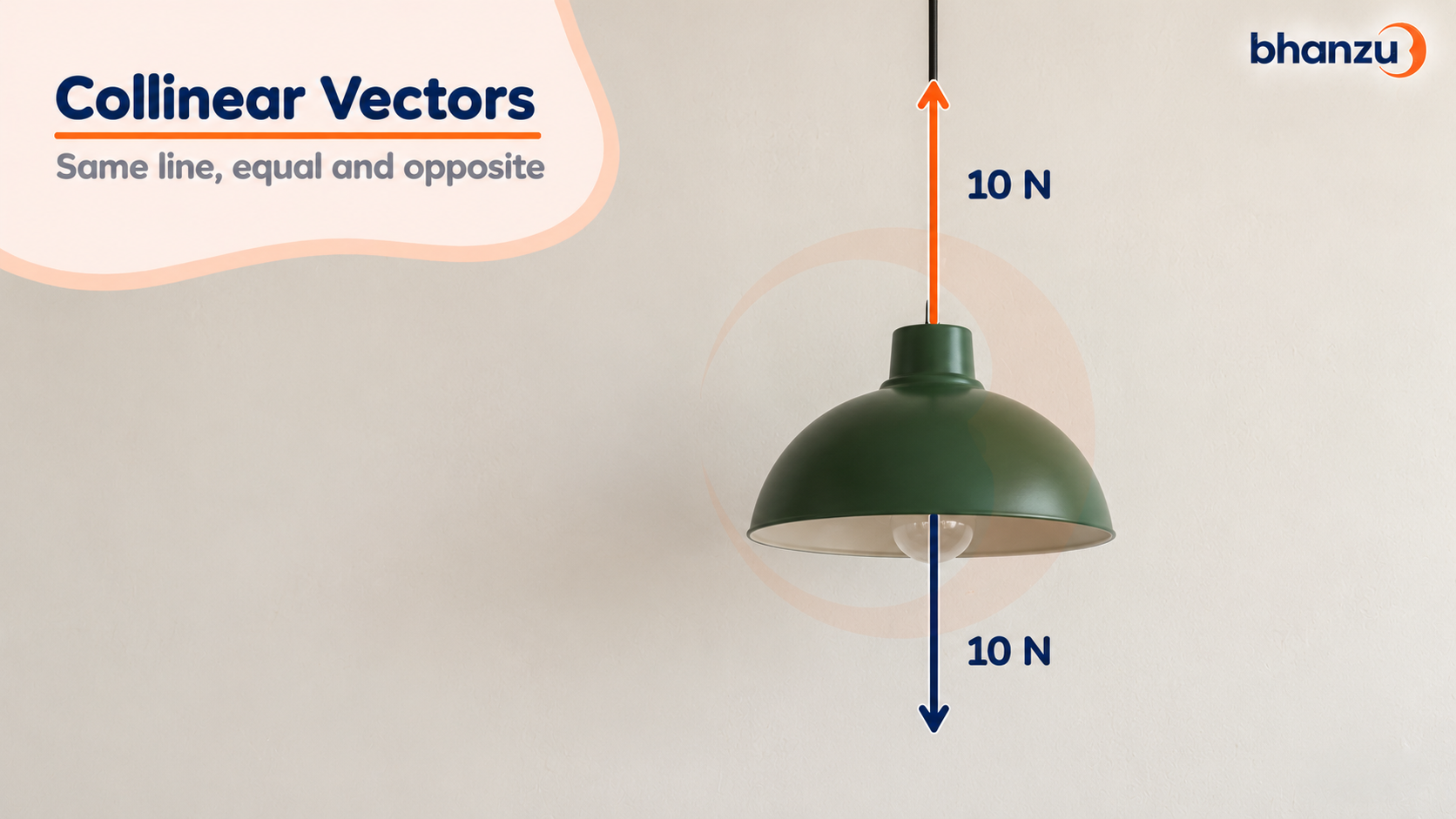
If they do lie on one line, the points are called collinear points; if not, they are non-collinear and would instead form a triangle or a scattered set. The same idea extends to vectors: two vectors are called collinear vectors when they point along the same line (parallel or anti-parallel). The heart of the topic is a set of quick algebraic tests that decide collinearity without having to plot anything.
What Is the Condition for Collinearity?
Three points , , and are collinear if any one of these equivalent conditions is true - checking one is enough:
Slope condition: slope of = slope of .
Area condition: the area of triangle is zero.
Determinant condition: the determinant built from the coordinates equals zero.
Vector condition: and are parallel.
They all say the same geometric thing in different algebra. The next sections take each in turn, and because they are equivalent you can pick whichever is fastest for the numbers in front of you.
How Do You Check Collinearity Using Slope?
The slope of the segment joining two points measures its steepness. If three points lie on one line, then every segment between them has the same slope - a straight line has a single, constant slope.
For points , , , compute the slope of and the slope of :
If these two values are equal, the points are collinear. Here and so on are the coordinates of the three points. The one caution: if any two points share the same -value, the slope is undefined (a vertical line), so in that case check whether all three share that -value instead - if they do, they are collinear on a vertical line.
How Do You Check Collinearity Using the Area of a Triangle?
Three non-collinear points enclose a triangle with some positive area. If the three points are collinear, that "triangle" flattens onto a line and its area shrinks to zero. So the test is simply: compute the triangle's area, and if it is zero the points are collinear.
The area of a triangle from coordinates is:
Setting this to zero gives the collinearity condition:
Each is a point's coordinates, and the vertical bars mean absolute value. This is often the fastest hand test because it avoids division and the undefined-slope trap. The full derivation of the area itself lives in area of triangle in coordinate geometry.
How Do You Check Collinearity Using Determinants?
The area expression above is exactly a determinant in disguise. Points are collinear when:
Expanding this determinant along the last column reproduces , so it is the same condition written compactly. This form is handy once you are comfortable with a determinant of a matrix, because it scales cleanly and is easy to remember: coordinates in the first two columns, ones in the last, set the whole thing to zero.
How Do You Check Collinearity Using Vectors?
In vector language, points , , are collinear when the vector from to is parallel to the vector from to . Two vectors are parallel when one is a scalar multiple of the other:
Equivalently, their cross product is the zero vector: . Because both vectors start at and point in the same direction, the three points cannot help but lie on one line. This is the natural test in three dimensions, where slopes no longer apply.
What Are the Properties of Collinear Points?
Collinearity carries a few consequences worth stating on their own:
Any two points are collinear. A single line always passes through two points; collinearity is only a real test for three or more.
The zero-area signature. Collinear points enclose no area - the triangle degenerates into a segment.
One shared slope. Every pair of collinear points gives the same slope (or all share a vertical line).
One point lies between the others. Among three collinear points, one is always between the other two, which links collinearity to the triangle inequality becoming an equality.
It is preserved under scaling and translation. Sliding or uniformly stretching a figure keeps collinear points collinear - a fact used throughout coordinate transformations on a straight line.
Where Is Collinearity Used?
Testing whether points share a line comes up constantly:
Coordinate geometry proofs. Showing three key points (like the vertices' midpoints or a centroid) are collinear is a standard exam task.
Computer graphics. Deciding whether points are collinear speeds up rendering, collision detection, and simplifying polygons.
Surveying and construction. Checking that markers, posts, or beams line up is a physical collinearity test.
Data and statistics. A perfect linear trend is collinear data; detecting near-collinearity flags redundant variables in regression.
Navigation. Confirming three landmarks lie on one bearing line helps fix or check a position.
Examples of Collinearity
Example 1
Are the points , , and collinear? Use the slope test.
Slope of . Slope of .
The slopes are equal.
Final answer: yes, the points are collinear.
Example 2
Check whether , , and are collinear using the area condition.
Compute :
The area is zero.
Final answer: yes, the points are collinear.
Example 3
A student checks , , and, seeing the -values go evenly, declares them collinear.
Wrong path. The student assumes evenly spaced -values mean the points line up.
Why it breaks. Equal -spacing says nothing about the -pattern. Test the slopes: slope of , slope of . They differ.
The rescue. Always compute the actual slopes (or the area). Since , the points are not collinear.
Final answer: not collinear - the slopes are and .
Example 4
Use the determinant test to check , , .
The determinant is zero.
Final answer: yes, the points are collinear.
Example 5
Find the value of for which , , and are collinear.
Equal slopes: , so . Then , giving .
Final answer: .
Example 6
Are the vectors and collinear?
Check for a scalar with : from the first components gives ; check the second, . ✓ Both match.
Final answer: yes, the vectors are collinear (parallel), so , , lie on one line.
Where Do Students Trip Up on Collinearity?
The recurring stumble is eyeballing points - assuming evenly spaced or "close enough" points are collinear without running a test. The second is mishandling the undefined slope when two points share an -value. Picking one algebraic condition and applying it cleanly settles every case.
Mistake 1: Judging collinearity by eye
Where it slips in: Deciding three plotted points "look like a line."
Don't do this: Skipping the calculation because the points seem lined up.
The correct way: Run one test - equal slopes, zero area, or zero determinant. A tiny difference in slope is invisible to the eye but breaks collinearity.
Mistake 2: Mishandling a vertical line
Where it slips in: Two points share the same , making the slope undefined.
Don't do this: Treating the undefined slope as an error and stopping.
The correct way: If two points share an -value, check whether all three share it. If they do, they lie on a vertical line and are collinear; if not, they are not.
Mistake 3: Forgetting the absolute value / sign in the area test
Where it slips in: Getting a negative number from the area expression and panicking.
Don't do this: Concluding "not collinear" because the raw expression is negative.
The correct way: Collinearity needs the expression to equal zero. A nonzero value - positive or negative - means non-collinear; only zero confirms collinearity.
Conclusion
Collinearity means three or more points lie on one straight line.
Test it with any single equivalent condition: equal slopes, zero triangle area, a zero determinant, or parallel vectors.
The area and determinant tests avoid the undefined-slope trap, so they are often the safest by hand.
Collinear points enclose no area, share one slope, and always have one point between the other two.
To take coordinate-geometry proofs further with a teacher, explore Bhanzu's geometry tutor or high school math tutor sessions, or browse math classes online for guided practice.
Read More
Practice These to Solidify Your Understanding
Work through these problems in order:
Are , , and collinear? Use the slope test.
Find so that , , and are collinear.
Use the area condition to check whether , , and are collinear.
Answer to Question 1: Slope , slope ; equal, so collinear. Answer to Question 2: , so , . Answer to Question 3: ; collinear.
Want a live Bhanzu trainer to walk through more coordinate-geometry problems with you? Book a free demo class.
Was this article helpful?
Your feedback helps us write better content