What Are The Solutions Of A Linear Equation?
A solution of a linear equation is any value, or set of values, that makes the equation a true statement when substituted for the variables. Put the value in, work out both sides, and if the left side equals the right side, that value is a solution.
A linear equation is an equation in which every variable appears only to the first power, with no squares, no roots, and no products of two variables. The number of solutions depends entirely on how many variables the equation carries.
One variable (form , with ): exactly one solution.
Two variables (form ): infinitely many solutions, each an ordered pair .
Everything below unpacks those two cases, how to find the values, and how to check that a value really is a solution. For the parent topic, see linear equations.
How Many Solutions Does A One-Variable Linear Equation Have?
A linear equation in one variable has exactly one solution. There is a single number that balances the equation, and no other number will.
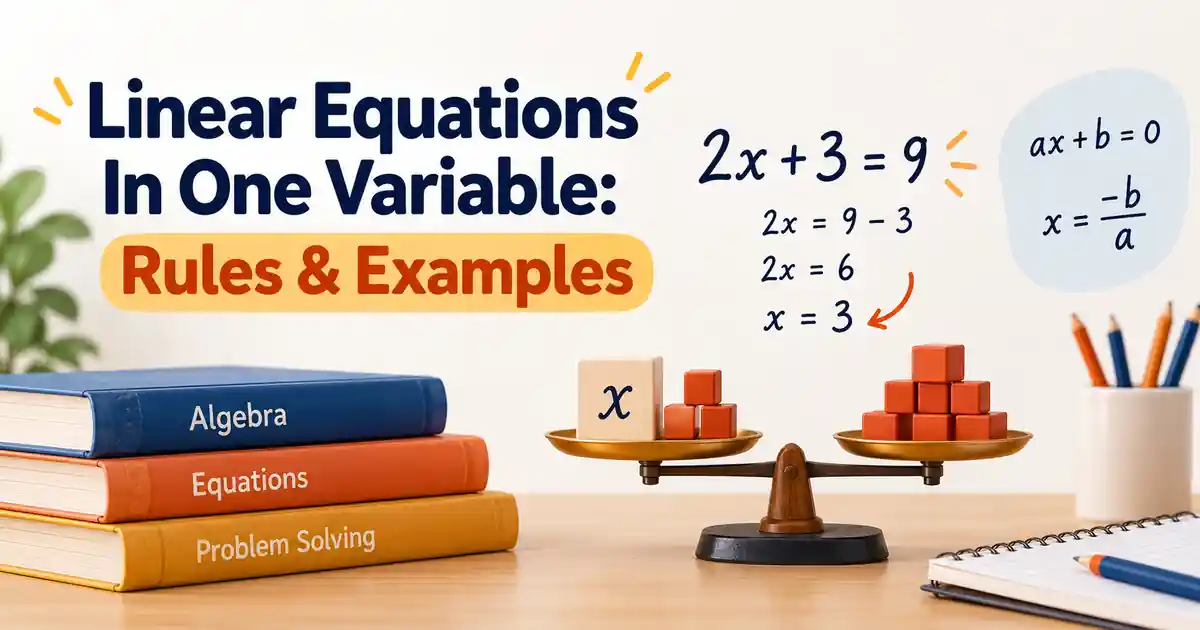
Take . Isolate the variable step by step:
The only value that works is . Substitute it back to confirm: , which matches the right side.
Why only one? A one-variable linear equation pins the variable down completely. There is no freedom left, so the answer is a single point on the number line.
The general rule falls straight out of the form: for with , the solution is always . For the full step-by-step method, see solving linear equations.
What Is A Solution Of A Linear Equation In Two Variables?
A solution of a two-variable linear equation is an ordered pair that makes the equation true. Both values matter, and they travel together.
Take . Pick a value for , then solve for :
If , then , giving the pair .
If , then , giving .
If , then , giving .
Each pair is a genuine solution. Check : . True.
The answer is never a single number here; it is always a pair, because the equation ties and to each other. Change and has to move to keep the balance. For a deeper treatment, see linear equations in two variables.
Why Does A Two-Variable Linear Equation Have Infinitely Many Solutions?
A two-variable linear equation has infinitely many solutions because you are free to choose any value you like for one variable, and the equation then fixes the other. One free choice, endless pairs.
Think of again. You can set to , , , , , or any real number at all. For each choice, exactly one makes the equation balance. Since there are infinitely many numbers to choose from, there are infinitely many valid pairs.
This is the single biggest jump from one-variable equations. Removing one constraint (going from two conditions to one) hands the equation a degree of freedom, and that freedom is what stretches a single answer into an infinite family. Here is the whole story in one table.
Table: How the number of variables sets the number of solutions.
Equation type | Form | Number of solutions | A solution looks like |
|---|---|---|---|
One variable | Exactly one | A single number, e.g. | |
Two variables | Infinitely many | An ordered pair, e.g. |
How Do You Find And Verify A Solution?
Finding a solution and checking a solution are two different jobs. Finding means computing a value; verifying means proving it works. Skipping the second step is where marks quietly disappear.
To find a solution of a two-variable equation, choose a value for one variable and solve for the other. For , let :
So is a solution.
To verify a solution, substitute both numbers back into the original equation and confirm the two sides are equal:
The left side equals the right side, so is confirmed. Always substitute into the original equation, not a line you rewrote along the way, so a mistake made earlier cannot slip through the check. When you want to isolate a single variable cleanly before substituting, solve for x first.
How Is The Graph The Set Of All Solutions?
The graph of a two-variable linear equation is the complete picture of its solutions. Every point on the line is a solution, and every solution is a point on the line. The line and the solution set are the same object drawn two ways.
Plot the pairs found earlier for , namely , , and , and they fall on one straight line. Any other point on that same line, such as , is also a solution: . A point off the line, such as , gives , so it fails.
That equality between a line and its solution set is why the topic sits at the heart of algebra. Once you can read a line as a solution set, graphing linear equations becomes a way of showing all answers at once, and finding where two lines cross becomes a way of solving a system of equations.
Why Do The Solutions Of A Linear Equation Matter?
Solutions are not the end of an exercise; they are the answer to a real question hiding inside the symbols. The equation is the model, and the solution is the number the model was built to produce.
They turn a situation into an answer. A budget, a distance-speed-time setup, or a mixing problem becomes a linear equation, and its solution is the amount, the time, or the quantity you actually needed.
They reveal structure, not just numbers. Knowing that a two-variable equation has a whole line of solutions tells you a relationship is flexible, while a one-variable equation locking to a single value tells you the situation is fully determined.
They connect algebra to geometry. Because the solution set of a two-variable equation is a line, questions about numbers become questions about pictures, and vice versa. That bridge underpins coordinate geometry, calculus, and data science.
The deeper point is that "solving" is really "finding what fits." Every field that models the world with equations cares less about the equation than about its solutions, because the solution is where the mathematics touches the real question.
Who Invented Linear Equations And Their Solutions?
People were solving linear equations for real needs, splitting land, sharing grain, balancing trade, long before anyone drew a graph. The leap from "find the number" to "the graph is the set of all solutions" took two very different mathematicians, centuries apart.
Two figures shaped how we find and picture these solutions:
Muhammad ibn Musa al-Khwarizmi (c. 780–850, Baghdad) wrote Al-Jabr, the work that gives algebra its name, and set out systematic, repeatable steps for solving linear and quadratic equations rather than guessing.
René Descartes (1596–1650, France) built the coordinate plane, turning the solution set of a two-variable equation into a line and founding the coordinate geometry every student uses today.
Where Are The Solutions Of A Linear Equation Used In The Real World?
Finding the value that fits an equation runs quietly under a wide range of everyday and professional work.
Personal budgeting: setting spending equal to income gives a linear equation whose solution is how much you can save or must cut.
Cooking and scaling recipes: doubling or tripling ingredients is solving a linear equation for the new quantity that keeps the ratio true.
Business break-even: setting total cost equal to total revenue produces a linear equation whose solution is the number of units a company must sell to stop losing money.
Engineering and unit conversion: converting temperature, currency, or measurement units uses a linear relationship, and each conversion is a solution of that equation.
Navigation and travel: distance equals speed times time is linear, so working out an arrival time or a required speed is solving for the unknown.
One skill, finding the value that makes an equation true, sits under kitchens, spreadsheets, factories, and flight plans. Mathematics is the shared language beneath jobs that look nothing alike. You can see many of these worked out in applications of linear equations.
What Are The Most Common Solutions Of A Linear Equation Mistakes?
These three errors account for most lost marks on this topic, confirmed against Lumen Learning's verification lesson, an O-Level error guide, and an SAT-traps review.
Thinking a two-variable equation has only one solution.
Where it slips in:
A student solves , finds , and stops, treating it like a one-variable equation with a single answer.
Don't do this:
Do not report one pair as "the solution" of a two-variable equation. A single equation in two variables has infinitely many solutions, one for every choice of .
The correct way:
State that the solution is a set, and give the rule or several pairs. For , every pair of the form works, which is why the graph is a whole line, not a point.
Not verifying the answer by substitution.
Where it slips in:
A student finds a value, writes it down, and moves on without ever putting it back into the equation.
Don't do this:
Do not trust a computed value on sight. A small slip earlier means the "answer" fails silently.
The correct way:
Substitute the value into the original equation and confirm both sides match. For in : . If the two sides are not equal, the value is not a solution.
Sign errors when substituting negatives.
Where it slips in:
Checking a pair like , a student writes as instead of , or drops the minus sign entirely.
Don't do this:
Do not substitute negative values without brackets. A missing sign flips the result and hides a correct or incorrect answer.
The correct way:
Always wrap negatives in parentheses before you compute. Write , keeping the sign attached to the number the whole way through.
Practice Problems On Solutions Of A Linear Equation
Answers follow each problem.
Is a solution of ?
(Answer: , true, so yes.)Solve the one-variable equation .
(Answer: , so .)Find three solutions of .
(Answer: for example , , and .)If in , find and write the solution pair.
(Answer: , so , giving .)Is a solution of ?
(Answer: , so no.)For , find the solutions when and .
(Answer: and .)
Where Should You Go Next After Solutions Of A Linear Equation?
Once a solution set clicks as either one number or a whole line, several natural doors open from here.
Graphing linear equations. Draw the solution set of a two-variable equation and read every answer straight off the line.
System of equations. Find the single pair that solves two equations at once, the point where two solution lines cross.
Standard form of linear equations. See how the layout makes finding and comparing solutions faster.
If your child is building these foundations, a live Bhanzu trainer teaches solutions starting from the "why" (what a solution really represents, and why a line is a set of answers) in the Bhanzu algebra program.
Was this article helpful?
Your feedback helps us write better content