What Is A Many-One Function?
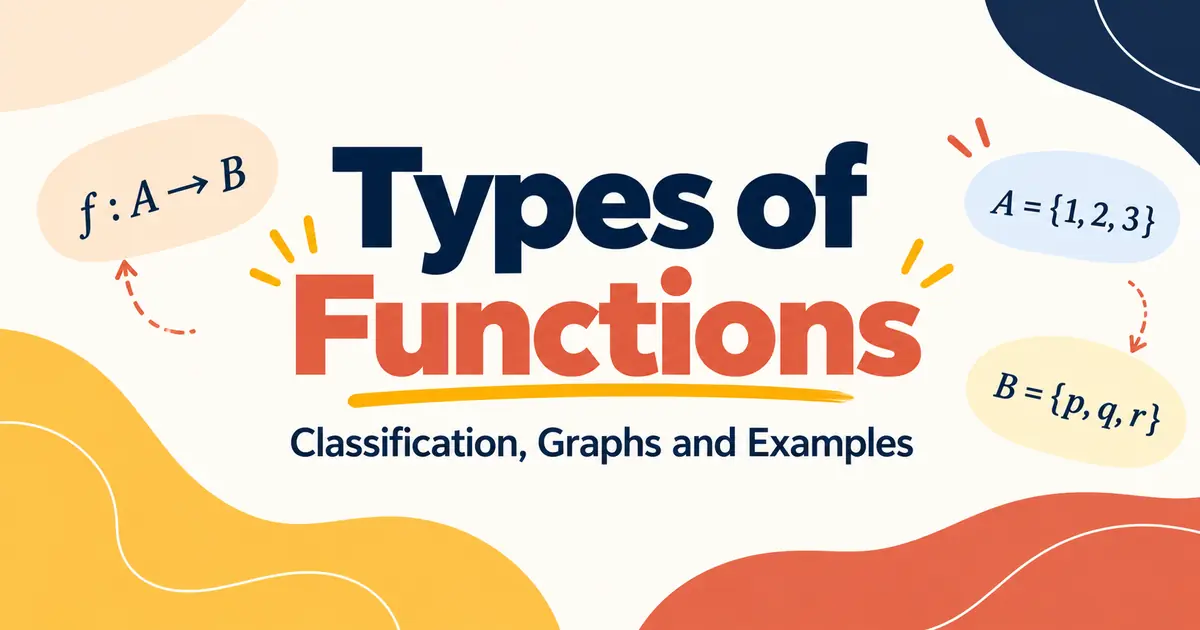
A many-one function is a function in which two or more distinct elements of the domain are mapped to the same element of the codomain. In plainer words, different inputs can produce the same output, and at least one output is shared by more than one input.
The word "function" still does its usual work here. Every input must have exactly one output; that rule is never broken. What makes a function many-one is that the reverse is not tidy: a single output can be traced back to several inputs. If you want a refresher on the input-output rule itself, see relations and functions.
Compare the two possibilities for any function:
One-one (injective): different inputs always give different outputs. No output is ever repeated.
Many-one: at least two different inputs give the same output. Some output is repeated.
Every function is exactly one of these two. There is no third case, and a full map of the categories lives at types of functions.
What Are Some Examples Of A Many-One Function?
The quickest way to recognise a many-one function is to find two different inputs that land on the same output.
Example 1: The squaring function .
Two different inputs, and , share the output . The same thing happens for every non-zero value, so is many-one.
Example 2: The absolute-value function .
Again, and both map to . The absolute value function is many-one for the same reason squaring is: it erases the sign.
Example 3: A constant function .
Here every input maps to . A constant function is the most extreme many-one function, since the whole domain collapses onto a single output.
Example 4: A finite mapping.
Let the domain be and define by , , , . Inputs and share the output , and and share , so is many-one.
Trigonometric functions such as and are also many-one over the real numbers, because their values repeat with every full turn.
How Do You Identify A Many-One Function On A Graph?
For a function you can see on a graph, use the horizontal-line test. Draw horizontal lines (lines parallel to the x-axis) across the graph and count how many times each one touches the curve.
If every horizontal line meets the graph at most once, the function is one-one.
If any horizontal line meets the graph at two or more points, the function is many-one.
The logic is direct. A horizontal line represents a single output value . The points where it cuts the curve are the inputs that produce that output. Two crossings mean two different inputs sharing one output, which is the definition of many-one.
The horizontal-line test decides one-one versus many-one. It is a separate check from the vertical line test, which decides whether a graph is a function at all. The two tests answer two different questions, and mixing them up is a common slip we return to below.
What Are The Properties Of A Many-One Function?
A many-one function has a handful of features that follow straight from its definition.
At least one output is repeated. By definition, two or more inputs share an image, so the outputs cannot all be distinct.
It fails the horizontal-line test. Some horizontal line meets the graph more than once.
It has no inverse function. Because one output traces back to several inputs, you cannot reverse the map uniquely. Only one-one functions can be inverted; the reasoning is covered under inverse functions.
The number of distinct outputs is smaller than the number of inputs (for a finite domain). Several inputs collapse onto each shared output, so the image set is strictly smaller than the domain.
That last point is the intuition behind the whole idea: a many-one function compresses. It takes a larger collection of inputs and folds several of them onto the same result.
What Is The Difference Between A Many-One And A One-One Function?
Both are functions, so both obey the rule "one input, one output." The difference is only in whether outputs get repeated.
Table: One-one versus many-one at a glance.
Feature | One-one (injective) | Many-one |
|---|---|---|
Different inputs | Always give different outputs | At least two give the same output |
Repeated outputs | Never | Yes |
Horizontal-line test | Passes (each line hits once at most) | Fails (some line hits twice or more) |
Inverse function | Exists | Does not exist |
Example |
For a deeper treatment of the injective case, see one-to-one function and its formal cousin injective function. The two labels describe the same property from slightly different angles.
Can A Many-One Function Be Onto (Or Into)?
Yes. "Many-one versus one-one" and "onto versus into" are two separate classifications, and any combination of them is possible. One describes how inputs behave; the other describes whether the outputs cover the whole codomain.
Onto (surjective): every element of the codomain is used as an output.
Into: at least one element of the codomain is never used as an output.
Because the two classifications are independent, all four pairings exist.
Table: The four ways a function can combine the two classifications.
Into (some codomain unused) | Onto (whole codomain used) | |
|---|---|---|
One-one | One-one into | One-one onto (bijective) |
Many-one | Many-one into | Many-one onto |
A many-one function is happily onto whenever its outputs still cover the entire codomain, even though several inputs share each of those outputs. So the belief that "many-one means not onto" is false. Read more at onto function, into function, and surjective function. A function that is both one-one and onto is a bijective function, the only kind with a full inverse.
Why Does The Many-One Classification Matter?
Sorting functions into one-one and many-one is not busywork for exams. The split decides one deep question: can the function be undone?
Invertibility. A function can be reversed only when each output points back to exactly one input. That is precisely what "one-one" guarantees. A many-one function has folded several inputs together, so the information about which input you started from is lost, and no inverse can recover it.
Information and compression. Many-one maps are the mathematics of deliberately losing detail. Rounding a decimal, grading a score, or grouping cities into countries all throw away distinctions on purpose, keeping only what matters. Each is a many-one function doing useful work.
Solving equations. When is many-one, an equation like can have several solutions. Knowing the function is many-one tells you to expect more than one answer, which is exactly the situation with giving both and .
So the label is a shortcut for real consequences. The moment you know a function is many-one, you know it has no inverse, that it compresses its inputs, and that its equations may carry extra solutions.
Who Shaped The Modern Idea Of A Function?
For a long time, mathematicians pictured a "function" as a single formula. The modern, roomier idea, that a function is any rule pairing each input with one output, is what made the many-one and one-one classification possible in the first place.
Two more names shaped the vocabulary we still use:
Nicolas Bourbaki (the collective pen name of a group of French mathematicians, active from 1935) popularised the precise terms injection, surjection, and bijection, giving the one-one and onto ideas the clean labels students learn today.
Augustin-Louis Cauchy (1789–1857, France) sharpened the study of continuity and helped push mathematics toward the careful, rule-based view of functions that Dirichlet's definition completed.
Where Are Many-One Functions Used In The Real World?
Many-one functions appear anywhere a system deliberately treats different inputs as equivalent.
Grading and scoring: every percentage in a band maps to one letter grade, a many-one map from many scores onto a few grades.
Computer science and hashing: a hash function sends huge numbers of possible inputs to a fixed range of codes; different inputs sharing a code is a "collision," which is many-one behaviour by design.
Rounding and measurement: rounding to the nearest whole number sends a whole interval of decimals to a single integer.
Classification and machine learning: a classifier maps countless different images onto a small set of labels such as "cat" or "dog," which is a many-one map.
Everyday grouping: assigning each city to its country, or each date to its day of the week, sends many inputs to one output.
One idea, folding many inputs onto shared outputs, runs grading systems, search engines, measurement, and artificial intelligence alike. Mathematics is the shared language beneath fields that look unrelated.
What Are The Most Common Many-One Function Mistakes?
These three errors account for most lost marks on function classification, verified against horizontal-line-test references and one-to-one function guides.
Confusing many-one with "one-many."
Where it slips in:
A student reverses the phrase and thinks a many-one function lets one input give several outputs.
Don't do this:
Do not treat "one input, many outputs" as a function. A rule where a single input produces two or more outputs is not a function at all; it fails the very definition.
The correct way:
Read "many-one" as "many inputs to one output." The many sits on the input side. Every function, including a many-one one, still gives each input exactly one output.
Believing a many-one function can never be onto.
Where it slips in:
A student assumes that because inputs are shared, the codomain cannot be fully covered, and labels every many-one function "into."
Don't do this:
Do not tie the two classifications together. Whether outputs repeat (one-one versus many-one) is independent of whether the codomain is fully covered (into versus onto).
The correct way:
Check the two properties separately. If every codomain element is still hit by some input, the function is onto, even when several inputs share each output. Many-one onto functions are perfectly ordinary.
Using the vertical-line test to check for many-one.
Where it slips in:
A student draws vertical lines to decide whether a graph is one-one or many-one.
Don't do this:
Do not swap the tests. The vertical-line test only checks whether a graph is a function; it says nothing about one-one versus many-one.
The correct way:
Apply the horizontal-line test for the one-one versus many-one question. Confirm the graph is a function with a vertical line first, then draw horizontal lines: more than one crossing means many-one.
Practice Problems On Many-One Functions
Decide whether each function is one-one or many-one, and give a brief reason. Answers follow each line.
on all real numbers.
(Answer: Many-one, since .)on all real numbers.
(Answer: One-one, since different inputs always give different outputs.)on all real numbers.
(Answer: Many-one, since .)The mapping .
(Answer: Many-one, since inputs and share the output .)on all real numbers.
(Answer: Many-one, since .)on all real numbers.
(Answer: One-one, since every real output comes from exactly one input.)
Where Should You Go Next After Many-One Functions?
The one-one versus many-one split is one branch of a larger map of functions, and several natural doors open from here.
Types of functions. See where many-one sits among all the standard categories, from constant to polynomial to trigonometric.
One-to-one function. Study the opposite case in full, including why only these functions can be inverted.
Inverse functions. Learn the exact condition a function must meet before it can be undone, and how the inverse is built.
Even and odd function. Explore symmetry, the property that makes and many-one in the first place.
If your child is building these foundations, a live Bhanzu trainer teaches function classification starting from the "why" (invertibility and compression) in the Bhanzu algebra program.
Was this article helpful?
Your feedback helps us write better content
Frequently Asked Questions
What is a many-one function in simple words?
Is a many-one function?
What is the difference between a many-one function and a one-many relation?
Can a many-one function have an inverse?
How do you test whether a function is many-one from its graph?
Which curricula cover many-one functions?