The Year Math Stops Being Only About Numbers
For most students, one math course is where letters first stand in for numbers, and that course is Algebra 1. Up to this point, a problem gave you numbers and asked for an answer. Algebra 1 flips it: now a letter like holds a value you do not yet know, and the work is figuring out what it must be. That shift, from "compute this" to "find the unknown," is the single biggest leap between middle-school math and high-school math, and it is the whole reason Algebra 1 matters.
Because so much later math is built on it, Algebra 1 is less a single topic than a foundation. The sections below lay out exactly what it contains and what it asks you to be able to do.
What Is Algebra 1?
Algebra 1 is the introductory algebra course that teaches students to use variables (letters that represent numbers) together with numbers and operations to describe relationships and solve problems. Where arithmetic asks you to calculate with known numbers, algebra asks you to reason about unknown ones - writing an algebraic expression for a situation, forming an equation, and solving it.
The course sits at the base of the algebra branch of mathematics. Its through-line is that expressions, equations, inequalities, functions, tables, and graphs are all different ways of describing the same relationships, and Algebra 1 is where a student learns to move fluently between them.
What Grade Is Algebra 1?
In the United States, Algebra 1 is most often taken in 9th grade (freshman year), though the range runs from 7th to 9th grade depending on a student's pace and school. Many schools offer it in 8th grade, or even 7th grade for students who move quickly, while others hold it for 9th. It is generally counted as a high-school-level course regardless of the grade in which a particular student takes it. The exact placement varies by school and readiness, but the content is the same: the foundational algebra skills below.
What Topics Are Covered In Algebra 1?
Algebra 1 packs a lot of fast-moving topics that build on each other. Grouped, the core coverage is:
Real numbers and their properties. Integers, rational numbers, order of operations, and the commutative, associative, distributive, and identity properties.
Expressions. Writing, evaluating, and simplifying algebraic expressions, including combining like terms.
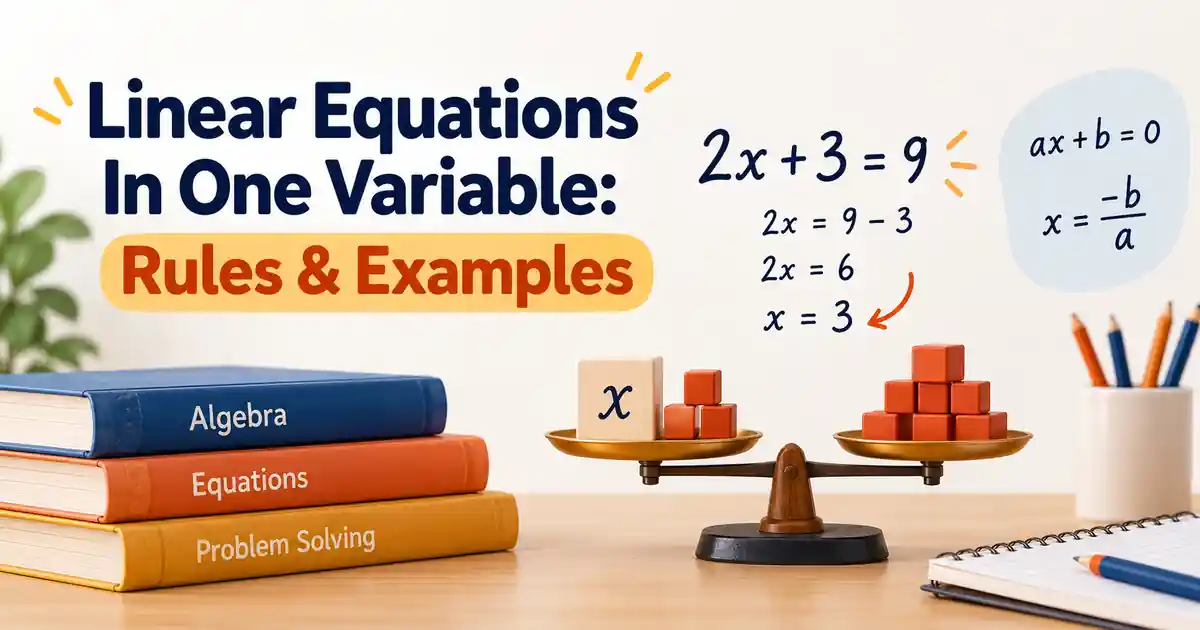
Linear equations. Solving one- and two-step and multi-step linear equations in one variable.
Inequalities. Solving and graphing inequalities, including compound and absolute-value inequalities.
Functions and graphs. The idea of a function, domain and range, and the main types of functions, especially linear functions, slope, and intercepts.
Systems of equations. Solving two equations in two variables by graphing, substitution, and elimination.
Exponents and polynomials. The exponent rules, and adding, subtracting, and multiplying polynomials.
Factoring. The main factoring methods - common factors, trinomials, and the difference of squares.
Quadratic equations. Solving quadratic equations by factoring, the square-root method, completing the square, and the quadratic formula.
Radicals. Simplifying square roots and other radical expressions.
Data and statistics. Reading and building scatter plots, lines of best fit, and basic descriptive measures.
What Skills Do You Build In Algebra 1?
Behind the topic list sit a handful of durable skills:
Abstraction. Treating a letter as a stand-in for any number, and reasoning about it before you know its value.
Translation. Turning a sentence or a real situation into an expression or equation, and back again.
Procedure with justification. Solving step by step while knowing why each step keeps the equation balanced.
Multiple representations. Reading the same relationship as an equation, a table, and a graph, and switching between them.
Checking. Substituting an answer back to confirm it works, rather than trusting the steps blindly.
These skills, not any single formula, are what later courses in geometry, Algebra 2, and calculus assume you already have.
Is Algebra 1 Hard?
Algebra 1 can be challenging, and for many students it is the first math class that genuinely makes them think rather than just compute. The difficulty is rarely the arithmetic; it is the conceptual jump to working with unknowns and abstract symbols. A student who could always "see the answer" in earlier grades now has to trust a process to reach one.
The honest read from students themselves, echoed across forums, is that the struggle usually comes from a shaky foundation, not from a lack of ability. Gaps in fractions, negative numbers, and order of operations resurface the moment they are needed inside an algebra step. Close those gaps and Algebra 1 becomes far more manageable, which is exactly why the preparation section below matters.
How Do You Prepare For And Succeed In Algebra 1?
Success in Algebra 1 leans on habits more than talent:
Firm up pre-algebra basics. Fractions, decimals, percentages, negative numbers, and order of operations should be automatic before the abstract work starts.
Learn the why, not just the steps. A student who understands why you do the same thing to both sides of an equation can rebuild a forgotten step; a student who only memorised the step is stuck when the problem looks new.
Practise a few problem types, not a hundred near-identical problems. Depth across variations beats volume of repetition.
Check every answer by substituting it back. This one habit catches most sign and arithmetic errors on the spot.
Keep a running list of your own recurring mistakes. Reviewing your personal error patterns is faster than re-reading the whole chapter.
Algebra 1 vs Pre-Algebra vs Algebra 2?
These three courses form a ladder:
Pre-Algebra bridges arithmetic and algebra: integers, fractions, ratios, basic expressions, and a first look at variables.
Algebra 1 builds the core algebra toolkit: linear equations and inequalities, functions, systems, polynomials, factoring, and quadratics.
Algebra 2 extends that toolkit to more advanced functions — quadratics in depth, polynomials of higher degree, exponential and logarithmic functions, and complex numbers.
Each course assumes fluency in the one before it, which is why a wobbly Algebra 1 makes Algebra 2 harder than it needs to be.
Examples Of Algebra 1
The set runs from evaluating an expression, through the most common equation-solving error, to a linear equation, factoring, slope, and a word problem.
Example 1
Evaluate when .
Substitute and follow the order of operations:
Final answer: 30.
Example 2
Solve .
Wrong attempt. A student multiplies the 2 by only the first term inside the brackets, writing , then , so .
Where it breaks. Test it in the original: , not 16. The answer fails because the 2 was not distributed to both terms inside the brackets.
Correct. Distribute the 2 across the full bracket, then undo the operations in order:
Check: .
Final answer: . The distributive property applies to every term inside the brackets.
Example 3
Solve the linear equation .
Gather the variable terms on one side and the numbers on the other, one step per line:
Final answer: .
Example 4
Factor and solve .
Find two numbers that multiply to 6 and add to 5; those are 2 and 3. Factor and set each bracket to zero:
Final answer: or .
Example 5
Find the slope of the line through the points and .
Slope is the change in over the change in :
Final answer: the slope is 3, meaning the line rises 3 units for every 1 unit it moves right.
Example 6
A number increased by 7 gives 22. Write and solve an equation for the number.
Translate the words into algebra. "A number" is , "increased by 7" is , and "gives 22" is :
Final answer: the number is 15. Naming the unknown and translating phrase by phrase is the heart of every Algebra 1 word problem.
Common Mistakes
Mistake 1: Not distributing to every term
Where it slips in: Expanding a bracket multiplied by a number or a negative sign.
Don't do this: Write , distributing to the first term only.
The correct way: The distributive property reaches every term inside the brackets: . The learner meeting the distributive property for the first time nearly always distributes to the first term and forgets the second; writing the multiplication over each term separately makes the omission impossible.
Mistake 2: Losing track of negative signs
Where it slips in: Moving terms across the equals sign or distributing a negative.
Don't do this: Turn into .
The correct way: A negative outside a bracket flips the sign of every term inside: . The reliable check is to substitute your answer back; a dropped sign almost always shows up as an answer that fails the original equation.
Mistake 3: Doing operations in the wrong order
Where it slips in: Evaluating expressions or clearing an equation.
Don't do this: Add before multiplying, or divide before undoing the addition in a two-step equation.
The correct way: Follow the order of operations when evaluating, and undo operations in reverse order when solving. In , subtract 3 first, then divide by 2, the reverse of how the expression was built.
The Mathematicians Behind Algebra
Algebra takes its name from Muhammad ibn Musa al-Khwarizmi (c. 780 – c. 850, Persia), whose book written around 820 CE, titled in part al-jabr, gave the subject its word and its first systematic methods for solving equations. His name, Latinised, is also the root of the word "algorithm," which is why so much of what Algebra 1 teaches traces back to one scholar in ninth-century Baghdad.
Conclusion
Algebra 1 is the foundational course where variables replace fixed numbers and students learn to write, solve, and graph relationships.
It is usually taken between 7th and 9th grade, most often in 9th, and covers expressions, equations, inequalities, functions, systems, polynomials, factoring, and quadratics.
Its lasting value is the skills — abstraction, translation, and checking — that every later math course assumes.
The most common errors are incomplete distribution, dropped negative signs, and wrong order of operations, all caught by substituting the answer back.
To build a strong Algebra 1 foundation with a teacher, explore Bhanzu's algebra tutor sessions, a high school math tutor, or structured math classes online.
Want a live trainer to guide your child through Algebra 1 topic by topic? Book a free demo class.
Read More
Was this article helpful?
Your feedback helps us write better content