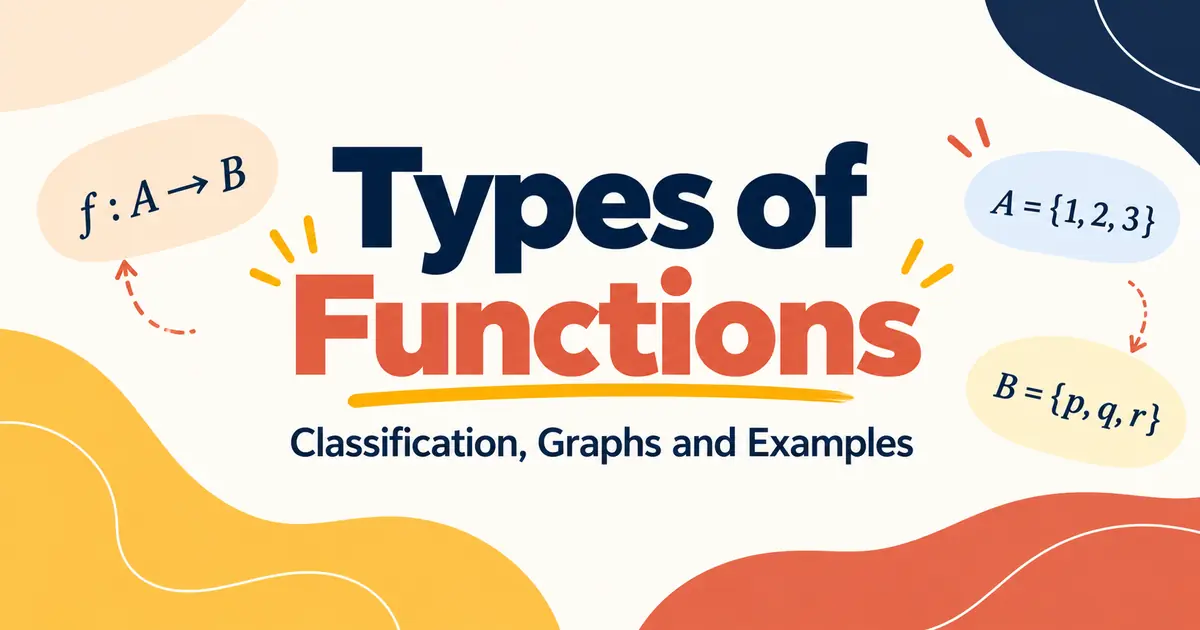
What Is a Set in Math? (The Answer Up Front)
A set in math is a well-defined collection of distinct objects, written inside curly braces . Each object is called an element of the set, and every set has the same rule: you can always answer the question "is this thing in the set, yes or no?" without ambiguity.
That single requirement — well-defined membership — is what separates a mathematical set from a casual list. "The set of even numbers less than 10" is a set: . "The set of interesting numbers" is not a set, because "interesting" has no precise rule.
A Concrete First Example
Take the set of single-digit even numbers:
Read this aloud as "E is the set containing 2, 4, 6, and 8." Three things to notice immediately, because they show up in every problem about sets:
Order doesn't matter. and are the same set.
Duplicates collapse. is the same set as . A set lists each element once.
Membership is binary. The number is in — written . The number is not — written .
The notation (read "is an element of") and ("is not an element of") are the two most-used symbols in all of set theory. Internalise them now and the rest of the article gets easier.
Two Ways to Write a Set
Mathematicians write sets in two standard forms:
Roster form — list every element inside braces: .
Set-builder form — describe the rule: , read as "the set of all such that is even and between 0 and 10." The vertical bar means "such that."
Roster form is simpler for small finite sets. Set-builder form is the only practical way to describe large or infinite sets — like the set of all real numbers between 0 and 1.
Set Symbols You Will See Repeatedly
These nine symbols carry almost every set-theory statement you will read. Each one has a precise meaning — and confusion between any two of them produces wrong answers downstream.
Symbol | Read as | Meaning |
|---|---|---|
"curly braces" | Encloses the elements of a set | |
"is an element of" | means is in set | |
"is not an element of" | means is not in | |
or | "is a subset of" | Every element of one set is also in another |
"union" | Combines elements of two sets (the OR) | |
"intersection" | Elements common to two sets (the AND) | |
or | "empty set" | A set with no elements |
"universal set" | The set of all elements under consideration | |
or | "such that" | Used in set-builder form |
The two symbols students confuse most often — (union) and (intersection) — have a built-in memory aid: the union looks like a capital U for Union; the intersection looks like a lower-case n for the first letter of intersection.
Where Sets Came From — and Why They Built Modern Mathematics
"The essence of mathematics lies precisely in its freedom." — Georg Cantor, 1883.
Sets were not always a part of mathematics. Until the late 1800s, mathematicians worked with numbers, equations, and shapes — but had no single language to talk about collections of mathematical objects in general. Then a single mathematician changed that.
Between 1874 and 1884, Georg Cantor — working at the University of Halle in Germany — invented set theory while trying to solve a problem about trigonometric series. He needed to describe the collection of points where a series did or did not converge, and the existing tools were not precise enough. So he built a new one.
Cantor's first major paper, published in 1874, proved something that shocked his contemporaries: that some infinities are larger than others — that the real numbers are "more numerous" than the natural numbers, even though both collections are infinite. To prove this, he had to define what "more numerous" even meant for infinite collections — and the answer was sets, paired with one-to-one correspondence.
Modern mathematics rests on this foundation. Three concrete examples of where sets quietly do the work:
Probability — every probability question begins with a sample space, which is a set of possible outcomes. Roll one die: the sample space is .
Computer science and databases — every database query is a set operation. "Customers in the US AND who ordered last month" is the intersection of two sets. "Customers in the US OR in Canada" is the union.
Statistics and machine learning — every dataset is a set of observations; every classification model partitions data into sets.
The 12 Types of Sets Every Student Should Know
Sets get classified by what's inside them and how they relate to other sets. Here are the 12 types that appear in school and early college mathematics.
1. Empty Set (or Null Set)
A set with no elements at all. Written or . Example: the set of even numbers between 3 and 5.
2. Singleton Set (or Unit Set)
A set with exactly one element. Example: the set of even prime numbers is the singleton — because 2 is the only even prime.
3. Finite Set
A set you can count, even if the count is large. Example: the set of letters in the English alphabet has 26 elements.
4. Infinite Set
A set whose elements cannot be counted. Example: the set of natural numbers .
5. Equal Sets
Two sets containing exactly the same elements. Example: and are equal — order doesn't matter.
6. Equivalent Sets
Two sets with the same number of elements, but not necessarily the same elements. Example: and are equivalent (both have 3 elements) but not equal.
7. Subset and Proper Subset
Set is a subset of set (written ) if every element of is also in . If is a subset of but and are not equal, is a proper subset (written ).
Example: . Every set is a subset of itself; the empty set is a subset of every set.
8. Superset
If , then is a superset of , written . Superset is just "subset" read the other way.
9. Power Set
The set of all subsets of a given set. If , then the power set is:
A set with elements has subsets — so above has elements. The power set always contains the empty set and the original set itself.
10. Universal Set
The set containing every element under discussion, usually written . In a probability problem about a coin toss, . In a problem about real numbers, .
11. Overlapping Sets
Two sets that share at least one common element. Example: and overlap because is in both.
12. Disjoint Sets
Two sets that share no elements. Example: and are disjoint. Disjoint sets have empty intersection: .
The Four Core Operations on Sets
Once you have two sets, four operations let you build new sets from them. These four are the workhorses of probability, logic, and database querying.
Let and throughout the examples below.
Union () — The OR
The union of two sets is the set of elements that are in either set (or both). The keyword is or.
Intersection () — The AND
The intersection of two sets is the set of elements in both sets. The keyword is and.
Difference ( or ) — In A but not in B
The difference of and is the set of elements in but not in .
Note: , which is different from . Difference is not commutative.
Complement ( or ) — Not in A (relative to U)
The complement of — relative to a universal set — is the set of elements in but not in .
If and , then:
How Do You Represent Sets With Venn Diagrams?
A Venn diagram represents sets as overlapping circles inside a rectangle (the universal set ). Each region of the diagram corresponds to a specific set expression.
For two sets and :
The left-only crescent → (elements in but not )
The right-only crescent →
The overlapping lens → (elements in both)
The outside of both circles → (elements in neither)
The two circles together →
For three sets, the standard Venn diagram has eight regions (three single-only, three pair-only, one triple-overlap, one outside). This is the same picture used in elementary probability — where each region's area represents the probability of that combination.
Venn diagrams were introduced by John Venn in 1880 in the Philosophical Magazine — though Euler had used similar overlapping-circle diagrams a century earlier. The naming convention stuck for Venn because his version explicitly showed every possible logical combination.
What Are the Set Formulas?
A handful of identities turn up everywhere from counting problems to probability to logic. Memorise these; they save derivation time.
Cardinality formulas (where means "number of elements in "):
The first is the inclusion-exclusion principle for two sets; the second is the three-set version. Both generalise to any number of sets — a deep result in combinatorics.
Subset count. A set with elements has subsets (including the empty set and itself). Its power set has cardinality .
De Morgan's Laws — the most-used algebraic identities on sets:
In words: "the complement of a union is the intersection of complements," and vice versa. Named for Augustus De Morgan (1806–1871).
Distributive laws.
Commutative laws. and .
Associative laws. and the same for intersection.
Identity laws. and .
Complement laws. and .
A Worked Example — Wrong Path First
Suppose a problem says: "In a class of 30 students, 18 take Math, 14 take Physics, and 6 take both. How many take at least one of the two subjects?"
The intuitive (wrong) approach. A student in a hurry adds the two numbers: . That's already greater than the class size of 30 — so something is wrong. The wrong answer signals the error before the student even checks.
Why it's wrong. Adding counts the 6 students who take both twice — once in the Math set, once in the Physics set. The set-theory diagnosis is: over-counts .
The correct method — the inclusion-exclusion formula:
Final answer: 26 students take at least one of the two subjects. The 4 remaining students take neither.
The reason this formula matters: the same shape — "add the parts, subtract the overlap" — shows up later in probability () and in database joins. Get the pattern early and the later concepts feel like the same problem in a new costume.
At Bhanzu, our trainers use this exact wrong-path-first sequence — let the intuitive error happen, name it, then introduce the formula as the rescue. The reasoning sticks because the student felt the gap, not just memorised the rule.
Common Mistakes — and How to Avoid Them
Three failure modes show up repeatedly in classroom work on sets. Each one is genuinely small, but a single slip changes the answer.
Mistake 1: Confusing (union) and (intersection)
Where it slips in: Anywhere the problem uses the words "or" and "and" — students confidently pick the wrong symbol because they look similar.
Don't do this: Reading "students who take Math AND Physics" and writing .
The correct way: AND maps to (intersection). OR maps to (union). Memory aid: looks like a U for Union; looks like an n for intersection. The rusher who skips this check often hits this exact mistake.
Mistake 2: Treating an element as a set (or a set as an element)
Where it slips in: Power-set and subset problems. Students write when they mean .
Don't do this: is correct ( is an element). is wrong — is a set, not an element of .
The correct way: — single element belongs. — the singleton set is a subset. The second-guesser who freezes here often has the right intuition but uses the wrong symbol.
Mistake 3: Forgetting that the empty set is a subset of every set
Where it slips in: Listing all subsets of a set, especially when constructing the power set.
Don't do this: Power set of listed as — three elements.
The correct way: The power set of is — four elements. The empty set is always there. A set with elements has subsets — count them, and if the count is wrong, the empty set is usually what's missing.
The Mathematicians Who Shaped Set Theory
Georg Cantor (1845–1918, Russia/Germany) — Founded set theory through papers published between 1874 and 1884. Proved that some infinities are larger than others — a result so counterintuitive that several of his contemporaries refused to accept it. The mathematician David Hilbert later defended his work with the famous line: "No one shall expel us from the paradise that Cantor has created."
Richard Dedekind (1831–1916, Germany) — Cantor's friend and frequent correspondent. Dedekind formalised the idea of a set as a "system" and contributed the rigorous definition of infinite sets — a set is infinite if it can be put into one-to-one correspondence with a proper subset of itself.
Ernst Zermelo (1871–1953, Germany) — Built the first axiom system for set theory in 1908, addressing paradoxes that had emerged in Cantor's original formulation. The modern axiom system most mathematicians use today is called ZFC — Zermelo–Fraenkel set theory with the axiom of Choice.
These three turned set theory from one mathematician's idea into the language all of modern mathematics is now written in.
A Practical Next Step
Try these three problems before moving on. Each one tests a distinct slice of what's above.
List all subsets of . (There should be .)
Let and . Find , , , and .
In a survey of 50 students, 28 play cricket, 23 play football, and 8 play both. How many play neither?
If you got stuck on problem 3, come back to the inclusion-exclusion worked example above — the same formula applies. Want to build this kind of reasoning with a live Bhanzu trainer? Book a free demo class — online globally.
Was this article helpful?
Your feedback helps us write better content