Key Points
- The arithmetic mean sums n values and divides by n, while the geometric mean multiplies n values and takes the nth root.
- The geometric mean is the correct average for anything that compounds, including growth rates, returns and index numbers.
- For any set of positive numbers the geometric mean is never greater than the arithmetic mean, and they are equal only when all values are identical.
- The geometric mean requires every value to be positive, because an even root of a negative product is undefined.
- Averaging percentage returns arithmetically overstates performance, which is why annualised returns are always computed geometrically.
When the Average Return Is Not the Return You Got
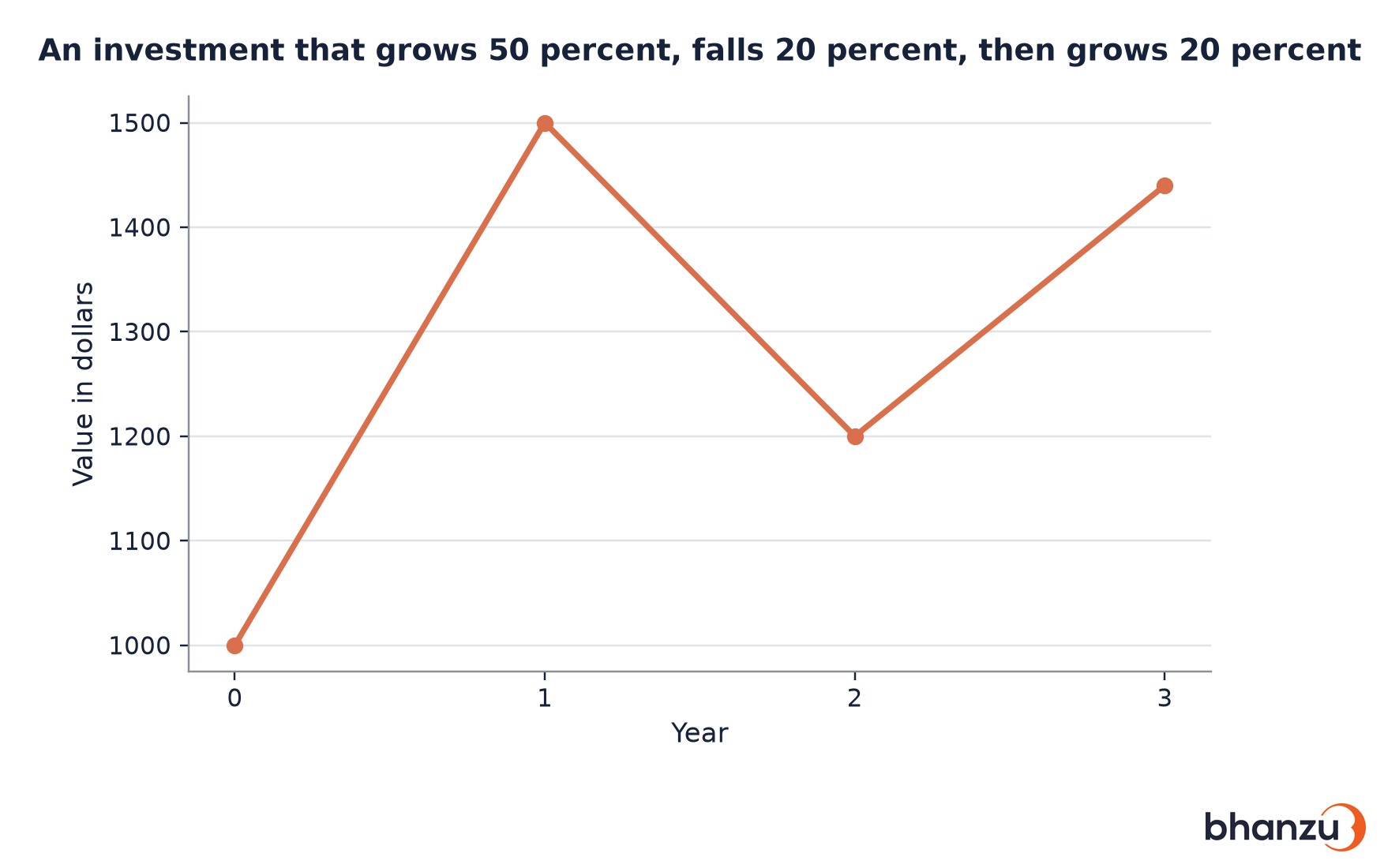
An investment gains 50 percent, loses 20 percent, then gains 20 percent each year. The arithmetic mean of those three returns is 16.67 percent a year, which on 1,000 dollars would compound to 1,588 after three years.
The account actually holds 1,440. The arithmetic mean did not approximate the answer; it produced a number the investment never earned.
What Is the Difference Between Arithmetic Mean and Geometric Mean?
The two means apply different operations, which is why they answer different questions.
The arithmetic mean of values is their sum divided by :
The geometric mean is the th root of their product:
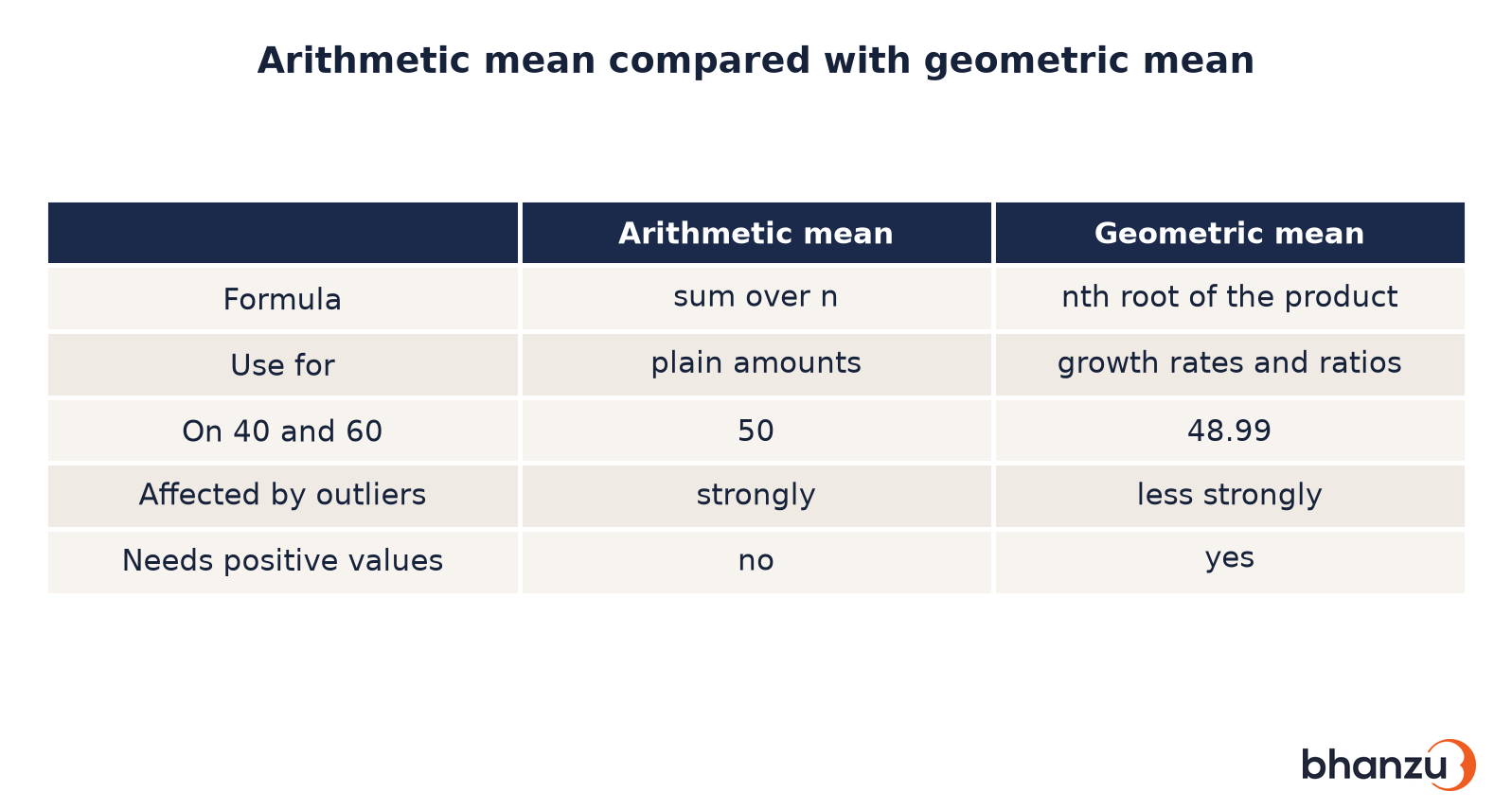
Addition is the right operation when quantities accumulate side by side, such as marks or heights. Multiplication is the right operation when each period acts on the result of the last, which is exactly what compounding means.
Try It Yourself
Use the data explorer to see Arithmetic Mean vs Geometric Mean at work: drag, change the numbers and watch what happens.
When Should You Use the Geometric Mean?
Use it whenever the values are multiplicative factors rather than standalone amounts.
- Growth rates and investment returns, where each year multiplies the previous balance.
- Index numbers and price relatives, where a basket's change is a product of component changes.
- Ratios measured on different scales, because the geometric mean treats a doubling and a halving as equal and opposite while the arithmetic mean does not.
- Rates of population or bacterial change, which compound in exactly the same way as money.
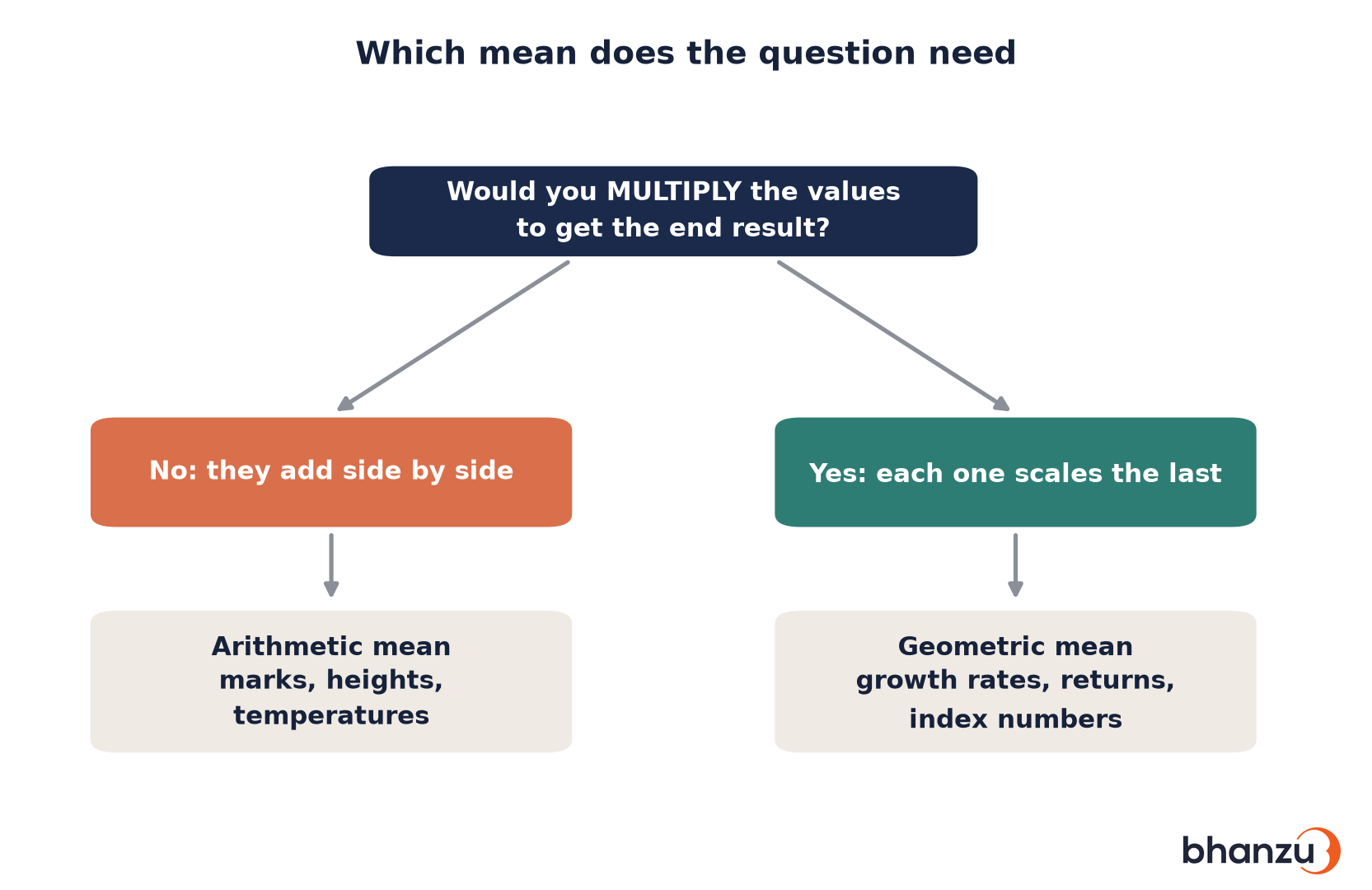
The test is mechanical. Ask whether the quantities would be multiplied together to get the end result. If yes, average them geometrically.
A doubling followed by a halving returns you to the start. The geometric mean of 2 and 0.5 is , correctly reporting no net change. The arithmetic mean is 1.25, which claims a 25 percent average gain on a process that ended exactly where it began.
How Do the Two Means Relate?
For any set of positive numbers:
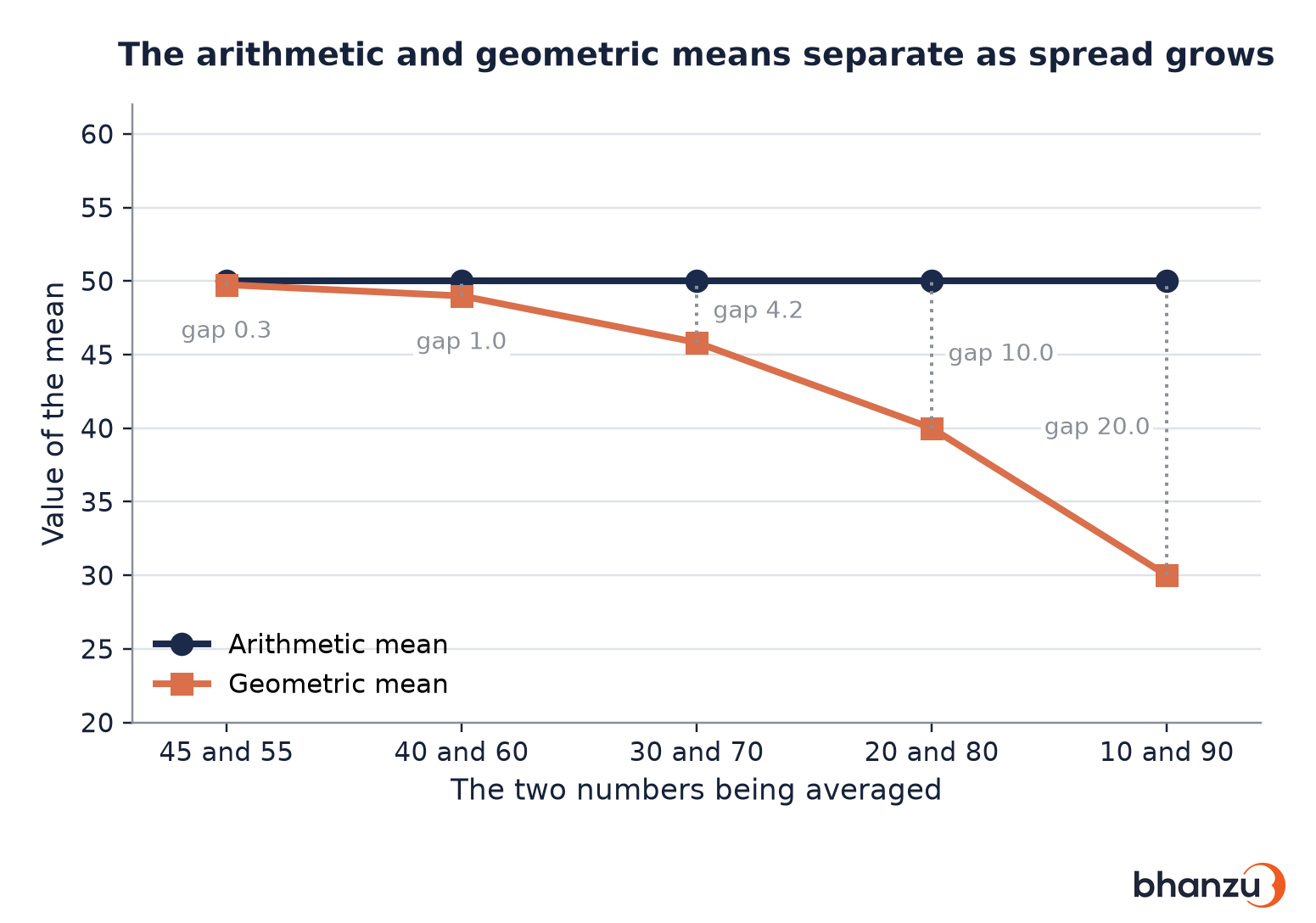
with equality only when every value is the same. This is the AM-GM inequality, and the gap between the two widens as the values spread out. The harmonic mean extends the chain downwards, giving .
For two numbers the relationship is exact and useful: .
Examples of Arithmetic Mean vs Geometric Mean
Example 1
Find both means of 4 and 9.
The geometric mean is smaller, as the inequality requires.
Example 2
An investment returns +50 percent, then -20 percent, then +20 percent. Find the average annual return.
The instinct is to average the percentages: percent.
Test it. Starting from 1,000 and growing at 16.67 percent for three years gives . Following the actual returns gives . The arithmetic mean overstates the result by 148 dollars.
Convert each return to a growth factor and take the geometric mean:
The average annual return is 12.92 percent, and , matching the account exactly.
Example 3
Find the geometric mean of 2, 8 and 32.
The values form a geometric sequence, and the geometric mean of three such terms is always the middle one.
Example 4
A city's population grows from 200,000 to 288,000 over two years. Find the average annual growth rate.
Total growth factor:
The population grew by an average of 20 percent a year. Checking: .
Example 5
Find both means of 40 and 60.
The two differ by about one unit here. On widely spread values the gap grows sharply, which is why the AM-GM gap is itself a crude measure of dispersion.
Example 6
Why can the geometric mean not be used on returns of -120 percent?
A return of -120 percent gives a growth factor of . A negative factor makes the product negative, and an even root of a negative number is undefined.
The deeper point is that a loss greater than 100 percent is impossible for an ordinary investment, so a negative factor usually signals a data error rather than a limitation of the method.
Why Compounding Needs Its Own Average
The two means diverge because addition and multiplication model different processes.
- Compounding is multiplicative. Each period scales the previous total, so the combined effect is a product and the correct average is a root of that product.
- The arithmetic mean always overstates growth. Because , averaging returns arithmetically reports a figure the investment never achieved, and the error grows with volatility.
- Regulators require the geometric version. Annualised returns quoted by funds are compound annual growth rates, which is the geometric mean of the yearly factors.
- Symmetry in ratios requires it. A doubling and a halving should cancel, and only the geometric mean reports that correctly.
The same logic governs official price indices. A consumer price index tracks the product of component price relatives rather than their arithmetic sum, which is why index construction uses geometric averaging at the elementary level.
What Most Guides Get Wrong About the Two Means
Two points are usually missing, and both decide whether a student can apply the distinction.
The first is that returns must be converted to growth factors before averaging. Taking the geometric mean of 50, -20 and 20 directly is impossible, because the product is negative. The values that get multiplied are 1.5, 0.8 and 1.2, and the step from a percentage to a factor is where most attempts fail silently.
The second is that the geometric mean is not simply "the smaller average". It is the answer to a different question. On compounding data the geometric mean is correct and the arithmetic mean is wrong, not merely larger. Presenting the inequality without that point leaves students choosing the geometric mean because it is conservative, rather than because it is right.
Where Students Trip Up on These Two Means
Mistake 1: Averaging percentages instead of growth factors
Where it slips in: Any investment or population question quoting percentages.
Don't do this: Computing from the raw percentages.
The correct way: Convert each to a factor first, giving 1.5, 0.8 and 1.2, then take the cube root of their product.
Students who know the geometric mean formula still fall here, because the question supplies percentages and the formula asks for values, and nothing in the wording announces that a conversion step sits between them.
Mistake 2: Using the geometric mean on data containing zero or negatives
Where it slips in: Data sets where one observation is zero.
Don't do this: Including a zero, which drives the entire product to zero and the geometric mean with it.
The correct way: The geometric mean requires strictly positive values. A zero makes it zero regardless of the other values, which is mathematically correct and practically useless.
Mistake 3: Forgetting to convert the factor back to a percentage
Where it slips in: The final line of a growth question.
Don't do this: Reporting the average annual return as 1.1292.
The correct way: Subtract 1 and multiply by 100, giving 12.92 percent. The factor and the rate are different quantities, and only one of them answers the question asked.
The practical consequence appears wherever performance is advertised. A fund quoting an arithmetic average of volatile annual returns reports a number no investor received, which is precisely why annualised figures are defined geometrically rather than left to the publisher's choice.
Key Takeaways
- The arithmetic mean sums and divides; the geometric mean multiplies and takes a root.
- Anything that compounds, including growth rates and returns, requires the geometric mean.
- The geometric mean is never greater than the arithmetic mean, with equality only for identical values.
- Percentages must be converted to growth factors before a geometric mean can be taken.
- To work through averaging problems with a teacher, explore Bhanzu's high school math tutor sessions or math classes online.
Read More
- Measures of Central Tendency
- Relation Between Mean Median and Mode
- Descriptive Statistics
- Average Formula
- Variance
Research Behind This Article
- US Bureau of Labor Statistics, Occupational Employment and Wages Summary, May 2025 (2026). bls.gov
- NIST/SEMATECH, e-Handbook of Statistical Methods, 1.3.5.6 Measures of Scale (2022). itl.nist.gov
- US Census Bureau, Income and Poverty: income data and reports (2026). census.gov
- NIST/SEMATECH, e-Handbook of Statistical Methods, 1.3.3.14 Histogram (2022). itl.nist.gov
- NIST/SEMATECH, e-Handbook of Statistical Methods, 1.3.6.6.1 Normal Distribution (2022). itl.nist.gov
Quick Quiz: Check Yourself
Three levels, fresh numbers every time, instant feedback with the working.
Was this article helpful?
Your feedback helps us write better content
Frequently Asked Questions
What is the main difference in arithmetic mean vs geometric mean?
Which is bigger, the arithmetic mean or the geometric mean?
When should I use the geometric mean instead of the arithmetic mean?
Can the geometric mean be used with negative numbers?
In arithmetic mean vs geometric mean, why does the arithmetic one overstate returns?